Thank you for visiting SNEWPapers!
Sign up free
Alexandria Gazette, Commercial And Political
Alexandria, Virginia
What is this article about?
Opinion piece arguing against US involvement in South American independence wars from Spain, as it would mainly benefit English trade by opening new markets, while England stays neutral to evade European backlash. US gains would be minimal due to English underselling.
Clipping
OCR Quality
Full Text
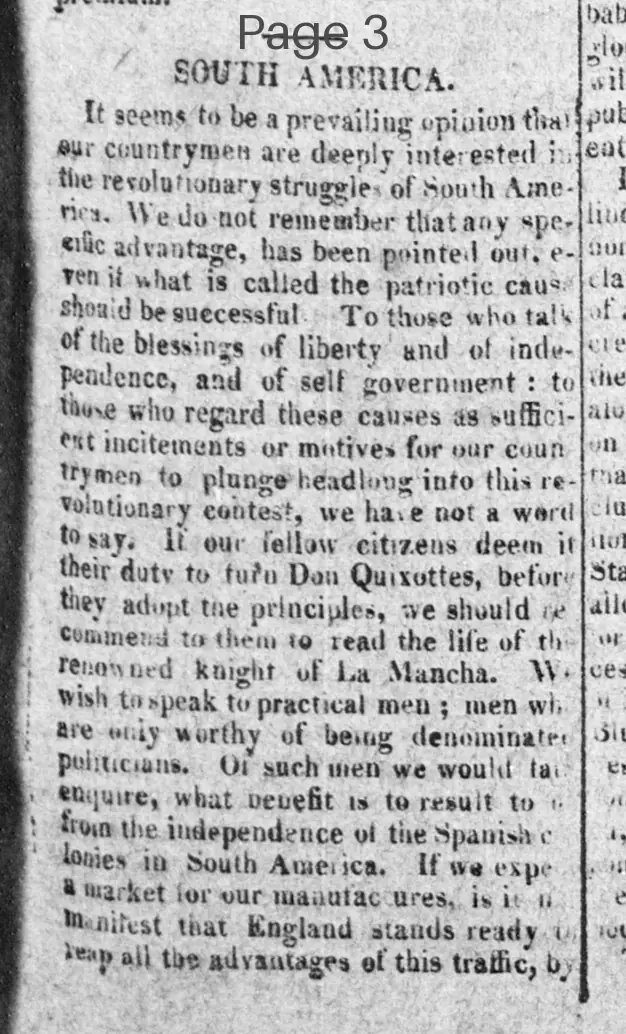
It seems to be a prevailing opinion that our countrymen are deeply interested in the revolutionary struggles of South America. We do not remember that any specific advantage, has been pointed out, even if what is called the patriotic cause should be successful. To those who talk of the blessings of liberty and of independence, and of self government: to those who regard these causes as sufficient incitements or motives for our countrymen to plunge headlong into this revolutionary contest, we have not a word to say. If our fellow citizens deem it their duty to turn Don Quixottes, before they adopt the principles, we should recommend to them to read the life of the renowned knight of La Mancha. We wish to speak to practical men; men who are only worthy of being denominated politicians. To such men we would ask, what benefit is to result to from the independence of the Spanish colonies in South America. If we expect a market for our manufactures, is it not manifest that England stands ready to reap all the advantages of this traffic, by underselling us in every article? It is necessary to obtain further evidence than we have already had, of both the disposition and the power of the British government, to take every advantage of this kind? We can easily conceive that England whose store houses are loaded with her manufactures, has a direct & immediate interest in the independence of the Spanish colonies. She has every inducement to wish the emancipation of these colonies, because it would open new ports for the reception of her merchandise. This may be one reason why the British ministry have looked with so much apparent apathy on this question. Disgusted with the conduct of Ferdinand, since his re-ascension to the throne of his ancestors, and satisfied with the expulsion of the French from the peninsula, they feel very little sympathy for that monarch and shew but little disposition to embark in his controversy again. They see further, that by adopting his quarrel, they would awaken the jealousy of confederated Europe, who look with eyes of jealousy and distrust on the movements of the British cabinet. These we presume are the guarding motives of the English government; they look with quietude on the struggle, which, if it eventuates in the independence of South America, will furnish them with an abundant market for their manufactures. Thus Europe is quieted while the English will reap all the advantages resulting from a successful contest. Never did the English have an interest in the emancipation of any country more direct and immediate than they have in this.
The exclusion of English merchandise from the continent which, as a general proposition, subject to some modifications, however, is correct, has left an inconceivable mass of home manufacture on the hands of the merchant awaiting the first moment for a favorable vent. In short, the cries of the English manufacturers resounding across the Atlantic, who are idle and starving for want of employment, are unequivocal demonstrations, how anxiously the government must desire a political offshoot abroad, which will supply them with a market for their productions. The distress of the manufacturing class proves how cheaply these articles may be purchased; let the independent ports of Spanish America be once opened, and the English would monopolize their commerce; it would be in their power to undersell all other nations. Yet although the English have such strong and predominant motives to embark in this controversy, they deem it too serious a point to risque the vengeance of confederated Europe. By doing nothing, they stand ready at any moment to reap all the advantage of the struggle. But many of our own countrymen would fain persuade us that it is the duty of our government to do, what England declines doing, to incur the resentment of confederated Europe, by adopting the cause of the South Americans patriots. We are told that we must take up arms in defence of Spanish liberty, and we will suppose that all this is done, nay to give every advantage to our opponents, we will further suppose that this struggle eventuates in the independence of South America. For what purpose, shall we then have embarked in this controversy and shed the blood of our fellow citizens! we shall have done all this for the encouragement of English manufacturers, to the exclusion of our own. We can do no greater favour to England, than by adopting this quarrel; we shall have our blood to loose, and the English will reap the benefit of the sacrifice.
What sub-type of article is it?
What keywords are associated?
What entities or persons were involved?
Where did it happen?
Foreign News Details
Primary Location
South America
Key Persons
Outcome
hypothetical independence of spanish colonies would open markets primarily benefiting english manufacturers by underselling others, with no direct advantage to the us.
Event Details
The article expresses skepticism about US interest in supporting South American revolutionary struggles for independence from Spain, arguing that success would primarily benefit English trade by providing new markets for their manufactures, while England remains neutral to avoid conflict with confederated Europe. It criticizes the idea of US intervention as aiding England at the cost of American blood and excluding US commerce.