Thank you for visiting SNEWPapers!
Sign up free
The National Intelligencer And Washington Advertiser
Washington, District Of Columbia
What is this article about?
British forces under Lt. Gen. J. Hely Hutchinson capture Alexandria from French Gen. Menou after operations starting August 17, 1801, leading to capitulation on September 2. Garrison of over 8,000 soldiers and 1,300 sailors to be transported to France.
Merged-components note: These three components form a single continuous article on the surrender of Alexandria, with seamless text continuation across the splits, under the 'Foreign Intelligence' section.
Clippings
1 of 2
OCR Quality
Full Text
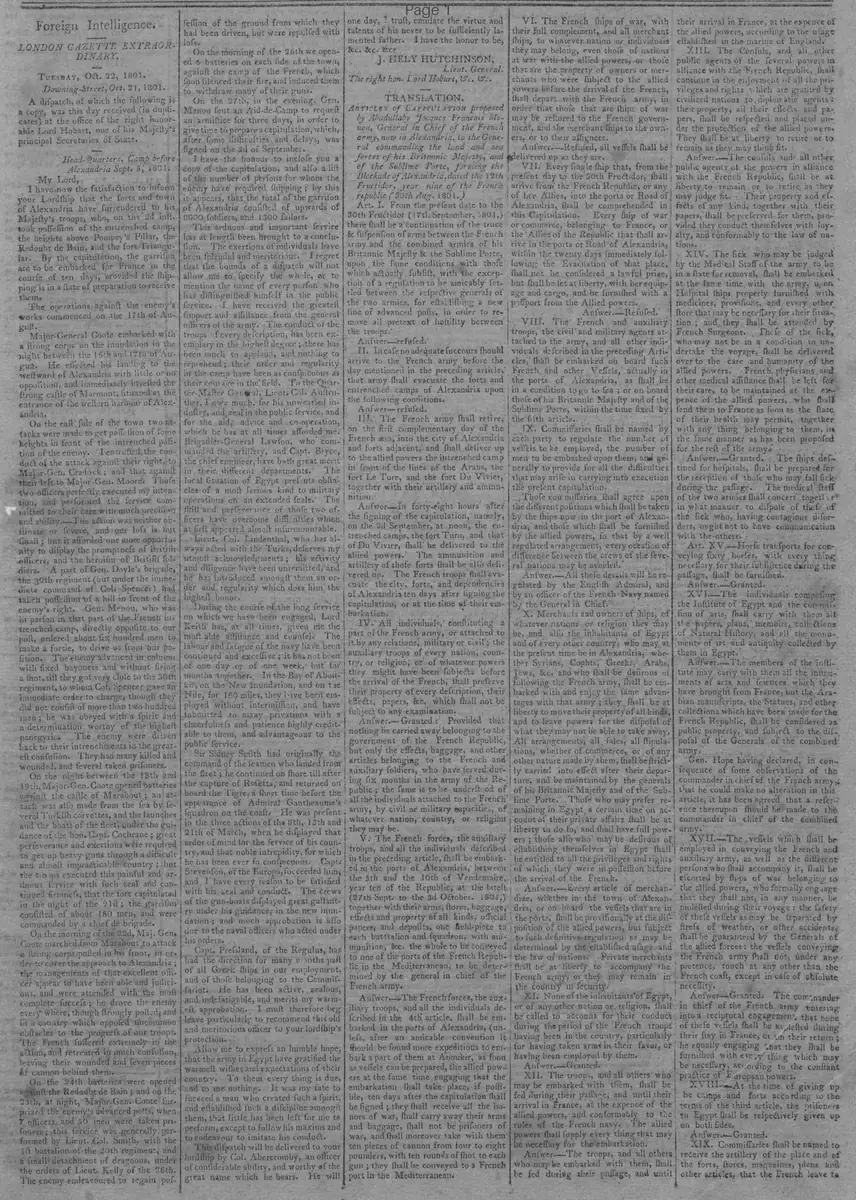
LONDON GAZETTE EXTRAORDINARY.
TUESDAY, OCT. 22, 1801.
Downing-Street, Oct. 21, 1801:
A dispatch, of which the following is a copy, was this day received (in duplicates) at the office of the right honorable Lord Hobart, one of his Majesty's principal Secretaries of State.
Head-quarters, Camp before Alexandria, Sept. 5, 1801.
My Lord,
I have now the satisfaction to inform your Lordship that the forts and town of Alexandria have surrendered to his Majesty's troops, who, on the 2d inst. took possession of the entrenched camp, the heights above Pompey's Pillar, the Redoubt de Bain, and the fort Triangular. By the capitulation, the garrison are to be embarked for France in the course of ten days, provided the shipping is in a state of preparation to receive them.
The operations against the enemy's works commenced on the 17th of August.
Major-General Coote embarked with a strong corps on the inundation in the night between the 16th and 17th of August. He effected his landing to the westward of Alexandria with little or no opposition, and immediately invested the strong castle of Marabout, situated at the entrance of the western harbour of Alexandria.
On the east side of the town two attacks were made to get possession of some heights in front of the intrenched position of the enemy. I entrusted the conduct of the attack against their right, to Major-Gen. Cradock; and that against their left to Major-Gen. Moore. Those two officers perfectly executed my intention, and performed the service committed to their care with much precision and ability.—The action was neither obstinate or severe, and our loss is but small; but it afforded one more opportunity to display the promptness of British officers, and the heroism of British soldiers. A part of Gen. Doyle's brigade, the 30th regiment (but under the immediate command of Col. Spencer) had taken possession of a hill in front of the enemy's right. Gen. Menou, who was in person in that part of the French intrenched camp, directly opposite to our post, ordered about six hundred men to make a sortie, to drive us from our position. The enemy advanced in column with fixed bayonets and without firing a shot, till they got very close to the 30th regiment, to whom Col. Spencer gave an immediate order to charge, though they did not consist of more than two hundred men; he was obeyed with a spirit and a determination worthy of the highest panegyric. The enemy were driven back to their intrenchments in the greatest confusion. They had many killed and wounded, and several taken prisoners.
On the night between the 18th and 19th, Major-Gen. Coote opened batteries against the castle of Marabout; an attack was also made from the sea by several Turkish corvettes, and the launches and the boats of the fleet, under the guidance of the hon. Capt. Cochrane; great perseverance and exertions were required to get up heavy guns through a difficult and almost impracticable country; but the troops executed this painful and arduous service with such zeal and continued firmness, that the fort capitulated on the night of the 21st; the garrison consisted of about 180 men, and were commanded by a chef de brigade.
On the morning of the 22d, Maj. Gen. Coote marched from Marabout to attack a strong corps posted in his front, in order to cover the approach to Alexandria; the managements of that excellent officer appear to have been able and judicious, and were attended with the most complete success; he drove the enemy every where, though strongly posted, and in a country which opposed uncommon obstacles to the progress of our troops. The French suffered extremely in the action, and retreated in much confusion, leaving their wounded and even pieces of cannon behind them.
On the 24th batteries were opened against the Redoubt de Bain; and on the 25th, at night, Major-Gen. Coote surprised the enemy's advanced posts, when 7 officers and 50 men were taken prisoners; this service was generally performed by Lieut. Col. Smith, with the 1st battalion of the 20th regiment, and a small detachment of dragoons, under the orders of Lieut. Kelly of the 26th. The enemy endeavoured to regain possession of the ground from which they had been driven, but were repulsed with loss.
On the morning of the 26th we opened batteries on each side of the town, against the camp of the French, which soon silenced their fire, and induced them to withdraw many of their guns. On the 27th, in the evening, Gen. Menou sent an Aid-de-Camp to request an armistice for three days, in order to give time to prepare a capitulation, which, after some difficulties and delays, was signed on the 2d of September.
I have the honour to enclose you a copy of the capitulation, and also a list of the number of persons for whom the enemy have required shipping; by this it appears, that the total of the garrison of Alexandria consisted of upwards of 8000 soldiers, and 1300 sailors.
This arduous and important service has at length been brought to a conclusion. The exertions of individuals have been splendid and unmeritorious. I regret that the bounds of a dispatch will not allow me to specify the whole, or to mention the name of every person who has distinguished himself in the public service. I have received the greatest support and assistance from the general officers of the army. The conduct of the troops of every description, has been exemplary in the highest degree; there has been much to applaud, and nothing to reprehend; their order and regularity in the camp have been as conspicuous as their courage in the field. For the Quartermaster General, Lieut. Col. Anstruther, I owe much, for his unwearied industry, and zeal in the public service, and for the aid, advice and co-operation, which he has at all times afforded me.
Brigadier-General Lawson, who commanded the artillery, and Capt. Bryce, the chief engineer, have both great merit in their different departments. The local situation of Egypt presents obstacles of a most serious kind to military operations on an extended scale. The skill and perseverance of those two officers have overcome difficulties which at first appeared almost insurmountable.
Lieut. Col. Lindenthal, who has always acted with the Turks, deserves my utmost acknowledgments; his activity and diligence have been unremitted, and he has introduced amongst them an order and regularity which does him the highest honor.
During the course of the long service on which we have been engaged, Lord Keith has, at all times, given me the most able assistance and counsel. The labour and fatigue of the navy have been continued and excessive; it has not been of one day or of one week, but for months together. In the Bay of Aboukir, on the New Inundation, and on the Nile, for 160 miles, they have been employed without intermission, and have submitted to many privations with a cheerfulness and patience highly creditable to them, and advantageous to the public service.
Sir Sidney Smith had originally the command of the seamen who landed from the fleet; he continued on shore till after the capture of Rosetta, and returned on board the Tigre, a short time before the appearance of Admiral Gantheaume's squadron on the coast. He was present in the three actions of the 8th, 13th and 21st of March, when he displayed that ardor of mind for the service of his country, and that noble intrepidity, for which he has been ever so conspicuous. Capt. Stevenson, of the Europa, succeeded him, and I have every reason to be satisfied with his zeal and conduct. The crews of the gun-boats displayed great gallantry under his guidance, in the new inundation; and much approbation is also due to the naval officers who acted under his orders.
Capt. Presland, of the Regulus, has had the direction for many months past of all Greek ships in our employment, and of those belonging to the Commissariat. He has been active, zealous, and indefatigable, and merits my warmest approbation. I must therefore beg leave particularly to recommend this old and meritorious officer to your Lordship's protection.
Allow me to express an humble hope, that the army in Egypt have gratified the warmest wishes and expectations of their country. To them every thing is due, and to me nothing. It was my fate to succeed a man who created such a spirit, and established such a discipline amongst them, that little has been left for me to perform, except to follow his maxims and to endeavour to imitate his conduct.
This dispatch will be delivered to your Lordship by Col. Abercromby, an officer of considerable ability, and worthy of the great name which he bears. He will one day, I trust, emulate the virtue and talents of his never to be sufficiently lamented father.
I have the honor to be, &c. &c. &c.
J. HELY HUTCHINSON,
Lieut. General.
The right hon. Lord Hobart, &c. &c.
TRANSLATION.
ARTICLES OF CAPITULATION proposed by Abdullaby Fouques Francois Menou, General in Chief of the French army, now in Alexandria, to the General commanding the land and sea forces of his Britannic Majesty, and of the Sublime Porte, forming the Blockade of Alexandria, dated the 12th Fructidor, year nine of the French republic (30th Aug. 1801.)
Art. I. From the present date to the 30th Fructidor (17th September, 1801,) there shall be a continuation of the truce & suspension of arms between the French army and the combined armies of his Britannic Majesty & the Sublime Porte, upon the same conditions with those which actually subsist, with the exception of a regulation to be amicably settled between the respective generals of the two armies, for establishing a new line of advanced posts, in order to remove all pretext of hostility between the troops.
Answer—refused.
II. In case no adequate succours should arrive to the French army before the day mentioned in the preceding article, that army shall evacuate the forts and entrenched camps of Alexandria upon the following conditions.
Answer—refused.
III. The French army shall retire, on the first complementary day of the French era, into the city of Alexandria and forts adjacent, and shall deliver up to the allied powers the intrenched camp in front of the lines of the Arabs, the fort Le Ture, and the fort Du Vivier, together with their artillery and ammunition.
Answer: In forty-eight hours after the signing of the capitulation, namely, on the 2d September, at noon, the entrenched camps, the fort Turo, and that of Du Vivier, shall be delivered to the allied powers. The ammunition and artillery of those forts shall be also delivered up. The French troops shall evacuate the city, forts, and dependencies of Alexandria ten days after signing the capitulation, or at the time of their embarkation.
IV. All individuals constituting a part of the French army, or attached to it by any relations, military or civil; the auxiliary troops of every nation, country, or religion, or of whatever powers they might have been subjects before the arrival of the French, shall preserve their property of every description, their effects, papers, &c. which shall not be subject to any examination.
Answer.—Granted: Provided that nothing be carried away belonging to the government of the French Republic, but only the effects, baggage, and other articles belonging to the French and auxiliary soldiers, who have served during six months in the army of the Republic; the same is to be understood of all the individuals attached to the French army, by civil or military capacities, of whatever nation, country, or religion they may be.
V. The French forces, the auxiliary troops, and all the individuals described in the preceding article, shall be embarked in the ports of Alexandria, between the 5th and the 10th of Vendemaire, year ten of the Republic, at the latest (27th Sept. to the 3d October. 1801,) together with their arms, stores, baggage, effects and property of all kinds, official papers, and deposits, one field-piece to each battalion and squadron, with ammunition, &c. the whole to be conveyed to one of the ports of the French Republic in the Mediterranean, to be determined by the general in chief of the French army.
Answer. The French forces, the auxiliary troops, and all the individuals described in the 4th article, shall be embarked in the ports of Alexandria, (unless, after an amicable convention it should be found more expeditious to embark a part of them at Aboukir, as soon as vessels can be prepared, the allied powers at the same time engaging that the embarkation shall take place, if possible, ten days after the capitulation shall be signed; they shall receive all the honors of war, shall carry away their arms and baggage, shall not be prisoners of war, and shall moreover take with them ten pieces of cannon from four to eight pounders, with ten rounds of shot to each gun; they shall be conveyed to a French port in the Mediterranean.
VI. The French ships of war, with their full complement, and all merchant ships, to whatever nation or individuals they may belong, even those of nations at war with the allied powers, or those that are the property of owners or merchants who were subject to the allied powers before the arrival of the French, shall depart with the French army, in order that those that are ships of war may be restored to the French government, and the merchant ships to the owners, or to their assignees.
Answer. Refused, all vessels shall be delivered up as they are.
VII. Every single ship that, from the present day to the 30th Fructidor, shall arrive from the French Republic, or any of her Allies, into the ports or Road of Alexandria, shall be comprehended in this Capitulation. Every ship of war or commerce, belonging to France, or the Allies of the Republic that shall arrive in the ports or Road of Alexandria, within the twenty days immediately following the Evacuation of that place, shall not be considered a lawful prize, but shall be set at liberty, with her equipage and cargo, and be furnished with a passport from the Allied powers.
Answer. Refused.
VIII. The French and auxiliary troops, the civil and military agents attached to the army, and all other individuals described in the preceding Articles, shall be embarked on board such French and other Vessels, actually in the ports of Alexandria, as shall be in a condition to go to sea; or on board those of his Britannic Majesty and of the Sublime Porte, within the time fixed by the fifth article.
IX. Commissaries shall be named by each party to regulate the number of vessels to be employed, the number of men to be embarked upon them, and generally to provide for all the difficulties that may arise in carrying into execution the present capitulation. Those commissaries shall agree upon the different positions which shall be taken by the ships now in the port of Alexandria, and those which shall be furnished by the allied powers, so that by a well regulated arrangement, every occasion of difference between the crews of the several nations may be avoided.
Answer.—All these details will be regulated by the English Admiral, and by an officer of the French Navy named by the General in Chief.
X. Merchants and owners of ships, of whatever nations or religion they may be, and also the inhabitants of Egypt and of every other country, who may at the present time be in Alexandria, whether Syrians, Cophts, Greeks, Arabs, Jews, &c. and who shall be desirous of following the French army, shall be embarked with and enjoy the same advantages with that army; they shall be at liberty to move their property of all kinds, and to leave powers for the disposal of what they may not be able to take away. All arrangements, all sales, all stipulations, whether of commerce, or of any other nature made by them, shall be strictly carried into effect after their departure, and be maintained by the generals of his Britannic Majesty and of the Sublime Porte. Those who may prefer remaining in Egypt a certain time on account of their private affairs shall be at liberty to do so, and shall have full powers; those also who may be desirous of establishing themselves in Egypt shall be entitled to all the privileges and rights of which they were in possession before the arrival of the French.
Answer.—Every article of merchandise, whether in the town of Alexandria, or on board the vessels that are in the ports, shall be provisionally at the disposition of the allied powers, but subject to such definitive regulation as may be determined by the established usage and the law of nations. Private merchants shall be at liberty to accompany the French army, or they may remain in the country in security.
XI. None of the inhabitants of Egypt, or of any other nation or religion, shall be called to account for their conduct during the period of the French troops having been in the country, particularly for having taken arms in their favor, or having been employed by them.
Answer,—Granted.
XII. The troops, and all others who may be embarked with them, shall be fed during their passage, and until their arrival in France, at the expense of the allied powers, and conformably to the rules of the French navy. The allied powers shall supply every thing that may be necessary for the embarkation.
Answer. The troops, and all others who may be embarked with them, shall be fed during their passage, and until their arrival in France, at the expense of the allied powers, according to the usage established in the marine of England.
XIII. The Consuls, and all other public agents of the several powers in alliance with the French Republic, shall continue in the enjoyment of all the privileges and rights which are granted by civilized nations to diplomatic agents: their property, all their effects, and papers, shall be respected and placed under the protection of the allied powers. They shall be at liberty to retire or to remain as they may think fit.
Answer.—The consuls and all other public agents of the powers in alliance with the French Republic, shall be at liberty to remain or to retire as they may judge fit. Their property and effects of any kind, together with their papers, shall be preserved for them, provided they conduct themselves with loyalty, and conformably to the law of nations.
XIV. The sick who may be judged by the Medical Staff of the army, to be in a state for removal, shall be embarked at the same time with the army, on board Hospital ships properly furnished with medicines, provisions, and every other store that may be necessary for their situation; and they shall be attended by French Surgeons. Those of the sick, who may not be in a condition to undertake the voyage, shall be delivered over to the care and humanity of the allied powers. French physicians and other medical assistance shall be left for their care, to be maintained at the expense of the allied powers, who shall send them to France as soon as the state of their health may permit, together with any thing belonging to them, in the same manner as has been proposed for the rest of the army.
Answer. Granted. The ships destined for hospitals, shall be prepared for the reception of those who may fall sick during the passage. The medical staff of the two armies shall concert together in what manner to dispose of those of the sick who, having contagious disorders, ought not to have communication with the others.
Art. XV.—Horse transports for conveying sixty horses, with every thing necessary for their subsistence during the passage, shall be furnished.
Answer. Granted.
XVI. The individuals composing the Institute of Egypt and the commission of arts, shall carry with them all the papers, plans, memoirs, collections of Natural History, and all the monuments of art and antiquity collected by them in Egypt.
Answer.—The members of the institute may carry with them all the instruments of arts and sciences which they have brought from France, but the Arabian manuscripts, the Statues, and other collections which have been made for the French Republic, shall be considered as public property, and subject to the disposal of the Generals of the combined army.
Gen. Hope having declared, in consequence of some observations of the commander in chief of the French army that he could make no alteration in this article, it has been agreed that a reference thereupon should be made to the commander in chief of the combined army.
XVII. The vessels which shall be employed in conveying the French and auxiliary army, as well as the different persons who shall accompany it, shall be escorted by ships of war belonging to the allied powers, who formally engage that they shall not, in any manner, be molested during their voyage: the safety of these vessels as may be separated by stress of weather, or other accidents, shall be guaranteed by the Generals of the allied forces: the vessels conveying the French army shall not, under any pretence, touch at any other than the French coast, except in case of absolute necessity.
Answer—Granted. The commander in chief of the French army entering into a reciprocal engagement, that none of these vessels shall be seized during their stay in France, or on their return; he equally engaging that they shall be furnished with every thing which may be necessary, according to the constant practice of European powers.
XVIII.—At the time of giving up the camps and forts according to the terms of the third article, the prisoners in Egypt shall be respectively given up on both sides.
Answer. Granted.
XIX. Commissaries shall be named to receive the artillery of the place and of the forts, stores, magazines, plans and other articles that the French leave te
the allied powers, and lists of inventories shall be made out, signed by the commissaries of the different powers, according as the forts and magazines shall be given up to the allied powers.
Answer—Granted. Provided that all the plans of the city and forts of Alexandria, as well as all maps of the country, shall be delivered up to the English commissary. The batteries, cisterns, and other public buildings, shall also be given up in the condition in which they actually are.
XX. A passport shall be granted to a French armed vessel, in order to convey to Toulon, immediately after the camps and forts before-mentioned shall be given up, officers charged by the commander in chief to carry to his government the present capitulation.
Answer—Granted. But if it is a French vessel, it shall not be armed.
XXI. On giving up the camps and forts mentioned in the preceding articles, hostages shall be given on both sides, in order to guarantee the execution of the present treaty. They shall be chosen from among the officers of rank in the respective armies; namely, four from the French army, two from the British troops, and two from the troops of the Sublime Porte. The four French hostages shall be embarked on board the English ship commanding the squadron, and the two British and Turkish hostages on board one of the vessels which shall carry the commander in chief, the lieutenant-generals. They shall all be reciprocally delivered up on their arrival in France.
Answer—There shall be placed in the hands of the commander in chief of the French army, four officers of rank as hostages, namely, one officer of the Navy, one officer of the British army, and two officers of the Turkish army. The commander in chief shall, in like manner, place in the hands of the commander in chief of the British army, four officers of rank. The hostages shall be restored on both sides at the period of the embarkation.
XXII. If any difficulties should arise during the execution of the present capitulation, they shall be amicably settled by the commissaries of the armies.
Answer—Granted.
(Signed) KEITH, Admiral.
(Signed) J. H. HUTCHINSON,
Lieutenant-General commander in chief.
(Signed) HUSSEIN, captain Pacha.
(Signed) A. J. F. MENOU, General in chief of the French Army.
Camps, West of Alexandria,
August 29, 1801.
SIR,
Captain Cochrane, with seven sloops of war, having entered into the Western Harbor of Alexandria, on the evening of the 21st inst. and anchored on my left flank, I immediately determined to move forward, and take as advanced a position near the town of Alexandria as prudence and security would permit.
The necessary arrangements having been made in the morning of the 22d, the troops advanced against the enemy, who was strongly posted upon a ridge of high hills, having his right flank secured by two heavy guns, and his left by two batteries containing three more, with many field pieces placed in the intervals of his line.
The army moved through the Sand-Hills in three columns, the guards forming two upon the right near the lake, and major-general Ludlow's brigade the third upon the left, having the left battalion of the 27th regiment in advance; major-general Finch's brigade composed a reserve, and was destined to give its support wherever it might be required.
In this manner, having our field artillery with the advanced guard, the troops continued to move forward with the greatest coolness and regularity, under a heavy fire of cannon and small arms, forcing the enemy to retreat constantly before them, and driving them to their present position within the walls of Alexandria.
Major-general Ludlow, earl of Cavan, and Finch, upon this, as upon all other occasions, having given me all possible support, and deserve every commendation for the precision and regularity with which they led on their respective columns.
The exertions of the captains commanding the ships of war upon our left and of the officers commanding the gun-boats upon our right, were attended with the best effect; their continued and unremitting fire kept the enemy in check.
To captain Cochrane I feel extremely obliged, for his zeal and constant readiness to afford every assistance in his power. Capt. Stevenson, who commanded the gun-boats upon the lake, also calls for my earnest approbation of his conduct.
Permit me, sir, to repeat to you the intrepid and gallant behaviour of the whole of the troops during the affair of yesterday, which lasted from six until ten o'clock in the morning. Their bravery, was only equalled by the cool and regular manner in which they advanced under a severe and heavy cannonade. Happy am I to add, that our loss is only trifling, when compared to
the advantages we have gained, and the difficulties we had to surmount in a country, which, at every step afforded the enemy the means of making the most desperate resistance.
The loss of the enemy must have been considerably greater than ours. It is impossible for me to ascertain the numbers. Seven pieces of heavy Ordnance were left behind by the French in the hurry of their retreat, and have fallen into our hands.
I feel much indebted to Lieutenant-Colonel Duncan, quarter master general, for his judicious arrangements, and for his conduct during the whole of yesterday; he deserves my sincere thanks.
Enclosed I have the honor to transmit a return of the killed and wounded, &c.
I have the honor, &c.
E. COOTE, maj. gen.
To Lieutenant General
Sir J. Hutchinson,
Camp, West of Alexandria,
August 23, 1801.
SIR,
I have the honor to enclose the summons, and the articles of capitulation of the Fort of Marabout.
The speedy and fortunate reduction of that post, so important to our fleets, was I am happy to say, effected without any loss on our side, and calls upon me to lay before you the unremitting zeal and attention of lieut. col. Darby, who, with the first battalion of the 54th regiment covered the attack; the very judicious manner in which he posted the light company of that corps, who, by being placed on an adjoining rock, silenced the guns by their musquetry, greatly accelerated the fall of the fort.
I also feel myself indebted for the effectual exertions of major Gookson, of the royal artillery, and for the prompt arrangements of capt. Ford, the commanding engineer.
I transmit a return of prisoners taken, stores found in the fort, &c.
I have the honor, &c.
E. COOTE, maj. gen.
Summons of the Fort of Marabout.
Camp, 21st Aug.
SIR,
As, after the event of this day, and the means employed against the fort which you command, there remain no hopes of your being able to defend it, or even to retire into Alexandria, I summon you in the name of humanity, to surrender on the terms which shall be granted to you; otherwise you will here be answerable for all the consequences that may ensue, having determined to employ the whole of the British and Ottoman forces under my command to compel you to surrender.
I have the honor, &c.
E. COOTE, maj. gen.
(ANSWER)
Fort Marabout, 3d Fructidor.
SIR,
I have the honor to lay before you the terms of Capitulation, which this garrison require: and from the generosity which characterizes your nation, I promise myself you will agree to them.
I have the honor, &c.
ETIENNE.
Capitulation of the Fort of Marabout.
Art. 1. The garrison demand to march out with the honors of war:—
Answer—Granted, after having grounded their arms on the Glacis, shall be prisoners of war.—2. They shall preserve their baggage: granted.—3. The officers shall have their swords and sabres: granted. 4. The garrison shall be conveyed into France, and treated during the voyage, each agreeably to his rank, conformably to the maritime laws of England: answered by the first article; the garrison shall be conveyed to France, but not to serve till they are exchanged. 5. Such individuals as may have Effects at Alexandria, shall have permission to bring them away: answer, with the restrictions that shall be made by the officers commanding the land and sea forces of England. 6. An officer shall be sent from the garrison to the general in chief, to communicate to him the present Capitulation: answer, a French officer shall be sent to Alexandria by sea. A detachment of the British forces shall take possession of the fort of Marabout, immediately after the ratification of this Capitulation. The garrison shall march out to-morrow morning, and after having deposited their arms on the Glacis, shall be embarked on English vessels.
(Done and Ratified, etc. the 3d Fructidor.)
Signed,
ETIENNE, Chief of Bat.
Camp West of Alexandria, August 26.
SIR,
Being anxious to push my Piquets upon the left as far as possible towards the enemy's advanced work, the Redoubt de Bain, I directed Lieut. Colonel Smith, with the 1st Battalion of the 20th Regiment, assisted with a small detachment of the 26th Light Dragoons, commanded by Lieut. Kelly, to attack and drive in the French Outposts upon the right of their position. He was to be supported by a battalion of infantry, disposed for that purpose on the Sand Hills.
Soon after dark last night, Lieut. Colonel Smith commenced the attack, by turning the left of the enemy's Piquets, and scouring the hills as he advanced.
The cool and spirited conduct of that officer, and the Corps under his command, as also the detachment of the 26th Dragoons, is well deserving of praise; not a man attempted to load, and the whole was effected by the bayonet.
The loss of the enemy in this affair amounted to upwards of one hundred men killed, wounded, and taken; of the latter I enclose the return.
This service was performed on our side with the loss of only three men slightly wounded; and has placed me in a situation to erect a battery within about six hundred yards of the Redoubt de Bain.
The enemy, however, extremely exasperated at our success, made several attempts to regain the ground he had lost; with this view he kept up a very heavy fire of cannon and musquetry for about an hour; when, finding all his endeavours ineffectual, he retired, leaving us peaceable possessors of the advantages we had gained in the early part of the night. Enclosed is a return of our loss in the latter part of the affair.
I have the honour to be &c.
E. COOTE M. GEN.
To Lieut. General J. Hely Hutchinson
[General Total—13 rank and file, 3 horses killed; 6 officers, 4 sergeants, 1 drummer, 113 rank and file wounded.]
What sub-type of article is it?
What keywords are associated?
What entities or persons were involved?
Where did it happen?
Foreign News Details
Primary Location
Alexandria
Event Date
August 17 September 2, 1801
Key Persons
Outcome
alexandria surrendered; french garrison of 8000 soldiers and 1300 sailors to be embarked for france within ten days; british losses small, including 13 rank and file and 3 horses killed, 6 officers and 113 rank and file wounded in various actions.
Event Details
British troops under Lt. Gen. Hutchinson commenced operations on August 17, capturing positions including Marabout fort, heights near Pompey's Pillar, Redoubt de Bain, and fort Triangular. After assaults, batteries, and engagements driving back French forces, Gen. Menou requested armistice on August 27, leading to capitulation signed September 2. Detailed terms included evacuation, preservation of property, embarkation with honors of war, and transport to France.