Thank you for visiting SNEWPapers!
Sign up free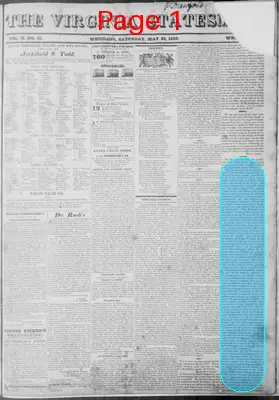
Editorial
May 23, 1829
Virginia Statesman
Wheeling, Ohio County, West Virginia
What is this article about?
Editorial critiques the President's unconstitutional use of recess appointments to remove and install officers without Senate consent, arguing the clause applies only to accidental vacancies and urges public vigilance against such overreach.
Clipping
OCR Quality
78%
Good
Full Text
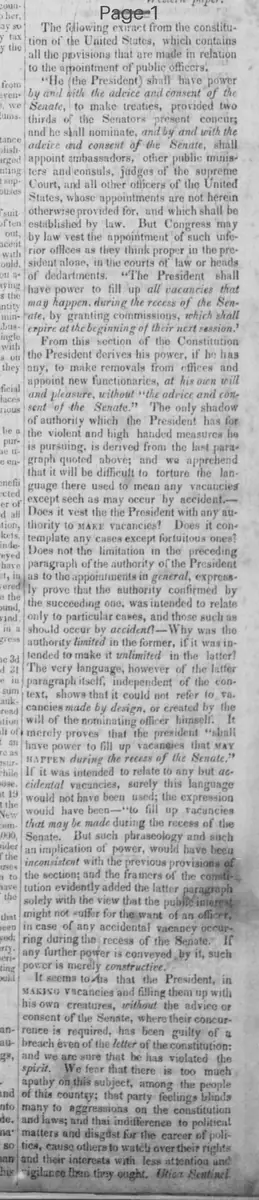
The following extract from the constitution of the United States, which contains all the provisions that are made in relation to the appointment of public officers. He (the President) shall have power by and with the advice and consent of the Senate, to make treaties, provided two thirds of the Senators present concur; and he shall nominate, and by and with the advice and consent of the Senate, shall appoint ambassadors, other public ministers and consuls, judges of the supreme Court, and all other officers of the United States, whose appointments are not herein otherwise provided for, and which shall be established by law. But Congress may by law vest the appointment of such inferior offices as they think proper in the president alone, in the courts of law or heads of departments. "The President shall have power to fill up all vacancies that may happen, during the recess of the Senate, by granting commissions, which shall expire at the beginning of their next session."
From this section of the Constitution the President derives his power, if he has any, to make removals from offices and appoint new functionaries, at his own will and pleasure, without "the advice and consent of the Senate." The only shadow of authority which the President has for the violent and high handed measures he is pursuing, is derived from the last paragraph quoted above; and we apprehend that it will be difficult to torture the language there used to mean any vacancies except such as may occur by accident.— Does it vest the President with any authority to Make vacancies? Does it contemplate any cases except fortuitous ones? Does not the limitation in the preceding paragraph of the authority of the President as to the appointments in general, expressly prove that the authority confirmed by the succeeding one, was intended to relate only to particular cases, and those such as should occur by accident?-Why was the authority limited in the former, if it was intended to make it unlimited in the latter? The very language, however of the latter paragraph itself, independent of the context, shows that it could not refer to vacancies made by design, or created by the will of the nominating officer himself. It merely proves that the president "shall have power to fill up vacancies that may happen during the recess of the Senate." If it was intended to relate to any but accidental vacancies, surely this language would not have been used; the expression would have been—"to fill up vacancies that may be made during the recess of the Senate. But such phraseology and such an implication of power, would have been inconsistent with the previous provisions of the section; and the framers of the constitution evidently added the latter paragraph solely with the view that the public interest might not suffer for the want of an officer, in case of any accidental vacancy occurring during the recess of the Senate. If any further power is conveyed by it, such power is merely constructive. It seems to us that the President, in Making vacancies and filling them up with his own creatures, without the advice or consent of the Senate, where their concurrence is required, has been guilty of a breach even of the letter of the constitution: and we are sure that he has violated the spirit. We fear that there is too much apathy on this subject, among the people of this country; that party feelings blinds many to aggressions on the constitution and laws; and that indifference to political matters and disgust for the career of politics, cause others to watch over their rights and their interests with less attention and vigilance than they ought. Nica Sentinel
From this section of the Constitution the President derives his power, if he has any, to make removals from offices and appoint new functionaries, at his own will and pleasure, without "the advice and consent of the Senate." The only shadow of authority which the President has for the violent and high handed measures he is pursuing, is derived from the last paragraph quoted above; and we apprehend that it will be difficult to torture the language there used to mean any vacancies except such as may occur by accident.— Does it vest the President with any authority to Make vacancies? Does it contemplate any cases except fortuitous ones? Does not the limitation in the preceding paragraph of the authority of the President as to the appointments in general, expressly prove that the authority confirmed by the succeeding one, was intended to relate only to particular cases, and those such as should occur by accident?-Why was the authority limited in the former, if it was intended to make it unlimited in the latter? The very language, however of the latter paragraph itself, independent of the context, shows that it could not refer to vacancies made by design, or created by the will of the nominating officer himself. It merely proves that the president "shall have power to fill up vacancies that may happen during the recess of the Senate." If it was intended to relate to any but accidental vacancies, surely this language would not have been used; the expression would have been—"to fill up vacancies that may be made during the recess of the Senate. But such phraseology and such an implication of power, would have been inconsistent with the previous provisions of the section; and the framers of the constitution evidently added the latter paragraph solely with the view that the public interest might not suffer for the want of an officer, in case of any accidental vacancy occurring during the recess of the Senate. If any further power is conveyed by it, such power is merely constructive. It seems to us that the President, in Making vacancies and filling them up with his own creatures, without the advice or consent of the Senate, where their concurrence is required, has been guilty of a breach even of the letter of the constitution: and we are sure that he has violated the spirit. We fear that there is too much apathy on this subject, among the people of this country; that party feelings blinds many to aggressions on the constitution and laws; and that indifference to political matters and disgust for the career of politics, cause others to watch over their rights and their interests with less attention and vigilance than they ought. Nica Sentinel
What sub-type of article is it?
Constitutional
Legal Reform
Partisan Politics
What keywords are associated?
Presidential Appointments
Recess Appointments
Constitutional Authority
Senate Consent
Removal Power
Public Vigilance
What entities or persons were involved?
President
Senate
Congress
United States Constitution
Editorial Details
Primary Topic
Presidential Power To Remove And Appoint Officers Without Senate Consent
Stance / Tone
Critical Of Presidential Overreach And Violation Of Constitutional Limits
Key Figures
President
Senate
Congress
United States Constitution
Key Arguments
Presidential Appointment Power Requires Senate Advice And Consent Per Constitution.
Recess Appointment Clause Applies Only To Accidental Vacancies, Not Those Created Intentionally.
President's Actions To Make And Fill Vacancies Without Senate Consent Breach The Letter And Spirit Of The Constitution.
Public Apathy And Party Feelings Enable Constitutional Aggressions; Vigilance Is Needed.