Thank you for visiting SNEWPapers!
Sign up free
Literary
November 4, 1819
Daily National Intelligencer
Washington, District Of Columbia
What is this article about?
David P. Hillhouse describes a second expedition to the Tallulah Rapids in Georgia, correcting prior estimates of their extent (4-5 miles), cascades (5 major ones), and bank heights (up to 600+ feet). Notes caverns, sands, and an ancient stone fortification on the Chattooga. Accompanied by notable figures including Dr. Joel Abbott and Col. W. S. Adair. Dated October 8, 1819.
Clipping
OCR Quality
98%
Excellent
Full Text
MORE OF THE RAPIDS OF TALLULAH.
FROM THE GEORGIA JOURNAL.
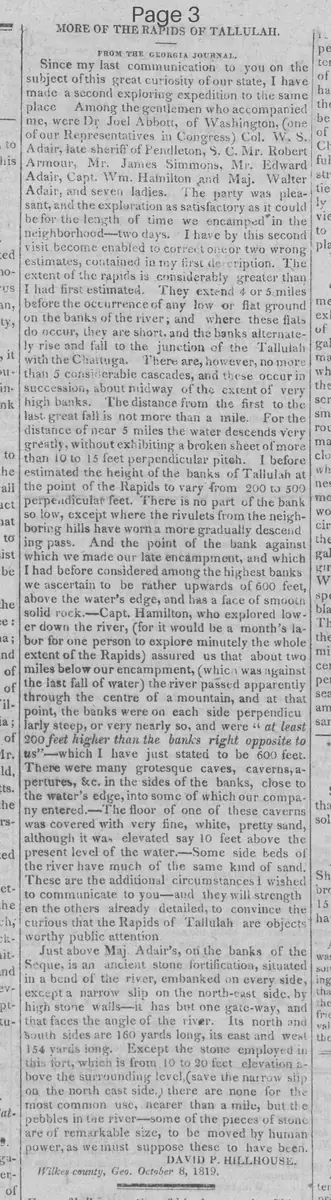
Since my last communication to you on the subject of this great curiosity of our state, I have made a second exploring expedition to the same place. Among the gentlemen who accompanied me, were Dr Joel Abbott, of Washington, (one of our Representatives in Congress) Col. W. S. Adair, late sheriff of Pendleton, S. C. Mr. Robert Armour, Mr. James Simmons, Mr. Edward Adair, Capt. Wm. Hamilton and Maj. Walter Adair, and seven ladies. The party was pleasant, and the exploration as satisfactory as it could be for the length of time we encamped in the neighborhood—two days. I have by this second visit become enabled to correct one or two wrong estimates, contained in my first description. The extent of the rapids is considerably greater than I had first estimated. They extend 4 or 5 miles before the occurrence of any low or flat ground on the banks of the river; and where these flats do occur, they are short, and the banks alternately rise and fall to the junction of the Tallulah with the Chattooga. There are, however, no more than 5 considerable cascades, and these occur in succession, about midway of the extent of very high banks. The distance from the first to the last great fall is not more than a mile. For the distance of near 5 miles the water descends very greatly, without exhibiting a broken sheet of more than 10 to 15 feet perpendicular pitch. I before estimated the height of the banks of Tallulah at the point of the Rapids to vary from 200 to 500 perpendicular feet. There is no part of the bank so low, except where the rivulets from the neighboring hills have worn a more gradually descending pass. And the point of the bank against which we made our late encampment, and which I had before considered among the highest banks we ascertain to be rather upwards of 600 feet above the water's edge, and has a face of smooth solid rock.—Capt. Hamilton, who explored lower down the river, (for it would be a month's labor for one person to explore minutely the whole extent of the Rapids) assured us that about two miles below our encampment, (which was against the last fall of water) the river passed apparently through the centre of a mountain, and at that point, the banks were on each side perpendicularly steep, or very nearly so, and were "at least 200 feet higher than the banks right opposite to us" which I have just stated to be 600 feet. There were many grotesque caves, caverns, apertures, &c. in the sides of the banks, close to the water's edge, into some of which our company entered.—The floor of one of these caverns was covered with very fine, white, pretty sand, although it was elevated say 10 feet above the present level of the water.—Some side beds of the river have much of the same kind of sand. These are the additional circumstances I wished to communicate to you—and they will strengthen the others already detailed, to convince the curious that the Rapids of Tallulah are objects worthy public attention.
Just above Maj Adair's, on the banks of the Chattooga, is an ancient stone fortification, situated in a bend of the river, embanked on every side, except a narrow slip on the north-east side, by high stone walls—it has but one gate-way, and that faces the angle of the river. Its north and south sides are 160 yards long, its east and west 154 yards long. Except the stone employed in this fort, which is from 10 to 20 feet elevation above the surrounding level,(save the narrow slip on the north east side.) there are none for the most common use, nearer than a mile, but the pebbles in the river—some of the pieces of stone are of remarkable size, to be moved by human power,as we must suppose these to have been.
DAVID P. HILLHOUSE.
Wilkes county, Geo. October 8, 1819.
FROM THE GEORGIA JOURNAL.
Since my last communication to you on the subject of this great curiosity of our state, I have made a second exploring expedition to the same place. Among the gentlemen who accompanied me, were Dr Joel Abbott, of Washington, (one of our Representatives in Congress) Col. W. S. Adair, late sheriff of Pendleton, S. C. Mr. Robert Armour, Mr. James Simmons, Mr. Edward Adair, Capt. Wm. Hamilton and Maj. Walter Adair, and seven ladies. The party was pleasant, and the exploration as satisfactory as it could be for the length of time we encamped in the neighborhood—two days. I have by this second visit become enabled to correct one or two wrong estimates, contained in my first description. The extent of the rapids is considerably greater than I had first estimated. They extend 4 or 5 miles before the occurrence of any low or flat ground on the banks of the river; and where these flats do occur, they are short, and the banks alternately rise and fall to the junction of the Tallulah with the Chattooga. There are, however, no more than 5 considerable cascades, and these occur in succession, about midway of the extent of very high banks. The distance from the first to the last great fall is not more than a mile. For the distance of near 5 miles the water descends very greatly, without exhibiting a broken sheet of more than 10 to 15 feet perpendicular pitch. I before estimated the height of the banks of Tallulah at the point of the Rapids to vary from 200 to 500 perpendicular feet. There is no part of the bank so low, except where the rivulets from the neighboring hills have worn a more gradually descending pass. And the point of the bank against which we made our late encampment, and which I had before considered among the highest banks we ascertain to be rather upwards of 600 feet above the water's edge, and has a face of smooth solid rock.—Capt. Hamilton, who explored lower down the river, (for it would be a month's labor for one person to explore minutely the whole extent of the Rapids) assured us that about two miles below our encampment, (which was against the last fall of water) the river passed apparently through the centre of a mountain, and at that point, the banks were on each side perpendicularly steep, or very nearly so, and were "at least 200 feet higher than the banks right opposite to us" which I have just stated to be 600 feet. There were many grotesque caves, caverns, apertures, &c. in the sides of the banks, close to the water's edge, into some of which our company entered.—The floor of one of these caverns was covered with very fine, white, pretty sand, although it was elevated say 10 feet above the present level of the water.—Some side beds of the river have much of the same kind of sand. These are the additional circumstances I wished to communicate to you—and they will strengthen the others already detailed, to convince the curious that the Rapids of Tallulah are objects worthy public attention.
Just above Maj Adair's, on the banks of the Chattooga, is an ancient stone fortification, situated in a bend of the river, embanked on every side, except a narrow slip on the north-east side, by high stone walls—it has but one gate-way, and that faces the angle of the river. Its north and south sides are 160 yards long, its east and west 154 yards long. Except the stone employed in this fort, which is from 10 to 20 feet elevation above the surrounding level,(save the narrow slip on the north east side.) there are none for the most common use, nearer than a mile, but the pebbles in the river—some of the pieces of stone are of remarkable size, to be moved by human power,as we must suppose these to have been.
DAVID P. HILLHOUSE.
Wilkes county, Geo. October 8, 1819.
What sub-type of article is it?
Essay
Journey Narrative
What themes does it cover?
Nature
What keywords are associated?
Tallulah Rapids
Exploration
Cascades
High Banks
Caverns
Stone Fortification
Georgia
Chattooga
What entities or persons were involved?
David P. Hillhouse.
Literary Details
Title
More Of The Rapids Of Tallulah.
Author
David P. Hillhouse.
Subject
Second Exploring Expedition To The Rapids Of Tallulah.
Form / Style
Descriptive Prose Account Of Natural Exploration.
Key Lines
The Extent Of The Rapids Is Considerably Greater Than I Had First Estimated. They Extend 4 Or 5 Miles Before The Occurrence Of Any Low Or Flat Ground On The Banks Of The River;
The Point Of The Bank Against Which We Made Our Late Encampment... Upwards Of 600 Feet Above The Water's Edge, And Has A Face Of Smooth Solid Rock.
The Rapids Of Tallulah Are Objects Worthy Public Attention.
Just Above Maj Adair's, On The Banks Of The Chattooga, Is An Ancient Stone Fortification...