Thank you for visiting SNEWPapers!
Sign up free
Letter to Editor
August 5, 1800
Gazette Of The United States, & Daily Advertiser
Philadelphia, Philadelphia County, Pennsylvania
What is this article about?
A satirical account of a chaotic Jacobin meeting at the State House in Philadelphia, mocking the ignorance, criminal backgrounds, and disorderly proceedings of attendees as they nominate candidates for assembly and council elections.
Clipping
OCR Quality
95%
Excellent
Full Text
For the GAZETTE of the UNITED STATES.
MR. WAYNE
SIR,
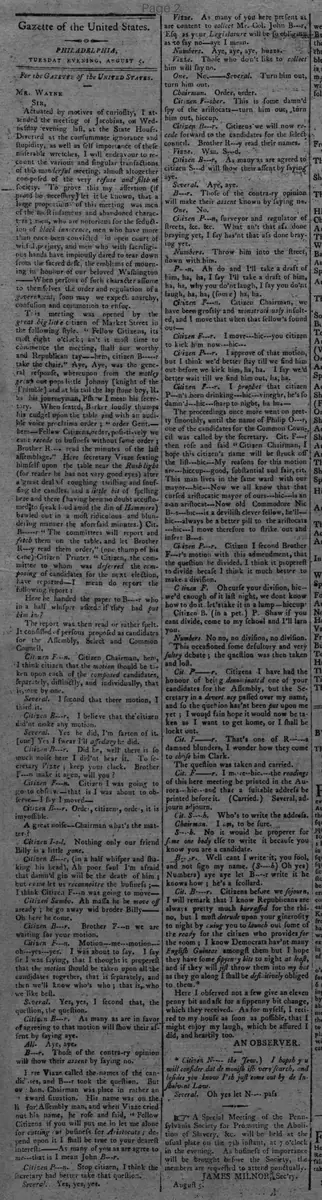
Actuated by motives of curiosity, I attended the meeting of Jacobins, on Wednesday evening last, at the State House. Diverted at the consummate ignorance and stupidity, as well as self importance of these miserable wretches, I will endeavour to recount the various and singular transactions of this wonderful meeting, almost altogether composed of the very refuse and filth of the city. To prove this my assertion (if proof be necessary) let it be known, that a large proportion of this meeting was men of the most infamous and abandoned character: men, who are notorious for the seduction of black innocence, men who have more than once been convicted in open court of wilful perjury, and men who with sacrilegious hands have impiously dared to tear down from the sacred desk, the emblems of mourning in honour of our beloved Washington.—When persons of such character assume to themselves the order and regulation of a government, soon may we expect anarchy, confusion and commotion to ensue.
This meeting was opened by the great big little citizen of Market Street in the following style. 'Fellow Citizens, it's not eight o'clock; an't it not time to commence the meeting, shall our worthy and Republican tay—hem, citizen B———take the chair.' 'Aye, Aye,' was the general response, whereupon from the motley group out pops little Johnny E——knight of the thimble] and at his tail the lapstone boy, R—— as his journeyman, Ph—— I mean his secretary. When seated, Barker loudly thumps his cudgel upon the table and with an audible voice proclaims order; 'order Gent.—hem—Fellow Citizens, order, positively we can't proceed to business without some order; Brother R—— read the minutes of the last assemblage.' Here secretary Vizze seating himself upon the table near the rushlight (for reader he has not very good eyes) after a great deal of coughing twisting and snuffing the candles, and a little bit of spelling here and there (having been no doubt accustomed to speak loud amid the din of Hammers) bawled out in a most ridiculous and bungling manner the aforesaid minutes.)
Cit. B——o——r 'The committees will report and fetch them on the table, and let Brother R——y read them order,' (one thump of his cane) 'Citizen Printer.' 'Citizen, the committee to whom was deferred the composing of candidates for the next election, have reported—I mean do report the following report:' Here he handed the paper to B——r who in a half whine asks if they had put him in?
The report was then read or rather pelt. It consisted of persons proposed as candidates for the Assembly, Select and Common Council,
Citizen F——n. 'Citizen Chairman, hem, I think citizen that the motion should be taken upon each of the composed candidates, separately, distinctly, and individually, that is, one by one.'
Several. 'I second that motion, I third it.'
Citizen B——r. 'I believe that the citizen didn't make any motion.'
Several. 'Yes he did, I'm certain of it.' [one] 'Yes I swear I'll make affidavit he did.'
Citizen B——r. 'Did he, well there is so much noise here I didn't hear it. To secretary Vizze; keep your clack. Brother F——n make it again, will you?'
Citizen F——n. 'Citizen I was going to observe—that is I was about to observe—I say I moved—'
Citizen B——r. 'Order, citizens, order, it is impossible.'
A great noise—'Chairman what's the matter?'
Citizen I——l. 'Nothing only our friend Billy is a little gone.'
Citizen B——r, (in a half whisper and shaking his head), 'Ah poor soul I'm afraid that damn'd gin will be the death of him; but come let us reconnoitre the business; I think Citizen F——n was going to move——'
Citizen Sambo. 'Ah massa he be move off aready; he go away wid broder Billy Ob here he come.'
Citizen B——r. 'Brother F——n we are waiting for your motion.'
Citizen F——n. 'Motion—me—motion—oh—yes—yes. I was about to say.. I say if I was saying, that I thought it proper that the motion should be taken upon all the candidates together, that is separately, and then we'll know who's who; that is, who we like best.'
Several. 'Yes, yes, I second that, the question, the question.'
Citizen B——r. 'As many as are in favor of agreeing to that motion will show their assent by saying aye.'
All—'Aye, aye.'
B——r. 'Those of the contrary opinion will show their assent by saying no.'
I——r Vizze called the names of the candidates, and B——r took the question. But our honest Chairman was placed in rather an awkward situation. His name was on the list for Assembly man, and when Vizze cried out his name, he rose and said, 'Fellow Citizens if you will put me in let me alone for cutting out business for Aristocrats; depend upon it I shall be true to your dearest interests—As many of you as are agreed to me—that is I mean John B——t.'
Citizen P——t. 'Stop citizen, I think the secretary had better take that question.'
Several. 'Yes, yes, yes.'
Vizze. 'As many of you here present as are content to elect Mr. Col. John B——r, Esq as your Legislature will be so obliging as to say no aye I mean.'
Numbers. 'Aye, aye, aye, huzza.'
Vizze. 'Those who don't like to elect him will say no.'
One. 'No.'—Several. 'Turn him out, turn him out.'
Chairman. 'Order, order.'
Citizen P——sher. 'This is some damn'd spy of the aristocrats—turn him out, turn him out, hiccup.'
Citizen B——r. 'Citizens we will now proceed forward to the candidates for the select council. Brother R——y read their names.'
Vizze. 'Wm. S——d.'
Citizen B——r. 'As many as are agreed to citizen S——d will show their assent by saying aye.'
Several. 'Aye, aye.'
B——r. 'Those of this contrary opinion will make their assent known by saying no.'
One. 'No.'
Citizen P——n, surveyor and regulator of streets, &c. &c. 'What an't that as done braying yet, I say hasn't that ass done braying yet.'
Numbers. 'Throw him into the street, down with him.'
P——n. 'Ah do and I'll take a draft of him, ha, ha, I say I'll take a draft of him, ha, ha, why you don't laugh, I say you don't laugh, ha, ha, (some) ha, ha.'
Citizen F——rl. 'Citizen Chairman, we have been grossly and monstrously insulted, and I move that when that fellow's found out'
Citizen F——r. 'I move—hic—you citizen to kick him now.—hic—'
Citizen P——r. 'I approve of that motion, but I think we'd better stay till we find him out before we kick him, ha, ha. I say we'd better wait till we find him out, ha, ha.'
Citizen F——r. 'I protest that citizen P——n's been drinking—hic—vinegar, he's so damn'd—hic—sharp to night, ha ha.—'
The proceedings once more went on pretty smoothly, until the name of Philip O——r, one of the candidates for the Common Council was called by the secretary. Cit. F——r then rose and said 'Citizen Chairman, I hope this citizen's name will be struck off the list—hic—My reasons for this motion are—hiccup—good, substantial and fair, cit. This man lives in the same ward with our mayor—hic—Now we all know that that cursed aristocratic mayor of ours—hic—is an a—an aristocrat—Now old Commodore Nic B——s—hic—is a devilish clever fellow, he'll—hic—always be a better pill to the aristocrats—hic—I move therefore to strike out and insert B——s.'
Citizen P——t. 'Citizen I second Brother F——r's motion with this amendment, that the question be divided. I think it proper to divide because I think it much better to make a division.'
Citizen F. 'Obscure your division, hic—we'd enough of it last night, we dont know how to do it. let's take it in a lump—hiccup'
Citizen B. (in a pet.) 'P. Shaw if you cant divide, come to my school and I'll larn you.'
Numbers. 'No no, no division, no division.'
This occasioned some desultory and very silly debate; the question was then taken and lost.
Cit: P——r.
'Citizens I have had the honour of being denominated one of your candidates for the Assembly, but the Secretary in a dereliction passed over my name, and so the question hasn't been put upon me yet; I would fain hope it would now be taken as I want to get home, or I shall be locked out.'
Cit. Fr. 'That's one of R——s damned blunders, I wonder how they come to choose him Clark.'
The question was taken and carried.
Cit. Fr. 'I move—hic—the readings of this here meeting be printed in the Aurora—hic—and that a suitable address be printed before it.' (Carried.) Several, 'ad. journ adjourn.'
Cit. S——h. 'Who's to write the address.'
Chairman. 'I am, to be sure.'
S——b. 'No it would be properer for some one body else to write it because you know you are a candidate.'
B——r. 'Well cant I write it; you fool, and not sign my name.' (S——b) 'Oh yes'
Numbers 'aye aye let B——r write it he knows how; he's a scholar.'
Cit. B——r. 'Citizens before we sojourn, I will remark that I know Republicans are always pretty much barred for the rhino, but I must intrude upon your generosity to night by asking you to launch out some of the ready for the citizen who provides for the room; I know Democrats hav'nt many English Guineas amongst them but I hope they have some fippenny bills to night at least, and if they will just throw them into my hat as they go along I shall be definitively obliged to them.'
Here I observed not a few give an eleven penny bit and ask for a fippenny bit change, which they received. As for myself, I retired to my house as soon as possible, that I might enjoy my laugh, which be assured I did, and heartily too.
AN OBSERVER.
* Citizen N—— the Jew.) I hopes you will consider dat de monik is very catch, and besides you know P——sh ju come out by de Insolvent Law.
Several. 'Oh yes let N—— pass'
* Citizen N—— the Jew. I hope you will consider that the monkey is very catch, and besides you know P——sh just come out by the Insolvent Law.
Several. 'Oh yes let N—— pass'
MR. WAYNE
SIR,
Actuated by motives of curiosity, I attended the meeting of Jacobins, on Wednesday evening last, at the State House. Diverted at the consummate ignorance and stupidity, as well as self importance of these miserable wretches, I will endeavour to recount the various and singular transactions of this wonderful meeting, almost altogether composed of the very refuse and filth of the city. To prove this my assertion (if proof be necessary) let it be known, that a large proportion of this meeting was men of the most infamous and abandoned character: men, who are notorious for the seduction of black innocence, men who have more than once been convicted in open court of wilful perjury, and men who with sacrilegious hands have impiously dared to tear down from the sacred desk, the emblems of mourning in honour of our beloved Washington.—When persons of such character assume to themselves the order and regulation of a government, soon may we expect anarchy, confusion and commotion to ensue.
This meeting was opened by the great big little citizen of Market Street in the following style. 'Fellow Citizens, it's not eight o'clock; an't it not time to commence the meeting, shall our worthy and Republican tay—hem, citizen B———take the chair.' 'Aye, Aye,' was the general response, whereupon from the motley group out pops little Johnny E——knight of the thimble] and at his tail the lapstone boy, R—— as his journeyman, Ph—— I mean his secretary. When seated, Barker loudly thumps his cudgel upon the table and with an audible voice proclaims order; 'order Gent.—hem—Fellow Citizens, order, positively we can't proceed to business without some order; Brother R—— read the minutes of the last assemblage.' Here secretary Vizze seating himself upon the table near the rushlight (for reader he has not very good eyes) after a great deal of coughing twisting and snuffing the candles, and a little bit of spelling here and there (having been no doubt accustomed to speak loud amid the din of Hammers) bawled out in a most ridiculous and bungling manner the aforesaid minutes.)
Cit. B——o——r 'The committees will report and fetch them on the table, and let Brother R——y read them order,' (one thump of his cane) 'Citizen Printer.' 'Citizen, the committee to whom was deferred the composing of candidates for the next election, have reported—I mean do report the following report:' Here he handed the paper to B——r who in a half whine asks if they had put him in?
The report was then read or rather pelt. It consisted of persons proposed as candidates for the Assembly, Select and Common Council,
Citizen F——n. 'Citizen Chairman, hem, I think citizen that the motion should be taken upon each of the composed candidates, separately, distinctly, and individually, that is, one by one.'
Several. 'I second that motion, I third it.'
Citizen B——r. 'I believe that the citizen didn't make any motion.'
Several. 'Yes he did, I'm certain of it.' [one] 'Yes I swear I'll make affidavit he did.'
Citizen B——r. 'Did he, well there is so much noise here I didn't hear it. To secretary Vizze; keep your clack. Brother F——n make it again, will you?'
Citizen F——n. 'Citizen I was going to observe—that is I was about to observe—I say I moved—'
Citizen B——r. 'Order, citizens, order, it is impossible.'
A great noise—'Chairman what's the matter?'
Citizen I——l. 'Nothing only our friend Billy is a little gone.'
Citizen B——r, (in a half whisper and shaking his head), 'Ah poor soul I'm afraid that damn'd gin will be the death of him; but come let us reconnoitre the business; I think Citizen F——n was going to move——'
Citizen Sambo. 'Ah massa he be move off aready; he go away wid broder Billy Ob here he come.'
Citizen B——r. 'Brother F——n we are waiting for your motion.'
Citizen F——n. 'Motion—me—motion—oh—yes—yes. I was about to say.. I say if I was saying, that I thought it proper that the motion should be taken upon all the candidates together, that is separately, and then we'll know who's who; that is, who we like best.'
Several. 'Yes, yes, I second that, the question, the question.'
Citizen B——r. 'As many as are in favor of agreeing to that motion will show their assent by saying aye.'
All—'Aye, aye.'
B——r. 'Those of the contrary opinion will show their assent by saying no.'
I——r Vizze called the names of the candidates, and B——r took the question. But our honest Chairman was placed in rather an awkward situation. His name was on the list for Assembly man, and when Vizze cried out his name, he rose and said, 'Fellow Citizens if you will put me in let me alone for cutting out business for Aristocrats; depend upon it I shall be true to your dearest interests—As many of you as are agreed to me—that is I mean John B——t.'
Citizen P——t. 'Stop citizen, I think the secretary had better take that question.'
Several. 'Yes, yes, yes.'
Vizze. 'As many of you here present as are content to elect Mr. Col. John B——r, Esq as your Legislature will be so obliging as to say no aye I mean.'
Numbers. 'Aye, aye, aye, huzza.'
Vizze. 'Those who don't like to elect him will say no.'
One. 'No.'—Several. 'Turn him out, turn him out.'
Chairman. 'Order, order.'
Citizen P——sher. 'This is some damn'd spy of the aristocrats—turn him out, turn him out, hiccup.'
Citizen B——r. 'Citizens we will now proceed forward to the candidates for the select council. Brother R——y read their names.'
Vizze. 'Wm. S——d.'
Citizen B——r. 'As many as are agreed to citizen S——d will show their assent by saying aye.'
Several. 'Aye, aye.'
B——r. 'Those of this contrary opinion will make their assent known by saying no.'
One. 'No.'
Citizen P——n, surveyor and regulator of streets, &c. &c. 'What an't that as done braying yet, I say hasn't that ass done braying yet.'
Numbers. 'Throw him into the street, down with him.'
P——n. 'Ah do and I'll take a draft of him, ha, ha, I say I'll take a draft of him, ha, ha, why you don't laugh, I say you don't laugh, ha, ha, (some) ha, ha.'
Citizen F——rl. 'Citizen Chairman, we have been grossly and monstrously insulted, and I move that when that fellow's found out'
Citizen F——r. 'I move—hic—you citizen to kick him now.—hic—'
Citizen P——r. 'I approve of that motion, but I think we'd better stay till we find him out before we kick him, ha, ha. I say we'd better wait till we find him out, ha, ha.'
Citizen F——r. 'I protest that citizen P——n's been drinking—hic—vinegar, he's so damn'd—hic—sharp to night, ha ha.—'
The proceedings once more went on pretty smoothly, until the name of Philip O——r, one of the candidates for the Common Council was called by the secretary. Cit. F——r then rose and said 'Citizen Chairman, I hope this citizen's name will be struck off the list—hic—My reasons for this motion are—hiccup—good, substantial and fair, cit. This man lives in the same ward with our mayor—hic—Now we all know that that cursed aristocratic mayor of ours—hic—is an a—an aristocrat—Now old Commodore Nic B——s—hic—is a devilish clever fellow, he'll—hic—always be a better pill to the aristocrats—hic—I move therefore to strike out and insert B——s.'
Citizen P——t. 'Citizen I second Brother F——r's motion with this amendment, that the question be divided. I think it proper to divide because I think it much better to make a division.'
Citizen F. 'Obscure your division, hic—we'd enough of it last night, we dont know how to do it. let's take it in a lump—hiccup'
Citizen B. (in a pet.) 'P. Shaw if you cant divide, come to my school and I'll larn you.'
Numbers. 'No no, no division, no division.'
This occasioned some desultory and very silly debate; the question was then taken and lost.
Cit: P——r.
'Citizens I have had the honour of being denominated one of your candidates for the Assembly, but the Secretary in a dereliction passed over my name, and so the question hasn't been put upon me yet; I would fain hope it would now be taken as I want to get home, or I shall be locked out.'
Cit. Fr. 'That's one of R——s damned blunders, I wonder how they come to choose him Clark.'
The question was taken and carried.
Cit. Fr. 'I move—hic—the readings of this here meeting be printed in the Aurora—hic—and that a suitable address be printed before it.' (Carried.) Several, 'ad. journ adjourn.'
Cit. S——h. 'Who's to write the address.'
Chairman. 'I am, to be sure.'
S——b. 'No it would be properer for some one body else to write it because you know you are a candidate.'
B——r. 'Well cant I write it; you fool, and not sign my name.' (S——b) 'Oh yes'
Numbers 'aye aye let B——r write it he knows how; he's a scholar.'
Cit. B——r. 'Citizens before we sojourn, I will remark that I know Republicans are always pretty much barred for the rhino, but I must intrude upon your generosity to night by asking you to launch out some of the ready for the citizen who provides for the room; I know Democrats hav'nt many English Guineas amongst them but I hope they have some fippenny bills to night at least, and if they will just throw them into my hat as they go along I shall be definitively obliged to them.'
Here I observed not a few give an eleven penny bit and ask for a fippenny bit change, which they received. As for myself, I retired to my house as soon as possible, that I might enjoy my laugh, which be assured I did, and heartily too.
AN OBSERVER.
* Citizen N—— the Jew.) I hopes you will consider dat de monik is very catch, and besides you know P——sh ju come out by de Insolvent Law.
Several. 'Oh yes let N—— pass'
* Citizen N—— the Jew. I hope you will consider that the monkey is very catch, and besides you know P——sh just come out by the Insolvent Law.
Several. 'Oh yes let N—— pass'
What sub-type of article is it?
Satirical
Political
Provocative
What themes does it cover?
Politics
What keywords are associated?
Jacobin Meeting
Phila Politics
Election Satire
Aristocrat Spy
Republican Candidates
State House Assembly
What entities or persons were involved?
An Observer
Mr. Wayne
Letter to Editor Details
Author
An Observer
Recipient
Mr. Wayne
Main Argument
the jacobin meeting was chaotic and composed of ignorant, criminal individuals whose poor character and disorderly conduct threaten to bring anarchy if they influence government.
Notable Details
Accusations Of Perjury, Seduction, And Desecration Of Washington's Mourning Emblems
Mocking Of Election Candidate Nominations And Drunken Interruptions
References To Specific Figures Like Citizen B——R (Likely Barker), Citizen F——R, And Others