Thank you for visiting SNEWPapers!
Sign up free
Memphis Daily Appeal
Memphis, Shelby County, Tennessee
What is this article about?
US officials in Washington view war with Great Britain as possible due to British support for Confederate ships like the Alabama; Cabinet debates responses including letters of marque. France has not replied to US rejection of mediation offer, causing unease. April 6, 1863.
Clipping
OCR Quality
Full Text
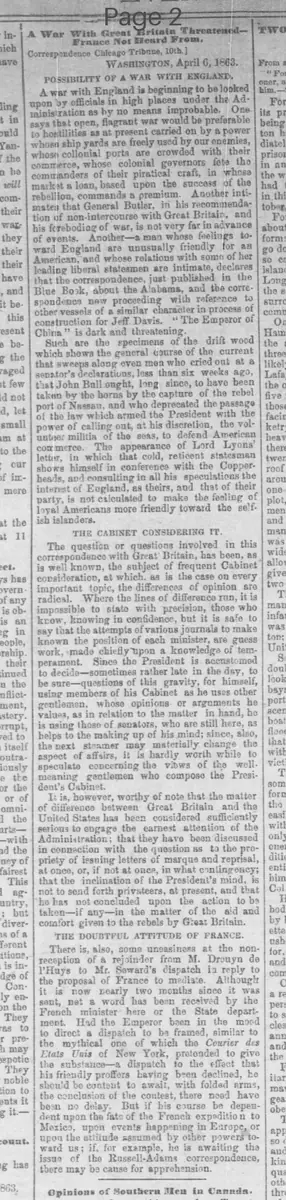
[Correspondence Chicago Tribune, 10th.]
WASHINGTON, April 6, 1863.
POSSIBILITY OF A WAR WITH ENGLAND
A war with England is beginning to be looked upon by officials in high places under the Administration as by no means improbable. One says that open, flagrant war would be preferable to hostilities as at present carried on by a power whose ship yards are freely used by our enemies, whose colonial ports are crowded with their commerce, whose colonial governors fete the commanders of their piratical craft, in whose market a loan, based upon the success of the rebellion, commands a premium. Another intimates that General Butler, in his recommendation of non-intercourse with Great Britain, and of events. Another—a man whose feelings toward England are unusually friendly for an American, and whose relations with some of her leading liberal statesmen are intimate, declares that the correspondence, just published in the Blue Book, about the Alabama, and the correspondence now proceeding with reference to other vessels of a similar character in process of construction for Jeff Davis. "The Emperor of China" is dark and threatening.
Such are the specimens of the drift wood which shows the general course of the current that sweeps along even men who cried out at a senator's declarations, less than six weeks ago, that John Bull ought, long since, to have been taken by the horns by the capture of the rebel port of Nassau, and who deprecated the passage of the law which armed the President with the power of calling out, at his discretion, the volunteer militia of the seas, to defend American commerce. The appearance of Lord Lyons letter, in which that cold, reticent statesman shows himself in conference with the Copperheads, and consulting in all his speculations the interest of England, as theirs, and that of their party, is not calculated to make the feeling of loyal Americans more friendly toward the selfish islanders.
THE CABINET CONSIDERING IT.
The question or questions involved in this correspondence with Great Britain, has been, as is well known, the subject of frequent Cabinet consideration, at which, as is the case on every important topic, the differences of opinion are radical. Where the lines of difference run, it is impossible to state with precision, those who know, knowing in confidence, but it is safe to say that the attempts of various journals to make known the position of each minister, are guess work, made chiefly upon a knowledge of temperament. Since the President is accustomed to decide—sometimes rather late in the day, to be sure—questions of this gravity, for himself, using members of his Cabinet as he uses other gentlemen, whose opinions or arguments he values, as in relation to the matter in hand, he is using those of senators, who are still here, as helps to the making up of his mind; since, also, the next steamer may materially change the aspect of affairs, it is hardly worth while to speculate concerning the views of the well-meaning gentlemen who compose the President's Cabinet.
It is, however, worthy of note that the matter of difference between Great Britain and the United States has been considered sufficiently serious to engage the earnest attention of the Administration: that they have been discussed in connection with the question as to the propriety of issuing letters of marque and reprisal, at once, or, if not at once, in what contingency; that the inclination of the President's mind, is not to send forth privateers, at present, and that he has not concluded upon the action to be taken—if any—in the matter of the aid and comfort given to the rebels by Great Britain.
THE DOUBTFUL ATTITUDE OF FRANCE.
There is, also, some uneasiness at the non-reception of a rejoinder from M. Drouyn de l'Huys to Mr. Seward's dispatch in reply to the proposal of France to mediate. Although it is now nearly two months since it was sent, not a word has been received by the French minister here or the State department. Had the Emperor been in the mood to direct a dispatch to be framed, similar to the mythical one of which the Courier des Etats Unis of New York, pretended to give the substance—a dispatch to the effect that his friendly proffers having been declined, he should be content to await, with folded arms, the conclusion of the contest, there need have been no delay. But if his course be dependent upon the fate of the French expedition to Mexico, upon events happening in Europe, or upon the attitude assumed by other powers toward us; if, for example, he is awaiting the issue of the Russell-Adams correspondence, there may be cause for apprehension.
What sub-type of article is it?
What keywords are associated?
What entities or persons were involved?
Where did it happen?
Foreign News Details
Primary Location
Great Britain
Event Date
April 6, 1863
Key Persons
Outcome
no immediate decisions on issuing letters of marque or reprisal; ongoing cabinet deliberations; french silence on mediation reply raises apprehension.
Event Details
US officials increasingly view war with England as possible due to British shipyards building Confederate vessels like the Alabama, colonial support for rebels, and Lord Lyons' consultations with Copperheads. Cabinet debates responses, including non-intercourse and privateers, but President inclines against issuing them presently. France has not responded to Seward's dispatch rejecting mediation proposal, possibly awaiting developments in Mexico or Europe.