Thank you for visiting SNEWPapers!
Sign up free
Editorial
January 23, 1834
Herald Of The Times
Newport, Newport County, Rhode Island
What is this article about?
In a folksy address dated October 3, 1833, Major J. Downing defends the Bank of the United States against political attacks, using a wagon metaphor to argue it stabilized the economy, criticizing removal efforts as dishonest and harmful, amid Jacksonian opposition.
Clipping
OCR Quality
98%
Excellent
Full Text
[From the New-York Daily Advertiser.
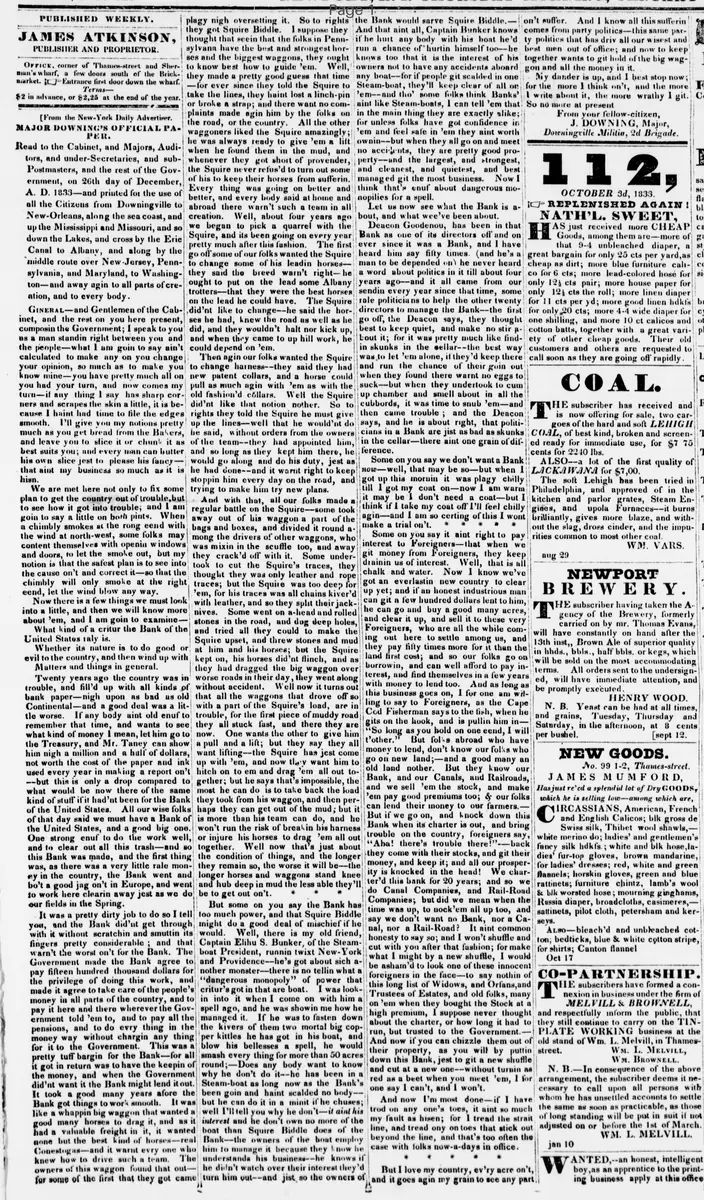
MAJOR DOWNING'S OFFICIAL PAPER.
Read to the Cabinet, and Majors, Auditors, and under-Secretaries, and sub-Postmasters, and the rest of the Government, on 26th day of December, A. D. 1833—and printed for the use of all the Citizens from Downingville to New-Orleans, along the sea coast, and up the Mississippi and Missouri, and so down the Lakes, and cross by the Erie Canal to Albany, and along by the middle route over New-Jersey, Pennsylvania, and Maryland, to Washington—and away again to all parts of creation, and to every body.
Gentlemen of the Cabinet, and the rest of you here present, composing the Government; I speak to you as a man standing right between you and the people—what I am going to say ain't calculated to make any of you change your opinion, so much as to make you know mine—you have pretty much all of you had your turn, and now comes my turn—if anything I say has sharp corners and scrapes the skin a little, it is because I hain't had time to file the edges smooth. I'll give you my notions pretty much as you get bread from the Bakers, and leave you to slice it or chunk it as best suits you; and every man can butter his own slice jest to please his fancy—that ain't my business so much as it is hisn.
We are met here not only to fix some plan to get the country out of trouble, but to see how it got into trouble; and I am going to say a little on both points. When a chimney smokes at the wrong end with the wind at north-west, some folks may content themselves with opening windows and doors, to let the smoke out, but my notion is that the safest plan is to see into the cause on't and correct it—so that the chimney will only smoke at the right end, let the wind blow any way.
Now there is a few things we must look into a little, and then we will know more about 'em, and I am going to examine—What kind of a critter the Bank of the United States really is.
Whether its nature is to do good or evil to the country, and then wind up with Matters and things in general.
Twenty years ago the country was in trouble, and fill'd up with all kinds of bank paper—nigh upon as bad as old Continental—and a good deal was a little worse. If anybody ain't old enough to remember that time, and wants to see what kind of money I mean, let him go to the Treasury, and Mr. Taney can show him nigh a million and a half of dollars, not worth the cost of the paper and ink used every year in making a report on't—but this is only a drop compared to what would be now there of the same kind of stuff if it hadn't been for the Bank of the United States. All our wise folks of that day said we must have a Bank of the United States, and a good big one. One strong enough to do the work well. and to clear out all this trash—and so this Bank was made, and the first thing was, as there was very little real money in the country, the Bank went and bought a good jag on't in Europe, and went to work here clearing away jest as we do our fields in the Spring.
It was a pretty dirty job to do so I tell you, and the Bank didn't get through with it without scratching and smutting its fingers pretty considerable; and that warn't the worst on't for the Bank. The Government made the Bank agree to pay fifteen hundred thousand dollars for the privilege of doing this work, and made it agree to take care of the people's money in all parts of the country, and to pay it here and there wherever the Government told 'em to, and to pay all the pensions, and to do every thing in the money way without charging any thing for it to the Government. This was a pretty tuff bargain for the Bank—for all it got in return was to have the keeping of the money, and when the Government didn't want it the Bank might lend it out.
It took a good many years afore the Bank got things to work smooth. It was like a whapping big waggon that wanted a good many horses to drag it, and as it had a valuable freight in it, it wanted none but the best kind of horses—real Conestogas—and it warnt every one who knew how to drive such a team. The owners of this waggon found that out—for some of the first that they got came plaguy nigh oversetting it. So to rights they got Squire Biddle. I suppose they thought that seeing that the folks in Pennsylvania have the best and strongest horses and the biggest waggons, they ought to know best how to guide 'em. Well, they made a pretty good guess that time—for ever since they told the Squire to take the lines, they hain't lost a linch-pin or broke a strap; and there warn't no complaints made agin him by the folks on the road, or the country. All the other waggoners liked the Squire amazingly; he was always ready to give 'em a lift when he found them in the mud, and whenever they got short of provender, the Squire never refus'd to turn out some of his to keep their horses from suffering.
Every thing was going on better and better, and everybody said at home and abroad there warn't such a team in all creation. Well, about four years ago we began to pick a quarrel with the Squire, and its been going on every year pretty much after this fashion. The first go off some of our folks wanted the Squire to change some of his leading horses—they said the breed warn't right—he ought to put on the lead some Albany trotters—that they were the best horses on the lead he could have.
The Squire didn't like to change—he said the horses he had, knew the road as well as he did, and they wouldn't halt nor kick up, and when they came to up hill work, he could depend on 'em.
Then agin our folks wanted the Squire to change harness—they said they had new patent collars, and a horse could pull as much agin with 'em as with the old fashion'd collars. Well the Squire didn't like that notion nother. So to rights they told the Squire he must give up the lines—well that he wouldn't do he said, without orders from the owners of the team—they had appointed him, and so long as they kept him there, he would go along and do his duty, jest as he had done—and it warnt right to keep stopping him every day on the road, and trying to make him try new plans.
And with that, all our folks made a regular battle on the Squire—some took away out of his waggon a part of the bags and boxes, and divided it round among the drivers of other waggons, who was mixing in the scuffle too, and away they crack'd off with it. Some undertook to cut the Squire's traces, they thought they was only leather and rope traces; but the Squire was too deep for 'em, for his traces was all chains kivered with leather, and so they split their jack-knives.
Some went on a-head and rolled stones in the road, and dug deep holes. and tried all they could to make the Squire upset, and threw stones and mud at him and his horses; but the Squire kept on, his horses didn't flinch, and as they had dragged the big waggon over worse roads in their day, they went along without accident. Well now it turns out that all the waggons that drove off so with a part of the Squire's load, are in trouble, for the first piece of muddy road they all stuck fast, and there they are now. One wants the other to give him a pull and a lift; but they say they all want lifting—the Squire has jest come up with 'em, and now they want him to hitch on to 'em and drag 'em all out together; but he says that's impossible, the most he can do is to take back the load they took from his waggon, and then perhaps they can get out of the mud; but it is more than his team can do, and he won't run the risk of breaking his harness or injure his horses to drag 'em all out together.
Well now that's just about the condition of things, and the longer they remain so, the worse it will be—the longer horses and waggons stand knee and hub deep in mud the less able they'll be to get out on't.
But some of you say the Bank has too much power, and that Squire Biddle might do a good deal of mischief if he would.
Well, there is my old friend, Captain Elihu S. Bunker, of the Steamboat President, running twixt New-York and Providence—he's got about sich another monster—there is no telling what a "dangerous monopoly" of power that critur's got in that are boat. I was looking into it when I come on with him a spell ago, and he was showing me how he managed it. If he was to fasten down the kivers of them two mortal big copper kittles he has got in his boat, and blow his bellesses a spell, he would smash every thing for more than 50 acres round;-Does anybody want to know why he don't do it—he has been in a Steam-boat as long now as the Bank's been going and hain't scalded no body—but he can do it in a minit if he chuses; well I'll tell you why he don't—it ain't his interest and he don't own no more of the boat than Squire Biddle does of the Bank—the owners of the boat employ him to manage it because they know he understands his business—he knows if he didn't watch over their interest they'd turn him out—and jist so the owners of the Bank would sarve Squire Biddle.
And that ain't all, Captain Bunker knows if he hurt anybody with his boat he'd run a chance of hurting himself too—he knows too that it is the interest of his owners not to have any accidents aboard any boat—for if people git scalded in one Steam-boat, they'll keep clear of all of 'em—and tho' some folks think Banks ain't like Steam-boats, I can tell 'em that in the main thing they are exactly alike; for unless folks have got confidence in 'em and feel safe in 'em they ain't worth owning—but when they all go on and meet no accidents, they are pretty good property—and the largest, and strongest, and cleanest, and quietest, and best managed git the most business. Now I think that's enuf about dangerous monopolies for a spell.
Let us now see what the Bank is about, and what we've been about.
Deacon Goodenow, has been in that Bank as one of its directors off and on ever since it was a Bank, and I have heard him say fifty times, (and he's a man to be depended on) he never heard a word about politics in it till about four years ago—and it all came from our sending every year since that time, some rale politicians to help the other twenty directors to manage the Bank—the first go off, the Deacon says, they thought best to keep quiet, and make no stir about it; for it was pretty much like finding skunks in the cellar—the best way was to let 'em alone, if they'd keep there and run the chance of their going out when they found there warnt no eggs to suck—but when they undertook to cum up chamber and smell about in all the cubbards, it was time to snub 'em—and then came trouble; and the Deacon says, and he is about right, that politicians in a Bank are jist as bad as skunks in the cellar—there ain't one grain of difference.
Some of you say we don't want a Bank now—well, that may be so—but when I got up this morning it was plaguy chilly till I got my coat on—now I am wearing it may be I don't need a coat—but I think if I take my coat off I'll feel chilly agin—and I am so certain of this I won't make a trial on't.
Some of you say it ain't right to pay interest to Foreigners—that when we git money from Foreigners, they keep draining us of interest. Well, that is all chalk and water. Now I know we've got an everlasting new country to clear up yet; and if an honest industrious man can git a few hundred dollars lent to him, he can go and buy a good many acres, and clear it up, and sell it to these very Foreigners, who are all the while coming out here to settle among us, and they pay fifty times more for it than the land first cost; and so our folks go on borrowing, and can well afford to pay interest, and find themselves in a few years with money to lend too. And as long as this business goes on, I for one am willing to say to Foreigners, as the Cape Cod Fisherman says to the fish, when he gits on the hook, and is pulling him in—"So long as you hold on one end, I will t'other."
But folks abroad who have money to lend, don't know our folks who go on new land;—and a good many an old land nother. But they know our Bank, and our Canals, and Railroads, and we sell 'em the stock, and make 'em pay good premiums too; our folks can lend their money to our farmers.—But if we go on, and knock down this Bank when its charter is out, and bring trouble on the country, foreigners say, "Aha! there's trouble there!"—back they come with their stocks, and git their money, and keep it; and all our prosperity is knocked in the head! We chartered this bank for 20 years; and so we do Canal Companies, and Rail-Road Companies; but did we mean when the time was up, to knock 'em all up too, and say we don't want no Bank, nor a Canal, nor a Rail-Road? It ain't common honesty to say so; and I won't shuffle and cut with you after that fashion; for make what I might by a new shuffle, I would be asham'd to look one of these innocent foreigners in the face—to say nothing of this long list of Widows, and Orphans, and Trustees of Estates, and old folks, many on 'em when they bought the Stock at a high premium, I suppose never thought about the charter, or how long it had to run, but trusted to the Government.—And now if you can chizzle them out of their property, as you will by putting down this Bank, jest to git a new shuffle and cut at a new one—without turning as red as a beet when you meet 'em, I for one say I can't, and I won't.
And now I'm most done—if I have trod on any one's toes, it ain't so much my fault as his'n; for I tread the strait line, and tread only on toes that stick out beyond the line, and that's too often the case with folks now-a-days in office.
But I love my country, every acre on't, and it goes agin my grain to see any part on't suffer. And I know all this suffering comes from party politics—this same party politics that has driv all our wisest and best men out of office; and now to keep together wants to git hold of the big waggon and all the money in it.
My dander is up, and I best stop now; for the more I think on't, and the more I write about it, the more wrathy I git.
So no more at present
From your fellow-citizen,
J. DOWNING, Major,
Downingville Militia, 2d Brigade.
OCTOBER 3d, 1833.
MAJOR DOWNING'S OFFICIAL PAPER.
Read to the Cabinet, and Majors, Auditors, and under-Secretaries, and sub-Postmasters, and the rest of the Government, on 26th day of December, A. D. 1833—and printed for the use of all the Citizens from Downingville to New-Orleans, along the sea coast, and up the Mississippi and Missouri, and so down the Lakes, and cross by the Erie Canal to Albany, and along by the middle route over New-Jersey, Pennsylvania, and Maryland, to Washington—and away again to all parts of creation, and to every body.
Gentlemen of the Cabinet, and the rest of you here present, composing the Government; I speak to you as a man standing right between you and the people—what I am going to say ain't calculated to make any of you change your opinion, so much as to make you know mine—you have pretty much all of you had your turn, and now comes my turn—if anything I say has sharp corners and scrapes the skin a little, it is because I hain't had time to file the edges smooth. I'll give you my notions pretty much as you get bread from the Bakers, and leave you to slice it or chunk it as best suits you; and every man can butter his own slice jest to please his fancy—that ain't my business so much as it is hisn.
We are met here not only to fix some plan to get the country out of trouble, but to see how it got into trouble; and I am going to say a little on both points. When a chimney smokes at the wrong end with the wind at north-west, some folks may content themselves with opening windows and doors, to let the smoke out, but my notion is that the safest plan is to see into the cause on't and correct it—so that the chimney will only smoke at the right end, let the wind blow any way.
Now there is a few things we must look into a little, and then we will know more about 'em, and I am going to examine—What kind of a critter the Bank of the United States really is.
Whether its nature is to do good or evil to the country, and then wind up with Matters and things in general.
Twenty years ago the country was in trouble, and fill'd up with all kinds of bank paper—nigh upon as bad as old Continental—and a good deal was a little worse. If anybody ain't old enough to remember that time, and wants to see what kind of money I mean, let him go to the Treasury, and Mr. Taney can show him nigh a million and a half of dollars, not worth the cost of the paper and ink used every year in making a report on't—but this is only a drop compared to what would be now there of the same kind of stuff if it hadn't been for the Bank of the United States. All our wise folks of that day said we must have a Bank of the United States, and a good big one. One strong enough to do the work well. and to clear out all this trash—and so this Bank was made, and the first thing was, as there was very little real money in the country, the Bank went and bought a good jag on't in Europe, and went to work here clearing away jest as we do our fields in the Spring.
It was a pretty dirty job to do so I tell you, and the Bank didn't get through with it without scratching and smutting its fingers pretty considerable; and that warn't the worst on't for the Bank. The Government made the Bank agree to pay fifteen hundred thousand dollars for the privilege of doing this work, and made it agree to take care of the people's money in all parts of the country, and to pay it here and there wherever the Government told 'em to, and to pay all the pensions, and to do every thing in the money way without charging any thing for it to the Government. This was a pretty tuff bargain for the Bank—for all it got in return was to have the keeping of the money, and when the Government didn't want it the Bank might lend it out.
It took a good many years afore the Bank got things to work smooth. It was like a whapping big waggon that wanted a good many horses to drag it, and as it had a valuable freight in it, it wanted none but the best kind of horses—real Conestogas—and it warnt every one who knew how to drive such a team. The owners of this waggon found that out—for some of the first that they got came plaguy nigh oversetting it. So to rights they got Squire Biddle. I suppose they thought that seeing that the folks in Pennsylvania have the best and strongest horses and the biggest waggons, they ought to know best how to guide 'em. Well, they made a pretty good guess that time—for ever since they told the Squire to take the lines, they hain't lost a linch-pin or broke a strap; and there warn't no complaints made agin him by the folks on the road, or the country. All the other waggoners liked the Squire amazingly; he was always ready to give 'em a lift when he found them in the mud, and whenever they got short of provender, the Squire never refus'd to turn out some of his to keep their horses from suffering.
Every thing was going on better and better, and everybody said at home and abroad there warn't such a team in all creation. Well, about four years ago we began to pick a quarrel with the Squire, and its been going on every year pretty much after this fashion. The first go off some of our folks wanted the Squire to change some of his leading horses—they said the breed warn't right—he ought to put on the lead some Albany trotters—that they were the best horses on the lead he could have.
The Squire didn't like to change—he said the horses he had, knew the road as well as he did, and they wouldn't halt nor kick up, and when they came to up hill work, he could depend on 'em.
Then agin our folks wanted the Squire to change harness—they said they had new patent collars, and a horse could pull as much agin with 'em as with the old fashion'd collars. Well the Squire didn't like that notion nother. So to rights they told the Squire he must give up the lines—well that he wouldn't do he said, without orders from the owners of the team—they had appointed him, and so long as they kept him there, he would go along and do his duty, jest as he had done—and it warnt right to keep stopping him every day on the road, and trying to make him try new plans.
And with that, all our folks made a regular battle on the Squire—some took away out of his waggon a part of the bags and boxes, and divided it round among the drivers of other waggons, who was mixing in the scuffle too, and away they crack'd off with it. Some undertook to cut the Squire's traces, they thought they was only leather and rope traces; but the Squire was too deep for 'em, for his traces was all chains kivered with leather, and so they split their jack-knives.
Some went on a-head and rolled stones in the road, and dug deep holes. and tried all they could to make the Squire upset, and threw stones and mud at him and his horses; but the Squire kept on, his horses didn't flinch, and as they had dragged the big waggon over worse roads in their day, they went along without accident. Well now it turns out that all the waggons that drove off so with a part of the Squire's load, are in trouble, for the first piece of muddy road they all stuck fast, and there they are now. One wants the other to give him a pull and a lift; but they say they all want lifting—the Squire has jest come up with 'em, and now they want him to hitch on to 'em and drag 'em all out together; but he says that's impossible, the most he can do is to take back the load they took from his waggon, and then perhaps they can get out of the mud; but it is more than his team can do, and he won't run the risk of breaking his harness or injure his horses to drag 'em all out together.
Well now that's just about the condition of things, and the longer they remain so, the worse it will be—the longer horses and waggons stand knee and hub deep in mud the less able they'll be to get out on't.
But some of you say the Bank has too much power, and that Squire Biddle might do a good deal of mischief if he would.
Well, there is my old friend, Captain Elihu S. Bunker, of the Steamboat President, running twixt New-York and Providence—he's got about sich another monster—there is no telling what a "dangerous monopoly" of power that critur's got in that are boat. I was looking into it when I come on with him a spell ago, and he was showing me how he managed it. If he was to fasten down the kivers of them two mortal big copper kittles he has got in his boat, and blow his bellesses a spell, he would smash every thing for more than 50 acres round;-Does anybody want to know why he don't do it—he has been in a Steam-boat as long now as the Bank's been going and hain't scalded no body—but he can do it in a minit if he chuses; well I'll tell you why he don't—it ain't his interest and he don't own no more of the boat than Squire Biddle does of the Bank—the owners of the boat employ him to manage it because they know he understands his business—he knows if he didn't watch over their interest they'd turn him out—and jist so the owners of the Bank would sarve Squire Biddle.
And that ain't all, Captain Bunker knows if he hurt anybody with his boat he'd run a chance of hurting himself too—he knows too that it is the interest of his owners not to have any accidents aboard any boat—for if people git scalded in one Steam-boat, they'll keep clear of all of 'em—and tho' some folks think Banks ain't like Steam-boats, I can tell 'em that in the main thing they are exactly alike; for unless folks have got confidence in 'em and feel safe in 'em they ain't worth owning—but when they all go on and meet no accidents, they are pretty good property—and the largest, and strongest, and cleanest, and quietest, and best managed git the most business. Now I think that's enuf about dangerous monopolies for a spell.
Let us now see what the Bank is about, and what we've been about.
Deacon Goodenow, has been in that Bank as one of its directors off and on ever since it was a Bank, and I have heard him say fifty times, (and he's a man to be depended on) he never heard a word about politics in it till about four years ago—and it all came from our sending every year since that time, some rale politicians to help the other twenty directors to manage the Bank—the first go off, the Deacon says, they thought best to keep quiet, and make no stir about it; for it was pretty much like finding skunks in the cellar—the best way was to let 'em alone, if they'd keep there and run the chance of their going out when they found there warnt no eggs to suck—but when they undertook to cum up chamber and smell about in all the cubbards, it was time to snub 'em—and then came trouble; and the Deacon says, and he is about right, that politicians in a Bank are jist as bad as skunks in the cellar—there ain't one grain of difference.
Some of you say we don't want a Bank now—well, that may be so—but when I got up this morning it was plaguy chilly till I got my coat on—now I am wearing it may be I don't need a coat—but I think if I take my coat off I'll feel chilly agin—and I am so certain of this I won't make a trial on't.
Some of you say it ain't right to pay interest to Foreigners—that when we git money from Foreigners, they keep draining us of interest. Well, that is all chalk and water. Now I know we've got an everlasting new country to clear up yet; and if an honest industrious man can git a few hundred dollars lent to him, he can go and buy a good many acres, and clear it up, and sell it to these very Foreigners, who are all the while coming out here to settle among us, and they pay fifty times more for it than the land first cost; and so our folks go on borrowing, and can well afford to pay interest, and find themselves in a few years with money to lend too. And as long as this business goes on, I for one am willing to say to Foreigners, as the Cape Cod Fisherman says to the fish, when he gits on the hook, and is pulling him in—"So long as you hold on one end, I will t'other."
But folks abroad who have money to lend, don't know our folks who go on new land;—and a good many an old land nother. But they know our Bank, and our Canals, and Railroads, and we sell 'em the stock, and make 'em pay good premiums too; our folks can lend their money to our farmers.—But if we go on, and knock down this Bank when its charter is out, and bring trouble on the country, foreigners say, "Aha! there's trouble there!"—back they come with their stocks, and git their money, and keep it; and all our prosperity is knocked in the head! We chartered this bank for 20 years; and so we do Canal Companies, and Rail-Road Companies; but did we mean when the time was up, to knock 'em all up too, and say we don't want no Bank, nor a Canal, nor a Rail-Road? It ain't common honesty to say so; and I won't shuffle and cut with you after that fashion; for make what I might by a new shuffle, I would be asham'd to look one of these innocent foreigners in the face—to say nothing of this long list of Widows, and Orphans, and Trustees of Estates, and old folks, many on 'em when they bought the Stock at a high premium, I suppose never thought about the charter, or how long it had to run, but trusted to the Government.—And now if you can chizzle them out of their property, as you will by putting down this Bank, jest to git a new shuffle and cut at a new one—without turning as red as a beet when you meet 'em, I for one say I can't, and I won't.
And now I'm most done—if I have trod on any one's toes, it ain't so much my fault as his'n; for I tread the strait line, and tread only on toes that stick out beyond the line, and that's too often the case with folks now-a-days in office.
But I love my country, every acre on't, and it goes agin my grain to see any part on't suffer. And I know all this suffering comes from party politics—this same party politics that has driv all our wisest and best men out of office; and now to keep together wants to git hold of the big waggon and all the money in it.
My dander is up, and I best stop now; for the more I think on't, and the more I write about it, the more wrathy I git.
So no more at present
From your fellow-citizen,
J. DOWNING, Major,
Downingville Militia, 2d Brigade.
OCTOBER 3d, 1833.
What sub-type of article is it?
Economic Policy
Partisan Politics
Satire
What keywords are associated?
Bank Of The United States
Nicholas Biddle
Economic Stability
Party Politics
Bank Charter
Foreign Investment
Political Interference
What entities or persons were involved?
Bank Of The United States
Squire Biddle
Mr. Taney
Deacon Goodenow
Captain Elihu S. Bunker
Government
Foreigners
Editorial Details
Primary Topic
Defense Of The Bank Of The United States
Stance / Tone
Supportive Of The Bank, Critical Of Political Attacks
Key Figures
Bank Of The United States
Squire Biddle
Mr. Taney
Deacon Goodenow
Captain Elihu S. Bunker
Government
Foreigners
Key Arguments
The Bank Stabilized The Currency By Clearing Out Worthless Bank Paper
Government Imposed Tough Terms On The Bank For Its Charter
Nicholas Biddle Has Managed The Bank Effectively Without Issues
Political Interference Has Politicized The Bank
Attacks On The Bank Have Caused Economic Trouble
The Bank's Power Is Not Dangerous If Well Managed, Like A Steamboat
Paying Interest To Foreigners Is Beneficial For Development
Destroying The Bank Would Harm Investors Including Widows And Orphans
Party Politics Is Causing National Suffering