Thank you for visiting SNEWPapers!
Sign up free
The Daily Cincinnati Republican, And Commercial Register
Cincinnati, Hamilton County, Ohio
What is this article about?
Biographical sketch of Martin Van Buren, detailing his moderate views on the Tariff as expressed in 1832, his role in policy adjustments, and defense against criticisms on Internal Improvements, including his vote on the Cumberland Road and broader political context involving Jackson's successor preferences.
Clipping
OCR Quality
Full Text
MARTIN VAN BUREN,
OF NEW YORK.
SKETCH OF THE LIFE OF M. VAN BUREN.
(continued.)
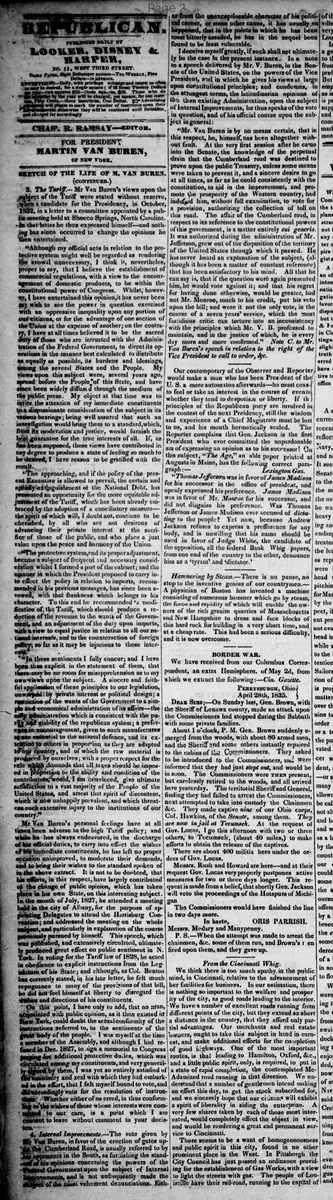
3. The Tariff.—Mr. Van Buren's views upon the subject of the Tariff were stated without reserve, when a candidate for the Presidency, in October, 1832, in a letter to a committee appointed by a public meeting held at Shocco Springs, North Carolina. In that letter he thus expressed himself—and nothing has since occurred to change the opinions he then entertained.
"Although my official acts in relation to the protective system might well be regarded as rendering the avowal unnecessary, I think it, nevertheless, proper to say, that I believe the establishment of commercial regulations, with a view to the encouragement of domestic products, to be within the constitutional power of Congress. Whilst, however, I have entertained this opinion, it has never been my wish to see the power in question exercised with an oppressive inequality upon any portion of our citizens, or for the advantage of one section of the Union at the expense of another; on the contrary, I have at all times believed it to be the sacred duty of those who are intrusted with the Administration of the Federal Government, to direct its operations in the manner best calculated to distribute as equally as possible, its burdens and blessings, among the several States and the People. My views upon this subject were, several years ago, spread before the People of this State, and have since been widely diffused through the medium of the public press. My object at that time was to invite the attention of my immediate constituents to a dispassionate consideration of the subject in its various bearings; being well assured that such an investigation would bring them to a standard, which, from its moderation and justice, would furnish the best guarantee for the true interests of all. If, as has been supposed, those views have contributed in any degree to produce a state of feeling so much to be desired, I have reason to be gratified with the result."
The approaching, and if the policy of the present Executive is allowed to prevail, the certain and speedy extinguishment of the National Debt, has presented an opportunity for the more equitable adjustment of the Tariff, which has been already embraced by the adoption of a conciliatory measure—the spirit of which will, I doubt not, continue to be cherished, by all who are not desirous of advancing their private interest at the sacrifice of those of the public, and who place a just value upon the peace and harmony of the Union.
The protective system, and its proper adjustment, became a subject of frequent and necessary consideration whilst I formed a part of the cabinet; and the manner in which the President proposed to carry into effect the policy in relation to imports, recommended in his previous messages, has since been avowed, with that frankness which belongs to his character. To this end he recommended 'a modification of the Tariff, which should produce a reduction of the revenue to the wants of the Government, and an adjustment of the duty upon imports, with a view to equal justice in relation to all our national interests, and to the counteraction of foreign policy, so far as it may be injurious to those interests.
"In these sentiments I fully concur; and I have been thus explicit in the statement of them, that there may be no room for misapprehension as to my own views upon the subject. A sincere and faithful application of these principles to our legislation, unwarped by private interest or political design; a restriction of the wants of the Government to a simple and economical administration of its affairs—the only administration which is consistent with the purity and stability of the republican system; a preference in encouragement, given to such manufactures as are essential to the national defence, and its extension to others in proportion as they are adapted to our country, and of which the raw material is produced by ourselves; with a proper respect for the rate which demands that all taxes should be imposed in proportion to the ability and condition of the contributors, would, I am convinced, give ultimate satisfaction to a vast majority of the People of the United States, and arrest that spirit of discontent, which is now unhappily prevalent, and which threatens such extensive injury to the institutions of our country."
Mr. Van Buren's personal feelings have at all times been adverse to the high Tariff policy; and while he has always endeavored, in the discharge of his official duties, to carry into effect the wishes of his immediate constituents, he has left no proper occasion unimproved, to moderate their demands, and to bring their wishes to the standard spoken of in the above extract. It is not to be doubted, that his efforts, in this respect, have largely contributed to the change of public opinion, which has taken place in his own State, on this interesting subject.
In the month of July, 1827, he attended a meeting held in the city of Albany, for the purpose of appointing Delegates to attend the Harrisburg Convention; and addressed the meeting on the whole subject, and particularly in explanation of the course previously pursued by himself. This speech, which was published, and extensively circulated, ultimately produced great effect on public sentiment in N. York. In voting for the Tariff law of 1828, he acted in obedience to explicit instructions from the Legislature of his State; and although, as Col. Benton has correctly stated, in his late letter, he felt much repugnance to many of the provisions of that bill, he did not feel himself at liberty to disregard the wishes and directions of his constituents.
On this point, I have only to add, that no man, acquainted with public opinion, as it then existed in New York, could doubt the actual conformity of the instructions referred to, to the sentiments of the great body of the people. I was myself at the time member of the Assembly, and although I had refused in Dec. 1827, to sign a memorial to Congress praying for additional protective duties, which was circulated among my constituents, and very generally used by them, I was yet so entirely satisfied of the unanimity and zeal with which they had embarked in the effort, that I felt myself bound to vote, and accordingly voted for the resolution of instructions. Whether either of us erred, in thus conforming to the wishes of those whose interests were committed to our care, is a point which I am content to leave without comment to your decision.
4. Internal Improvements.—The vote given by Van Buren, in favor of the erection of gates upon the Cumberland Road, is usually referred to by opponents in the South, as furnishing the standard of his opinions concerning the powers of the General Government upon the subject of Internal Improvements, and is not unfrequently made the subject of the most vehement denunciations. Either from the unexceptionable character of his political career, or some other cause, it has usually so happened, that in the points in which he has been most bitterly assailed, he has in the sequel been found to be least vulnerable. I deceive myself greatly, if such shall not ultimately be the case in the present instance. In a note to a speech delivered by Mr. Van Buren, in the Senate of the United States, on the powers of the Vice President, and in which he gives his views at large upon constitutional principles; and condemns, in the strongest terms, the latitudinarian opinions of the then existing Administration, upon the subject of Internal Improvements, he thus speaks of the vote in question, and of his official course upon the subject in general:
"Mr. Van Buren is by no means certain, that in this respect, he, himself, has been altogether without fault. At the very first session after he came into the Senate, the knowledge of the perpetual drain that the Cumberland road was destined to prove upon the public Treasury, unless some means were taken to prevent it, and a sincere desire to go at all times, as far as he could consistently with the constitution, to aid in the improvement, and promote the prosperity of the Western country, had induced him, without full examination, to vote for a provision, authorizing the collection of toll on this road. The affair of the Cumberland road, in respect to its reference to the constitutional powers of this government, is a matter entirely sui generis. It was authorized during the administration of Mr. Jefferson, grew out of the disposition of the territory of the United States through which it passed. He has never heard an explanation of the subject, (although it has been a matter of constant reference) that has been satisfactory to his mind. All that he can say is, that if the question were again presented to him, he would vote against it; and that his regret for having done otherwise, would be greater, had not Mr. Monroe, much to his credit, put his veto upon the bill; and were it not the only vote, in the course of a seven years' service, which the most fastidious critic can torture into an inconsistency with the principles which Mr. V. B. professed to maintain, and in the justice of which, he is every day more and more confirmed." Note C. to Mr. Van Buren's speech in relation to the right of the Vice President to call to order, &c.
Our contemporary of the Observer and Reporter would make a man who has been President of the U. S. a mere automaton afterwards he must cease to feel or take an interest in the course of events whether they tend to despotism or liberty. If the principles of the Republican party are involved in the contest of the next Presidency, still the wisdom and experience of a Chief Magistrate must be lost to us, and his mouth hermetically sealed. The Reporter complains that Gen. Jackson is the first President who ever committed the unpardonable sin of expressing an opinion as to his successor! On this subject, "The Age," an able paper printed at Augusta in Maine, has the following correct paragraph:
"Thomas Jefferson was in favor of James Madison for his successor in the office of president, and openly expressed his preference. James Madison was in favor of Mr. Monroe for his successor, and did not disguise his preference. Was Thomas Jefferson or James Madison ever accused of dictating to the people? Yet now, because Andrew Jackson refuses to express a preference for any body, and is unwilling that his name should be used in favor of Judge White, the candidate of the opposition, all the federal Bank Whig papers, from one end of the country to the other, denounce him as a 'tyrant' and 'dictator.'"
What sub-type of article is it?
What themes does it cover?
What keywords are associated?
What entities or persons were involved?
Where did it happen?
Story Details
Key Persons
Location
New York, North Carolina, United States
Event Date
October 1832
Story Details
Continuation of Van Buren's life sketch focusing on his balanced views on the Tariff, expressed in a 1832 letter advocating equitable protection without sectional bias, his moderation of New York's high tariff stance, and defense of his Internal Improvements vote on the Cumberland Road as a rare inconsistency later regretted, alongside commentary on Jackson's right to influence succession.