Thank you for visiting SNEWPapers!
Sign up free
Story
August 20, 1871
The Morning Star And Catholic Messenger
New Orleans, Orleans County, Louisiana
What is this article about?
A commentary on the declining observance of Sundays in Rome under the new reign, with shops open, government mandates, lectures at the university, and criticism of secular influences like Gavazzi's paper.
Clipping
OCR Quality
95%
Excellent
Full Text
Roman Sundays under the New Reign.
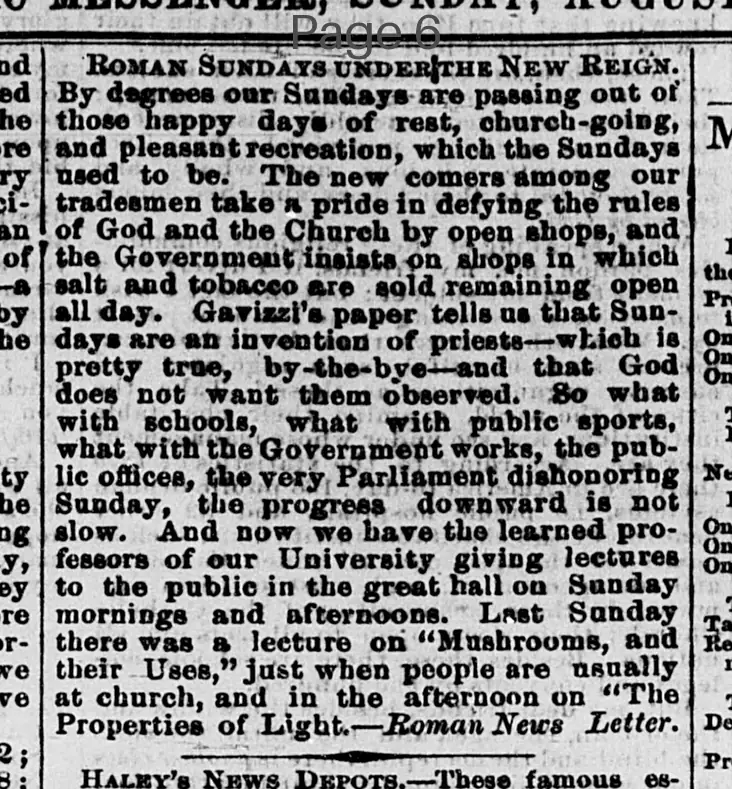
By degrees our Sundays are passing out of those happy days of rest, church-going, and pleasant recreation, which the Sundays used to be. The new comers among our tradesmen take a pride in defying the rules of God and the Church by open shops, and the Government insists on shops in which salt and tobacco are sold remaining open all day. Gavazzi's paper tells us that Sundays are an invention of priests--which is pretty true, by-the-bye and that God does not want them observed. So what with schools, what with public 'sports, what with the Government works, the public offices, the very Parliament dishonoring Sunday, the progress downward is not slow. And now we have the learned professors of our University giving lectures to the public in the great hall on Sunday mornings and afternoons. Last Sunday there was a lecture on "Mushrooms, and their Uses," just when people are usually at church, and in the afternoon on "The Properties of Light."
Roman News Letter.
By degrees our Sundays are passing out of those happy days of rest, church-going, and pleasant recreation, which the Sundays used to be. The new comers among our tradesmen take a pride in defying the rules of God and the Church by open shops, and the Government insists on shops in which salt and tobacco are sold remaining open all day. Gavazzi's paper tells us that Sundays are an invention of priests--which is pretty true, by-the-bye and that God does not want them observed. So what with schools, what with public 'sports, what with the Government works, the public offices, the very Parliament dishonoring Sunday, the progress downward is not slow. And now we have the learned professors of our University giving lectures to the public in the great hall on Sunday mornings and afternoons. Last Sunday there was a lecture on "Mushrooms, and their Uses," just when people are usually at church, and in the afternoon on "The Properties of Light."
Roman News Letter.
What sub-type of article is it?
Curiosity
What themes does it cover?
Social Manners
Moral Virtue
What keywords are associated?
Sunday Observance
Secularization
Rome
University Lectures
Government Policy
Gavazzi Paper
Where did it happen?
Rome
Story Details
Location
Rome
Event Date
Last Sunday
Story Details
Sundays in Rome are losing their traditional restful, church-centered character due to open shops, government policies, public activities, and university lectures on topics like mushrooms and light, amid criticism of secular views from Gavazzi's paper.