Thank you for visiting SNEWPapers!
Sign up free
Literary
September 25, 1850
The North Carolina Standard
Raleigh, Wake County, North Carolina
What is this article about?
A young Georges Cuvier witnesses swallows building a nest, usurped by sparrows, leading to the swallows' communal revenge by sealing the intruders inside. This event, along with later observations of the birds' life cycle and tragedy, inspires Cuvier's passion for natural history, launching his scientific career.
Clipping
OCR Quality
95%
Excellent
Full Text
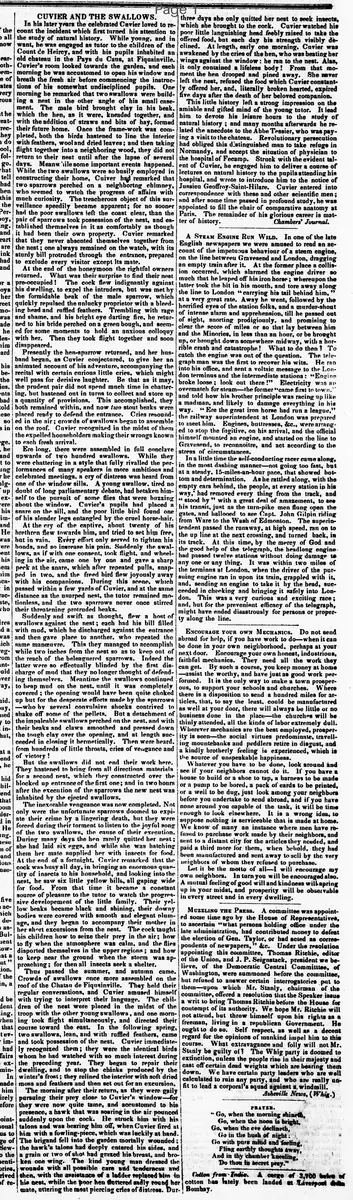
CUVIER AND THE SWALLOWS.
In his later years the celebrated Cuvier loved to recount the incident which first turned his attention to the study of natural history. While young, and in want, he was engaged as tutor to the children of the Count d'Hercy, and with his pupils inhabited an old chateau in the Pays du Caux, at Fiquainville. Cuvier's room looked towards the garden, and each morning he was accustomed to open his window and breathe the fresh air before commencing the instructions of his somewhat undisciplined pupils. One morning he remarked that two swallows were building a nest in the other angle of his small casement. The male bird brought clay in his beak, which the hen, as it were, kneaded together, and with the addition of straws and bits of hay, formed their future home. Once the frame-work was completed, both the birds hastened to line the interior with feathers, wool and dried leaves; and then taking flight together into a neighboring wood, they did not return to their nest until after the lapse of several days. Meanwhile some important events happened.
While the two swallows were so busily employed in constructing their home, Cuvier had remarked that two sparrows perched on a neighboring chimney, who seemed to watch the progress of affairs with much curiosity. The treacherous object of this surveillance speedily became apparent; for no sooner had the poor swallows left the coast clear, than the pair of sparrows took possession of the nest, and established themselves in it as comfortably as though it had been their own property. Cuvier remarked that they never absented themselves together from the nest; one always remained on the watch, with its sturdy bill protruded through the entrance, prepared to exclude every visitor except its mate.
At the end of the honeymoon the rightful owners returned. What was their surprise to find their nest pre-occupied! The cock flew indignantly against his dwelling, to expel the intruders, but was met by the formidable beak of the male sparrow, which quickly repulsed the unlucky proprietor with a bleeding head and ruffled feathers. Trembling with rage and shame, and his bright eye darting fire, he returned to his bride perched on a green bough, and seemed for some moments to hold an anxious colloquy with her. Then they took flight together and soon disappeared.
Presently the hen-sparrow returned, and her husband began, as Cuvier conjectured, to give her an animated account of his adventure, accompanying the recital with certain curious little cries, which might well pass for derisive laughter. Be that as it may, the prudent pair did not spend much time in chattering, but hastened out in turns to collect and store up a quantity of provisions. This accomplished, they both remained within, and now two stout beaks were placed ready to defend the entrance.
Cries resounded in the air; crowds of swallows began to assemble on the roof. Cuvier recognized in the midst of them the expelled householders making their wrongs known to each fresh arrival.
Ere long, there were assembled in full conclave upwards of two hundred swallows.
While they were chattering in a style that fully rivalled the performances of many speakers in more ambitious and celebrated meetings, a cry of distress was heard from one of the window sills. A young swallow, tired no doubt of long parliamentary debate, had betaken himself to the pursuit of some flies that were buzzing about the window. Cuvier's pupils had placed a snare on the sill, and the poor little bird found one of his slender legs entangled by the cruel horse-hair.
At the cry of the captive, about twenty of his brethren flew towards him, and tried to set him free, but in vain. Every effort only served to tighten his bonds, and so increase his pain. Suddenly the swallows, as if with one consent, took flight, and wheeling in the air, came one by one and gave a sharp peck at the snare, which after repeated pulls, snapped in two, and the freed bird flew joyously away with his companions. During this scene, which passed within a few yards of Cuvier, and at the same distance as the usurped nest, the tutor remained motionless, and the two sparrows never once stirred their threatening protruded beaks.
Suddenly and swift as thought, flew a host of swallows against the nest; each had his bill filled with mud, which he discharged against the entrance and then gave place to another, who repeated the same manoeuvre. This they managed to accomplish while two inches from the nest so as to keep out of the reach of the beleaguered sparrows. Indeed the latter were so effectually blinded by the first discharge of mud that they no longer thought of defending themselves. Meantime the swallows continued to heap mud on the nest, until it was completely covered; the opening would have been quite choked up but for the desperate efforts made by the sparrows—who by several convulsive shocks contrived to shake off some of the pellets. But a detachment of the implacable swallows perched on the nest, and with their beaks and claws smoothed and pressed down the tough clay over the opening, and at length succeeded in closing it hermetically. Then were heard, from hundreds of little throats, cries of vengeance and of victory!
But the swallows did not end their work here. They hastened to bring from all directions materials for a second nest, which they constructed over the blocked up entrance of the first one; and in two hours after the execution of the sparrows the new nest was inhabited by the ejected swallows.
The inexorable vengeance was now completed. Not only were the unfortunate sparrows doomed to expiate their crime by a lingering death, but they were forced during their torment to listen to the joyful song of the two swallows, the cause of their execution.
During many days the hen rarely quitted her nest; she had laid six eggs, and while she was hatching them her mate supplied her with insects for food.
At the end of a fortnight, Cuvier remarked that the cock was busy all day, in bringing an enormous quantity of insects to his household, and looking into the nest, he saw six little yellow bills, all gaping wide for food. From that time it became a constant source of pleasure to the tutor to watch the progressive development of the little family. Their yellow beaks became black and shining, their downy bodies were covered with smooth and elegant plumage, and they began to accompany their mother in her short excursions from the nest. The cock taught his children how to seize their prey in the air; how to fly when the atmosphere was calm, and the flies disported themselves in the upper regions; and how to keep near the ground when the storm was approaching; for then all insects seek a shelter.
Thus passed the summer, and autumn came. Crowds of swallows once more assembled on the roof of the Chateau de Fiquainville. They held their regular conversations, and Cuvier amused himself with trying to interpret their language. The children of the nest were placed in the midst of the troop with the other young swallows, and one morning took flight simultaneously, and directed their course toward the east. In the following spring, two swallows, lean, and with ruffled feathers, came and took possession of the nest. Cuvier immediately recognized them; they were the identical birds whom he had watched with so much interest during the preceding year. They began to repair their dwelling, and to stop the chinks produced by the winter's frost; they relined the interior with soft dried moss and feathers and then set out for an excursion.
The morning after their return, as they were gaily pursuing their prey close to Cuvier's window—for they were now quite tame, and accustomed to his presence, a hawk that was soaring in the air pounced suddenly upon the cock. He struck him with his talons and was bearing him off, when Cuvier fired at him with a fowling-piece, which was luckily at hand. The brigand fell into the garden mortally wounded; the hawk's talons had deeply entered his sides, and a grain or two of shot had grazed his breast, and broken one wing. The kind young man dressed the wounds with all possible care and tenderness and then, with the assistance of a ladder replaced him in his nest, while the poor hen fluttered sadly round her
three days she only quitted her nest to seek insects, which she brought to the cock. Cuvier watched his poor little languishing head feebly raised to take the offered food, but each day his strength visibly declined. At length, early one morning, Cuvier was awakened by the cries of the hen, who was beating her wings against the window: he ran to the nest. Alas, it only contained a lifeless body! From that moment the hen drooped and pined away. She never left the nest, refused the food which Cuvier constantly offered her, and, literally broken hearted, expired five days after the death of her beloved companion.
This little history left a strong impression on the amiable and gifted mind of the young tutor. It lead him to devote his leisure hours to the study of natural history; and many months afterwards he related the anecdote to the Abbe Haüy, who was paying a visit to the chateau. Revolutionary persecution had obliged this distinguished man to take refuge in Normandy, and accept the situation of physician to the hospital of Fecamp. Struck with the evident talent of Cuvier, he engaged him to deliver a course of lectures on natural history to the pupils attending his hospital, and wrote to introduce him to the notice of Jussieu, Geoffroy-Saint-Hilaire. Cuvier entered into correspondence with these and other scientific men; and after some time passed in profound study, he was appointed to fill the chair of comparative anatomy at Paris. The remainder of his glorious career is matter of history.
Chambers' Journal.
In his later years the celebrated Cuvier loved to recount the incident which first turned his attention to the study of natural history. While young, and in want, he was engaged as tutor to the children of the Count d'Hercy, and with his pupils inhabited an old chateau in the Pays du Caux, at Fiquainville. Cuvier's room looked towards the garden, and each morning he was accustomed to open his window and breathe the fresh air before commencing the instructions of his somewhat undisciplined pupils. One morning he remarked that two swallows were building a nest in the other angle of his small casement. The male bird brought clay in his beak, which the hen, as it were, kneaded together, and with the addition of straws and bits of hay, formed their future home. Once the frame-work was completed, both the birds hastened to line the interior with feathers, wool and dried leaves; and then taking flight together into a neighboring wood, they did not return to their nest until after the lapse of several days. Meanwhile some important events happened.
While the two swallows were so busily employed in constructing their home, Cuvier had remarked that two sparrows perched on a neighboring chimney, who seemed to watch the progress of affairs with much curiosity. The treacherous object of this surveillance speedily became apparent; for no sooner had the poor swallows left the coast clear, than the pair of sparrows took possession of the nest, and established themselves in it as comfortably as though it had been their own property. Cuvier remarked that they never absented themselves together from the nest; one always remained on the watch, with its sturdy bill protruded through the entrance, prepared to exclude every visitor except its mate.
At the end of the honeymoon the rightful owners returned. What was their surprise to find their nest pre-occupied! The cock flew indignantly against his dwelling, to expel the intruders, but was met by the formidable beak of the male sparrow, which quickly repulsed the unlucky proprietor with a bleeding head and ruffled feathers. Trembling with rage and shame, and his bright eye darting fire, he returned to his bride perched on a green bough, and seemed for some moments to hold an anxious colloquy with her. Then they took flight together and soon disappeared.
Presently the hen-sparrow returned, and her husband began, as Cuvier conjectured, to give her an animated account of his adventure, accompanying the recital with certain curious little cries, which might well pass for derisive laughter. Be that as it may, the prudent pair did not spend much time in chattering, but hastened out in turns to collect and store up a quantity of provisions. This accomplished, they both remained within, and now two stout beaks were placed ready to defend the entrance.
Cries resounded in the air; crowds of swallows began to assemble on the roof. Cuvier recognized in the midst of them the expelled householders making their wrongs known to each fresh arrival.
Ere long, there were assembled in full conclave upwards of two hundred swallows.
While they were chattering in a style that fully rivalled the performances of many speakers in more ambitious and celebrated meetings, a cry of distress was heard from one of the window sills. A young swallow, tired no doubt of long parliamentary debate, had betaken himself to the pursuit of some flies that were buzzing about the window. Cuvier's pupils had placed a snare on the sill, and the poor little bird found one of his slender legs entangled by the cruel horse-hair.
At the cry of the captive, about twenty of his brethren flew towards him, and tried to set him free, but in vain. Every effort only served to tighten his bonds, and so increase his pain. Suddenly the swallows, as if with one consent, took flight, and wheeling in the air, came one by one and gave a sharp peck at the snare, which after repeated pulls, snapped in two, and the freed bird flew joyously away with his companions. During this scene, which passed within a few yards of Cuvier, and at the same distance as the usurped nest, the tutor remained motionless, and the two sparrows never once stirred their threatening protruded beaks.
Suddenly and swift as thought, flew a host of swallows against the nest; each had his bill filled with mud, which he discharged against the entrance and then gave place to another, who repeated the same manoeuvre. This they managed to accomplish while two inches from the nest so as to keep out of the reach of the beleaguered sparrows. Indeed the latter were so effectually blinded by the first discharge of mud that they no longer thought of defending themselves. Meantime the swallows continued to heap mud on the nest, until it was completely covered; the opening would have been quite choked up but for the desperate efforts made by the sparrows—who by several convulsive shocks contrived to shake off some of the pellets. But a detachment of the implacable swallows perched on the nest, and with their beaks and claws smoothed and pressed down the tough clay over the opening, and at length succeeded in closing it hermetically. Then were heard, from hundreds of little throats, cries of vengeance and of victory!
But the swallows did not end their work here. They hastened to bring from all directions materials for a second nest, which they constructed over the blocked up entrance of the first one; and in two hours after the execution of the sparrows the new nest was inhabited by the ejected swallows.
The inexorable vengeance was now completed. Not only were the unfortunate sparrows doomed to expiate their crime by a lingering death, but they were forced during their torment to listen to the joyful song of the two swallows, the cause of their execution.
During many days the hen rarely quitted her nest; she had laid six eggs, and while she was hatching them her mate supplied her with insects for food.
At the end of a fortnight, Cuvier remarked that the cock was busy all day, in bringing an enormous quantity of insects to his household, and looking into the nest, he saw six little yellow bills, all gaping wide for food. From that time it became a constant source of pleasure to the tutor to watch the progressive development of the little family. Their yellow beaks became black and shining, their downy bodies were covered with smooth and elegant plumage, and they began to accompany their mother in her short excursions from the nest. The cock taught his children how to seize their prey in the air; how to fly when the atmosphere was calm, and the flies disported themselves in the upper regions; and how to keep near the ground when the storm was approaching; for then all insects seek a shelter.
Thus passed the summer, and autumn came. Crowds of swallows once more assembled on the roof of the Chateau de Fiquainville. They held their regular conversations, and Cuvier amused himself with trying to interpret their language. The children of the nest were placed in the midst of the troop with the other young swallows, and one morning took flight simultaneously, and directed their course toward the east. In the following spring, two swallows, lean, and with ruffled feathers, came and took possession of the nest. Cuvier immediately recognized them; they were the identical birds whom he had watched with so much interest during the preceding year. They began to repair their dwelling, and to stop the chinks produced by the winter's frost; they relined the interior with soft dried moss and feathers and then set out for an excursion.
The morning after their return, as they were gaily pursuing their prey close to Cuvier's window—for they were now quite tame, and accustomed to his presence, a hawk that was soaring in the air pounced suddenly upon the cock. He struck him with his talons and was bearing him off, when Cuvier fired at him with a fowling-piece, which was luckily at hand. The brigand fell into the garden mortally wounded; the hawk's talons had deeply entered his sides, and a grain or two of shot had grazed his breast, and broken one wing. The kind young man dressed the wounds with all possible care and tenderness and then, with the assistance of a ladder replaced him in his nest, while the poor hen fluttered sadly round her
three days she only quitted her nest to seek insects, which she brought to the cock. Cuvier watched his poor little languishing head feebly raised to take the offered food, but each day his strength visibly declined. At length, early one morning, Cuvier was awakened by the cries of the hen, who was beating her wings against the window: he ran to the nest. Alas, it only contained a lifeless body! From that moment the hen drooped and pined away. She never left the nest, refused the food which Cuvier constantly offered her, and, literally broken hearted, expired five days after the death of her beloved companion.
This little history left a strong impression on the amiable and gifted mind of the young tutor. It lead him to devote his leisure hours to the study of natural history; and many months afterwards he related the anecdote to the Abbe Haüy, who was paying a visit to the chateau. Revolutionary persecution had obliged this distinguished man to take refuge in Normandy, and accept the situation of physician to the hospital of Fecamp. Struck with the evident talent of Cuvier, he engaged him to deliver a course of lectures on natural history to the pupils attending his hospital, and wrote to introduce him to the notice of Jussieu, Geoffroy-Saint-Hilaire. Cuvier entered into correspondence with these and other scientific men; and after some time passed in profound study, he was appointed to fill the chair of comparative anatomy at Paris. The remainder of his glorious career is matter of history.
Chambers' Journal.
What sub-type of article is it?
Prose Fiction
What themes does it cover?
Nature
Moral Virtue
What keywords are associated?
Cuvier
Swallows
Sparrows
Natural History
Bird Nest
Vengeance
Biography
What entities or persons were involved?
Chambers' Journal
Literary Details
Title
Cuvier And The Swallows.
Author
Chambers' Journal
Subject
The Incident Which First Turned Cuvier's Attention To The Study Of Natural History
Form / Style
Biographical Anecdote In Narrative Prose
Key Lines
The Inexorable Vengeance Was Now Completed. Not Only Were The Unfortunate Sparrows Doomed To Expiate Their Crime By A Lingering Death, But They Were Forced During Their Torment To Listen To The Joyful Song Of The Two Swallows, The Cause Of Their Execution.
This Little History Left A Strong Impression On The Amiable And Gifted Mind Of The Young Tutor. It Lead Him To Devote His Leisure Hours To The Study Of Natural History;
Cuvier Entered Into Correspondence With These And Other Scientific Men; And After Some Time Passed In Profound Study, He Was Appointed To Fill The Chair Of Comparative Anatomy At Paris.