Thank you for visiting SNEWPapers!
Sign up free
The Newport Gazette
Newport, Newport County, Rhode Island
What is this article about?
On November 1, in the House of Lords, the Earl of Carlisle moved an address to the King supporting measures against American independence, praising British forces and condemning Congress. Debate ensued with opposition from Lords Rockingham and Richmond advocating reconciliation. Lord Sandwich defended naval preparations. The address passed 62-26, majority 66.
Clipping
OCR Quality
Full Text
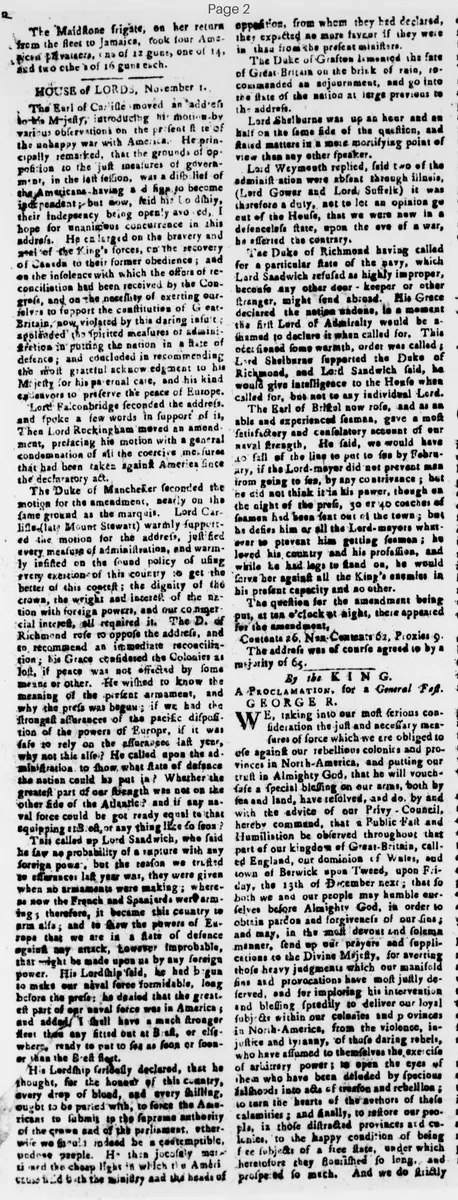
The Earl of Carlisle moved an address to his Majesty; introducing his motion by various observations on the present state of the unhappy war with America. He principally remarked, that the grounds of opposition to the just measures of government, in the last session, was a disbelief of the Americans having a design to become independent;—but now, said his Lordship, the Americans having avowed their independency openly, he hoped for unanimous concurrence in this address. He enlarged on the bravery and zeal of the King's forces, on the recovery of Canada to their former obedience; and on the insolence with which the offers of reconciliation had been received by the Congress, to support the constitution of Great Britain, now violated by this daring insult; applauded the spirited measures of administration in putting the nation in a state of defence; and concluded in recommending the most grateful acknowledgments to his Majesty for his personal care, and his kind endeavours to preserve the peace of Europe.
Lord Falconbridge seconded the address, and spoke a few words in support of it.
Then Lord Rockingham moved an amendment, prefacing his motion with a general condemnation of all the coercive measures that had been taken against America since the declaratory act.
The Duke of Manchester seconded the motion for the amendment, nearly on the same ground as the marquis. Lord Carmarthen (late Mount Stewart) warmly supported the motion for the address, justified every measure of administration, and warmly insisted on the sound policy of using every exertion of this country to get the better of this contest; the dignity of the crown, the weight and interest of the nation with foreign powers, and our commercial interest, all required it. The Duke of Richmond rose to oppose the address, and to recommend an immediate reconciliation; his Grace considered the Colonies as lost, if peace was not offered by some means or other.—He wished to know the meaning of the present armament, and why the press was begun: if we had the strongest assurances of the pacific disposition of the powers of Europe. if it was safe to rely on the assurances last year, why not this also? He called upon the administration to show, what state of defence the nation could be put in? Whether the greater part of our strength was not on the other side of the Atlantic:? and if any naval force could be got ready equal to that equipping at Brest, or anything like so strong?
This called up Lord Sandwich, who said he saw no probability of a rupture with any foreign power; but the reason we trusted to assurances last year was, they were given when no armaments were making; whereas now the French and Spaniards were arming therefore, it became this country to arm also: and to show the powers of Europe that we are in a state of defence against any attack, however improbable, that might be made upon us by any foreign power. His Lordship said, he had begun to make our naval force formidable, long before the present: he denied that the greatest part of our naval force was in America; and added, I shall have a much stronger fleet than any fitted out at Brest, or elsewhere, ready to put to sea as soon as the East Fleet.
His Lordship seriously declared, that he thought, for the honour of this country, every drop of blood, and every shilling, ought to be spared with: to force the Americans to submit to the supreme authority of the crown and of the parliament, otherwise we should indeed be contemptible, perverse people. He then jocosely mentioned the cheap light in which the American Congress had put both the ministry and his Lordship.
Opposition, from whom they had declared, they expected no more favour if they were in the unfortunate present ministry.
The Duke of Grafton lamented the fate of Great-Britain on the brink of ruin, recommended an adjournment, and go into the state of the nation at large previous to the address.
Lord Shelburne was up an hour and an half on the same side of the question, and stated matters in a more glorifying point of view than any other speaker.
Lord Weymouth replied, said two of the administration were absent through illness, (Lord Gower and Lord Suffolk) it was therefore a duty, not to let an opinion go out of the House, that we were now in a defenceless state, on the eve of a war, but asserted the contrary.
The Duke of Richmond having called for a particular state of the navy, which Lord Sandwich refused as highly improper, because any other door-keeper or other stranger, might send abroad. His Grace declared the notion ill-founded, so a moment the first Lord of Admiralty would be ashamed to declare it when called for. This occasioned some warmth, order was called: Lord Shelburne supported the Duke of Richmond, and Lord Sandwich said, he would give intelligence to the House when called for, but not to any individual Lord.
The Earl of Bristol now rose, and as an able and experienced seaman, gave a most satisfactory and consolatory account of our naval strength, He said, we would have 40 sail of the line to put to sea by February, if the Lord-mayor did not prevent men going to sea, by any contrivance; but he did not think it in his power, though on the sight of the press, 30 or 40 coaches of seamen had been sent out of the town; but he defies him or all the Lord-mayors whatever to prevent his getting seamen; he loved his country and his profession, and while he had legs to stand on, he would serve her against all the King's enemies in his present capacity and no other.
The question for the amendment being put, at ten o'clock at night, there appeared for the amendment, Contents 26. Not Contents 62, Proxies 9. The address was of course agreed to by a majority of 66.
What sub-type of article is it?
What keywords are associated?
What entities or persons were involved?
Where did it happen?
Domestic News Details
Primary Location
House Of Lords
Event Date
November 1
Key Persons
Outcome
the address was agreed to by a majority of 66 (62-26, with 9 proxies).
Event Details
The Earl of Carlisle moved an address to the King supporting measures against American independence, highlighting British forces' bravery, Canada's recovery, and Congress's insolence. Lord Rockingham proposed an amendment condemning coercive measures. Debate covered reconciliation, national defense, naval strength, and European assurances. Lord Sandwich defended armaments. The amendment was defeated.