Thank you for visiting SNEWPapers!
Sign up free
Story
February 12, 1885
The Manitowoc Pilot
Manitowoc, Manitowoc County, Wisconsin
What is this article about?
Retelling of the 1605 Gunpowder Plot in London, where conspirators led by Robert Catesby and Guy Fawkes planned to blow up King James I and Parliament with gunpowder, but the plot was foiled by an anonymous warning, leading to arrests and executions.
Clipping
OCR Quality
98%
Excellent
Full Text
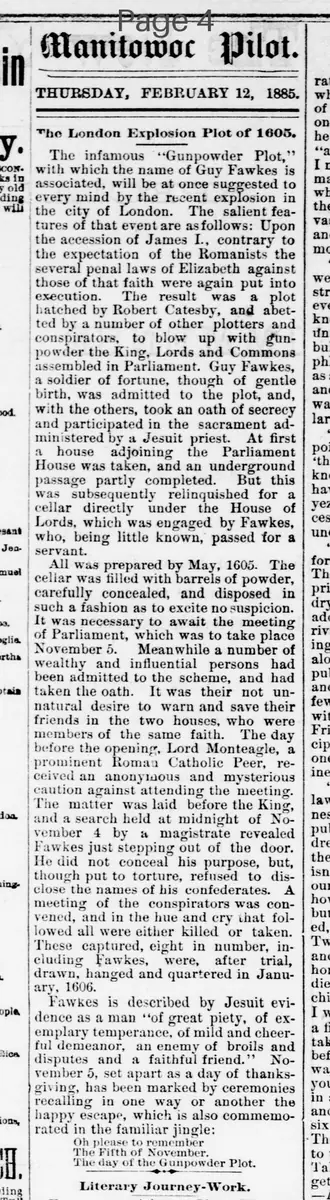
Manitowoc Pilot.
THURSDAY. FEBRUARY 12. 1885.
The London Explosion Plot of 1605.
The infamous "Gunpowder Plot," with which the name of Guy Fawkes is associated, will be at once suggested to every mind by the recent explosion in the city of London. The salient features of that event are as follows: Upon the accession of James I., contrary to the expectation of the Romanists the several penal laws of Elizabeth against those of that faith were again put into execution. The result was a plot hatched by Robert Catesby, and abetted by a number of other plotters and conspirators, to blow up with gunpowder the King, Lords and Commons assembled in Parliament. Guy Fawkes, a soldier of fortune, though of gentle birth, was admitted to the plot, and, with the others, took an oath of secrecy and participated in the sacrament administered by a Jesuit priest. At first a house adjoining the Parliament House was taken, and an underground passage partly completed. But this was subsequently relinquished for a cellar directly under the House of Lords, which was engaged by Fawkes, who, being little known, passed for a servant.
All was prepared by May, 1605. The cellar was filled with barrels of powder, carefully concealed, and disposed in such a fashion as to excite no suspicion. It was necessary to await the meeting of Parliament, which was to take place November 5. Meanwhile a number of wealthy and influential persons had been admitted to the scheme, and had taken the oath. It was their not unnatural desire to warn and save their friends in the two houses, who were members of the same faith. The day before the opening, Lord Monteagle, a prominent Roman Catholic Peer, received an anonymous and mysterious caution against attending the meeting. The matter was laid before the King, and a search held at midnight of November 4 by a magistrate revealed Fawkes just stepping out of the door. He did not conceal his purpose, but, though put to torture, refused to disclose the names of his confederates. A meeting of the conspirators was convened, and in the hue and cry that followed all were either killed or taken. These captured, eight in number, including Fawkes, were, after trial, drawn, hanged and quartered in January, 1606.
Fawkes is described by Jesuit evidence as a man "of great piety, of exemplary temperance, of mild and cheerful demeanor, an enemy of broils and disputes and a faithful friend." November 5, set apart as a day of thanksgiving, has been marked by ceremonies recalling in one way or another the happy escape, which is also commemorated in the familiar jingle:
Oh please to remember
The Fifth of November.
The day of the Gunpowder Plot.
THURSDAY. FEBRUARY 12. 1885.
The London Explosion Plot of 1605.
The infamous "Gunpowder Plot," with which the name of Guy Fawkes is associated, will be at once suggested to every mind by the recent explosion in the city of London. The salient features of that event are as follows: Upon the accession of James I., contrary to the expectation of the Romanists the several penal laws of Elizabeth against those of that faith were again put into execution. The result was a plot hatched by Robert Catesby, and abetted by a number of other plotters and conspirators, to blow up with gunpowder the King, Lords and Commons assembled in Parliament. Guy Fawkes, a soldier of fortune, though of gentle birth, was admitted to the plot, and, with the others, took an oath of secrecy and participated in the sacrament administered by a Jesuit priest. At first a house adjoining the Parliament House was taken, and an underground passage partly completed. But this was subsequently relinquished for a cellar directly under the House of Lords, which was engaged by Fawkes, who, being little known, passed for a servant.
All was prepared by May, 1605. The cellar was filled with barrels of powder, carefully concealed, and disposed in such a fashion as to excite no suspicion. It was necessary to await the meeting of Parliament, which was to take place November 5. Meanwhile a number of wealthy and influential persons had been admitted to the scheme, and had taken the oath. It was their not unnatural desire to warn and save their friends in the two houses, who were members of the same faith. The day before the opening, Lord Monteagle, a prominent Roman Catholic Peer, received an anonymous and mysterious caution against attending the meeting. The matter was laid before the King, and a search held at midnight of November 4 by a magistrate revealed Fawkes just stepping out of the door. He did not conceal his purpose, but, though put to torture, refused to disclose the names of his confederates. A meeting of the conspirators was convened, and in the hue and cry that followed all were either killed or taken. These captured, eight in number, including Fawkes, were, after trial, drawn, hanged and quartered in January, 1606.
Fawkes is described by Jesuit evidence as a man "of great piety, of exemplary temperance, of mild and cheerful demeanor, an enemy of broils and disputes and a faithful friend." November 5, set apart as a day of thanksgiving, has been marked by ceremonies recalling in one way or another the happy escape, which is also commemorated in the familiar jingle:
Oh please to remember
The Fifth of November.
The day of the Gunpowder Plot.
What sub-type of article is it?
Historical Event
Crime Story
What themes does it cover?
Crime Punishment
Justice
What keywords are associated?
Gunpowder Plot
Guy Fawkes
Conspiracy
Parliament
Execution
James I
What entities or persons were involved?
Guy Fawkes
Robert Catesby
James I.
Lord Monteagle
Where did it happen?
London, Parliament House
Story Details
Key Persons
Guy Fawkes
Robert Catesby
James I.
Lord Monteagle
Location
London, Parliament House
Event Date
1605, November 5
Story Details
Conspirators plotted to blow up King James I and Parliament with gunpowder hidden in a cellar under the House of Lords. Fawkes was caught during a search prompted by an anonymous letter to Lord Monteagle. The plot was foiled, leading to the capture, trial, and execution of the conspirators in 1606.