Thank you for visiting SNEWPapers!
Sign up free
Literary
December 9, 1841
Lincoln Telegraph
Bath, Sagadahoc County, Maine
What is this article about?
A moral tale of Lord Frederick Flauntington and his wife Julia, who neglect each other after their honeymoon amid fashionable society. Frederick falls for Miss Bijouton, but Julia, with her aid, cleverly exposes and reforms him, restoring marital happiness.
Clipping
OCR Quality
95%
Excellent
Full Text
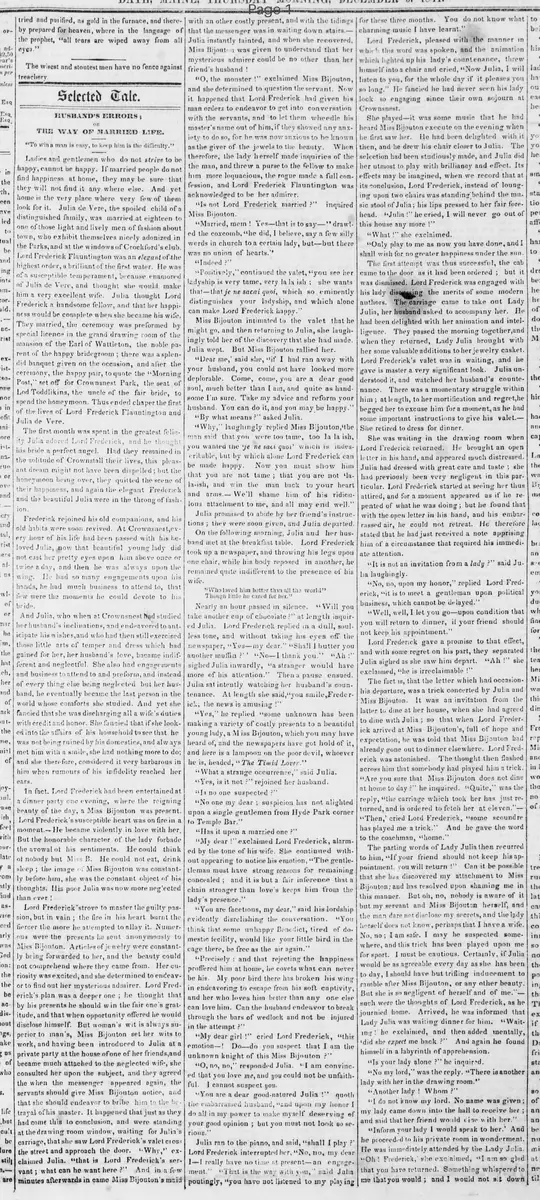
Selected Tale.
HUSBAND'S ERRORS;
ON
THE WAY OF MARRIED LIFE.
"To win a man is easy, to keep him is the difficulty."
Ladies and gentlemen who do not strive to be happy, cannot be happy. If married people do not find happiness at home, they may be sure that they will not find it anywhere else. And yet home is the very place where very few of them look for it. Julia de Vere, the spoiled child of a distinguished family, was married at eighteen to one of those light and lively men of fashion about town, who exhibit themselves nicely adonized in the Parks, and at the windows of Crockford's club. Lord Frederick Flauntington was an elegant of the highest order, a brilliant of the first water. He was of a susceptible temperament, because enamored of Julia de Vere, and thought she would make him a very excellent wife. Julia thought Lord Frederick a handsome fellow, and that her happiness would be complete when she became his wife.
They married, the ceremony was performed by special licence in the grand drawing room of the mansion of the Earl of Wattierton, the noble parent of the happy bridegroom; there was a splendid banquet given on the occasion, and after the ceremony, the happy pair, to quote the "Morning Post," set off for Crownsnest Park, the seat of Lord Toddlikins, the uncle of the fair bride, to spend the honeymoon. Thus ended chapter the first of the lives of Lord Frederick Flauntington and Julia de Vere.
The first month was spent in the greatest felicity. Julia adored Lord Frederick, and he thought his bride a perfect angel. Had they remained in the solitude of Crownsnest their lives, this pleasant dream might not have been dispelled; but the honeymoon being over, they quitted the scene of their happiness, and again the elegant Frederick and the beautiful Julia were in the throng of fashion.
Frederick rejoined his old companions, and his old habits were soon revived. At Crownsnest, every hour of his life had been passed with his beloved Julia, now that beautiful young lady did not cast her pretty eyes upon him above once or twice a day, and then he was always upon the wing. He had so many engagements upon his hands, he had much business to attend to, that few were the moments he could devote to his bride.
And Julia, who when at Crownsnest had studied her husband's inclinations, and endeavored to anticipate his wishes, and who had then still exercised those little arts of temper and dress which had gained for her, her husband's love, became indifferent and neglectful. She also had engagements and business to attend to and perform, and instead of every thing else being neglected but her husband, he eventually became the last person in the world whose comforts she studied. And yet she fancied that she was discharging all a wife's duties with credit and honor. She fancied that if she looked into the affairs of his household to see that he was not being ruined by his domestics, and always met him with a smile, she had nothing more to do; and she therefore, considered it very barbarous in him when rumours of his infidelity reached her ears.
In fact, Lord Frederick had been entertained at a dinner party one evening, where the reigning beauty of the day, a Miss Bijouton was present. Lord Frederick's susceptible heart was on fire in a moment.—He became violently in love with her. But the honorable character of the lady forbade the avowal of his sentiments. He could think of nobody but Miss B. He could not eat, drink, sleep; the image of Miss Bijouton was constantly before him, she was the constant object of his thoughts. His poor Julia was now more neglected than ever!
Lord Frederick strove to master the guilty passion, but in vain: the fire in his heart burnt the fiercer the more he attempted to allay it. Numerous were the presents he sent anonymously to Miss Bijouton. Articles of jewelry were constantly being forwarded to her, and the beauty could not comprehend where they came from. Her curiosity was excited, and she determined to endeavor to find out her mysterious admirer. Lord Frederick's plan was a deeper one; he thought that by his presents he should win the fair one's gratitude, and that when opportunity offered he would disclose himself. But woman's wit is always superior to man's, Miss Bijouton set her wits to work, and having been introduced to Julia at a private party at the house of one of her friends, and became much attached to the neglected wife, she consulted her upon the subject, and they agreed that when the messenger appeared again, the servants should give Miss Bijouton notice, and that she should endeavor to bribe him to the betrayal of his master. It happened that just as they had come to this conclusion, and were standing at the drawing room window, waiting for Julia's carriage, that she saw Lord Frederick's valet cross the street and approach the door. "Why," exclaimed Julia, "that is Lord Frederick's servant; what can he want here?" And in a few minutes afterwards in came Miss Bijouton's maid with another costly present, and with the tidings that the messenger was in waiting down stairs.—
Julia instantly fainted, and when she recovered, Miss Bijouton was given to understand that her mysterious admirer could be no other than her friend's husband!
"O, the monster!" exclaimed Miss Bijouton, and she determined to question the servant. Now it happened that Lord Frederick had given his man orders to endeavor to get into conversation with the servants, and to let them wheedle his master's name out of him, if they showed any anxiety to do so, for he was now anxious to be known as the giver of the jewels to the beauty. When therefore, the lady herself made inquiries of the man, and threw a purse to the fellow to make him more loquacious, the rogue made a full confession, and Lord Frederick Flauntington was acknowledged to be her admirer.
"Is not Lord Frederick married?" inquired Miss Bijouton.
"Married, mem! Yes—that is to say "drawled the coxcomb, "he did, I believe, say a few silly words in church to a certain lady, but—but there was no union of hearts."
"Indeed?"
"Positively," continued the valet, "you see her ladyship is very tame, very la la ish; she wants that—that je ne sais quoi, which so eminently distinguishes your ladyship, and which alone can make Lord Frederick happy."
Miss Bijouton intimated to the valet that he might go, and then returning to Julia, she laughingly told her of the discovery that she had made. Julia wept. But Miss Bijouton rallied her.
"Dear me," said she, "if I had run away with your husband, you could not have looked more deplorable. Come, come, you are a dear good soul, much better than I am, and quite as handsome I'm sure. Take my advice and reform your husband. You can do it, and you may be happy."
"By what means?" asked Julia.
"Why," laughingly replied Miss Bijouton, the man said that you were too tame, too la la ish, you wanted the je ne sais quoi which is indescribable, but by which alone Lord Frederick can be made happy. Now you must show him that you are not tame; that you are not 'la-la-ish, and win the man back to your heart and arms.—We'll shame him of his ridiculous attachment to me, and all may end well."
Julia promised to abide by her friend's instructions; they were soon given, and Julia departed.
On the following morning, Julia and her husband met at the breakfast table. Lord Frederick took up a newspaper, and throwing his legs upon one chair, while his body reposed in another, he remained quite indifferent to the presence of his wife.
"Who loved him better than all the world's
Though little he cared for her."
Nearly an hour passed in silence. "Will you take another cup of chocolate?" at length inquired Julia. Lord Frederick replied in a dull, soulless tone, and without taking his eyes off the newspaper, "Yes—my dear." "Shall I butter you another muffin?" "No—I thank you." "Ah!" sighed Julia inwardly, "a stranger would have more of his attention." Then a pause ensued. Julia sat intently watching her husband's countenance. At length she said "you smile, Frederick, the news is amusing!"
"Yes," he replied "some unknown has been making a variety of costly presents to a beautiful young lady, a Miss Bijouton, which you may have heard of, and the newspapers have got hold of it, and here is a lampoon on the poor devil, whoever he is, headed, "The Timid Lover."
"What a strange occurrence," said Julia.
"Yes, is it not?" rejoined her husband.
"Is no one suspected?"
"No one my dear; suspicion has not alighted upon a single gentleman from Hyde Park corner to Temple Bar."
"Has it upon a married one?"
"My dear!" exclaimed Lord Frederick, alarmed by the tone of his wife. She continued without appearing to notice his emotion, "The gentleman must have strong reasons for remaining concealed; and it is but a fair inference that a chain stronger than love's keeps him from the lady's presence."
"You are facetious, my dear," said his lordship evidently disrelishing the conversation. "You think that some unhappy Benedict, tired of domestic felicity, would like your little bird in the cage there, be free as the air again."
"Precisely: and that rejecting the happiness proffered him at home, he covets what can never be his. My poor bird there has broken his wing in endeavoring to escape from his soft captivity, and her who loves him better than any one else can love him. Can the husband endeavor to break through the bars of wedlock and not be injured in the attempt?"
"My dear girl!" cried Lord Frederick, "this emotion—! Do—do you suspect that I am the unknown knight of this Miss Bijouton?"
"O, no, no," responded Julia. "I am convinced that you love me, and you could not be unfaithful. I cannot suspect you."
"You are a dear good-natured Julia!" quoth the embarrassed husband, "and upon my honor I do all in my power to make myself deserving of your good opinion; but you must not look so serious."
Julia ran to the piano, and said, "shall I play?"
Lord Frederick interrupted her, "No, no, my dear I— I really have no time at present—an engagement." "That is the way with you," said Julia poutingly, "you have not listened to my playing for these three months. You do not know what charming music I have learnt."
Lord Frederick, pleased with the manner in which this word was spoken, and the animation which lighted up his lady's countenance, threw himself into a chair and cried. "Now Julia. I will listen to you, for the whole day if it pleases you so long." He fancied he had never seen his lady look so engaging since their own sojourn at Crownsnest.
She played—it was some music that he had heard Miss Bijouton execute on the evening when he first saw her. He had been delighted with it then, and he drew his chair closer to Julia. The selection had been studiously made, and Julia did her utmost to play with brilliancy and effect. Its effects may be imagined, when we record that at its conclusion, Lord Frederick, instead of lounging upon two chairs was standing behind the music stool of Julia; his lips pressed to her fair forehead. "Julia!" he cried, I will never go out of this house any more!"
"What!" she exclaimed.
"Only play to me as now you have done, and I shall wish for no greater happiness under the sun.
The first attempt was thus successful, the cab came to the door as it had been ordered; but it was dismissed. Lord Frederick was engaged with his lady discussing the merits of some modern authors. The carriage came to take out Lady Julia, her husband asked to accompany her. He had been delighted with her animation and intelligence. They passed the morning together, and when they returned, Lady Julia brought with her some valuable additions to her jewelry casket.
Lord Frederick's valet was in waiting, and he gave his master a very significant look. Julia understood it, and watched her husband's countenance. There was a momentary struggle within him; at length, to her mortification and regret, he begged her to excuse him for a moment, as he had some important instructions to give his valet.—
She retired to dress for dinner.
She was waiting in the drawing room when Lord Frederick returned. He brought an open letter in his hand, and appeared much distressed.
Julia had dressed with great care and taste; she had previously been very negligent in this particular. Lord Frederick started at seeing her thus attired, and for a moment appeared as if he repented of what he was doing; but he found that with the open letter in his hand, and his embarrassed air, he could not retreat. He therefore stated that he had just received a note apprising him of a circumstance that required his immediate attention.
"It is not an invitation from a lady?" said Julia laughingly.
"No, no, upon my honor," replied Lord Frederick, "it is to meet a gentleman upon political business, which cannot be delayed."
"Well, well, I let you go—upon condition that you will return to dinner, if your friend should not keep his appointment."
Lord Frederick gave a promise to that effect, and with some regret on his part, they separated.
Julia sighed as she saw him depart. "Ah!" she exclaimed, "he is irreclaimable!"
The fact is, that the letter which had occasioned his departure, was a trick concerted by Julia and Miss Bijouton. It was an invitation from the latter to dine at her house, when she had agreed to dine with Julia; so that when Lord Frederick arrived at Miss Bijouton's, full of hope and expectation, he was told that Miss Bijouton had already gone out to dinner elsewhere. Lord Frederick was astonished. The thought then flashed across him that somebody had played him a trick.
"Are you sure that Miss Bijouton does not dine at home to day?" he inquired. "Quite," was the reply, "the carriage which took her has just returned, and is ordered to fetch her at eleven.—"
"Then," cried Lord Frederick, "some scoundrel has played me a trick." And he gave the word to the coachman, "home."
The parting words of Lady Julia then recurred to him, "If your friend should not keep his appointment, you will return!" Can it be possible that she has discovered my attachment to Miss Bijouton; and has resolved upon shaming me in this manner. But oh, no, nobody is aware of it but my servant and Miss Bijouton herself, and the man dare not disclose my secrets, and the lady herself does not know, perhaps that I have a wife. No, no; I am safe. I may be suspected somewhere, and this trick has been played upon me for sport. I must be cautious. Certainly, if Julia would be as agreeable every day as she has been to day, I should have but trifling inducement to ramble after Miss Bijouton, or any other beauty. But she is so negligent of herself and of me.— such were the thoughts of Lord Frederick, as he journeyed home. Arrived, he was informed that Lady Julia was waiting dinner for him. "Waiting! he exclaimed, and then added mentally, 'did she expect me back?' And again he found himself in a labyrinth of apprehension.
"Is your lady alone?" he inquired.
"No my lord," was the reply. "There is another lady with her in the drawing room."
"Another lady! Whom?"
"I do not know my lord. No name was given; my lady came down into the hall to receive her; and said that her friend would dine with her."
"Inform your lady I would speak to her." And he proceeded to his private room in wonderment.
He was immediately attended by the Lady Julia.
"Oh! Frederick, she exclaimed, "I am so glad that you have returned. Something whispered to me that you would; and I would not sit down to dinner while there remained a prospect of your being here."
"Who is it that you have with you?" inquired his lordship.
"O, such a dear delightful friend of mine, A lady whom I met one evening at my cousin's; we have formed an intimacy; our tempers, our tastes our dispositions, are very similar, we are much in each other's company. You will be delighted with her."
"What is her name?"
"Nay, that I will not tell you. I will introduce you. You may never have heard of her. But you must not suffer her bright eyes to lure your heart from me."
"O, impossible!" said Lord Frederick with a smile.
"Well, well, I believe you. You are so constant, so good, so honorable, so kind, so conscientious, so just, that had a woman all the beauty and perfection of an angel, she would not move your affection from your Julia."
"Be assured, she would not," and pressing the hand of Julia to his lips, he asked to be introduced to her friend.
"Mind," said Julia, as they proceeded to the drawing room, "if you should have seen the lady before, you must not blame me for introducing her to you as a stranger, for I am sure I never heard you say you had the slightest knowledge of her," and then pushing open the drawing room door, she continued, "Lord Frederick, let me have the pleasure of introducing you to my dear friend Miss Bijouton!"
"Miss Bijouton!" exclaimed Lord Frederick.
A formal introduction took place.
"O," observed Miss Bijouton, "I have already had the pleasure of meeting his lordship."
"Indeed!" said Lady Julia. "I have understood him to say that he had never seen you."
"O—that is—," observed Lord Frederick—"I have had the honor of meeting Miss Bijouton but once, and that was so trifling an event that it perfectly escaped my recollection."
"Do you like this diamond necklace?" inquired Lady Julia, calling Lord Frederick's attention to the one she wore. Lord Frederick was amazed; it was the one which he had recently sent to Miss Bijouton, Endeavoring to conceal his embarrassment, he replied, "Y-e-s—it is—beautiful."
"And," rejoined Miss Bijouton, "it certainly becomes the wearer better than it would any other lady in the world. Does it not, Lord Frederick?"
This appeal was more than Lord Frederick could bear. He endeavored to smile, to reply, to form an apology—but his efforts were all in vain; and seeing the two ladies good naturedly smiling at his embarrassment suddenly cried,
"Ladies, I plead guilty. I throw myself upon your mercy. I will not attempt to excuse my conduct. I am sorry, and ashamed of it. Listen to what I propose. Forgive me, and if you afterwards find me ungrateful, cast me off, and abandon me forever."
The earnestness, the truthful manner in which these words were uttered, moved the Lady Julia to tears. She held forth her hand, and in a moment her tears were concealed in her husband's bosom.
Miss Bijouton beheld the scene with delight. She was the first to break the silence which ensued—"I think," said she, "that we must all of us want our dinner."
Not a word more was said of the affair. Lord Frederick was a sincere penitent, and Julia never reproved him; and he loved her the better for it.—Miss Bijouton remained the constant friend of both, and when the Lady Julia would seem to be relaxing in her efforts to preserve her husband's happiness, a word from her re-animated the devoted wife, and the happy husband was made to feel that there was no place like home—no treasure equal to the value of a good wife.
HUSBAND'S ERRORS;
ON
THE WAY OF MARRIED LIFE.
"To win a man is easy, to keep him is the difficulty."
Ladies and gentlemen who do not strive to be happy, cannot be happy. If married people do not find happiness at home, they may be sure that they will not find it anywhere else. And yet home is the very place where very few of them look for it. Julia de Vere, the spoiled child of a distinguished family, was married at eighteen to one of those light and lively men of fashion about town, who exhibit themselves nicely adonized in the Parks, and at the windows of Crockford's club. Lord Frederick Flauntington was an elegant of the highest order, a brilliant of the first water. He was of a susceptible temperament, because enamored of Julia de Vere, and thought she would make him a very excellent wife. Julia thought Lord Frederick a handsome fellow, and that her happiness would be complete when she became his wife.
They married, the ceremony was performed by special licence in the grand drawing room of the mansion of the Earl of Wattierton, the noble parent of the happy bridegroom; there was a splendid banquet given on the occasion, and after the ceremony, the happy pair, to quote the "Morning Post," set off for Crownsnest Park, the seat of Lord Toddlikins, the uncle of the fair bride, to spend the honeymoon. Thus ended chapter the first of the lives of Lord Frederick Flauntington and Julia de Vere.
The first month was spent in the greatest felicity. Julia adored Lord Frederick, and he thought his bride a perfect angel. Had they remained in the solitude of Crownsnest their lives, this pleasant dream might not have been dispelled; but the honeymoon being over, they quitted the scene of their happiness, and again the elegant Frederick and the beautiful Julia were in the throng of fashion.
Frederick rejoined his old companions, and his old habits were soon revived. At Crownsnest, every hour of his life had been passed with his beloved Julia, now that beautiful young lady did not cast her pretty eyes upon him above once or twice a day, and then he was always upon the wing. He had so many engagements upon his hands, he had much business to attend to, that few were the moments he could devote to his bride.
And Julia, who when at Crownsnest had studied her husband's inclinations, and endeavored to anticipate his wishes, and who had then still exercised those little arts of temper and dress which had gained for her, her husband's love, became indifferent and neglectful. She also had engagements and business to attend to and perform, and instead of every thing else being neglected but her husband, he eventually became the last person in the world whose comforts she studied. And yet she fancied that she was discharging all a wife's duties with credit and honor. She fancied that if she looked into the affairs of his household to see that he was not being ruined by his domestics, and always met him with a smile, she had nothing more to do; and she therefore, considered it very barbarous in him when rumours of his infidelity reached her ears.
In fact, Lord Frederick had been entertained at a dinner party one evening, where the reigning beauty of the day, a Miss Bijouton was present. Lord Frederick's susceptible heart was on fire in a moment.—He became violently in love with her. But the honorable character of the lady forbade the avowal of his sentiments. He could think of nobody but Miss B. He could not eat, drink, sleep; the image of Miss Bijouton was constantly before him, she was the constant object of his thoughts. His poor Julia was now more neglected than ever!
Lord Frederick strove to master the guilty passion, but in vain: the fire in his heart burnt the fiercer the more he attempted to allay it. Numerous were the presents he sent anonymously to Miss Bijouton. Articles of jewelry were constantly being forwarded to her, and the beauty could not comprehend where they came from. Her curiosity was excited, and she determined to endeavor to find out her mysterious admirer. Lord Frederick's plan was a deeper one; he thought that by his presents he should win the fair one's gratitude, and that when opportunity offered he would disclose himself. But woman's wit is always superior to man's, Miss Bijouton set her wits to work, and having been introduced to Julia at a private party at the house of one of her friends, and became much attached to the neglected wife, she consulted her upon the subject, and they agreed that when the messenger appeared again, the servants should give Miss Bijouton notice, and that she should endeavor to bribe him to the betrayal of his master. It happened that just as they had come to this conclusion, and were standing at the drawing room window, waiting for Julia's carriage, that she saw Lord Frederick's valet cross the street and approach the door. "Why," exclaimed Julia, "that is Lord Frederick's servant; what can he want here?" And in a few minutes afterwards in came Miss Bijouton's maid with another costly present, and with the tidings that the messenger was in waiting down stairs.—
Julia instantly fainted, and when she recovered, Miss Bijouton was given to understand that her mysterious admirer could be no other than her friend's husband!
"O, the monster!" exclaimed Miss Bijouton, and she determined to question the servant. Now it happened that Lord Frederick had given his man orders to endeavor to get into conversation with the servants, and to let them wheedle his master's name out of him, if they showed any anxiety to do so, for he was now anxious to be known as the giver of the jewels to the beauty. When therefore, the lady herself made inquiries of the man, and threw a purse to the fellow to make him more loquacious, the rogue made a full confession, and Lord Frederick Flauntington was acknowledged to be her admirer.
"Is not Lord Frederick married?" inquired Miss Bijouton.
"Married, mem! Yes—that is to say "drawled the coxcomb, "he did, I believe, say a few silly words in church to a certain lady, but—but there was no union of hearts."
"Indeed?"
"Positively," continued the valet, "you see her ladyship is very tame, very la la ish; she wants that—that je ne sais quoi, which so eminently distinguishes your ladyship, and which alone can make Lord Frederick happy."
Miss Bijouton intimated to the valet that he might go, and then returning to Julia, she laughingly told her of the discovery that she had made. Julia wept. But Miss Bijouton rallied her.
"Dear me," said she, "if I had run away with your husband, you could not have looked more deplorable. Come, come, you are a dear good soul, much better than I am, and quite as handsome I'm sure. Take my advice and reform your husband. You can do it, and you may be happy."
"By what means?" asked Julia.
"Why," laughingly replied Miss Bijouton, the man said that you were too tame, too la la ish, you wanted the je ne sais quoi which is indescribable, but by which alone Lord Frederick can be made happy. Now you must show him that you are not tame; that you are not 'la-la-ish, and win the man back to your heart and arms.—We'll shame him of his ridiculous attachment to me, and all may end well."
Julia promised to abide by her friend's instructions; they were soon given, and Julia departed.
On the following morning, Julia and her husband met at the breakfast table. Lord Frederick took up a newspaper, and throwing his legs upon one chair, while his body reposed in another, he remained quite indifferent to the presence of his wife.
"Who loved him better than all the world's
Though little he cared for her."
Nearly an hour passed in silence. "Will you take another cup of chocolate?" at length inquired Julia. Lord Frederick replied in a dull, soulless tone, and without taking his eyes off the newspaper, "Yes—my dear." "Shall I butter you another muffin?" "No—I thank you." "Ah!" sighed Julia inwardly, "a stranger would have more of his attention." Then a pause ensued. Julia sat intently watching her husband's countenance. At length she said "you smile, Frederick, the news is amusing!"
"Yes," he replied "some unknown has been making a variety of costly presents to a beautiful young lady, a Miss Bijouton, which you may have heard of, and the newspapers have got hold of it, and here is a lampoon on the poor devil, whoever he is, headed, "The Timid Lover."
"What a strange occurrence," said Julia.
"Yes, is it not?" rejoined her husband.
"Is no one suspected?"
"No one my dear; suspicion has not alighted upon a single gentleman from Hyde Park corner to Temple Bar."
"Has it upon a married one?"
"My dear!" exclaimed Lord Frederick, alarmed by the tone of his wife. She continued without appearing to notice his emotion, "The gentleman must have strong reasons for remaining concealed; and it is but a fair inference that a chain stronger than love's keeps him from the lady's presence."
"You are facetious, my dear," said his lordship evidently disrelishing the conversation. "You think that some unhappy Benedict, tired of domestic felicity, would like your little bird in the cage there, be free as the air again."
"Precisely: and that rejecting the happiness proffered him at home, he covets what can never be his. My poor bird there has broken his wing in endeavoring to escape from his soft captivity, and her who loves him better than any one else can love him. Can the husband endeavor to break through the bars of wedlock and not be injured in the attempt?"
"My dear girl!" cried Lord Frederick, "this emotion—! Do—do you suspect that I am the unknown knight of this Miss Bijouton?"
"O, no, no," responded Julia. "I am convinced that you love me, and you could not be unfaithful. I cannot suspect you."
"You are a dear good-natured Julia!" quoth the embarrassed husband, "and upon my honor I do all in my power to make myself deserving of your good opinion; but you must not look so serious."
Julia ran to the piano, and said, "shall I play?"
Lord Frederick interrupted her, "No, no, my dear I— I really have no time at present—an engagement." "That is the way with you," said Julia poutingly, "you have not listened to my playing for these three months. You do not know what charming music I have learnt."
Lord Frederick, pleased with the manner in which this word was spoken, and the animation which lighted up his lady's countenance, threw himself into a chair and cried. "Now Julia. I will listen to you, for the whole day if it pleases you so long." He fancied he had never seen his lady look so engaging since their own sojourn at Crownsnest.
She played—it was some music that he had heard Miss Bijouton execute on the evening when he first saw her. He had been delighted with it then, and he drew his chair closer to Julia. The selection had been studiously made, and Julia did her utmost to play with brilliancy and effect. Its effects may be imagined, when we record that at its conclusion, Lord Frederick, instead of lounging upon two chairs was standing behind the music stool of Julia; his lips pressed to her fair forehead. "Julia!" he cried, I will never go out of this house any more!"
"What!" she exclaimed.
"Only play to me as now you have done, and I shall wish for no greater happiness under the sun.
The first attempt was thus successful, the cab came to the door as it had been ordered; but it was dismissed. Lord Frederick was engaged with his lady discussing the merits of some modern authors. The carriage came to take out Lady Julia, her husband asked to accompany her. He had been delighted with her animation and intelligence. They passed the morning together, and when they returned, Lady Julia brought with her some valuable additions to her jewelry casket.
Lord Frederick's valet was in waiting, and he gave his master a very significant look. Julia understood it, and watched her husband's countenance. There was a momentary struggle within him; at length, to her mortification and regret, he begged her to excuse him for a moment, as he had some important instructions to give his valet.—
She retired to dress for dinner.
She was waiting in the drawing room when Lord Frederick returned. He brought an open letter in his hand, and appeared much distressed.
Julia had dressed with great care and taste; she had previously been very negligent in this particular. Lord Frederick started at seeing her thus attired, and for a moment appeared as if he repented of what he was doing; but he found that with the open letter in his hand, and his embarrassed air, he could not retreat. He therefore stated that he had just received a note apprising him of a circumstance that required his immediate attention.
"It is not an invitation from a lady?" said Julia laughingly.
"No, no, upon my honor," replied Lord Frederick, "it is to meet a gentleman upon political business, which cannot be delayed."
"Well, well, I let you go—upon condition that you will return to dinner, if your friend should not keep his appointment."
Lord Frederick gave a promise to that effect, and with some regret on his part, they separated.
Julia sighed as she saw him depart. "Ah!" she exclaimed, "he is irreclaimable!"
The fact is, that the letter which had occasioned his departure, was a trick concerted by Julia and Miss Bijouton. It was an invitation from the latter to dine at her house, when she had agreed to dine with Julia; so that when Lord Frederick arrived at Miss Bijouton's, full of hope and expectation, he was told that Miss Bijouton had already gone out to dinner elsewhere. Lord Frederick was astonished. The thought then flashed across him that somebody had played him a trick.
"Are you sure that Miss Bijouton does not dine at home to day?" he inquired. "Quite," was the reply, "the carriage which took her has just returned, and is ordered to fetch her at eleven.—"
"Then," cried Lord Frederick, "some scoundrel has played me a trick." And he gave the word to the coachman, "home."
The parting words of Lady Julia then recurred to him, "If your friend should not keep his appointment, you will return!" Can it be possible that she has discovered my attachment to Miss Bijouton; and has resolved upon shaming me in this manner. But oh, no, nobody is aware of it but my servant and Miss Bijouton herself, and the man dare not disclose my secrets, and the lady herself does not know, perhaps that I have a wife. No, no; I am safe. I may be suspected somewhere, and this trick has been played upon me for sport. I must be cautious. Certainly, if Julia would be as agreeable every day as she has been to day, I should have but trifling inducement to ramble after Miss Bijouton, or any other beauty. But she is so negligent of herself and of me.— such were the thoughts of Lord Frederick, as he journeyed home. Arrived, he was informed that Lady Julia was waiting dinner for him. "Waiting! he exclaimed, and then added mentally, 'did she expect me back?' And again he found himself in a labyrinth of apprehension.
"Is your lady alone?" he inquired.
"No my lord," was the reply. "There is another lady with her in the drawing room."
"Another lady! Whom?"
"I do not know my lord. No name was given; my lady came down into the hall to receive her; and said that her friend would dine with her."
"Inform your lady I would speak to her." And he proceeded to his private room in wonderment.
He was immediately attended by the Lady Julia.
"Oh! Frederick, she exclaimed, "I am so glad that you have returned. Something whispered to me that you would; and I would not sit down to dinner while there remained a prospect of your being here."
"Who is it that you have with you?" inquired his lordship.
"O, such a dear delightful friend of mine, A lady whom I met one evening at my cousin's; we have formed an intimacy; our tempers, our tastes our dispositions, are very similar, we are much in each other's company. You will be delighted with her."
"What is her name?"
"Nay, that I will not tell you. I will introduce you. You may never have heard of her. But you must not suffer her bright eyes to lure your heart from me."
"O, impossible!" said Lord Frederick with a smile.
"Well, well, I believe you. You are so constant, so good, so honorable, so kind, so conscientious, so just, that had a woman all the beauty and perfection of an angel, she would not move your affection from your Julia."
"Be assured, she would not," and pressing the hand of Julia to his lips, he asked to be introduced to her friend.
"Mind," said Julia, as they proceeded to the drawing room, "if you should have seen the lady before, you must not blame me for introducing her to you as a stranger, for I am sure I never heard you say you had the slightest knowledge of her," and then pushing open the drawing room door, she continued, "Lord Frederick, let me have the pleasure of introducing you to my dear friend Miss Bijouton!"
"Miss Bijouton!" exclaimed Lord Frederick.
A formal introduction took place.
"O," observed Miss Bijouton, "I have already had the pleasure of meeting his lordship."
"Indeed!" said Lady Julia. "I have understood him to say that he had never seen you."
"O—that is—," observed Lord Frederick—"I have had the honor of meeting Miss Bijouton but once, and that was so trifling an event that it perfectly escaped my recollection."
"Do you like this diamond necklace?" inquired Lady Julia, calling Lord Frederick's attention to the one she wore. Lord Frederick was amazed; it was the one which he had recently sent to Miss Bijouton, Endeavoring to conceal his embarrassment, he replied, "Y-e-s—it is—beautiful."
"And," rejoined Miss Bijouton, "it certainly becomes the wearer better than it would any other lady in the world. Does it not, Lord Frederick?"
This appeal was more than Lord Frederick could bear. He endeavored to smile, to reply, to form an apology—but his efforts were all in vain; and seeing the two ladies good naturedly smiling at his embarrassment suddenly cried,
"Ladies, I plead guilty. I throw myself upon your mercy. I will not attempt to excuse my conduct. I am sorry, and ashamed of it. Listen to what I propose. Forgive me, and if you afterwards find me ungrateful, cast me off, and abandon me forever."
The earnestness, the truthful manner in which these words were uttered, moved the Lady Julia to tears. She held forth her hand, and in a moment her tears were concealed in her husband's bosom.
Miss Bijouton beheld the scene with delight. She was the first to break the silence which ensued—"I think," said she, "that we must all of us want our dinner."
Not a word more was said of the affair. Lord Frederick was a sincere penitent, and Julia never reproved him; and he loved her the better for it.—Miss Bijouton remained the constant friend of both, and when the Lady Julia would seem to be relaxing in her efforts to preserve her husband's happiness, a word from her re-animated the devoted wife, and the happy husband was made to feel that there was no place like home—no treasure equal to the value of a good wife.
What sub-type of article is it?
Prose Fiction
Satire
What themes does it cover?
Love Romance
Moral Virtue
Social Manners
What keywords are associated?
Marriage
Infidelity
Reconciliation
Fashionable Society
Moral Tale
Husband's Folly
Wife's Wit
Literary Details
Title
Husband's Errors; On The Way Of Married Life.
Subject
On The Way Of Married Life
Key Lines
"To Win A Man Is Easy, To Keep Him Is The Difficulty."
"Ladies And Gentlemen Who Do Not Strive To Be Happy, Cannot Be Happy. If Married People Do Not Find Happiness At Home, They May Be Sure That They Will Not Find It Anywhere Else."
"Only Play To Me As Now You Have Done, And I Shall Wish For No Greater Happiness Under The Sun."
"Ladies, I Plead Guilty. I Throw Myself Upon Your Mercy."