Thank you for visiting SNEWPapers!
Sign up free
Foreign News
August 23, 1849
Vermont Watchman And State Journal
Montpelier, Washington County, Vermont
What is this article about?
In Paris, Sergeant Bertrand was tried by a military tribunal for desecrating graves, mutilating corpses, and possibly cannibalism due to an irresistible impulse. Deemed insane, he received a year's imprisonment despite the horrors confessed.
Clipping
OCR Quality
98%
Excellent
Full Text
A VAMPIRE.
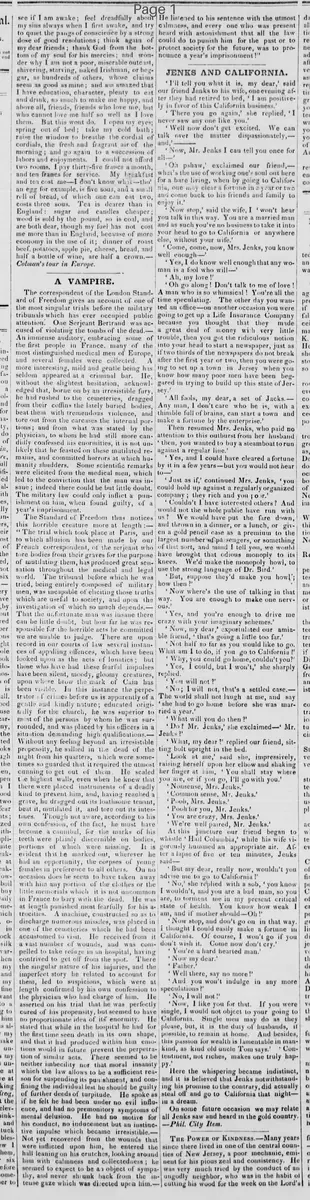
The correspondent of the London Standard of Freedom gives an account of one of the most singular trials before the military tribunals which has ever occupied public attention. One Serjeant Bertrand was accused of violating the tombs of the dead.- An immense auditory, embracing some of the first people in France, many of the most distinguished medical men of Europe, and several females were collected. A more interesting, mild and gentle being has seldom appeared at a criminal bar. He, without the slightest hesitation, acknowledged that, borne on by an irresistible fury, he had rushed to the cemeteries, dragged from their coffins the lately buried bodies, beat them with tremendous violence, and tore out from the carcases the internal portions; and from what was stated by the physician, to whom he had still more candidly confessed his enormities, it is not unlikely that he feasted on these mutilated remains, and committed horrors at which humanity shudders. Some scientific remarks were elicited from the medical men, which led to the conviction that the man was insane: indeed there could be but little doubt. The military law could only inflict a punishment on him, when found guilty, of a year's imprisonment. The Standard of Freedom thus notices this horrible creature more at length:-
"The trial which took place at Paris, and to which allusion has been made by our French correspondent, of the serjeant who tore bodies from their graves for the purpose of mutilating them, has produced great sensation throughout the medical and legal world. The tribunal before which he was tried, being entirely composed of military men, was incapable of eliciting those truths which are useful to society, and upon the investigation of which so much depends.- That the unfortunate man was insane there can be little doubt, but how far he was responsible for the horrible acts he committed we are unable to judge. There are upon record in our courts of law several instances of appalling offences, which have been looked upon as the acts of lunatics; but those who have had these fearful impulses have been silent, moody, gloomy creatures, upon whose brow the mark of Cain has been visible. In this instance the perpetrator of crimes before us is apparently of a gentle and kindly nature; educated originally for the church, he was superior to most of the persons by whom he was surrounded, and was placed by his officers in a situation demanding high qualifications.- Without any feeling beyond an irresistible propensity, he sallied in the dead of the night from his quarters, which were sometimes so guarded that it required the utmost cunning to get out of them. He scaled the highest walls, even when he knew that there were placed instruments of a deadly kind to prevent him, and, having reached a grave, he dragged out its loathsome tenant, beat it, mutilated it, and tore out its intestines. Though not aware, according to his own confession, of the fact, he must have become a cannibal, for the marks of his teeth were plainly discernible on bodies, portions of which were missing. It is evident that he marked out, wherever he had an opportunity, the corpses of young females in preference to all others. On no occasion does he seem to have taken away with him any portion of the clothes or the little memorials which it is not uncommon in France to bury with the dead. He was at length punished most fearfully for his atrocities. "A machine, constructed so as to discharge numerous missiles, was placed in one of the cemeteries which he had been accustomed to visit. He received from it a vast number of wounds, and was compelled to take refuge in an hospital, having contrived to get off from the spot. There the singular nature of his injuries, and the imperfect story he related to account for them, led to suspicions, which were at length confirmed by his own confession to the physician who had charge of him. He asserted on his trial that he was perfectly cured of his propensity, but seemed to have no proportionate idea of its enormity. He stated that while in the hospital he had for the first time seen death in its own shape, and that it had produced within him emotions which in future prevent the perpetration of similar acts. There seemed to be neither imbecility nor that moral insanity which the law allows to be a sufficient reason for suspending its punishment, and confining the individual lest he should be guilty of further deeds of turpitude. He spoke as if he felt he had been under no evil influence, and had no premonitory symptoms of mental delusion. He had no motive for his conduct, no inducement but an instinctive impulse which became irresistible.-- Not yet recovered from the wounds that were inflicted upon him, he entered the hall leaning on his crutches, looking around him with calmness and collectedness; he seemed to expect to be an object of sympathy, and never shrunk back from the intense gaze which was directed upon him. He listened to his sentence with the utmost calmness, and every one who was present heard with astonishment that all the law could do to punish him for the past or to protect society for the future, was to pronounce a year's imprisonment!"
The correspondent of the London Standard of Freedom gives an account of one of the most singular trials before the military tribunals which has ever occupied public attention. One Serjeant Bertrand was accused of violating the tombs of the dead.- An immense auditory, embracing some of the first people in France, many of the most distinguished medical men of Europe, and several females were collected. A more interesting, mild and gentle being has seldom appeared at a criminal bar. He, without the slightest hesitation, acknowledged that, borne on by an irresistible fury, he had rushed to the cemeteries, dragged from their coffins the lately buried bodies, beat them with tremendous violence, and tore out from the carcases the internal portions; and from what was stated by the physician, to whom he had still more candidly confessed his enormities, it is not unlikely that he feasted on these mutilated remains, and committed horrors at which humanity shudders. Some scientific remarks were elicited from the medical men, which led to the conviction that the man was insane: indeed there could be but little doubt. The military law could only inflict a punishment on him, when found guilty, of a year's imprisonment. The Standard of Freedom thus notices this horrible creature more at length:-
"The trial which took place at Paris, and to which allusion has been made by our French correspondent, of the serjeant who tore bodies from their graves for the purpose of mutilating them, has produced great sensation throughout the medical and legal world. The tribunal before which he was tried, being entirely composed of military men, was incapable of eliciting those truths which are useful to society, and upon the investigation of which so much depends.- That the unfortunate man was insane there can be little doubt, but how far he was responsible for the horrible acts he committed we are unable to judge. There are upon record in our courts of law several instances of appalling offences, which have been looked upon as the acts of lunatics; but those who have had these fearful impulses have been silent, moody, gloomy creatures, upon whose brow the mark of Cain has been visible. In this instance the perpetrator of crimes before us is apparently of a gentle and kindly nature; educated originally for the church, he was superior to most of the persons by whom he was surrounded, and was placed by his officers in a situation demanding high qualifications.- Without any feeling beyond an irresistible propensity, he sallied in the dead of the night from his quarters, which were sometimes so guarded that it required the utmost cunning to get out of them. He scaled the highest walls, even when he knew that there were placed instruments of a deadly kind to prevent him, and, having reached a grave, he dragged out its loathsome tenant, beat it, mutilated it, and tore out its intestines. Though not aware, according to his own confession, of the fact, he must have become a cannibal, for the marks of his teeth were plainly discernible on bodies, portions of which were missing. It is evident that he marked out, wherever he had an opportunity, the corpses of young females in preference to all others. On no occasion does he seem to have taken away with him any portion of the clothes or the little memorials which it is not uncommon in France to bury with the dead. He was at length punished most fearfully for his atrocities. "A machine, constructed so as to discharge numerous missiles, was placed in one of the cemeteries which he had been accustomed to visit. He received from it a vast number of wounds, and was compelled to take refuge in an hospital, having contrived to get off from the spot. There the singular nature of his injuries, and the imperfect story he related to account for them, led to suspicions, which were at length confirmed by his own confession to the physician who had charge of him. He asserted on his trial that he was perfectly cured of his propensity, but seemed to have no proportionate idea of its enormity. He stated that while in the hospital he had for the first time seen death in its own shape, and that it had produced within him emotions which in future prevent the perpetration of similar acts. There seemed to be neither imbecility nor that moral insanity which the law allows to be a sufficient reason for suspending its punishment, and confining the individual lest he should be guilty of further deeds of turpitude. He spoke as if he felt he had been under no evil influence, and had no premonitory symptoms of mental delusion. He had no motive for his conduct, no inducement but an instinctive impulse which became irresistible.-- Not yet recovered from the wounds that were inflicted upon him, he entered the hall leaning on his crutches, looking around him with calmness and collectedness; he seemed to expect to be an object of sympathy, and never shrunk back from the intense gaze which was directed upon him. He listened to his sentence with the utmost calmness, and every one who was present heard with astonishment that all the law could do to punish him for the past or to protect society for the future, was to pronounce a year's imprisonment!"
What sub-type of article is it?
Military Trial
Grave Desecration
What keywords are associated?
Paris Trial
Sergeant Bertrand
Grave Violation
Body Mutilation
Insanity
Cannibalism
Military Tribunal
What entities or persons were involved?
Serjeant Bertrand
Where did it happen?
Paris
Foreign News Details
Primary Location
Paris
Key Persons
Serjeant Bertrand
Outcome
year's imprisonment; deemed insane
Event Details
Sergeant Bertrand confessed to violating tombs, mutilating recently buried bodies, tearing out intestines, and possibly cannibalizing remains, driven by an irresistible impulse. Tried by military tribunal in Paris, he was convicted but received only a year's imprisonment due to insanity.