Thank you for visiting SNEWPapers!
Sign up free
The Liberator
Boston, Suffolk County, Massachusetts
What is this article about?
In his second letter to Rev. James Caughey, Robert Johnston from Dublin criticizes the American Methodist Episcopal Church's involvement in slavery, challenges Caughey's claims of abolitionism given his church ties, and urges him to separate from the pro-slavery institution while invoking Christian principles against it.
Clipping
OCR Quality
Full Text
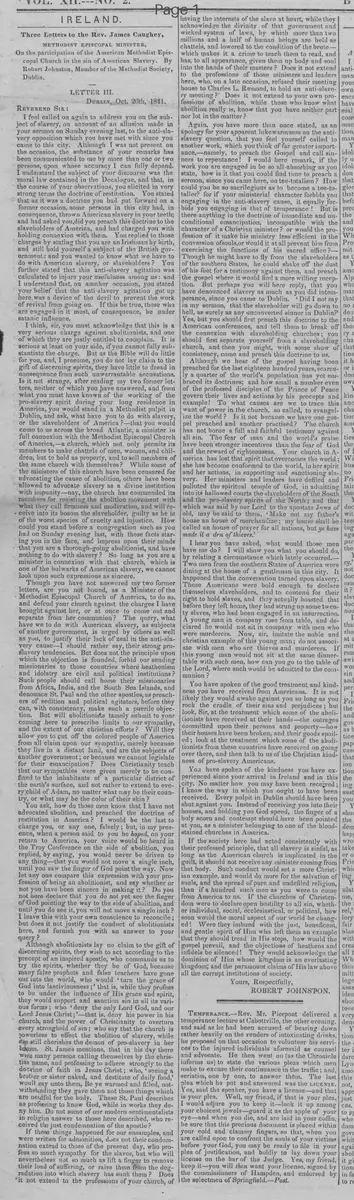
Three Letters to the Rev. James Caughey, METHODIST EPISCOPAL MINISTER:
On the participation of the American Methodist Episcopal Church in the sin of American Slavery. By Robert Johnston, Member of the Methodist Society, Dublin.
LETTER II
Dublin, Oct. 26th, 1841.
Reverend Sir:
I feel called on again to address you on the subject of slavery, on account of an allusion made in your sermon on Sunday evening last, to the anti-slavery opposition which you have met with since you came to this city. Although I was not present on the occasion, the substance of your remarks has been communicated to me by more than one or two persons, upon whose accuracy I can fully depend.
I understand the subject of your discourse was the moral law contained in the Decalogue, and that, in the course of your observations, you elicited in very strong terms the doctrine of restitution. You stated that as it was a doctrine you had put forward on a former occasion, some persons in this city had, in consequence, thrown American slavery in your teeth; and had asked you, did you preach this doctrine to the slaveholders of America, and had charged you with holding connexion with them. You replied to those charges by stating that you are an Irishman by birth, and still hold yourself a subject of the British government: and you wanted to know what we have to do with American slavery, or slaveholders? You further stated that this anti-slavery agitation was calculated to injure your usefulness among us: and I understand that, on another occasion, you stated your belief that the anti-slavery agitation got up here was a device of the devil to prevent the work of revival from going on. If this be true, those who are engaged in it must, of consequence, be under satanic influence.
I think, sir, you must acknowledge that this is a very serious charge against abolitionists, and one of which they are justly entitled to complain. It is serious at least on your side, if you cannot fully substantiate the charge. But as the Bible will do little for you, and, I presume, you do not lay claim to the gift of discerning spirits, they have little to dread in consequence from such unwarrantable accusations.
Is it not strange, after reading my two former letters, neither of which you have answered, and from what you must have known of the working of the pro-slavery spirit during your long residence in America, you would stand in a Methodist pulpit in Dublin, and ask, what have you to do with slavery, or the slaveholders of America?—that you would come to us across the broad Atlantic, a minister in full connexion with the Methodist Episcopal Church of America,—a church, which not only permits its members to make chattels of men, women, and children, but to hold as property, and to sell members of the same church with themselves? While some of the ministers of this church have been censured for advocating the cause of abolition, others have been allowed to advocate slavery as a divine institution with impunity—nay, the church has commended its members for resisting the abolition movement with what they call firmness and moderation, and will receive into its bosom the slaveholder, guilty as he is of the worst species of cruelty and injustice. How could you stand before a congregation such as you had on Sunday evening last, with these facts staring you in the face, and impress upon their minds that you are a thorough-going abolitionist, and have nothing to do with slavery? So long as you are a minister in connexion with that church, which is one of the bulwarks of American slavery, we cannot look upon such expressions as sincere.
Though you have not answered my two former letters, are you not bound, as a Minister of the Methodist Episcopal Church of America, to do so, and defend your church against the charges I have brought against her, or at once to come out and separate from her communion? The query, what have we to do with American slavery, as subjects of another government, is urged by others as well as you, to justify their lack of zeal in the anti-slavery cause—I should rather say, their strong pro-slavery tendencies. But does not the principle upon which the objection is founded, forbid our sending missionaries to those countries where heathenism and idolatry are civil and political institutions? Such people should call home their missionaries from Africa, India, and the South Sea Islands, and denounce St. Paul and the other apostles, as preachers of sedition and political agitators, before they can, with consistency, make such a puerile objection. But will abolitionists tamely submit to your coming here to prescribe limits to our sympathy, and the extent of our christian efforts? Will they allow you to cut off the colored people of America from all claim upon our sympathy, merely because they live in a distant land, and are the subjects of another government; or because we cannot legislate for their emancipation? Does Christianity teach that our sympathies were given merely to be confined to the inhabitants of a particular district of the earth's surface, and not rather to extend to every child of Adam, no matter what may be their country, or what may be the color of their skin?
You ask, how do those men know that I have not advocated abolition, and preached the doctrine of restitution in America? I would be the last to charge you, or any one, falsely; but, in my presence, when a person said to you he hoped, on your return to America, your voice would be heard in the Troy Conference on the side of abolition, you replied, by saying, you would never be driven to anything—that you would not move a single inch, until you saw the finger of God point the way. Now let any one compare this expression with your profession of being an abolitionist, and say whether or not you have been sincere in making it? Do you not here declare that you do not yet see the finger of God pointing the way to the side of abolition, and until you do see it, you will not move a single inch? I leave this with your own conscience to reconcile: but does it not justify the conduct of abolitionists here, and furnish you with an answer to your query?
Although abolitionists lay no claim to the gift of discerning spirits, they wish to act according to the precept of an inspired apostle, who commands us to try the spirits, whether they be of God, because many false prophets and false teachers have gone out into the world, who would turn the grace of God into lasciviousness; that is, while they profess to be under the influence of His grace and spirit, they would support and sanction sin in all its various forms; who 'deny the only Lord God, and our Lord Jesus Christ;'—that is, deny his power in his church, and the power of Christianity to overturn every stronghold of sin; who say that the church is powerless to effect the abolition of slavery, while she still cherishes the demon of pro-slavery in her bosom. St. James mentions, that in his day there were many persons calling themselves by the christian name, and professing to adhere strongly to the doctrine of faith in Jesus Christ; who, 'seeing a brother or sister naked, and destitute of daily food,' would say unto them, Be ye warmed and filled, notwithstanding they gave them not those things which are needful for the body. These St. Paul describes as professing to know God, while in works they deny him. Do not some of our modern sentimentalists in religion answer to those here described, who received the just condemnation of the apostle?
If these things happened for our ensamples, and were written for admonition, does not their condemnation extend to those of the present day, who profess so much sympathy for the slaves, but who will nevertheless not so much as lift a finger to remove their load of suffering, or raise them from the degradation into which slavery has sunk them? Does it not extend to the professions of your church, of having the interests of the slave at heart, while they acknowledge the divinity of that government and wicked system of laws, by which more than two millions and a half of human beings are held as chattels, and lowered to the condition of the brute—which makes it a crime to teach them to read, and has, to all appearance, given them up body and soul into the hands of their masters? Does it not extend to the professions of those ministers and leaders here, who, on a late occasion, refused their meeting house to Charles L. Remond, to hold an anti-slavery meeting? Does it not extend to your own professions of abolition, while those who know what abolition really is, know that you have neither part nor lot in the matter?
Again, you have more than once stated, as an apology for your apparent lukewarmness on the anti-slavery question, that you feel yourself called to another work, which you think of far greater importance,—namely, to preach the Gospel and call sinners to repentance! I would here remark, if the work you are engaged in be so all-absorbing as you state, how is it that you could find time to preach a sermon, since you came here, on tee-totalism? How could you be so sacrilegious as to become a tee-totaler? for if your ministerial character forbids you engaging in the anti-slavery cause, it equally forbids you engaging in that of temperance! But is there anything in the doctrine of immediate and unconditional emancipation, incompatible with the character of a Christian minister? or would the profession of it make his ministry less efficient in the conversion of souls, or would it at all prevent him from exercising the functions of his sacred office? Though he might have to fly from the slaveholders of the southern States, he could shake off the dust of his feet for a testimony against them, and preach the gospel where it would find a more willing reception. But perhaps you will here reply, that you have denounced slavery as much as you did intemperance, since you came to Dublin. 'Did I not say in my sermon, that the slaveholder will go down to hell, as surely as any unconverted sinner in Dublin?'
Yes, but you should first preach this doctrine to the American conferences, and tell them to break off the connexion with slaveholding churches; you should first separate yourself from a slaveholding church, and then you might, with some show of consistency, come and preach this doctrine to us.
Although we hear of the gospel having been preached for the last eighteen hundred years, scarcely a quarter of the world's population has yet embraced its doctrines; and how small a number even of the professed disciples of the Prince of Peace govern their lives and actions by his precepts and example! To what causes are we to trace this want of power in the church, so called, to evangelize the world? Is it not because we have one gospel preached and another practised? The church has not borne a full and faithful testimony against all sin. The fear of man and the world's praise have been stronger incentives than the fear of God and the reward of righteousness. Your church in America has lost that spirit that overcomes the world: she has become conformed to the world, in her spirit and her actions, in supporting and sanctioning slavery. Her ministers and leaders have defiled and polluted the spiritual temple of God, in admitting into its hallowed courts the slaveholders of the South and the pro-slavery spirits of the North; and that which was said by our Lord to the apostate Jews of old, may be said to them, 'Make not my father's house an house of merchandize; my house shall be called an house of prayer for all nations, but ye have made it a den of thieves.'
I hear you have asked, what would those men have me do? I will show you what you should do, by relating a circumstance which lately occurred.—Two men from the southern States of America were dining at the house of a gentleman in this city. It happened that the conversation turned upon slavery. These Americans were bold enough to declare themselves slaveholders, and to contend for their right to hold slaves, and they actually boasted that before they left home, they had strung up some twenty slaves, who had been engaged in an insurrection. A young man in company rose from table, and declared he would not sit in company with men who were murderers. Now, sir, imitate the noble and christian example of this young man; do not associate with men who are thieves and murderers. If this young man would not sit at the same dinner-table with such men, how can you go to the table of the Lord, where such would be admitted to the communion?
You have spoken of the good treatment and kindness you have received from Americans. It is not likely they would awake against you so long as you rock the cradle of their sins and prejudices; but look, Sir, at the treatment which some of the abolitionists have received at their hands—the outrages committed upon their persons and property—how their houses have been broken, and their goods spoiled; look at the treatment which some of the abolitionists from these countries have received on going over there, and then talk to us of the Christian kindness of pro-slavery Americans.
You have spoken of the kindness you have experienced since your arrival in Ireland and in this city. No matter how you may have been received: I know the way in which you ought to have been received. Every pulpit in Dublin should have been shut against you. Instead of receiving you into their houses, and bidding you God speed, the finger of a holy scorn and contempt should have been pointed at you, as a minister belonging to one of the blood-stained churches in America.
If the society here had acted consistently with their professed principle, that all slavery is sinful, as long as the American church is implicated in the guilt, it should not receive any minister coming from that body. Such conduct would set a more Christian example, and would do more for the salvation of souls, and the spread of pure and undefiled religion, than if a hundred such men as you were to come from America to us. If the churches of Christendom were to declare open hostility to all sin, whether individual, social, ecclesiastical, or political, how soon would the moral aspect of our world be changed! Were they imbued with the just, beneficent and gentle spirit of Him who left them an example that they should tread in His steps, how would the gospel prevail, and the objections of heathens and infidels be silenced! They would acknowledge the dominion of Him whose kingdom is an everlasting kingdom, and the paramount claims of His law above all the corrupt institutions of society.
Yours, Respectfully,
ROBERT JOHNSTON.
What sub-type of article is it?
What themes does it cover?
What keywords are associated?
What entities or persons were involved?
Letter to Editor Details
Author
Robert Johnston
Recipient
Rev. James Caughey
Main Argument
robert johnston accuses rev. james caughey of insincerity in his abolitionist claims due to his continued association with the pro-slavery methodist episcopal church of america and urges him to separate from it to align with true christian principles against slavery.
Notable Details