Thank you for visiting SNEWPapers!
Sign up free
Gazette Of The United States
New York, New York County, New York
What is this article about?
Proceedings of the U.S. House of Representatives on March 8-9, 1790, covering bills on arts promotion, land cessions, revenue instructions, clerk salaries, appropriations, and a presidential message on constitutional amendments. Key debate on Quakers' memorials regarding slavery abolition limits under the Constitution, resulting in referral to committee. Further discussion on assuming state debts, adopted 31-26.
Merged-components note: These components continue the report on congressional proceedings, including the resolution on assumption of state debts and related business, on page 4 with sequential reading order and direct textual flow.
Clipping
OCR Quality
Full Text
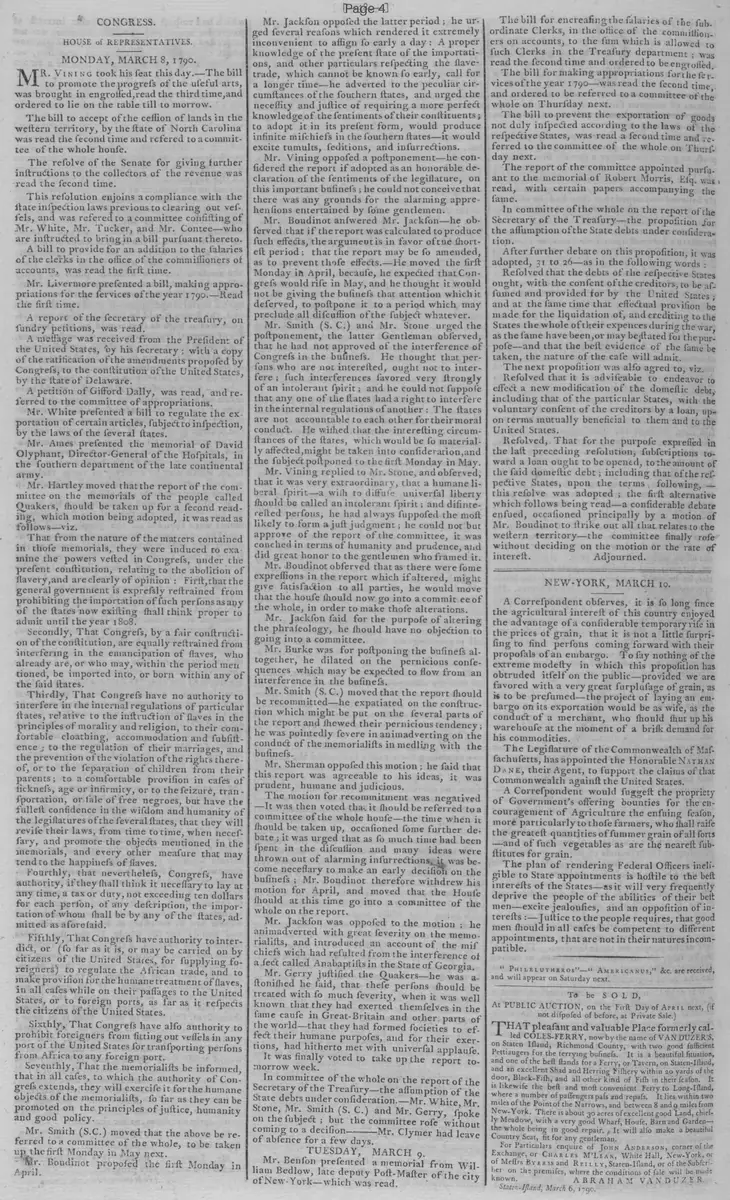
HOUSE of REPRESENTATIVES.
MONDAY, MARCH 8, 1790.
Mr. Vining took his seat this day. The bill to promote the progress of the useful arts, was brought in engrossed, read the third time, and ordered to lie on the table till tomorrow.
The bill to accept of the cession of lands in the western territory, by the state of North Carolina was read the second time and referred to a committee of the whole house.
The resolve of the Senate for giving further instructions to the collectors of the revenue was read the second time.
This resolution enjoins a compliance with the state inspection laws previous to clearing out vessels, and was referred to a committee consisting of Mr. White, Mr. Tucker, and Mr. Contee—who are instructed to bring in a bill pursuant thereto.
A bill to provide for an addition to the salaries of the clerks in the office of the commissioners of accounts, was read the first time.
Mr. Livermore presented a bill, making appropriations for the services of the year 1790. Read the first time.
A report of the secretary of the treasury, on sundry petitions, was read.
A message was received from the President of the United States, by his secretary; with a copy of the ratification of the amendments proposed by Congress, to the constitution of the United States, by the state of Delaware.
A petition of Gifford Dalley, was read, and referred to the committee of appropriations.
Mr. White presented a bill to regulate the exportation of certain articles, subject to inspection, by the laws, of the several states.
Mr. Ames presented the memorial of David Olyphant, Director-General of the Hospitals, in the southern department of the late continental army.
Mr. Hartley moved that the report of the committee on the memorials of the people called Quakers, should be taken up for a second reading, which motion being adopted, it was read as follows—viz.
That from the nature of the matters contained in those memorials, they were induced to examine the powers vested in Congress, under the present constitution, relating to the abolition of slavery, and are clearly of opinion: First, that the general government is expressly restrained from prohibiting the importation of such persons as any of the states now existing shall think proper to admit until the year 1808.
Secondly, That Congress, by a fair construction of the constitution, are equally restrained from interfering in the emancipation of slaves, who already are, or who may, within the period mentioned, be imported into, or born within any of the said states.
Thirdly, That Congress have no authority to interfere in the internal regulations of particular states, relative to the instruction of slaves in the principles of morality and religion, to their comfortable clothing, accommodation and subsistence; to the regulation of their marriages, and the prevention of the violation of the rights thereof, or to the separation of children from their parents; to a comfortable provision in cases of sickness, age or infirmity, or to the seizure, transportation, or sale of free negroes, but have the fullest confidence in the wisdom and humanity of the legislatures of the several states, that they will revise their laws, from time to time, when necessary, and promote the objects mentioned in the memorials, and every other measure that may tend to the happiness of slaves.
Fourthly, that nevertheless, Congress, have authority, if they shall think it necessary to lay at any time, a tax or duty, not exceeding ten dollars for each person, of any description, the importation of whom shall be by any of the states, admitted as aforesaid.
Fifthly, That Congress have authority to interdict. or (so far as it is, or may be carried on by citizens of the United States, for supplying foreigners) to regulate the African trade, and to make provision for the humane treatment of slaves, in all cases while on their passages to the United States, or to foreign ports, as far as it respects the citizens of the United States.
Sixthly, That Congress have also authority to prohibit foreigners from fitting out vessels in any port of the United States for transporting persons from Africa to any foreign port.
Seventhly, That the memorialists be informed. that in all cases, to which the authority of Congress extends, they will exercise it for the humane objects of the memorialists, so far as they can be promoted on the principles of justice, humanity and good policy.
Mr. Smith (S.C.) moved that the above be referred to a committee of the whole, to be taken up the first Monday in May next.
Mr. Boudinot proposed the first Monday in April.
Mr. Jackson opposed the latter period; he urged several reasons which rendered it extremely inconvenient to assign so early a day: A proper knowledge of the present state of the importations, and other particulars respecting the slave-trade, which cannot be known so early, call for a longer time—he adverted to the peculiar circumstances of the southern states, and urged the necessity and justice of requiring a more perfect knowledge of the sentiments of their constituents; to adopt it in its present form, would produce infinite mischiefs in the southern states—it would excite tumults, seditions, and insurrections.
Mr. Vining opposed a postponement—he considered the report if adopted as an honorable declaration of the sentiments of the legislature, on this important business; he could not conceive that there was any grounds for the alarming apprehensions entertained by some gentlemen.
Mr. Boudinot answered Mr. Jackson—he observed that if the report was calculated to produce such effects, the arguments are in favor of the shortest period; that the report may be so amended, as to prevent those effects. He moved the first Monday in April, because, he expected that Congress would rise in May, and he thought it would not be giving the business that attention which it deserved, to postpone it to a period which may preclude all discussion of the subject whatever.
Mr. Smith (S. C.) and Mr. Stone urged the postponement, the latter Gentleman observed, that he had not approved of the interference of Congress in the business. He thought that persons who are not interested, ought not to interfere; such interferences savored very strongly of an intolerant spirit; and he could not suppose that any one of the states had a right to interfere in the internal regulations of another: The states are not accountable to each other for their moral conduct. He wished that the interesting circumstances of the states, which would be so materially affected, might be taken into consideration, and the subject postponed to the first Monday in May.
Mr. Vining replied to Mr. Stone, and observed, that it was very extraordinary, that a humane liberal spirit—a wish to diffuse universal liberty should be called an intolerant spirit; and disinterested persons, he had always supposed the most likely to form a just judgment; he could not but approve of the report of the committee, it was couched in terms of humanity and prudence, and did great honor to the gentlemen who framed it.
Mr. Boudinot observed that as there were some expressions in the report which if altered, might give satisfaction to all parties, he would move that the house should now go into a committee of the whole, in order to make those alterations.
Mr. Jackson said for the purpose of altering the phraseology, he should have no objection to going into a committee.
Mr. Burke was for postponing the business altogether, he dilated on the pernicious consequences which may be expected to flow from an interference in the business.
Mr. Smith (S. C.) moved that the report should be recommitted—he expatiated on the construction which might be put on the several parts of the report and shewed their pernicious tendency; he was pointedly severe in animadverting on the conduct of the memorialists in meddling with the business.
Mr. Sherman opposed this motion; he said that this report was agreeable to his ideas, it was prudent, humane and judicious.
The motion for recommitment was negatived—It was then voted that it should be referred to a committee of the whole house—the time when it should be taken up, occasioned some further debate; it was urged that as so much time had been spent in the discussion and many ideas were thrown out of alarming insurrections, it was become necessary to make an early decision on the business; Mr. Boudinot therefore withdrew his motion for April, and moved that the House should at this time go into a committee of the whole on the report.
Mr. Jackson was opposed to the motion; he animadverted with great severity on the memorialists, and introduced an account of the mischiefs which had resulted from the interference of a sect called Anabaptists in the State of Georgia.
Mr. Gerry justified the Quakers—he was astonished he said, that these persons should be treated with so much severity, when it was well known that they had exerted themselves in the same cause in Great-Britain and other parts of the world—that they had formed societies to effect their humane purposes, and for their exertions, had hitherto met with universal applause.
It was finally voted to take up the report tomorrow week.
In committee of the whole on the report of the Secretary of the Treasury—the assumption of the State debts under consideration.—Mr. White, Mr. Stone, Mr. Smith (S. C.) and Mr. Gerry, spoke on the subject; but the committee rose without coming to a decision— Mr. Clymer had leave of absence for a few days.
TUESDAY, MARCH 9.
Mr. Benson presented a memorial from William Bedlow, late deputy Post-Master of the city of New-York—which was read.
The bill for increasing the salaries of the subordinate Clerks, in the office of the commissioners on accounts, to the sum which is allowed to such Clerks in the Treasury department; was read the second time and ordered to be engrossed.
The bill for making appropriations for the services of the year 1790—was read the second time, and ordered to be referred to a committee of the whole on Thursday next.
The bill to prevent the exportation of goods not duly inspected according to the laws of the respective States, was read a second time and referred to the committee of the whole on Thursday next.
The report of the committee appointed pursuant to the memorial of Robert Morris, Esq. was read, with certain papers accompanying the same.
In committee of the whole on the report of the Secretary of the Treasury—the proposition for the assumption of the State debts under consideration.
After further debate on this proposition, it was adopted, 31 to 26—as in the following words:
Resolved that the debts of the respective States ought, with the consent of the creditors, to be assumed and provided for by the United States; and at the same time that effectual provision be made for the liquidation of, and crediting to the States the whole of their expenses during the war, as the same have been, or may be stated for the purpose—and that the best evidence of the same be taken, the nature of the case will admit.
The next proposition was also agreed to, viz.
Resolved that it is advisable to endeavor to effect a new modification of the domestic debt, including that of the particular States, with the voluntary consent of the creditors by a loan, upon terms mutually beneficial to them and to the United States.
Resolved, That for the purpose expressed in the last preceding resolution, subscriptions toward a loan ought to be opened, to the amount of the said domestic debt; including that of the respective States, upon the terms following,— this resolve was adopted; the first alternative which follows being read—a considerable debate ensued, occasioned principally by a motion of Mr. Boudinot to strike out all that relates to the western territory—the committee finally rose without deciding on the motion or the rate of interest.
Adjourned.
What sub-type of article is it?
What themes does it cover?
What keywords are associated?
What entities or persons were involved?
Where did it happen?
Story Details
Key Persons
Location
House Of Representatives, United States Congress
Event Date
March 8, 1790 And March 9, 1790
Story Details
The House processes various bills on arts, land cessions, revenue, salaries, and appropriations; receives presidential message on amendments; debates and refers Quakers' memorials on slavery, affirming constitutional limits while expressing confidence in state legislatures; discusses and adopts assumption of state debts 31-26; considers debt modification.