Thank you for visiting SNEWPapers!
Sign up free
The Leader Enterprise
Fitzgerald, Ben Hill County, Georgia
What is this article about?
Georgia's State Department of Entomology advises farmers to plant winter wheat, rye, and barley no earlier than October 20 to avoid severe damage from the Hessian fly pest. Additional measures include burning stubble, plowing under volunteer wheat, crop rotation, and using good seed on prepared land.
Clipping
OCR Quality
Full Text
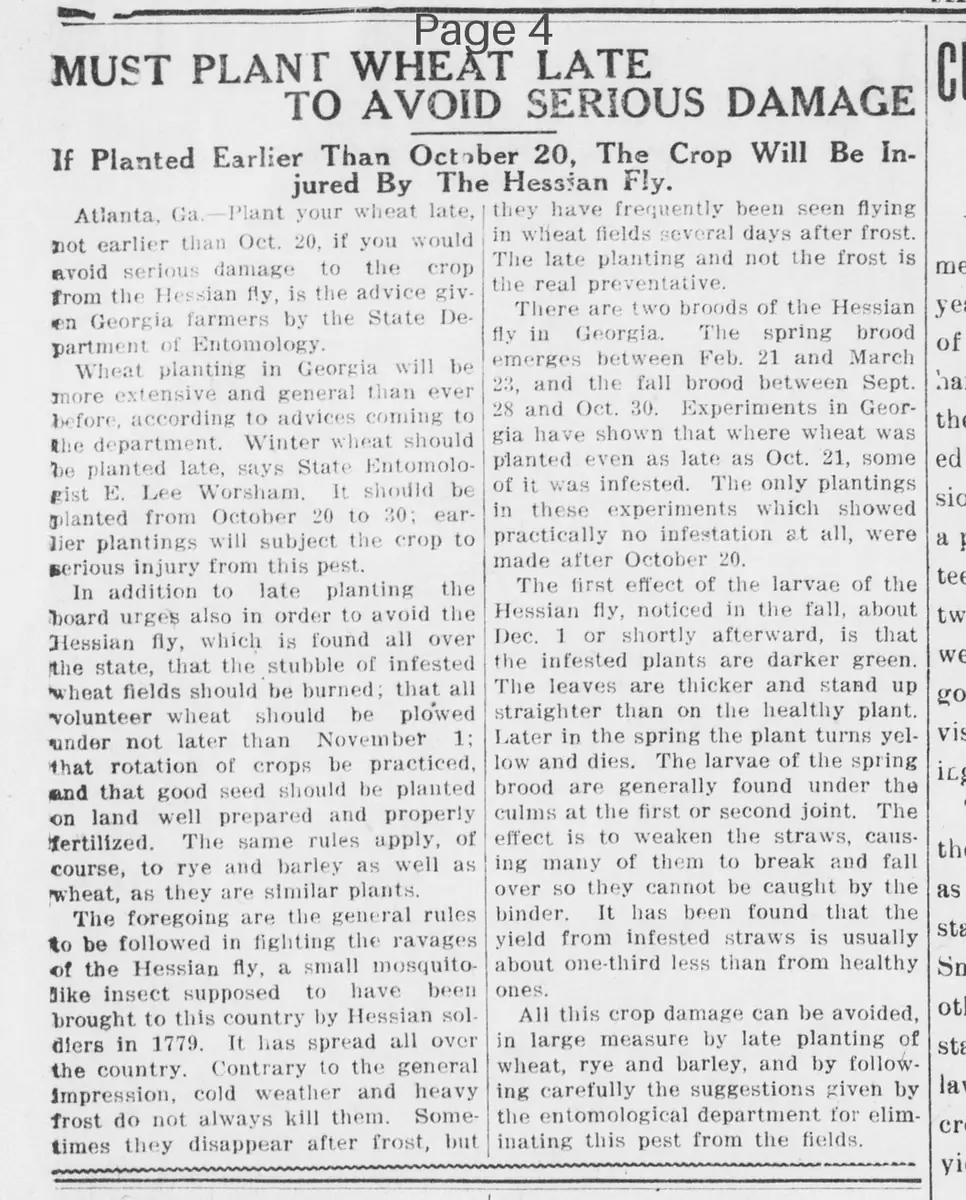
TO AVOID SERIOUS
DAMAGE
Atlanta, Ga. Plant your wheat late, not earlier than Oct. 20, if you would avoid serious damage to the crop from the Hessian fly, is the advice given Georgia farmers by the State Department of Entomology.
Wheat planting in Georgia will be more extensive and general than ever before, according to advices coming to the department. Winter wheat should be planted late, says State Entomologist E. Lee Worsham. It should be planted from October 20 to 30; earlier plantings will subject the crop to serious injury from this pest.
In addition to late planting the board urges also in order to avoid the Hessian fly, which is found all over the state, that the stubble of infested wheat fields should be burned, that all volunteer wheat should be plowed under not later than November 1; that rotation of crops be practiced, and that good seed should be planted on land well prepared and properly fertilized. The same rules apply, of course, to rye and barley as well as wheat, as they are similar plants.
The foregoing are the general rules to be followed in fighting the ravages of the Hessian fly, a small mosquito-like insect supposed to have been brought to this country by Hessian soldiers in 1776. It has spread all over the country. Contrary to the general impression, cold weather and heavy frost do not always kill them. Sometimes they disappear after frost, but they have frequently been seen flying in wheat fields several days after frost.
The late planting and not the frost is the real preventative.
There are two broods of the Hessian fly in Georgia. The spring brood emerges between Feb. 21 and March 23, and the fall brood between Sept. 28 and Oct. 30. Experiments in Georgia have shown that where wheat was planted even as late as Oct. 21, some of it was infested. The only plantings in these experiments which showed practically no infestation at all, were made after October 20.
The first effect of the larvae of the Hessian fly, noticed in the fall, about Dec. 1 or shortly afterward, is that the infested plants are darker green. The leaves are thicker and stand up straighter than on the healthy plant. Later in the spring the plant turns yellow and dies. The larvae of the spring brood are generally found under the culms at the first or second joint. The effect is to weaken the straws, causing many of them to break and fall over so they cannot be caught by the binder. It has been found that the yield from infested straws is usually about one-third less than from healthy ones.
All this crop damage can be avoided in large measure by late planting of wheat, rye and barley, and by following carefully the suggestions given by the entomological department for eliminating this pest from the fields.
What sub-type of article is it?
What keywords are associated?
What entities or persons were involved?
Where did it happen?
Domestic News Details
Primary Location
Georgia
Key Persons
Outcome
crop damage from hessian fly can be avoided by late planting after october 20 and following recommended practices; infested fields yield about one-third less.
Event Details
State Entomologist E. Lee Worsham advises Georgia farmers to plant winter wheat, rye, and barley from October 20 to 30 to prevent infestation by the Hessian fly, a pest present statewide. Additional measures include burning stubble of infested fields, plowing under volunteer wheat by November 1, practicing crop rotation, and planting good seed on well-prepared and fertilized land. The Hessian fly, introduced in 1776, has two broods in Georgia and is not reliably killed by frost; late planting is the primary preventative. Infestation causes darker green plants in fall, yellowing and death in spring, and weakened straws reducing yield.