Thank you for visiting SNEWPapers!
Sign up free
The Virginia Gazette
Richmond, Williamsburg, Richmond County, Virginia
What is this article about?
In a detailed response to 'A Virginian,' Robert C. Nicholas defends Virginia's paper currency, arguing its necessity during wartime, proper funding and management, benefits over specie in internal trade, and refutes claims of economic harm, urging support for remaining notes' credit. Dated Williamsburg, September 22, 1773.
Merged-components note: This is a single continuous letter to the editor split across two pages, as evidenced by the sequential reading order and flowing text content on the topic of paper currency.
Clippings
1 of 2
OCR Quality
Full Text
GENTLEMEN,
WILLIAMSBURG, September 22, 1773.
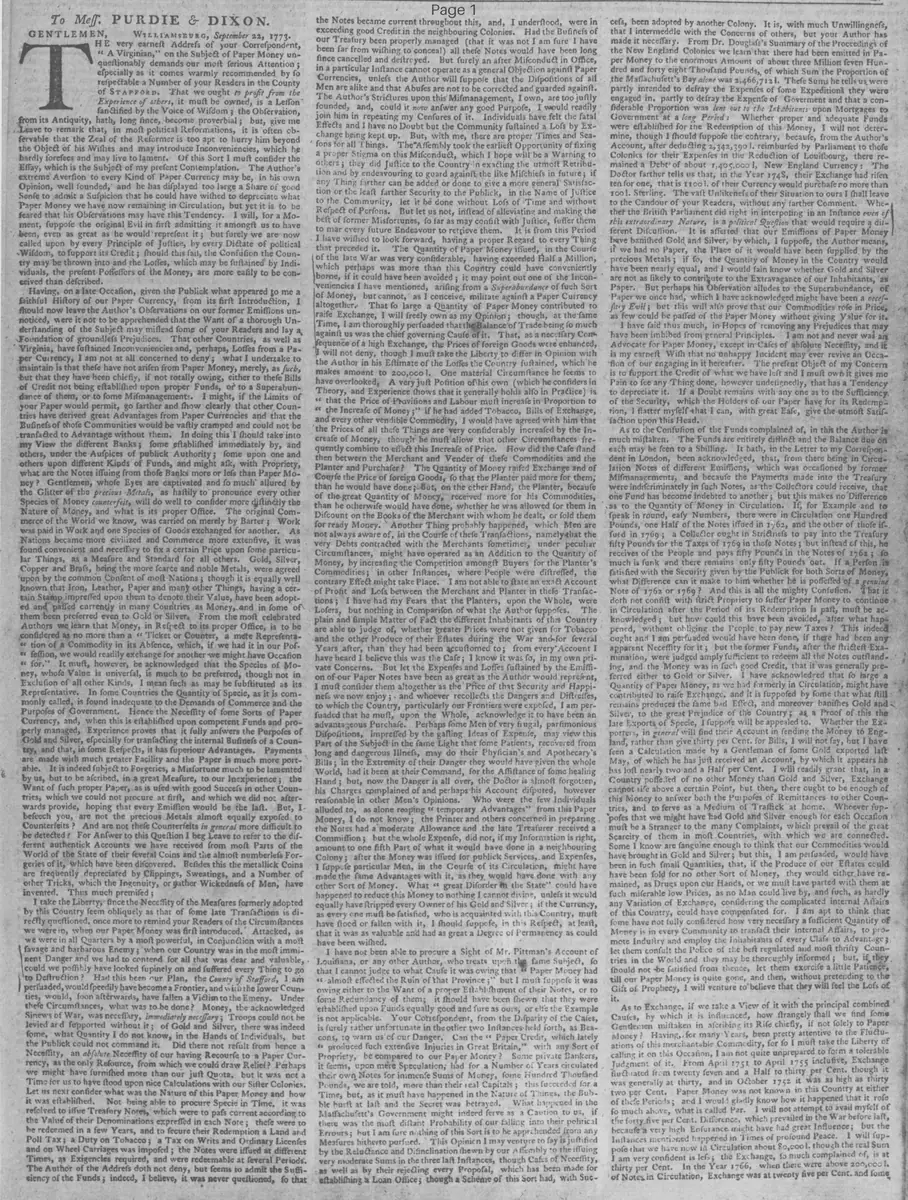
The very earnest Address of your Correspondent, "A Virginian," on the Subject of Paper Money unquestionably demands our most serious Attention; especially as it comes warmly recommended by so respectable a Number of your Readers in the County of STAFFORD. That we ought to profit from the Experience of others, it must be owned, is a Lesson sanctified by the Voice of Wisdom; the Observation, from its Antiquity, hath, long since, become proverbial; but, give me Leave to remark that, in most political Reformations, it is often observable that the Zeal of the Reformer is too apt to hurry him beyond the Object of his Wishes and may introduce Inconveniencies, which he hardly foresees and may live to lament. Of this Sort I must consider the Essay, which is the Subject of my present Contemplation. The Author's extreme Aversion to every Kind of Paper Currency may be, in his own Opinion, well founded, and he has displayed too large a Share of good Sense to admit a Suspicion that he could have wished to depreciate what Paper Money we have now remaining in Circulation, but yet it is to be feared that his Observations may have this Tendency. I will, for a Moment, suppose the original Evil in first admitting it amongst us to have been, even as great as he would represent it; but surely we are now called upon by every Principle of Justice, by every Dictate of political Wisdom, to support its Credit; Should this fail, the Confusion the Country may be thrown into and the Loss, which may be sustained by Individuals, the present Possessors of the Money, are more easily to be conceived than described.
Having, on a late Occasion, given the Publick what appeared to me a faithful History of our Paper Currency, from its first Introduction, I should now leave the Author's Observations on our former Emissions unnoticed, were it not to be apprehended that the Want of a thorough Understanding of the Subject may mislead some of your Readers and lay a Foundation of groundless Prejudices. That other Countries, as well as Virginia, have obtained Inconveniencies and, perhaps, Loss from a Paper Currency, I am not at all concerned to deny; what I undertake to maintain is that these have not arisen from Paper Money, merely, as such, but that they have been chiefly, if not totally owing, either to these Bills of Credit not being established upon proper Funds, or to a Superabundance of them, or to some Mismanegements. I might, if the Limits of your Paper would permit, go farther and show clearly that other Countries have derived great Advantages from Paper Currencies and that the Business of those Communities would be vastly cramped and could not be transacted to Advantage without them. In doing this I should take into my View the different Banks; some established immediately by, and others, under the Auspices of publick Authority; some upon one and others upon different Kinds of Funds, and might ask, with Propriety, what are the Notes issuing from those Banks more or less than Paper Money? Gentlemen, whose Eyes are captivated and so much allured by the Glitter of the precious Metals, as hastily to pronounce every other Species of Money counterfeit, will do well to consider more distinctly the Nature of Money, and what is its proper Office. The original Commerce of the World we know, was carried on merely by Barter; Work was paid in Work and one Species of Goods is exchanged for another. As Nations became more civilized and Commerce more extensive, it was found convenient and necessary to fix a certain Price upon some particular Things, as a Measure and Standard for all others. Gold, Silver, Copper and Brass, being the more scarce and noble Metals, were agreed upon by the common Consent of most Nations; though it is equally well known that Iron, Leather, Paper and many other Things, having a certain Stamp impressed upon them to denote their Value, have been adopted and passed current in many Countries as Money, and in some of them been preferred even to Gold or Silver. From the most celebrated Authors we learn that Money, in Respect to its proper Office, is to be considered as no more than a "Ticket or Counter, a mere Representation of a Commodity in its Absence, which, if we had it in our Possession, we would readily exchange for another we might have Occasion for." It must, however, be acknowledged that the Species of Money, whose Value is universal, is much to be preferred, though not in Exclusion of all other Kinds, I mean such as may be substituted as its Representative. In some Countries the Quantity of Specie, as it is commonly called, is found inadequate to the Demands of Commerce and the Purposes of Government. Hence the Necessity of some Sorts of Paper Currency, and, when this is established upon competent Funds and properly managed, Experience proves that it fully answers the Purposes of Gold and Silver, especially for transacting the internal Business of a Country, and that, in some Respects, it has superior Advantages. Payments are made with much greater Facility and the Paper is much more portable. It is indeed subject to Forgeries, a Misfortune much to be lamented by us, but to be ascribed, in a great Measure, to our Inexperience; the Want of such proper Paper, as is used with good Success in other Countries, which we could not procure at first, and which we did not afterwards provide, hoping that every Emission would be the last. But, I beseech you, are not the precious Metals almost equally exposed to Counterfeits? And are not these Counterfeits in general more difficult to be detected? For Answer to this Question I beg Leave to refer to the different authentick Accounts we have received from most Parts of the World of the State of their several Coins and the almost numberless Forgeries of it, which have been discovered. Besides this the metallick Coins are frequently depreciated by Clippings, Sweatins, and a Number of other Tricks, which the Ingenuity, or rather Wickedness of Men, have invented. Thus much premised;
I take the Liberty, since the Necessity of the Measures formerly adopted by this Country seem obliquely as that of some late Transactions is directly questioned, once more to remind your Readers of the Circumstances we were in, when our Paper Money was first introduced. Attacked, as we were in all Quarters by a most powerful, in Conjunction with a most savage and barbarous Enemy; when our Country was in the most imminent Danger and we had to contend for all that was dear and valuable, could we possibly have looked supinely on and suffered every Thing to go to Destruction? Had this been our Plan, the County of Stafford, I am persuaded, would speedily have become a Frontier, and with the lower Counties, would, soon afterwards, have fallen a Victim to the Enemy. Under these Circumstances, what was to be done? Money, the acknowledged Sinews of War, was necessary, immediately necessary; Troops could not be levied and supported without it; of Gold and Silver, there was indeed some, what Quantity I do not know, in the Hands of Individuals, but the Publick could not command it. Did there not result from hence a Necessity, an absolute Necessity of our having Recourse to a Paper Currency, as the only Resource, from which we could draw Relief? Perhaps we might have furnished more than our just Quota, but it was not a Time for us to have stood upon nice Calculations with our Sister Colonies.
Let us next consider what was the Nature of this Paper Money and how it was established. Not being able to procure Specie in Time, it was resolved to issue Treasury Notes, which were to pass current according to the Value of their Denominations expressed in each Note; these were to be redeemed in a few Years, and to secure their Redemption a Land and Poll Tax; a Duty on Tobacco; a Tax on Writs and Ordinary Licenses and on Wheel Carriages was imposed; the Notes were issued at different Times, as Exigencies required, and were redeemable at several Periods. The Author of the Address doth not deny, but seems to admit the Sufficiency of the Funds; indeed, I believe, it was never questioned, so that the Notes became current throughout this, and, I understand, were in exceeding good Credit in the neighbouring Colonies. Had the Business of our Treasury been properly managed (that it was not I am sure I have been far from wishing to conceal) all these Notes would have been long since cancelled and destroyed. But surely an after Misconduct in Office, in a particular Instance cannot operate as a general Objection against Paper Currencies, unless the Author will suppose that the Dispositions of all Men are alike and that Abuses are not to be corrected and guarded against. The Author's Strictures upon this Mismanagement, I own, are too justly founded, and, could it not answer any good Purpose, I would readily join him in repeating my Censures of it. Individuals have felt the fatal Effects and I have no Doubt but the Community sustained a Loss by Exchange being kept up. But, with me, there are proper Times and Seasons for all Things. The Assembly took the earliest Opportunity of fixing a proper Stigma on this Misconduct, which I hope will be a Warning to others; they did Justice to the Country in exacting the utmost Retribution and by endeavouring to guard against the like Mischiefs in future; if any Thing further can be added or done to give a more general Satisfaction or the least farther Security to the Publick, in the Name of Justice to the Community, let it be done without Loss of Time and without Respect of Persons. But let us not, instead of alleviating and making the best of former Misfortunes, so far as may consist with Justice, suffer them to mar every future Endeavour to retrieve them. It is from this Period I have wished to look forward, having a proper Regard to every Thing that preceded it. The Quantity of Paper Money issued, in the Course of the late War was very considerable, having exceeded Half a Million, which perhaps was more than this Country could have conveniently borne, if it could have been avoided; it may point out one of the Inconveniencies I have mentioned, arising from a Superabundance of such Sort of Money, but cannot, as I conceive, militate against a Paper Currency altogether. That so large a Quantity of Paper Money contributed to raise Exchange, I will readily own as my Opinion; though, at the Same Time, I am thoroughly persuaded that the Balance of Trade being so much against us was the chief governing Cause of it. That, as a necessary Consequence of a high Exchange, the Prices of foreign Goods were enhanced, I will not deny, though I must take the Liberty to differ in Opinion with the Author in his Estimate of the Losses the Country sustained, which he makes amount to 200,000l. One material Circumstance he seems to have overlooked, A very just Position of his own (which he considers in Theory, and Experience shows that it generally holds also in Practice) is "that the Price of Provisions and Labour must increase in Proportion to the Increase of Money;" if he had added Tobacco, Bills of Exchange, and every other vendible Commodity, I would have agreed with him that the Prices of all these Things are very considerably increased by the Increase of Money, though he must allow that other Circumstances frequently combine to effect this Increase of Price. How did the Case then stand between the Merchant and Vender of these Commodities and the Planter and Purchaser? The Quantity of Money raised Exchange and of Course the Price of foreign Goods, so that the Planter paid more for them than he would have done; But, on the other Hand, the Planter, because of the great Quantity of Money, received more for his Commodities, than he otherwise would have done, whether he was allowed for them in Discount on the Books of the Merchant with whom he dealt, or sold them for ready Money. Another Thing probably happened, which Men are not always aware of, in the course of these Transactions, namely that the very Debts contracted with the Merchants sometimes, under peculiar Circumstances, might have operated as an Addition to the Quantity of Money, by increasing the Competition amongst Buyers for the Planter's Commodities; in other Instances, where People were distressed, the contrary Effect might take Place. I am not able to state an exact Account of Profit and Loss between the Merchant and Planter in these Transactions; I have had my Fears that the Planters, upon the Whole, were Losers, but nothing in Comparison of what the Author supposes. The plain and Simple Matter of Fact the different Inhabitants of this Country are able to judge of, whether greater Prices were not given for Tobacco and the other Produce of their Estates during the War and for several Years after, than they had been accustomed to; from every Account I have heard I believe this was the Case; I know it was so, in my own private Concerns. But let the Expences and Losses sustained by the Emission of our Paper Notes have been as great as the Author would represent, I must consider them altogether as the Price of that Security and Happiness we now enjoy; - and whoever recollects the Dangers and Distresses, to which the Country, particularly our Frontiers were exposed, I am persuaded that he must, upon the Whole, acknowledge it to have been an advantageous Purchase. Perhaps some Men of very frugal, parsimonious Dispositions, impressed by the galling Ideas of Expence, may view this Part of the Subject in the same Light that some Patients, recovered from long and dangerous Illness, may do their Physician's and Apothecary's Bills; in the Extremity of their Danger they would have given the whole World, had it been at their Command, for the Assistance of some healing Hand; but, now the Danger is all over, the Doctor is almost forgotten, his Charges complained of and perhaps his Account disputed, however reasonable in other Men's Opinions. Who were the few Individuals alluded to, as alone reaping "temporary Advantages" from this Paper Money, I do not know; the Printer and others concerned in preparing the Notes had a moderate Allowance and the late Treasurer received a Commission; but the whole Expence, did not, if my Information is right, amount to one fifth Part of what it would have done in a neighbouring Colony; after the Money was issued for publick Services, and Expences, I suppose particular Men, in the course of its Circulation, might have made the same Advantages with it, as they would have done with any other Sort of Money. What "great Disorder in the State" could have happened to reduce this Money to nothing I cannot divine, unless it would equally have Stript every Owner of his Gold and Silver; if the Currency, as every one must be satisfied, who is acquainted with this Country, must have stood or fallen with it, I should suppose, in this Respect, at least, that it was as valuable and had as great a Degree of Permanency as could have been wished.
I have not been able to procure a Sight of Mr. Pittman's Account of Louisiana, or any other Author, who treats upon the same Subject, so that I cannot judge to what Cause it was owing that "Paper Money had almost effected the Ruin of that Province;" but I must suppose it was owing either to the Want of a proper Establishment of their Notes, or to some Redundancy of them; it should have been shewn that they were established upon Funds equally good and sure as ours, or else the Example is not applicable. Your Correspondent, from the Disparity of the Cases, is surely rather unfortunate in the other two Instances held forth, as Beacons, to warn us of our Danger. Can the "Paper Credit, which lately produced such extensive Injuries in Great Britain," with any Sort of Propriety, be compared to our Paper Money? Some private Bankers, it seems, upon mere Speculation, had for a Number of Years circulated their own Notes for immense Sums of Money, one Hundred Thousand Pounds, we are told, more than their real Capitals; this succeeded for a Time, but, as it must have happened in the Nature of Things, the Bubble burst at last and the Secret was betrayed. What happened in the Massachusetts Government might indeed serve as a Caution to us, if there was the most distant Probability of our falling into their political Errors; but I am sure nothing of this Sort is to be apprehended from any Measures hitherto pursued. This Opinion I may venture to say is justified by the Reluctance and Disinclination shewn by our Assembly to the issuing very moderate Sums in the three last Instances, though Cases of Necessity, as well as by their rejecting every Proposal, which has been made for establishing a Loan Office; though a Scheme of this Sort had, with Success, been adopted by another Colony. It is, with much Unwillingness, that I intermeddle with the Concerns of others, but your Author has made it necessary. From Dr. Douglas's Summary of the Proceedings of the New England Colonies we learn that there had been emitted in Paper Money to the enormous Amount of about three Million even Hundred and forty eight Thousand Pounds, of which Sum the Proportion of the Massachusetts Bay alone was 2,466,712 l. These Sums he tells us were partly intended to defray the Expenses of some Expeditions they were engaged in, partly to defray the Expence of Government and that a considerable Proportion was lent out to the Inhabitants upon Mortgages to Government at a long Period: Whether proper and adequate Funds were established for the Redemption of this Money, I will not determine, though I should suppose the contrary, because, from the Author's Account, after deducting 2,342,390 l. reimbursed by Parliament to those Colonies for their Expenses in the Reduction of Louisbourg, there remained a Debt of about 1,400,000 l. New England Currency: The Doctor farther tells us that, in the Year 1748, their Exchange had risen ten for one, that is 100 l. of their Currency would purchase no more than 10 l. Sterling. The vast Unlikeness of their Situation to ours I shall leave to the Candour of your Readers, without any farther Comment. Whether the British Parliament did right in interposing in an Instance even of this extraordinary Nature, is a political Question that would require a different Discussion. It is asserted that our Emissions of Paper Money have banished Gold and Silver, by which, I suppose, the Author means, if we had no Paper, the Place of it would have been supplied by the precious Metals; if so, the Quantity of Money in the Country would have been nearly equal, and I would fain know whether Gold and Silver are not as likely to contribute to the Extravagance of our Inhabitants, as Paper. But perhaps his Observation alludes to the Superabundance, of Paper we once had, which I have acknowledged might have been a necessary Evil; but this will also prove that our Commodities rose in Price as few could be passed of the Paper Money without giving Value for it.
I have said thus much, in Hopes of removing any Prejudices that may have been imbibed from general Principles. I am not and never was an Advocate or Paper Money, except in Cases of absolute Necessity, and it is my earnest Wish that no unhappy Incident may ever revive an Occasion of our engaging in it hereafter. The present Object of my Concern is to support the Credit of what we have left and I must own it gives me Pain to see any Thing done, however undesignedly, that has a Tendency to depreciate it. If a Doubt remains with any one as to the Sufficiency of the Security, which the Holders of our Paper have for its Redemption, I flatter myself that I can, with great Ease, give the utmost Satisfaction upon this Head.
As to the Confusion of these Funds complained of, in this the Author is much mistaken. The Funds are entirely distinct and the Balance due on each may be seen to a Shilling. It hath, in the Letter to my Correspondent in London, been acknowledged, that, from there being in Circulation Notes of different Emissions, which was occasioned by former Mismanegements, and because the Payments made into the Treasury were indiscriminately in such Notes, as the Collectors could receive, that one Fund has become indebted to another; but this makes no Difference as to the Quantity of Money in Circulation. If, for Example and to speak in round, easy Numbers, there were in Circulation one Hundred Pounds, one Half of the Notes issued in 1762, and the other of those issued in 1769; a Collector ought in Strictures to pay into the Treasury fifty Pounds for the Taxes of 1769 in those Notes; but instead of this, he receives of the People and pays fifty Pounds in the Notes of 1762; so much is sunk and there remains only fifty Pounds out. If a Person is satisfied with the Security given by the Publick for both Sorts of Money, what Difference can it make to him whether he is possessed of a genuine Note of 1762 or 1769? And this is all the mighty Confusion. That it doth not consist with strict Propriety to suffer Paper Money to continue in Circulation after the Period of its Redemption is past, must be acknowledged; but how could this have been avoided, after what happened, without obliging the People to pay new Taxes? This indeed ought and I am persuaded would have been done, if there had been any apparent Necessity for it; but the former Funds, after the strictest Examination, were judged amply sufficient to redeem all the Notes outstanding, and the Money was in such good Credit, that it was generally preferred either to Gold or Silver. I have acknowledged that so large a Quantity of Paper Money, as we had formerly in Circulation, might have contributed to raise Exchange. and it is supposed by some that what still remains produces the same bad Effect, and moreover banishes Gold and Silver; to the great Prejudice of the Country; as a Proof of this the late Exports of Specie, I suppose will be appealed to. Whether the Exportors, in general will find their Account in sending the Money to England, rather than give thirty per Cent. for Bills, I will not say, but I have seen a Calculation made by a Gentleman of some Gold exported last May, of which he has just received an Account, by which it appears he has lost nearly two and a Half per Cent. I will readily grant that, in a Country possessed of no other Money than Gold and Silver, Exchange cannot rise above a certain Point, but then, there ought to be enough of this Money to answer both the Purposes of Remittances to other Countries, and to serve as a Medium of Traffic at home. Whoever supposes that we might have had Gold and Silver enough for each Occasion must be a Stranger to the many Complaints, which prevail of the great Scarcity of them in most Countries, with which we are connected. Some I know are sanguine enough to think that our Commodities would have brought in Gold and Silver; but this, I am persuaded, would have been in such small Quantities, that, if the Produce of our Estates could have been sold for no other Sort of Money, they would either have remained, as Drugs upon our Hands, or we must have parted with them at such miserable low Prices, as no Man could live by, and such, as hardly any Variation of Exchange, considering the complicated internal Affairs of this Country, could have compensated for. I am apt to think that some have not fully considered how very necessary a sufficient Quantity of Money is in every Community to transact their internal Affairs, to promote Industry and employ the Inhabitants of every Class to Advantage; let them consult the Police of the best regulated and most thrifty Countries in the World and they may be thoroughly informed; but, if they should not be satisfied from thence, let them exercise a little Patience, till our Paper Money is quite gone, and then, without pretending to the Gift of Prophecy, I will venture to believe that they will feel the Loss of it.
As to Exchange, if we take a View of it with the principal combined Causes, by which it is influenced, how strangely shall we find some Gentlemen mistaken in ascribing its Rise chiefly, if not solely to Paper Money? Having, for many Years, been pretty attentive to the Fluctuations of this merchantable Commodity, for so I must take the Liberty of calling it on this Occasion, I am not quite unprepared to form a tolerable Judgment of it. From April 1751 to April 1755 inclusive, Exchange fluctuated from twenty seven and a Half to thirty per Cent. though it was generally at thirty, and in October 1752 it was as high as thirty two per Cent. Paper Money was not known in this Country at either of these Periods; and I would gladly know how it happened that it rose so much above, what is called Par. I will not attempt to avail myself of the forty five per Cent. Difference, which prevailed in the War before last, because a very high Insurance might have had great Influence; but the Instances mentioned happened in Times of profound Peace. I will suppose that we have now in Circulation about 80,000 l. though the real Sum I am very confident is less; the Exchange, so much complained of, is at thirty per Cent. In the Year 1766, when there were above 200,000 l. of Notes in Circulation, Exchange was at twenty five per Cent. and sometimes lower.
Several Years ago, when the Paper in Circulation amounted to 140,000 l.
Exchange was down as low as fifteen per Cent; in May 1771 it was at
twenty per Cent. and continued at the same Rate in October, though
the 30,000 l. was then issued to pay for lost Tobacco. To what could
all these Shillings and Changes have been owing? To nothing more or
less than certain Causes, which are well understood in the commercial
World. Bills of Exchange considered as a Merchandise, in Respect to
Price, should be viewed in a compound Proportion, directly as to the
Demand, and reciprocally as to the Plenty of them; or, in other
Words, the Value or Price of Bills will be in Proportion to the Number of
them brought to Market, compared with the Quantity of Money, which
may be there to purchase them; if more Money, than Bills, Exchange
will rise; if less Money, than the Drawers have Occasion for, Exchange
will fall. A few Years since, Bills were so plenty at Market that the
Drawers could hardly procure Money enough at fifteen per Cent. and
lately, they have become so scarce, that it is doubted by some whether
the monied Men could have made all their Remittances even at a higher
Exchange, than prevailed, had they not exported a Quantity of Specie.
The former very low Exchange brought in great Part of the Specie, we
had in the Country; this, added to what Money was here before, contri-
buted to raise Exchange; but the great governing Cause of this Rise was
the extreme Scarcity of Bills, and this, owing chiefly to Misfortunes in
Great Britain. At the Same Time the Demands for them appeared greatly
increased, probably owing to the vast Importations of Goods for several
Years, which must have augmented the Balance of Trade greatly against
us. From this Source, in my Opinion, are derived the greatest Misfor-
tunes to this Country. Could we but prevail with ourselves to lessen our
Imports, and endeavour to make, within ourselves, such Necessaries, as
our Soil and Climate are well adapted to, the Balance would soon be
changed in our Favour and we need not fear any ill Consequences attend-
ing Exchange, though the Quantity of Paper Money should be much
greater than it is. I would observe farther that, though our Paper Money
is by some few so much complained of, I do not recollect one single In-
stance of a Drawer's receiving a Shilling more in Paper for his Bills, than
he did in Gold or Silver. That our Paper Currency hath hitherto sup-
ported its Credit so well could not, as is supposed, have been owing barely
to what the Virginian is pleased to term the "Countenance of the Legis-
"lature," nor to "Want of Thought in the Possessors of it," nor to
"the Absence of other Money." I rather presume that those, who have
had most to do with it, were Men versed in Business, particularly well
acquainted with Money Matters and who were satisfied that this Money
was established by the Laws of the Community on proper Principles. It
was not owing to "the Absence of other Money," because for many
Years and till Exchange lately took a little Start, the Paper Money was
generally preferred to Gold or Silver, and I believe, at this Time, it is
preferred to all Kinds of Silver, except Dollars, which happen to be in
Demand in Great Britain, and this, even under the supposed Disadvantage
of its not being a legal Tender, which surely must be considered by every
impartial Person as a Proof of its Goodness. Who the Gentleman was
of such "Affluence and Credit in England and yet terrified with Appre-
"hensions of a Jail, because his Creditor insisted on receiving Gold or
"Silver and would not take the Paper he was possessed of," I do not
know, though I am supposed his Affluence and Credit would have secured
him against these terrible Apprehensions, had he inclined to have made
Use of either. He possibly might have applied to the Treasury, though I
do not recollect an Instance of a Person's appearing under these Circum-
stances; if the Sum was large, it is probable it was not in the Treasurer's
Power, at the Time, to accommodate him, otherwise he certainly would
have done it. The true State of the Treasury, in Respect to Gold and
Silver (for there are no Secrets, which I would wish to conceal) has been
this. In the course of Business there had circulated through the Office
very considerable Sums of cash and the Treasury for several Years was
actually possessed of this Kind of Money from fifteen to twenty Thousand
Pounds, which remained ready to be exchanged for Paper. The Holders
of the Notes, especially such as were tattered or torn, were repeatedly in-
vited to bring them in. The Treasurer frequently made personal Appli-
cations, just before the Meetings of the Committee appointed to burn the
Notes, to such Persons as he supposed possessed of any Quantity of the
Money and desired them to exchange it that the Burnings might be as
large as he could make them. Notwithstanding this, the Holders of the
Notes, many at least, declined bringing them in, generally giving some
Reasons that they were satisfied with the Paper and that it was most con-
venient. When Exchange about July 1772 rose to twenty five per Cent.
the monied Men having been accustomed to buy Bills under Par, hearing
that Exchange was low to the Northward, and, in Hopes of giving a
Check to it here; made considerable Draughts on the Treasury and continued
to do so until the Stock of Specie was nearly exhausted; so that the
Treasurer hath not, of late, been able to furnish any large Sums of Gold
and Silver; he hath endeavoured to reserve as much as would accommo-
date those, who might have Occasion of small Change and to take in those
scattered Notes. Under these Circumstances, it must be submitted how
friendly it is to this Community, in any Member of it, who happens to be
averse to our Currency, to seize an unfortunate Moment, and from a
Disappointment of one or two Individuals, to conclude that our Money
is of little or no Worth, and this, though a whole Country stands bound
as Security for it. I should rather have expected, as is done in other
Countries, since every Man is certainly interested in supporting, the Credit
of the Money, that every Virginian, at least, would have taken Pains
and Pleasure in assisting the Treasury, by throwing into it all the Specie he
could. Your Correspondent declines investigating thoroughly "whether
"the late Act of Assembly authorising the Emission of 36,824 l. was
"founded either on Wisdom or Necessity;" he might have had his Rea-
ons for declining this Investigation, and therefore, instead of untying the
Knot, he, Alexander like, cuts it by giving us his Opinion, as "an In-
"dividual," that it rested on neither, I will not venture to rest a Matter
of such Consequence upon my private Opinion, but rather choose to rely on
the better Judgment of the Legislature, which I know corresponded with
the previous Desires and Wishes of the Generality of the Trade, that both
the Emissions of 1769 and 1771 should be immediately called in; if a
better Expedient, than that made Use of, had been proposed, it doubtless
would have been adopted. But I have lived long enough to know how
much easier it is to find Fault with Measures, than to amend them. The
Necessity, without repeating all the Reasons formerly mentioned, was
evident from this single Consideration, that the Circulation of the Notes
of both Emissions was stopped through the greatest Part, if not the whole
Country. Could "Justice, Policy, or common Humanity" have justi-
fied the Legislature in withholding the best Relief from the Owners of
these Notes, that it was in their Power to give them? But we are told
that "the new Money was not a Whit less liable to Abuse than the Emis-
"sions of 1769 and 1771, although it was certain that the new Emission
must give Rise to a considerable publick Expence." Publick Expences
I know are terrible Bugbears to some People, who, though daily Expe-
rience shows that even private Families cannot live free of considerable
Expences seem to suppose that the Business of this great Country and
every Contingency may be supported almost without them; but, for my
Part, I shall never grudge a moderate publick Expence to secure either a
great publick Good or to relieve the Community from a great publick
Calamity. If any one doubts my Disposition to political Economy, or
my Endeavours to save every Thing to the Country, that is in my Power,
I shall only say that I have been peculiarly unfortunate, in not being able
to convince him of both, and, perhaps, I may not live to see better Opportu-
nities of doing it, than have already offered. That the new Money may
be liable to Abuse, I will not deny; but, that it is much more secure
against Counterfeits and Forgeries, than any we have ever had, is sub-
mitted to the Judgments of all, who have examined it. This was the
Opinion of the Assembly, even of those Members I conversed with, who
were against the Emission. The Means of discovering the good from the
forged Bills of the other Emissions having been made publick, would have
rendered them, after a Time, the more dangerous. The Forgers were
possessed of exact Copies the original Arms, Types and all the other
Devices; the chief Errors of the Counterfeits consisted in the Difference
of Paper and the Water Letters; if these had been corrected, it might
have puzzled the most knowing to detect the new Forgeries; tho' we could
have been sure that no new Counterfeits would have been attempted, yet
how many People in the Country are unable to understand these discrimi-
minating Marks, which are now become familiar to Persons of Discern-
ment? Can any unprejudiced Person, after a Moment's Reflection, say
it is within any Degree of Comparison, near so easy to forge an entire
Set of new Bills, impressed on Paper of a new Fabric, guarded in the
Manner these are, as it is to correct the Errors in the Forgeries of the
former Notes?
"No good Reason, it seems, has yet been furnished for empowering
"the Emission of so large a Sum as 36,824 l." considering this Sum,
that the Taxes had brought in, as the Treasurer informed the Publick.
Is it not surprisingly strange that the Author should insist that so large a
Sum was ordered to be emitted, when it was clearly proved by the Letter
he quotes and the Act of Assembly thereby referred to, that no more
than 29,000 l. could be issued? The Sum, however, was not so much
relied on, as that the Assembly had not taken upon them to direct other
Notes to be issued to call in those of 1769, whose Period of Redemption
was past, and that the Notes to be issued for calling in those of 1771 were
only to be substituted in their Stead and made redeemable on the Same Day
that they were to be redeemed. Whether receiving old Notes for Taxes,
instead of new ones, under the Circumstances formerly related, was pro-
per or not, is again submitted; it was unavoidable, and the Country could
not have sustained the least possible Inconvenience, had not the new Notes
been unhappily forged, which I believe no one foresaw or could have sus-
pected. One Expence indeed will be incurred by it; I mean the Interest
to be paid on such Sums, as have been borrowed to redeem the Notes of
1769, but this, and all the Expences attending the new Money, will be
fully reimbursed by the Interest received on the Balance due from the late
Treasurer's Estate. What Principles the Author had to go upon in esti-
mating the Losses incurred by the late Forgeries, he best knows; but,
from all I have been able to collect, I have my Hopes that they do not
amount to one fourth Part of the Sum. Be this however more or less,
it is much to be lamented; and the Cautions suggested by it I am hopeful
will prove the Means of preventing such Mischiefs hereafter. Could
those, who have the greatest Dislike to Paper Money, prevail with them-
selves to exercise a little Patience, this Business, in a few Years, will
probably be all wound up and settled to the Satisfaction of every one. I
should do Injustice to the Conclusion of the Address, if I suffered it to pass
unnoticed. In Answer to a Quotation from Baron Montesquieu, I beg
Leave to refer your Author to Baron Pufendorf (from whom, by the Bye,
Montesquieu borrowed his Sentiments) where he will find that this learned
Author considers every Kind of Money as variable in its Value. "When
"therefore, says he, the Price of a Thing happens to be changed, we
"must carefully distinguish whether that Change be made in the Value
"of the Thing or in the Value of Money. The former happens, when
"the Plenty of Money, standing, as it was, the Commodity begins to
be more plentiful or scarce than usual; the latter, when the Commo-
"dity, remaining as usual, the Plenty of Money is increased or decreas-
ed;" which Observations are illustrated by familiar Examples.
Thus you may see, Gentlemen, that a Man possessed to-day of 120 l.
in Gold and Silver which would entitle him to 100 l. Sterling, to-mor-
row, by such an Influx of these precious Metals as seems to be wished and
expected, might be obliged to give 130 l. for 100 l. Sterling. Or, if the
Number of Bills brought to Market should be considerably lessened.
though the Quantity of Gold and Silver continued as formerly, he might
feel the same Effects. The Gentleman speaks of an "Irruption of thirty
"or forty Thousand Pounds from our Printing Office" just as an Histo-
rian would describe the Irruption of the Goths and Vandals; but surely he
would not insinuate that nothing more hath been thought necessary, than
barely sending an Order to the Printer to strike off such a Number of
Treasury Notes, as if they were no more than so many simple Advertise-
ments, he must know that there never has been an Emission voted, but
upon the maturest Deliberation and then only, on the most pressing Emer-
gency; he must also acknowledge that, in every Instance, the most com-
petent Funds have been established for the Redemption of the Money.
Fearing that I may have trespassed too far on your Indulgence, I shall
only add that I am, Gentlemen, your obliged humble Servant,
RO. C. NICHOLAS.
What sub-type of article is it?
What themes does it cover?
What keywords are associated?
What entities or persons were involved?
Letter to Editor Details
Author
Ro. C. Nicholas
Recipient
Messrs. Purdie & Dixon
Main Argument
virginia should support the credit of its existing paper money despite past issues, as it was necessary during war, properly funded, and beneficial for internal commerce; criticisms from 'a virginian' overlook these facts and risk causing unnecessary depreciation.
Notable Details