Thank you for visiting SNEWPapers!
Sign up free
Editorial
June 10, 1911
The Labor World
Duluth, Saint Louis County, Minnesota
What is this article about?
A Socialist critiques the commission form of municipal government as a nonpartisan surrender of democracy to capitalist interests, arguing it erases meaningful party differences between Republicans and Democrats while ignoring the class-based conflict represented by the Socialist Party.
Clipping
OCR Quality
95%
Excellent
Full Text
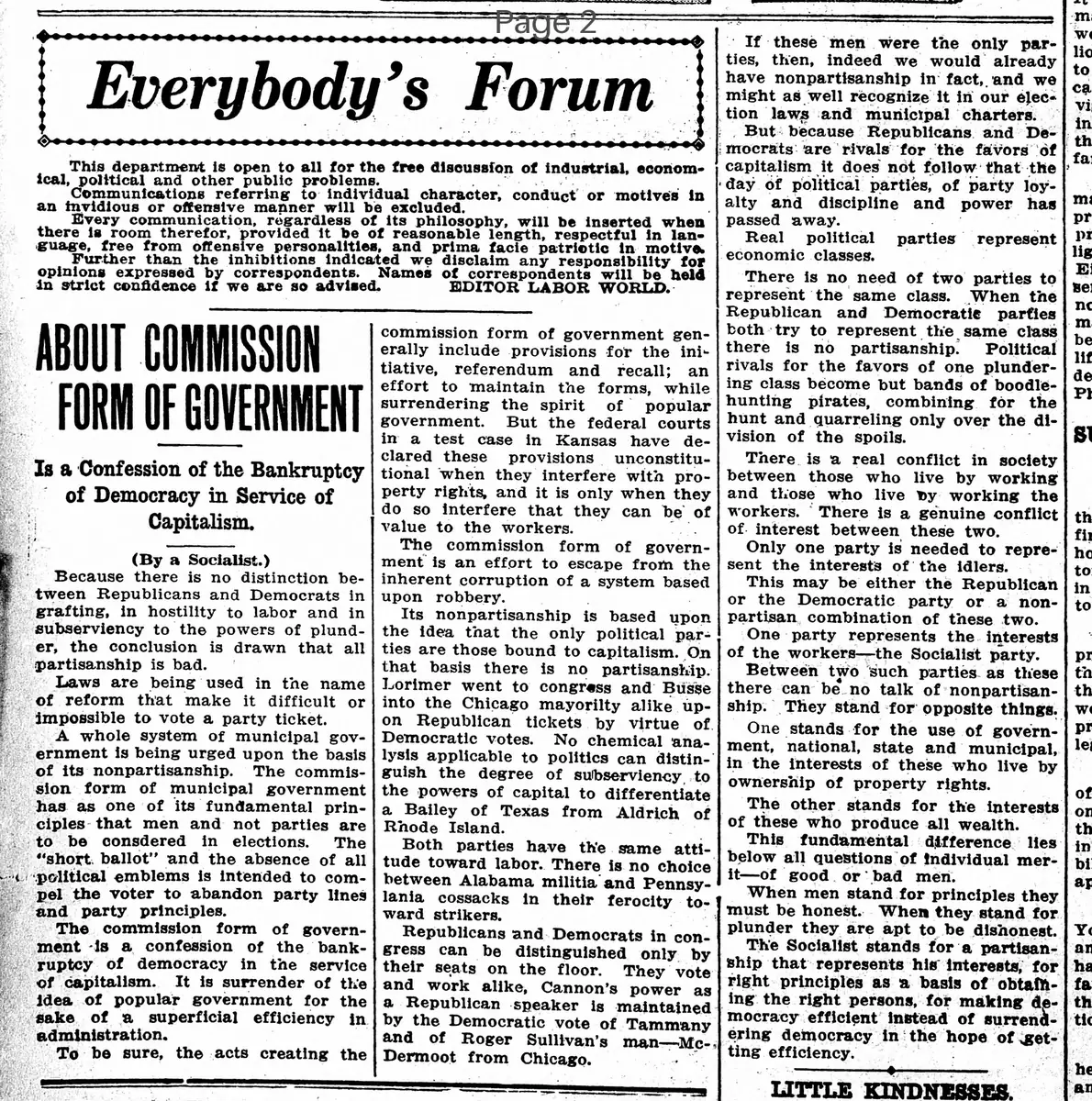
ABOUT COMMISSION FORM OF GOVERNMENT
Is a Confession of the Bankruptcy of Democracy in Service of Capitalism.
(By a Socialist.)
Because there is no distinction between Republicans and Democrats in grafting, in hostility to labor and in subserviency to the powers of plunder, the conclusion is drawn that all partisanship is bad.
Laws are being used in the name of reform that make it difficult or impossible to vote a party ticket.
A whole system of municipal government is being urged upon the basis of its nonpartisanship. The commission form of municipal government has as one of its fundamental principles-that men and not parties are to be considered in elections.
The "short ballot" and the absence of all political emblems is intended to compel the voter to abandon party lines and party principles.
The commission form of government is a confession of the bankruptcy of democracy in the service of capitalism. It is surrender of the idea of popular government for the sake of a superficial efficiency in administration.
To be sure, the acts creating the commission form of government generally include provisions for the initiative, referendum and recall: an effort to maintain the forms, while surrendering the spirit of popular government. But the federal courts in a test case in Kansas have declared these provisions unconstitutional when they interfere with property rights, and it is only when they do so interfere that they can be of value to the workers.
The commission form of government is an effort to escape from the inherent corruption of a system based upon robbery.
Its nonpartisanship is based upon the idea that the only political parties are those bound to capitalism. On that basis there is no partisanship.
Lorimer went to congress and Busse into the Chicago mayoralty alike upon Republican tickets by virtue of Democratic votes. No chemical analysis applicable to politics can distinguish the degree of subserviency to the powers of capital to differentiate a Bailey of Texas from Aldrich of Rhode Island.
Both parties have the same attitude toward labor. There is no choice between Alabama militia and Pennsylvania Cossacks in their ferocity toward strikers.
Republicans and Democrats in congress can be distinguished only by their seats on the floor. They vote and work alike, Cannon's power as a Republican speaker is maintained by the Democratic vote of Tammany and of Roger Sullivan's man--McDermoot from Chicago.
If these men were the only parties, then, indeed we would already have nonpartisanship in fact, and we might as well recognize it in our election laws and municipal charters.
But because Republicans and Democrats are rivals for the favors of capitalism it does not follow that the day of political parties, of party loyalty and discipline and power has passed away.
Real political parties represent economic classes.
There is no need of two parties to represent the same class. When the Republican and Democratic parties both try to represent the same class there is no partisanship.
Political rivals for the favors of one plundering class become but bands of boodle-hunting pirates, combining for the hunt and quarreling only over the division of the spoils.
There is a real conflict in society between those who live by working and those who live by working the workers. There is a genuine conflict of interest between these two.
Only one party is needed to represent the interests of the idlers. This may be either the Republican or the Democratic party or a non-partisan combination of these two.
One party represents the interests of the workers-the Socialist party.
Between two such parties as these there can be no talk of nonpartisanship. They stand for opposite things.
One stands for the use of government, national, state and municipal, in the interests of those who live by ownership of property rights.
The other stands for the interests of those who produce all wealth.
This fundamental difference lies below all questions of individual merit of good or bad men.
When men stand for principles they must be honest. When they stand for plunder they are apt to be dishonest.
The Socialist stands for a partisanship that represents his interests, for right principles as a basis of obtaining the right persons, for making democracy efficient instead of surrendering democracy in the hope of getting efficiency.
Is a Confession of the Bankruptcy of Democracy in Service of Capitalism.
(By a Socialist.)
Because there is no distinction between Republicans and Democrats in grafting, in hostility to labor and in subserviency to the powers of plunder, the conclusion is drawn that all partisanship is bad.
Laws are being used in the name of reform that make it difficult or impossible to vote a party ticket.
A whole system of municipal government is being urged upon the basis of its nonpartisanship. The commission form of municipal government has as one of its fundamental principles-that men and not parties are to be considered in elections.
The "short ballot" and the absence of all political emblems is intended to compel the voter to abandon party lines and party principles.
The commission form of government is a confession of the bankruptcy of democracy in the service of capitalism. It is surrender of the idea of popular government for the sake of a superficial efficiency in administration.
To be sure, the acts creating the commission form of government generally include provisions for the initiative, referendum and recall: an effort to maintain the forms, while surrendering the spirit of popular government. But the federal courts in a test case in Kansas have declared these provisions unconstitutional when they interfere with property rights, and it is only when they do so interfere that they can be of value to the workers.
The commission form of government is an effort to escape from the inherent corruption of a system based upon robbery.
Its nonpartisanship is based upon the idea that the only political parties are those bound to capitalism. On that basis there is no partisanship.
Lorimer went to congress and Busse into the Chicago mayoralty alike upon Republican tickets by virtue of Democratic votes. No chemical analysis applicable to politics can distinguish the degree of subserviency to the powers of capital to differentiate a Bailey of Texas from Aldrich of Rhode Island.
Both parties have the same attitude toward labor. There is no choice between Alabama militia and Pennsylvania Cossacks in their ferocity toward strikers.
Republicans and Democrats in congress can be distinguished only by their seats on the floor. They vote and work alike, Cannon's power as a Republican speaker is maintained by the Democratic vote of Tammany and of Roger Sullivan's man--McDermoot from Chicago.
If these men were the only parties, then, indeed we would already have nonpartisanship in fact, and we might as well recognize it in our election laws and municipal charters.
But because Republicans and Democrats are rivals for the favors of capitalism it does not follow that the day of political parties, of party loyalty and discipline and power has passed away.
Real political parties represent economic classes.
There is no need of two parties to represent the same class. When the Republican and Democratic parties both try to represent the same class there is no partisanship.
Political rivals for the favors of one plundering class become but bands of boodle-hunting pirates, combining for the hunt and quarreling only over the division of the spoils.
There is a real conflict in society between those who live by working and those who live by working the workers. There is a genuine conflict of interest between these two.
Only one party is needed to represent the interests of the idlers. This may be either the Republican or the Democratic party or a non-partisan combination of these two.
One party represents the interests of the workers-the Socialist party.
Between two such parties as these there can be no talk of nonpartisanship. They stand for opposite things.
One stands for the use of government, national, state and municipal, in the interests of those who live by ownership of property rights.
The other stands for the interests of those who produce all wealth.
This fundamental difference lies below all questions of individual merit of good or bad men.
When men stand for principles they must be honest. When they stand for plunder they are apt to be dishonest.
The Socialist stands for a partisanship that represents his interests, for right principles as a basis of obtaining the right persons, for making democracy efficient instead of surrendering democracy in the hope of getting efficiency.
What sub-type of article is it?
Partisan Politics
Labor
Economic Policy
What keywords are associated?
Commission Government
Nonpartisanship
Socialism
Capitalism
Labor Interests
Political Parties
Democracy
Class Conflict
What entities or persons were involved?
Republicans
Democrats
Socialist Party
Lorimer
Busse
Bailey Of Texas
Aldrich Of Rhode Island
Cannon
Tammany
Roger Sullivan
Mcdermoot
Editorial Details
Primary Topic
Critique Of Commission Form Of Government As Bankruptcy Of Democracy Serving Capitalism
Stance / Tone
Socialist Advocacy For Class Based Partisanship Against Nonpartisan Capitalist Control
Key Figures
Republicans
Democrats
Socialist Party
Lorimer
Busse
Bailey Of Texas
Aldrich Of Rhode Island
Cannon
Tammany
Roger Sullivan
Mcdermoot
Key Arguments
No Distinction Between Republicans And Democrats In Serving Capitalism And Opposing Labor
Commission Form Promotes Nonpartisanship To Abandon Party Principles
It Surrenders Popular Government For Administrative Efficiency
Initiative, Referendum, Recall Undermined By Courts Protecting Property Rights
Real Parties Represent Economic Classes; Socialist Party For Workers
Capitalist Parties Are Rivals For Spoils, Not True Partisanship
Fundamental Conflict Between Workers And Owners Requires Partisan Opposition