Thank you for visiting SNEWPapers!
Sign up free
Editorial
May 7, 1864
Brownlow's Knoxville Whig, And Rebel Ventilator
Knoxville, Knox County, Tennessee
What is this article about?
This editorial defends the perpetuity of the American Union as established by the Constitution and Articles of Confederation, arguing against secession amid current national events, emphasizing the government's firmness and founders' intent for a permanent nation.
Clipping
OCR Quality
92%
Excellent
Full Text
The Union Perpetual.
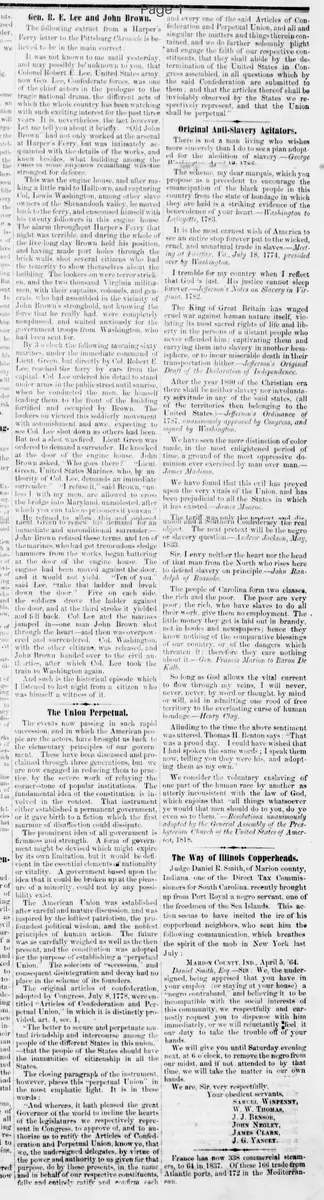
The events now passing in such rapid succession, and in which the American people are the actors, have brought us back to the elementary principles of our government. These have been discussed and proclaimed through three generations, but we are now engaged in reducing them to practice, by the severe work of relaying the corner-stone of popular institutions. The fundamental idea of the constitution is involved in the contest. That instrument either established a permanent government, or it gave birth to a fiction which the first murmur of disaffection could dissipate. The prominent idea of all government is firmness and strength. A form of government might be devised which might expire by its own limitation, but it would be deficient in the essential elements of nationality or vitality. A government based upon the idea that it could be broken up at the pleasure of a minority, could not by any possibility exist.
The American Union was established after careful and mature discussion, and was inspired by the loftiest patriotism, the profoundest political wisdom, and the noblest principles of human action. The future was as carefully weighed as well as the then present, and the constitution was adopted for the purpose of establishing a "perpetual Union." The solecism of "secession," and consequent disintegration and decay had no place in the scheme of its founders.
The original articles of confederation, adopted by Congress, July 8, 1778, were entitled "Articles of Confederation and Perpetual Union," in which it is distinctly provided, art. 4, sec. 1.
The better to secure and perpetuate mutual friendship and intercourse among the people of the different States in this union—the free inhabitants of each of these States, paupers, vagabonds, and fugitives from justice excepted, shall be entitled to all the privileges and immunities of free citizens in the several States.
The closing paragraph of the instrument, however, places this "perpetual Union" in the most emphatic light. It is in these words:
"And whereas, it hath pleased the great Governor of the world to incline the hearts of the legislatures we respectively represent in Congress, to approve of, and to authorize us to ratify the Articles of Confederation and Perpetual Union, know ye, that we, the undersigned delegates, by virtue of the power and authority to us given for that purpose, do by these presents, in the name and in behalf of our respective constituents, fully and entirely ratify and confirm each and every one of the said Articles of Confederation and Perpetual Union, and all and singular the matters and things therein contained, and we do further solemnly plight and engage the faith of our respective constituents, that they shall abide by the determination of the United States in Congress assembled, in all questions which by the said Confederation are submitted to them, and that the articles thereof shall be inviolably observed by the States we respectively represent, and that the Union shall be perpetual."
The events now passing in such rapid succession, and in which the American people are the actors, have brought us back to the elementary principles of our government. These have been discussed and proclaimed through three generations, but we are now engaged in reducing them to practice, by the severe work of relaying the corner-stone of popular institutions. The fundamental idea of the constitution is involved in the contest. That instrument either established a permanent government, or it gave birth to a fiction which the first murmur of disaffection could dissipate. The prominent idea of all government is firmness and strength. A form of government might be devised which might expire by its own limitation, but it would be deficient in the essential elements of nationality or vitality. A government based upon the idea that it could be broken up at the pleasure of a minority, could not by any possibility exist.
The American Union was established after careful and mature discussion, and was inspired by the loftiest patriotism, the profoundest political wisdom, and the noblest principles of human action. The future was as carefully weighed as well as the then present, and the constitution was adopted for the purpose of establishing a "perpetual Union." The solecism of "secession," and consequent disintegration and decay had no place in the scheme of its founders.
The original articles of confederation, adopted by Congress, July 8, 1778, were entitled "Articles of Confederation and Perpetual Union," in which it is distinctly provided, art. 4, sec. 1.
The better to secure and perpetuate mutual friendship and intercourse among the people of the different States in this union—the free inhabitants of each of these States, paupers, vagabonds, and fugitives from justice excepted, shall be entitled to all the privileges and immunities of free citizens in the several States.
The closing paragraph of the instrument, however, places this "perpetual Union" in the most emphatic light. It is in these words:
"And whereas, it hath pleased the great Governor of the world to incline the hearts of the legislatures we respectively represent in Congress, to approve of, and to authorize us to ratify the Articles of Confederation and Perpetual Union, know ye, that we, the undersigned delegates, by virtue of the power and authority to us given for that purpose, do by these presents, in the name and in behalf of our respective constituents, fully and entirely ratify and confirm each and every one of the said Articles of Confederation and Perpetual Union, and all and singular the matters and things therein contained, and we do further solemnly plight and engage the faith of our respective constituents, that they shall abide by the determination of the United States in Congress assembled, in all questions which by the said Confederation are submitted to them, and that the articles thereof shall be inviolably observed by the States we respectively represent, and that the Union shall be perpetual."
What sub-type of article is it?
Constitutional
What keywords are associated?
Perpetual Union
Secession
American Constitution
Articles Of Confederation
Government Permanence
National Unity
What entities or persons were involved?
American Founders
United States Congress
Delegates To The Confederation
Editorial Details
Primary Topic
Perpetuity Of The American Union Against Secession
Stance / Tone
Strongly Pro Perpetual Union And Anti Secession
Key Figures
American Founders
United States Congress
Delegates To The Confederation
Key Arguments
The Constitution Establishes A Permanent Government Essential For Nationality And Vitality
Secession Is A Solecism Incompatible With The Founders' Scheme
The Articles Of Confederation Explicitly Title And Provide For A 'Perpetual Union'
Ratification Pledges Inviolable Observance And Perpetual Union