Thank you for visiting SNEWPapers!
Sign up free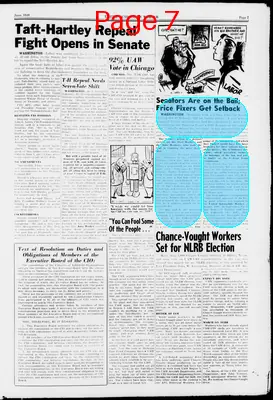
Story
June 1, 1949
United Automobile Worker
Detroit, Wayne County, Michigan
What is this article about?
The U.S. Senate passes the O'Mahoney bill, defeating a steel and cement industry push for a moratorium on FTC enforcement against price-fixing basing points, supported by unions and key senators, preserving anti-monopoly laws.
Clipping
OCR Quality
92%
Excellent
Full Text
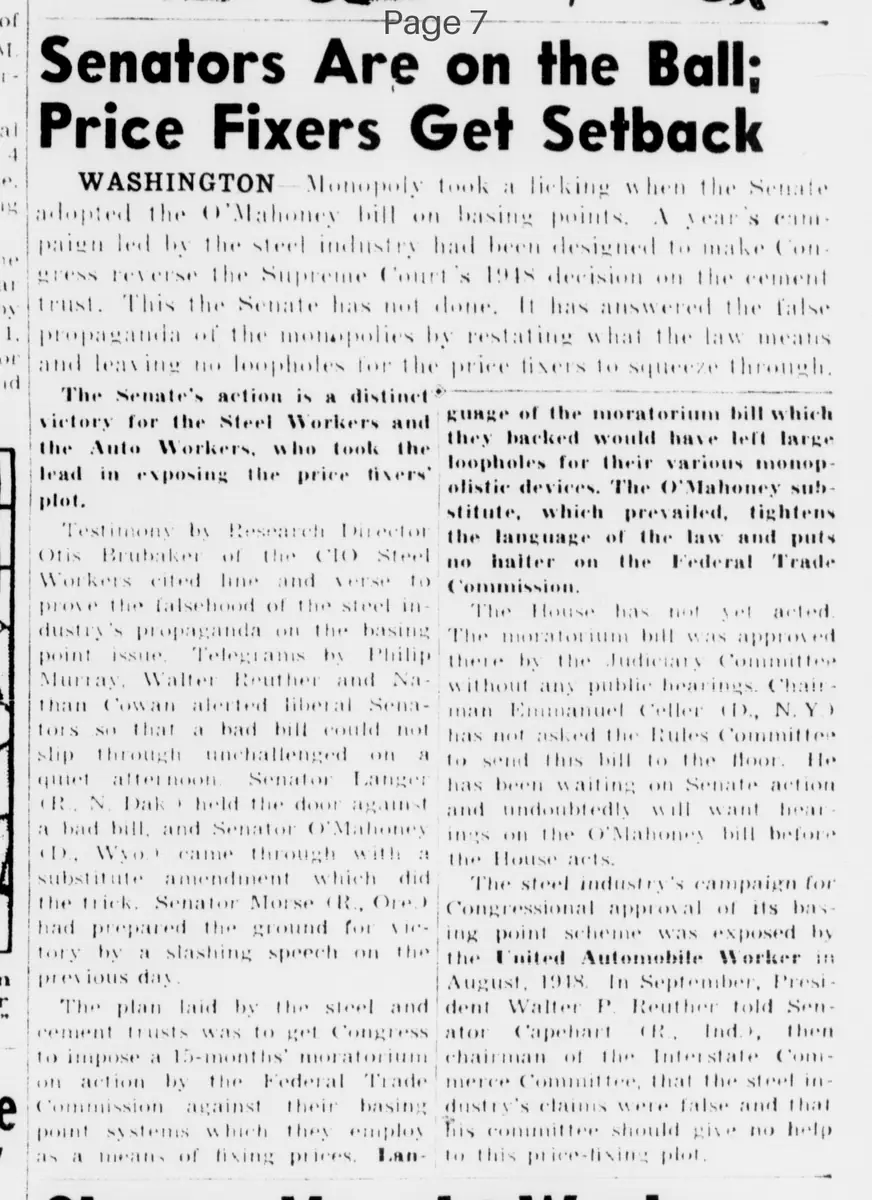
Senators Are on the Ball: Price Fixers Get Setback
WASHINGTON
Monopoly took a licking when the Senate adopted the O'Mahoney bill on basing points. A smear campaign led by the steel industry had been designed to make Congress reverse the Supreme Court's tough decision on the cement trust. This the Senate has not done. It has answered the false propaganda of the monopolies by restating what the law means and leaving no loopholes for the price fixers to squeeze through.
The Senate's action is a distinct victory for the Steel Workers and the Auto Workers, who took the lead in exposing the price fixers' plot.
Testimony by Rose Mary Detor, Otis Brubaker of the CIO Steel Workers cited line and verse to prove the falsehood of the steel industry's propaganda on the basing point issue. Telegrams by Philip Murray, Walter Reuther and Nathan Cowan alerted liberal Senators so that a bad bill could not slip through unchallenged on a quiet afternoon. Senator Langer of N. Dak. held the floor against a bad bill, and Senator O'Mahoney (D., Wyo.) came through with a substitute amendment which did the trick. Senator Morse (R., O.) had prepared the ground for victory by a slashing speech on the previous day.
The plan laid by the steel and cement trusts was to get Congress to impose a 1 1/2-months' moratorium on action by the Federal Trade Commission against their basing point systems which they employ as a means of fixing prices. Language of the moratorium bill which they backed would have left large loopholes for their various monopolistic devices. The O'Mahoney substitute, which prevailed, tightens the language of the law and puts no halter on the Federal Trade Commission.
The House has not yet acted. The moratorium bill was approved there by the Judiciary Committee without any public hearings. Chairman Emanuel Celler (D., N.Y.) has not asked the Rules Committee to send this bill to the floor. It has been waiting on Senate action and undoubtedly will want hearings on the O'Mahoney bill before the House acts.
The steel industry's campaign for congressional approval of its basing point scheme was exposed by the United Automobile Worker in August, 1948. In September, President Walter P. Reuther told Sen. Chapman (R., Ind.), then chairman of the Interstate Commerce Committee, that the steel industry's claims were false and that his committee should give no help to this price-fixing plot.
WASHINGTON
Monopoly took a licking when the Senate adopted the O'Mahoney bill on basing points. A smear campaign led by the steel industry had been designed to make Congress reverse the Supreme Court's tough decision on the cement trust. This the Senate has not done. It has answered the false propaganda of the monopolies by restating what the law means and leaving no loopholes for the price fixers to squeeze through.
The Senate's action is a distinct victory for the Steel Workers and the Auto Workers, who took the lead in exposing the price fixers' plot.
Testimony by Rose Mary Detor, Otis Brubaker of the CIO Steel Workers cited line and verse to prove the falsehood of the steel industry's propaganda on the basing point issue. Telegrams by Philip Murray, Walter Reuther and Nathan Cowan alerted liberal Senators so that a bad bill could not slip through unchallenged on a quiet afternoon. Senator Langer of N. Dak. held the floor against a bad bill, and Senator O'Mahoney (D., Wyo.) came through with a substitute amendment which did the trick. Senator Morse (R., O.) had prepared the ground for victory by a slashing speech on the previous day.
The plan laid by the steel and cement trusts was to get Congress to impose a 1 1/2-months' moratorium on action by the Federal Trade Commission against their basing point systems which they employ as a means of fixing prices. Language of the moratorium bill which they backed would have left large loopholes for their various monopolistic devices. The O'Mahoney substitute, which prevailed, tightens the language of the law and puts no halter on the Federal Trade Commission.
The House has not yet acted. The moratorium bill was approved there by the Judiciary Committee without any public hearings. Chairman Emanuel Celler (D., N.Y.) has not asked the Rules Committee to send this bill to the floor. It has been waiting on Senate action and undoubtedly will want hearings on the O'Mahoney bill before the House acts.
The steel industry's campaign for congressional approval of its basing point scheme was exposed by the United Automobile Worker in August, 1948. In September, President Walter P. Reuther told Sen. Chapman (R., Ind.), then chairman of the Interstate Commerce Committee, that the steel industry's claims were false and that his committee should give no help to this price-fixing plot.
What sub-type of article is it?
Historical Event
What themes does it cover?
Justice
Crime Punishment
Triumph
What keywords are associated?
Senate Action
Price Fixing
Steel Industry
Monopoly
Unions
Basing Points
O'mahoney Bill
What entities or persons were involved?
O'mahoney
Langer
Morse
Rose Mary Detor
Otis Brubaker
Philip Murray
Walter Reuther
Nathan Cowan
Emanuel Celler
Chapman
Where did it happen?
Washington
Story Details
Key Persons
O'mahoney
Langer
Morse
Rose Mary Detor
Otis Brubaker
Philip Murray
Walter Reuther
Nathan Cowan
Emanuel Celler
Chapman
Location
Washington
Event Date
1948
Story Details
The Senate adopts the O'Mahoney bill, rejecting a steel and cement industry-backed moratorium on FTC actions against basing point price-fixing systems, closing loopholes and affirming the Supreme Court's decision, aided by union testimony and senator interventions.