Thank you for visiting SNEWPapers!
Sign up free
Editorial
February 21, 1848
Alexandria Gazette
Alexandria, Alexandria County, District Of Columbia
What is this article about?
Editorial criticizes the Polk administration for fostering military dominance over civil authority during the Mexican-American War, with army officers denouncing dissenters as traitors via the press, warning of threats to constitutional rights and free speech.
Clipping
OCR Quality
98%
Excellent
Full Text
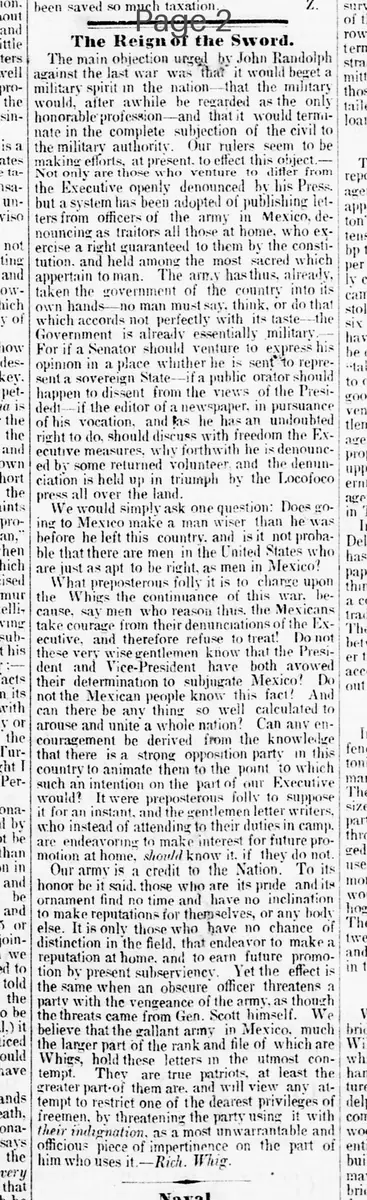
The Reign of the Sword.
The main objection urged by John Randolph against the last war was that it would beget a military spirit in the nation—that the military would, after awhile be regarded as the only honorable profession—and that it would terminate in the complete subjection of the civil to the military authority. Our rulers seem to be making efforts, at present, to effect this object.— Not only are those who venture to differ from the Executive openly denounced by his Press, but a system has been adopted of publishing letters from officers of the army in Mexico, denouncing as traitors all those at home, who exercise a right guaranteed to them by the constitution, and held among the most sacred which appertain to man. The army has thus, already, taken the government of the country into its own hands—no man must say, think, or do that which accords not perfectly with its taste—the Government is already essentially military.
For if a Senator should venture to express his opinion in a place whither he is sent to represent a sovereign State—if a public orator should happen to dissent from the views of the President—if the editor of a newspaper, in pursuance of his vocation, and as he has an undoubted right to do, should discuss with freedom the Executive measures, why forthwith he is denounced by some returned volunteer, and the denunciation is held up in triumph by the Locofoco press all over the land.
We would simply ask one question: Does going to Mexico make a man wiser than he was before he left this country, and is it not probable that there are men in the United States who are just as apt to be right, as men in Mexico?
What preposterous folly it is to charge upon the Whigs the continuance of this war, because, say men who reason thus, the Mexicans take courage from their denunciations of the Executive, and therefore refuse to treat! Do not these very wise gentlemen know that the President and Vice-President have both avowed their determination to subjugate Mexico? Do not the Mexican people know this fact? And can there be any thing so well calculated to arouse and unite a whole nation? Can any encouragement be derived from the knowledge that there is a strong opposition party in this country to animate them to the point to which such an intention on the part of our Executive would? It were preposterous folly to suppose it for an instant, and the gentlemen letter writers, who instead of attending to their duties in camp are endeavoring to make interest for future promotion at home, should know it, if they do not.
Our army is a credit to the Nation. To its honor be it said, those who are its pride and its ornament find no time and have no inclination to make reputations for themselves, or any body else. It is only those who have no chance of distinction in the field, that endeavor to make a reputation at home, and to earn future promotion by present subserviency. Yet the effect is the same when an obscure officer threatens a party with the vengeance of the army, as though the threats came from Gen. Scott himself. We believe that the gallant army in Mexico, much the larger part of the rank and file of which are Whigs, hold these letters in the utmost contempt. They are true patriots, at least the greater part of them are, and will view any attempt to restrict one of the dearest privileges of freemen, by threatening the party using it with their indignation, as a most unwarrantable and officious piece of impertinence on the part of him who uses it.—Rich. Whig.
The main objection urged by John Randolph against the last war was that it would beget a military spirit in the nation—that the military would, after awhile be regarded as the only honorable profession—and that it would terminate in the complete subjection of the civil to the military authority. Our rulers seem to be making efforts, at present, to effect this object.— Not only are those who venture to differ from the Executive openly denounced by his Press, but a system has been adopted of publishing letters from officers of the army in Mexico, denouncing as traitors all those at home, who exercise a right guaranteed to them by the constitution, and held among the most sacred which appertain to man. The army has thus, already, taken the government of the country into its own hands—no man must say, think, or do that which accords not perfectly with its taste—the Government is already essentially military.
For if a Senator should venture to express his opinion in a place whither he is sent to represent a sovereign State—if a public orator should happen to dissent from the views of the President—if the editor of a newspaper, in pursuance of his vocation, and as he has an undoubted right to do, should discuss with freedom the Executive measures, why forthwith he is denounced by some returned volunteer, and the denunciation is held up in triumph by the Locofoco press all over the land.
We would simply ask one question: Does going to Mexico make a man wiser than he was before he left this country, and is it not probable that there are men in the United States who are just as apt to be right, as men in Mexico?
What preposterous folly it is to charge upon the Whigs the continuance of this war, because, say men who reason thus, the Mexicans take courage from their denunciations of the Executive, and therefore refuse to treat! Do not these very wise gentlemen know that the President and Vice-President have both avowed their determination to subjugate Mexico? Do not the Mexican people know this fact? And can there be any thing so well calculated to arouse and unite a whole nation? Can any encouragement be derived from the knowledge that there is a strong opposition party in this country to animate them to the point to which such an intention on the part of our Executive would? It were preposterous folly to suppose it for an instant, and the gentlemen letter writers, who instead of attending to their duties in camp are endeavoring to make interest for future promotion at home, should know it, if they do not.
Our army is a credit to the Nation. To its honor be it said, those who are its pride and its ornament find no time and have no inclination to make reputations for themselves, or any body else. It is only those who have no chance of distinction in the field, that endeavor to make a reputation at home, and to earn future promotion by present subserviency. Yet the effect is the same when an obscure officer threatens a party with the vengeance of the army, as though the threats came from Gen. Scott himself. We believe that the gallant army in Mexico, much the larger part of the rank and file of which are Whigs, hold these letters in the utmost contempt. They are true patriots, at least the greater part of them are, and will view any attempt to restrict one of the dearest privileges of freemen, by threatening the party using it with their indignation, as a most unwarrantable and officious piece of impertinence on the part of him who uses it.—Rich. Whig.
What sub-type of article is it?
War Or Peace
Partisan Politics
Constitutional
What keywords are associated?
Military Spirit
Mexican War
Civil Liberties
Free Speech
Whig Opposition
Locofoco Press
Army Threats
Constitutional Rights
What entities or persons were involved?
John Randolph
Executive
President
Vice President
Army Officers In Mexico
Gen. Scott
Whigs
Locofoco Press
Mexicans
Editorial Details
Primary Topic
Military Subjection Of Civil Authority During Mexican War
Stance / Tone
Strongly Critical Of Administration And Military Interference In Politics
Key Figures
John Randolph
Executive
President
Vice President
Army Officers In Mexico
Gen. Scott
Whigs
Locofoco Press
Mexicans
Key Arguments
War Begets Military Spirit Leading To Subjection Of Civil Authority
Army Officers Denounce Dissenters As Traitors Via Published Letters
Constitutional Right To Free Speech Is Sacred And Must Not Be Suppressed
Whig Opposition Does Not Prolong War; Administration's Subjugation Intent Unites Mexicans
True Soldiers Focus On Duty, Not Political Threats For Promotion
Army Rank And File, Mostly Whigs, Contemptuous Of Such Political Meddling