Thank you for visiting SNEWPapers!
Sign up free
Story
January 28, 1846
The Daily Spy
Worcester, Worcester County, Massachusetts
What is this article about?
Ohio's rapid transformation from Indian wilderness in the late 18th century to a prosperous state by 1840, with population growing from 45,365 in 1800 to 1,600,000. Features steamboats, canals, towns, natural resources, and westward migration to Indiana, Illinois, and beyond, as noted by De Tocqueville.
Clipping
OCR Quality
98%
Excellent
Full Text
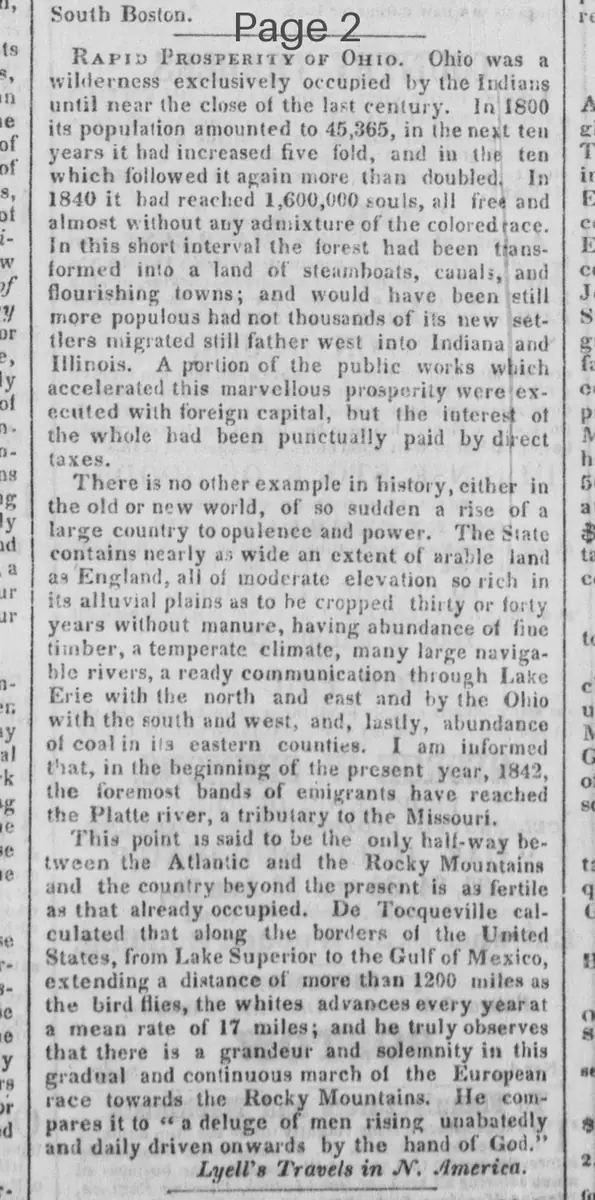
RAPID PROSPERITY OF OHIO. OHIO WAS a wilderness exclusively occupied by the Indians until near the close of the last century. In 1800 its population amounted to 45,365, in the next ten years it had increased five fold, and in the ten which followed it again more than doubled. In 1840 it had reached 1,600,000 souls, all free and almost without any admixture of the colored race.
In this short interval the forest had been transformed into a land of steamboats, canals, and flourishing towns; and would have been still more populous had not thousands of its new settlers migrated still farther west into Indiana and Illinois. A portion of the public works which accelerated this marvellous prosperity were executed with foreign capital, but the interest of the whole had been punctually paid by direct taxes.
There is no other example in history, either in the old or new world, of so sudden a rise of a large country to opulence and power. The State contains nearly as wide an extent of arable land as England, all of moderate elevation so rich in its alluvial plains as to be cropped thirty or forty years without manure, having abundance of fine timber, a temperate climate, many large navigable rivers, a ready communication through Lake Erie with the north and east and by the Ohio with the south and west, and, lastly, abundance of coal in its eastern counties. I am informed that, in the beginning of the present year, 1842, the foremost bands of emigrants have reached the Platte river, a tributary to the Missouri.
This point is said to be the only half-way between the Atlantic and the Rocky Mountains and the country beyond the present is as fertile as that already occupied. De Tocqueville calculated that along the borders of the United States, from Lake Superior to the Gulf of Mexico, extending a distance of more than 1200 miles as the bird flies, the whites advance every year at a mean rate of 17 miles; and he truly observes that there is a grandeur and solemnity in this gradual and continuous march of the European race towards the Rocky Mountains. He compares it to "a deluge of men rising unabatedly and daily driven onwards by the hand of God."
In this short interval the forest had been transformed into a land of steamboats, canals, and flourishing towns; and would have been still more populous had not thousands of its new settlers migrated still farther west into Indiana and Illinois. A portion of the public works which accelerated this marvellous prosperity were executed with foreign capital, but the interest of the whole had been punctually paid by direct taxes.
There is no other example in history, either in the old or new world, of so sudden a rise of a large country to opulence and power. The State contains nearly as wide an extent of arable land as England, all of moderate elevation so rich in its alluvial plains as to be cropped thirty or forty years without manure, having abundance of fine timber, a temperate climate, many large navigable rivers, a ready communication through Lake Erie with the north and east and by the Ohio with the south and west, and, lastly, abundance of coal in its eastern counties. I am informed that, in the beginning of the present year, 1842, the foremost bands of emigrants have reached the Platte river, a tributary to the Missouri.
This point is said to be the only half-way between the Atlantic and the Rocky Mountains and the country beyond the present is as fertile as that already occupied. De Tocqueville calculated that along the borders of the United States, from Lake Superior to the Gulf of Mexico, extending a distance of more than 1200 miles as the bird flies, the whites advance every year at a mean rate of 17 miles; and he truly observes that there is a grandeur and solemnity in this gradual and continuous march of the European race towards the Rocky Mountains. He compares it to "a deluge of men rising unabatedly and daily driven onwards by the hand of God."
What sub-type of article is it?
Historical Event
What themes does it cover?
Fortune Reversal
Exploration
Triumph
What keywords are associated?
Ohio Prosperity
Population Growth
Westward Migration
Historical Development
Natural Resources
What entities or persons were involved?
De Tocqueville
Where did it happen?
Ohio, Indiana, Illinois, Platte River
Story Details
Key Persons
De Tocqueville
Location
Ohio, Indiana, Illinois, Platte River
Event Date
1800 1842
Story Details
Ohio grows from wilderness to prosperous state with population from 45,365 in 1800 to 1,600,000 in 1840, aided by infrastructure and resources; settlers migrate west; De Tocqueville describes European advance as divine deluge.