Thank you for visiting SNEWPapers!
Sign up free
Portland Gazette, And Maine Advertiser
Portland, Cumberland County, Maine
What is this article about?
In the U.S. House of Representatives in Washington on May 26-27, debate ensued over a resolution by Mr. Randolph praising President Madison's prompt handling of British overtures to restore harmony and commerce. Opponents argued it was adulatory and unnecessary. The resolution was not adopted after a tied vote.
Merged-components note: These components are parts of the same congressional proceedings report from Washington; the second appears to be a partial duplicate or continuation due to parsing overlap. Relabeled from 'story' to 'domestic_news' for consistency with similar national political reporting.
Clipping
OCR Quality
Full Text
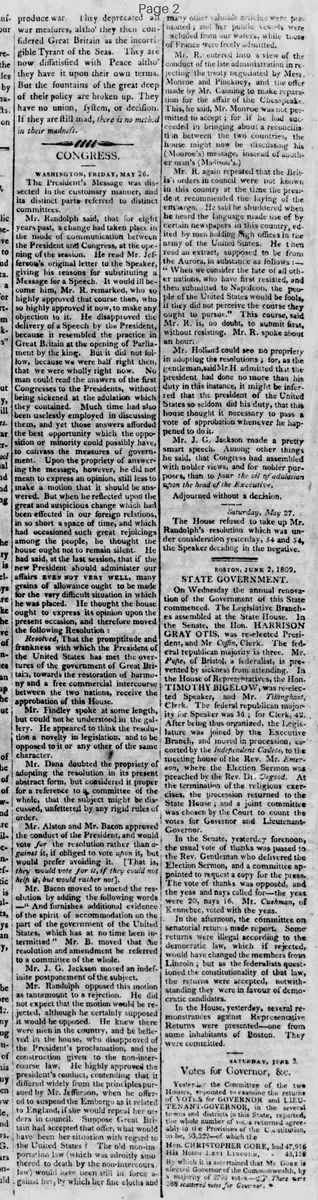
WASHINGTON, FRIDAY, MAY 26.
The President's Message was dissected in the customary manner, and its distinct parts referred to distinct committees.
Mr. Randolph said, that for eight years past, a change had taken place in the mode of communication between the President and Congress, at the opening of the session. He read Mr. Jefferson's original letter to the Speaker, giving his reasons for substituting a Message for a Speech. It would ill become him, Mr. R. remarked, who so highly approved that course then, who so highly approved it now, to make any objection to it. He disapproved the delivery of a Speech by the President, because it resembled the practice in Great Britain at the opening of Parliament by the king. But it did not follow, because we were half right then, that we were wholly right now. No man could read the answers of the first Congresses to the Presidents, without being sickened at the adulation which they contained. Much time had also been uselessly employed in discussing them, and yet those answers afforded the best opportunity which the opposition or minority could possibly have, to canvass the measures of government. Upon the propriety of answering the message, however, he did not mean to express an opinion, still less to make a motion that it should be answered. But when he reflected upon the great and auspicious change which had been effected in our foreign relations, in so short a space of time, and which had occasioned such great rejoicings among the people, he thought the house ought not to remain silent. He had said, at the last session, that if the new President should administer our affairs EVEN NOT VERY WELL, many grains of allowance ought to be made for the very difficult situation in which he was placed. He thought the house ought to express its opinion upon the present occasion, and therefore moved the following Resolution :
Resolved, That the promptitude and frankness with which the President of the United States has met the overtures of the government of Great Britain, towards the restoration of harmony and a free commercial intercourse between the two nations, receive the approbation of this House.
Mr. Findley spoke at some length, but could not be understood in the gallery. He appeared to think the resolution a novelty in legislation, and to be opposed to it or any other of the same character.
Mr. Dana doubted the propriety of adopting the resolution in its present abstract form, but considered it proper for a reference to a committee of the whole, that the subject might be discussed, unfettered by any rigid rules of order.
Mr. Alston and Mr. Bacon approved the conduct of the President, and would vote for the resolution rather than against it, if obliged to vote upon it, but would prefer avoiding it. [That is, they would vote for it, if they could not help it, but would rather not].
Mr. Bacon moved to amend the resolution by adding the following words _"And furnishes additional evidence of the spirit of accommodation on the part of the government of the United States, which has at no time been intermitted" Mr. B. moved that the resolution and amendment be referred to a committee of the whole
Mr. J. G. Jackson moved an indefinite postponement of the subject.
Mr. Randolph opposed this motion as tantamount to a rejection. He did not expect that the motion would be rejected, although he certainly supposed it would be opposed. He knew there were men in the country, and he believed in the house, who disapproved of the President's proclamation, and the construction given to the non-intercourse law. He highly approved the president's conduct, contending that it differed widely from the principles pursued by Mr. Jefferson, when he offered to suspend the Embargo as it related to England, if she would repeal her orders in council. Suppose Great Britain had accepted that offer, what would have been her situation with regard to the United States ? The old non-importation law (which was adroitly smothered to death by the non-intercourse law) would have been still in force against her, by which her fine cloths and many other valuable articles were prohibited; and her public vessels were excluded from our waters, while those of France were freely admitted.
Mr. R. entered into a view of the conduct of the late administration in rejecting the treaty negotiated by Messrs. Monroe and Pinkney, and the offer made by Mr. Canning to make reparation for the affair of the Chesapeake. This, he said, Mr. Monroe was not permitted to accept; for if he had succeeded in bringing about a reconciliation between the two countries, the house might now be discussing his (Monroe's) message instead of another man's (Madison's.)
Mr. R. again repeated that the British orders in council were not known in this country at the time the president recommended the laying of the embargo. He said he shuddered when he heard the language made use of by certain newspapers in this country, edited by men holding high offices in the army of the United States. He then read an extract, supposed to be from the Aurora, in substance as follows :—
"When we consider the state of all other nations, who have first resisted, and then submitted to Napoleon, the people of the United States would be fools, if they did not perceive the course they ought to pursue." This course, said Mr. R. is, no doubt, to submit first, without resisting. Mr. R. spoke about an hour.
Mr. Holland could see no propriety in adopting the resolutions ; for, as the gentleman, said Mr. H. admitted that the president had done no more than his duty in this instance, it might be inferred that the president of the United States so seldom did his duty, that this house thought it necessary to pass a vote of approbation whenever he happened to do it.
Mr. J. G. Jackson made a pretty smart speech. Among other things he said, that Congress had assembled with nobler views, and for nobler purposes, than to pour the oil of adulation upon the head of the Executive.
Adjourned without a decision.
Saturday, May 27.
The House refused to take up Mr. Randolph's resolution which was under consideration yesterday, 54 and 54, the Speaker deciding in the negative.
What sub-type of article is it?
What keywords are associated?
What entities or persons were involved?
Where did it happen?
Domestic News Details
Primary Location
Washington
Event Date
Friday, May 26 Saturday, May 27
Key Persons
Outcome
adjourned without decision on may 26; on may 27, house refused to take up the resolution in a 54-54 tie, speaker deciding in the negative.
Event Details
Debate in the House of Representatives on Mr. Randolph's resolution approving the President's prompt and frank response to British overtures for restoring harmony and commercial intercourse. Speakers discussed historical precedents, adulation concerns, and foreign policy differences from prior administrations. Amendments and postponement motions were proposed but no decision reached initially.