Thank you for visiting SNEWPapers!
Sign up free
Editorial
April 23, 1833
The New Hampshire Gazette
Portsmouth, Rockingham County, New Hampshire
What is this article about?
The Richmond Enquirer's 'Cursory Review' critiques John C. Calhoun's early ultra-federalist positions on protective tariffs (1816), internal improvements, and the national bank, contrasting them with his current nullification and states' rights advocacy, rebutting defenses in the Washington Telegraph.
Clipping
OCR Quality
95%
Excellent
Full Text
POLITICAL.
From the Richmond Enquirer.
CURSORY REVIEW.
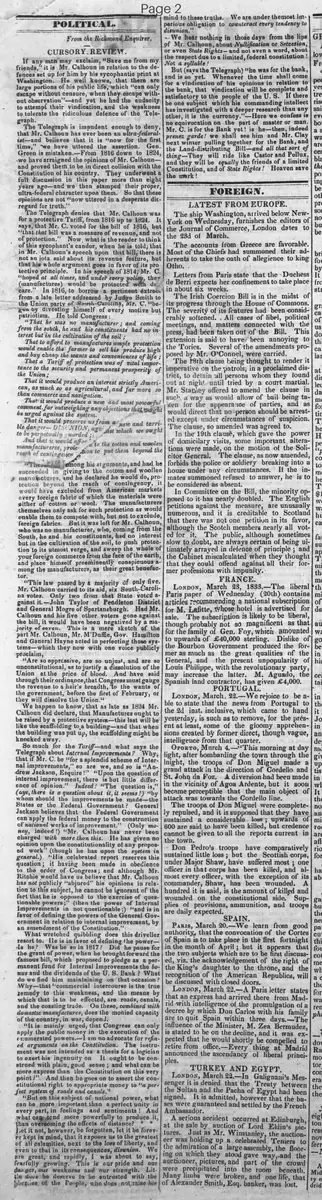
If any man may exclaim, "Save me from my friends," it is Mr. Calhoun in relation to the defenses set up for him by his sycophantic print at Washington. He well knows, that there are large portions of his public life, which can only escape without censure, when they escape without observation—and yet he had the audacity to attempt their vindication, and the weakness to tolerate the ridiculous defence of the Telegraph.
The Telegraph is impudent enough to deny that Mr. Calhoun has ever been an ultra-federalist—and believes that it is "now for the first time," we have uttered the assertion. Gen. Green is mistaken.—From 1816 down to 1824, we have arraigned the opinions of Mr. Calhoun—and proved them to be in direct collision with the Constitution of his country. They underwent a full discussion in this paper more than eight years ago—and we then stamped their proper, ultra-federal character upon them. So that these opinions are not 'now uttered in a desperate disregard for truth."
The Telegraph denies that Mr. Calhoun was for a protective Tariff, from 1816 up to 1824. It says, that Mr. C. voted for the bill of 1816, but "that that bill was a measure of revenue, and not of protection." Now, what is the reader to think of this sycophant's candor, when he is told; that in Mr. Calhoun's speech upon that bill, there is not an iota said about its revenue feature, but that his whole argument goes in favor of its protective principle. In his speech of 1814, Mr. C. "hoped at all times, and under every policy, the (manufactures) would be protected with due care." In 1816, to borrow a pertinent extract from: a late letter addressed by Judge Smith to the Union party of South-Carolina, Mr. C. "began by divesting himself of every motive but patriotism. He told Congress:
"That he was no manufacturer; and coming from the south, he and his constituents had no interest but in the cultivation of the soil :
That to afford to manufactures ample protection would enable the farmer to sell his produce high and buy cheap the wants and conveniences of life ;
That a Tariff of protection was of vital importance to the security and permanent prosperity of the Union;
That it would produce an interest strictly American, as much so as agricultural, and far more so than commerce and navigation.
That it would produce a new and most powerful comment. far outweighing any objections that might be urged against the system.
That it would preserve us from a new and terrible danger—DISUNION, against which we ought to be perpetually guarded;
And that it would afford to the cotton and woolen manufacturers, protection beyond the reach of contingency
These among his arguments, and had he succeeded in giving to the cotton and woollen manufactures, and he declared he would do, protection beyond the reach of contingency, it would have excluded from American markets every foreign fabric of which the materials were either of cotton or wool. The manufacturers themselves only ask for such protection as would enable them to compete with, but not to exclude, foreign fabrics. But it was left for Mr. Calhoun, who was no manufacturer, who, coming from the South, he and his constituents, had no interest but in the cultivation of the soil, to push protection to its utmost verge, and sweep the whole of your foreign commerce from the face of the earth. and place himself preeminently conspicuous among the manufacturers, as their great benefactor.
"This law passed by a majority of only five. Mr. Calhoun carried to its aid, six South-Carolina votes. Only two from that State voted against it.—John Taylor of Pendleton District and General Moore of Spartansburgh. Had Mr. Calhoun and his five other voters gone against the bill, it would have been negatived by a majority of seven, This is a mere sketch of the part Mr. Calhoun, Mr. M'Duffie, Gov. Hamilton and General Hayne acted in perfecting those systems—which they now with one voice publicly proclaim,
"Are so oppressive, are so unjust, and are so unconstitutional, as to justify a dissolution of the Union at the price of blood. And have said through their ordinance,that Congress must gauge the revenue to a hair's breadth, to the wants of the government, before the first of February, or they will dissolve the Union."
We happen to know, that as late as 1824 Mr. Calhoun did declare, that Manufactures ought to be raised by a protective system—this last will be like the scaffolding to a building—and that when the building was put up, the scaffolding might be knocked away.
So much for the Tariff—and what says the Telegraph about Internal Improvements? Why; that if Mr. C. be "for a splendid scheme of Internal improvements,"so are we, and so is "Andrew Jackson, Esquire!" "Upon the question of internal improvement, there is but little difference of opinion." Indeed! "The question is," (aye,there is a question about it, it seems!) "by whom should the improvements be made—the States or the Federal Government? General Jackson believes that the Federal Government can apply the federal money to the construction of national works of improvement." (Only money, indeed!"Mr. Calhoun has never been charged with more than this. He has given no opinion upon the constitutionality of any proposed work"' (though he has upon the system in general.) "His celebrated report reserves this question; it having been made in obedience to the order of Congress; and although Mr. Ritchie would have us believe that Mr. Calhoun has not publicly "abjured" his opinions in relation to this subject, he cannot be ignorant of the fact that he is opposed to the exercise of questionable powers;" (then the power of Internal Improvements is not questionable;"and is in favor of defining the powers of the General Government in relation to internal improvement, by an amendment of the Constitution.
What wretched quibbling does this driveller resort to. He is in favor of defining the power— Is he? Was he so in 1817? Did he pause for the grant of power, when he brought forward the famous bill, which proposed to pledge as a permanent fund for Internal Improvements the bonus and the dividends of the U. S. Bank ? What do we find him maintaining on that occasion? Why—that "commercial intercourse is the true remedy to this weakness, and the means by which that is to be effected, are roads, canals, and the coasting trade. On these, combined with domestic manufactures, does the monied capacity of the country, in war, depend.
"It is mainly urged, that Congress can only apply the public money in the execution of the enumerated powers.—I am no advocate for refined. arguments on the Constitution. The instrument was not intended as a thesis for a logician to exert his ingenuity on It ought to be construed with plain, good sense; and what can be more express than the Constitution on this very point?". And then he goes on to assert the constitutional right to appropriate money to "a perfect system of roads and canals."
"But on this subject of national power, what can be more important than a perfect unity in every part, in feelings and sentiments! And what can tend more powerfully to produce it, than overcoming the effects of distance?
Let it not, however, be forgotten, let it be forever kept in mind, that it exposes us to the greatest of all calamities, next to the loss of liberty, and even to that in its consequences, disunion. We are great, and rapidly, I was about to say. fearfully growing. This is our pride and our danger, our weakness and our strength. Little does he deserve to be entrusted with the Liberties. of the People, who does not raise his mind to these truths. We are under the most imperious obligation to counteract every tendency to disunion."
We hear nothing in those days from the lips of Mr. Calhoun. about—Nullification or Secession, or even State Rights—and not even a word, about the respect due to a limited, federal constitution! Not a syllable!
But (says the Telegraph) "he was for the bank, and is so yet. Whenever the time shall come for a vindication of his opinions in relation to the bank, that vindication will be complete and satisfactory to the people of the U. S. If there be one subject which his commanding intellect has investigated with a deeper research than any other, it is the currency." Here we confess is no equivocation on the part of master or man. Mr. C. is for the Bank yet! is he—then, indeed prenez garde! we shall see him and Mr. Clay next winter pulling together for the Bank, and the Land-distributing Bill—and all that sort of thing—They will ride like Castor and Pollux. and they will be equally the friends of a limited Constitution, and of State Rights! Heaven save the mark!
From the Richmond Enquirer.
CURSORY REVIEW.
If any man may exclaim, "Save me from my friends," it is Mr. Calhoun in relation to the defenses set up for him by his sycophantic print at Washington. He well knows, that there are large portions of his public life, which can only escape without censure, when they escape without observation—and yet he had the audacity to attempt their vindication, and the weakness to tolerate the ridiculous defence of the Telegraph.
The Telegraph is impudent enough to deny that Mr. Calhoun has ever been an ultra-federalist—and believes that it is "now for the first time," we have uttered the assertion. Gen. Green is mistaken.—From 1816 down to 1824, we have arraigned the opinions of Mr. Calhoun—and proved them to be in direct collision with the Constitution of his country. They underwent a full discussion in this paper more than eight years ago—and we then stamped their proper, ultra-federal character upon them. So that these opinions are not 'now uttered in a desperate disregard for truth."
The Telegraph denies that Mr. Calhoun was for a protective Tariff, from 1816 up to 1824. It says, that Mr. C. voted for the bill of 1816, but "that that bill was a measure of revenue, and not of protection." Now, what is the reader to think of this sycophant's candor, when he is told; that in Mr. Calhoun's speech upon that bill, there is not an iota said about its revenue feature, but that his whole argument goes in favor of its protective principle. In his speech of 1814, Mr. C. "hoped at all times, and under every policy, the (manufactures) would be protected with due care." In 1816, to borrow a pertinent extract from: a late letter addressed by Judge Smith to the Union party of South-Carolina, Mr. C. "began by divesting himself of every motive but patriotism. He told Congress:
"That he was no manufacturer; and coming from the south, he and his constituents had no interest but in the cultivation of the soil :
That to afford to manufactures ample protection would enable the farmer to sell his produce high and buy cheap the wants and conveniences of life ;
That a Tariff of protection was of vital importance to the security and permanent prosperity of the Union;
That it would produce an interest strictly American, as much so as agricultural, and far more so than commerce and navigation.
That it would produce a new and most powerful comment. far outweighing any objections that might be urged against the system.
That it would preserve us from a new and terrible danger—DISUNION, against which we ought to be perpetually guarded;
And that it would afford to the cotton and woolen manufacturers, protection beyond the reach of contingency
These among his arguments, and had he succeeded in giving to the cotton and woollen manufactures, and he declared he would do, protection beyond the reach of contingency, it would have excluded from American markets every foreign fabric of which the materials were either of cotton or wool. The manufacturers themselves only ask for such protection as would enable them to compete with, but not to exclude, foreign fabrics. But it was left for Mr. Calhoun, who was no manufacturer, who, coming from the South, he and his constituents, had no interest but in the cultivation of the soil, to push protection to its utmost verge, and sweep the whole of your foreign commerce from the face of the earth. and place himself preeminently conspicuous among the manufacturers, as their great benefactor.
"This law passed by a majority of only five. Mr. Calhoun carried to its aid, six South-Carolina votes. Only two from that State voted against it.—John Taylor of Pendleton District and General Moore of Spartansburgh. Had Mr. Calhoun and his five other voters gone against the bill, it would have been negatived by a majority of seven, This is a mere sketch of the part Mr. Calhoun, Mr. M'Duffie, Gov. Hamilton and General Hayne acted in perfecting those systems—which they now with one voice publicly proclaim,
"Are so oppressive, are so unjust, and are so unconstitutional, as to justify a dissolution of the Union at the price of blood. And have said through their ordinance,that Congress must gauge the revenue to a hair's breadth, to the wants of the government, before the first of February, or they will dissolve the Union."
We happen to know, that as late as 1824 Mr. Calhoun did declare, that Manufactures ought to be raised by a protective system—this last will be like the scaffolding to a building—and that when the building was put up, the scaffolding might be knocked away.
So much for the Tariff—and what says the Telegraph about Internal Improvements? Why; that if Mr. C. be "for a splendid scheme of Internal improvements,"so are we, and so is "Andrew Jackson, Esquire!" "Upon the question of internal improvement, there is but little difference of opinion." Indeed! "The question is," (aye,there is a question about it, it seems!) "by whom should the improvements be made—the States or the Federal Government? General Jackson believes that the Federal Government can apply the federal money to the construction of national works of improvement." (Only money, indeed!"Mr. Calhoun has never been charged with more than this. He has given no opinion upon the constitutionality of any proposed work"' (though he has upon the system in general.) "His celebrated report reserves this question; it having been made in obedience to the order of Congress; and although Mr. Ritchie would have us believe that Mr. Calhoun has not publicly "abjured" his opinions in relation to this subject, he cannot be ignorant of the fact that he is opposed to the exercise of questionable powers;" (then the power of Internal Improvements is not questionable;"and is in favor of defining the powers of the General Government in relation to internal improvement, by an amendment of the Constitution.
What wretched quibbling does this driveller resort to. He is in favor of defining the power— Is he? Was he so in 1817? Did he pause for the grant of power, when he brought forward the famous bill, which proposed to pledge as a permanent fund for Internal Improvements the bonus and the dividends of the U. S. Bank ? What do we find him maintaining on that occasion? Why—that "commercial intercourse is the true remedy to this weakness, and the means by which that is to be effected, are roads, canals, and the coasting trade. On these, combined with domestic manufactures, does the monied capacity of the country, in war, depend.
"It is mainly urged, that Congress can only apply the public money in the execution of the enumerated powers.—I am no advocate for refined. arguments on the Constitution. The instrument was not intended as a thesis for a logician to exert his ingenuity on It ought to be construed with plain, good sense; and what can be more express than the Constitution on this very point?". And then he goes on to assert the constitutional right to appropriate money to "a perfect system of roads and canals."
"But on this subject of national power, what can be more important than a perfect unity in every part, in feelings and sentiments! And what can tend more powerfully to produce it, than overcoming the effects of distance?
Let it not, however, be forgotten, let it be forever kept in mind, that it exposes us to the greatest of all calamities, next to the loss of liberty, and even to that in its consequences, disunion. We are great, and rapidly, I was about to say. fearfully growing. This is our pride and our danger, our weakness and our strength. Little does he deserve to be entrusted with the Liberties. of the People, who does not raise his mind to these truths. We are under the most imperious obligation to counteract every tendency to disunion."
We hear nothing in those days from the lips of Mr. Calhoun. about—Nullification or Secession, or even State Rights—and not even a word, about the respect due to a limited, federal constitution! Not a syllable!
But (says the Telegraph) "he was for the bank, and is so yet. Whenever the time shall come for a vindication of his opinions in relation to the bank, that vindication will be complete and satisfactory to the people of the U. S. If there be one subject which his commanding intellect has investigated with a deeper research than any other, it is the currency." Here we confess is no equivocation on the part of master or man. Mr. C. is for the Bank yet! is he—then, indeed prenez garde! we shall see him and Mr. Clay next winter pulling together for the Bank, and the Land-distributing Bill—and all that sort of thing—They will ride like Castor and Pollux. and they will be equally the friends of a limited Constitution, and of State Rights! Heaven save the mark!
What sub-type of article is it?
Partisan Politics
Economic Policy
Constitutional
What keywords are associated?
Calhoun Criticism
Protective Tariff
Internal Improvements
Ultra Federalist
Nullification
National Bank
States Rights
What entities or persons were involved?
Mr. Calhoun
Telegraph
Gen. Green
Judge Smith
Andrew Jackson
Mr. Clay
Mr. M'duffie
Gov. Hamilton
General Hayne
John Taylor
General Moore
Editorial Details
Primary Topic
Critique Of John C. Calhoun's Political Inconsistencies On Federal Powers
Stance / Tone
Strongly Critical And Sarcastic
Key Figures
Mr. Calhoun
Telegraph
Gen. Green
Judge Smith
Andrew Jackson
Mr. Clay
Mr. M'duffie
Gov. Hamilton
General Hayne
John Taylor
General Moore
Key Arguments
Calhoun Was An Ultra Federalist From 1816 1824, Supporting Policies Conflicting With The Constitution
Calhoun Advocated For Protective Tariff In 1816 Speech, Emphasizing Protection Over Revenue
Calhoun's Tariff Support Aimed To Exclude Foreign Fabrics And Benefit Manufacturers Despite His Southern Agrarian Background
Calhoun Pushed Internal Improvements In 1817, Asserting Constitutional Right Without Needing Amendment
Calhoun Remains Pro National Bank, Potentially Aligning With Clay Against States' Rights
Current Nullification Stance Contradicts Past Federalist Positions On Tariff And Improvements