Thank you for visiting SNEWPapers!
Sign up free
Literary
January 29, 1898
St. Tammany Farmer
Covington, Saint Tammany County, Louisiana
What is this article about?
A sermon recounting the preacher's personal anecdote of seeking help from an old minister in a crisis, urging listeners to turn to God in adversity. Uses coral reef metaphor to illustrate how small, enduring efforts build lasting spiritual and moral structures, referencing Beethoven's legacy and parental influences.
Clipping
OCR Quality
95%
Excellent
Full Text
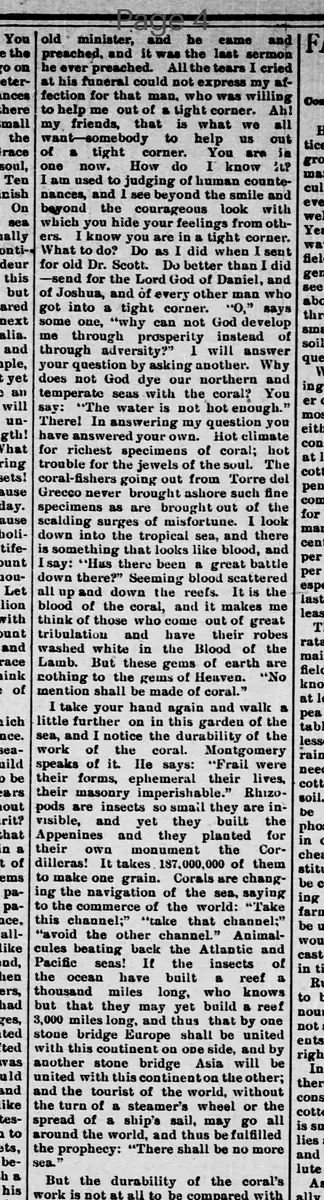
old minister, and he came and preached, and it was the last sermon he ever preached. All the tears I cried at his funeral could not express my affection for that man, who was willing to help me out of a tight corner. Ah! my friends, that is what we all want—somebody to help us out of a tight corner. You are in one now. How do I know? I am used to judging of human countenances, and I see beyond the smile and beyond the courageous look with which you hide your feelings from others. I know you are in a tight corner. What to do? Do as I did when I sent for old Dr. Scott. Do better than I did—send for the Lord God of Daniel, and of Joshua, and of every other man who got into a tight corner. "O," says some one, "why can not God develop me through prosperity instead of through adversity?" I will answer your question by asking another. Why does not God dye our northern and temperate seas with the coral? You say: "The water is not hot enough." There! In answering my question you have answered your own. Hot climate for richest specimens of coral; hot trouble for the jewels of the soul. The coral-fishers going out from Torre del Grecco never brought ashore such fine specimens as are brought out of the scalding surges of misfortune. I look down into the tropical sea, and there is something that looks like blood, and I say: Has there been a great battle down there? Seeming blood scattered all up and down the reefs. It is the blood of the coral, and it makes me think of those who come out of great tribulation and have their robes washed white in the Blood of the Lamb. But these gems of earth are nothing to the gems of Heaven. "No mention shall be made of coral."
I take your hand again and walk a little further on in this garden of the sea, and I notice the durability of the work of the coral. Montgomery speaks of it. He says: Frail were their forms, ephemeral their lives, their masonry imperishable." Rhizopods are insects so small they are invisible, and yet they built the Appenines and they planted for their own monument the Cordilleras! It takes 187,000,000 of them to make one grain. Corals are changing the navigation of the sea, saying to the commerce of the world: "Take this channel;" "take that channel;" "avoid the other channel." Animalcules beating back the Atlantic and Pacific seas! If the insects of the ocean have built a reef a thousand miles long, who knows but that they may yet build a reef 3,000 miles long, and thus that by one stone bridge Europe shall be united with this continent on one side, and by another stone bridge Asia will be united with this continent on the other; and the tourist of the world, without the turn of a steamer's wheel or the spread of a ship's sail, may go all around the world, and thus be fulfilled the prophecy: "There shall be no more sea."
But the durability of the coral's work is not at all to be compared with the durability of our work for God. The coral is going to crumble in the fires of the last day, but our work for God will endure forever. No more discouraged man ever lived than Beethoven, the great musical composer. Unmercifully criticised by brother artists and his music sometimes rejected. Deaf for 25 years, and forced, on his way to Vienna, to beg food and lodging at a very plain house by the roadside. In the evening the family opened a musical instrument and played and sang with great enthusiasm; and one of the numbers they rendered was so emotional that tears ran down their cheeks while they sang and played. Beethoven, sitting in the room, too deaf to hear the singing, was curious to know what was the music that so overpowered them, and when they got through he reached up and took the folio in his hand and found it was his own music—Beethoven's Symphony in A—and he cried out: "I wrote that!" The household sat and stood abashed to find that their poor-looking guest was the great composer. But he never left that house alive. A fever seized him that night, and no relief could be afforded, and in a few days he died. But just before expiring he took the hand of his nephew, who had been sent for and had arrived, saying: "After all, Hummel, I must have had some talent." Poor Beethoven! His work still lives, and in the twentieth century will be better appreciated than it was in the nineteenth; and as long as there is on earth an orchestra to play or an oratorio to sing, Beethoven's nine symphonies will be the enchantment of nations. But you are not a composer, and you say that there is nothing remarkable about you—only a mother trying to rear your family for usefulness and Heaven. Yet the song with which you sing your child to sleep will never cease its mission. You will grow old and die. That son will pass out into the world. The song with which you sang him to sleep last night will go with him while he lives, conscious or unconscious restraint and inspiration here, and may help open to him the gate of a glorious and triumphant hereafter. The lullabies of this century will sing through all the centuries. The humblest good accomplished in time will last through eternity. I sometimes get discouraged, as I suppose you do, at the vastness of the work and at how little we are doing. And yet, do you suppose the rhizopod said: "There is no need of my working; I can not build the Cordilleras." Do you suppose the madrepore said: "There is no need of my working; I can not build the Sandwich Islands." Each one attended to his own business; and there are the Sandwich Islands, and there are the Cordilleras. Ah, my friends, the redemption of this world is a great enterprise. I did not see it start; I will not in this world see its close. I am only an insect as compared with the great work to be done, but yet I must do my part. Help build this eternal corallum I will. My parents toiled on this reef long before I was born. I pray God that my children may toil on this reef long after I am dead. Insects all of us, but honored by God to help heave up the reef of light across which shall break the ocean's immortal gladness. Better be insignificant and useful than great and idle. The mastodons and megatheriums of the earth, what did they do but stalk their great carcasses across the land and leave their skeletons through the strata, while the coral-lines went on heaving up the islands all covered with fruitage and verdure. Better be a coralline than a mastodon. So now I am trying to make one little coralline. The polyp picks out of the wave that smites it carbonate of lime and with that builds up its own insectile masonry. So out of the wave of your tears I take the salt; out of the bruise I take the blue, and out of your bleeding heart I take the red, and out of them altogether I make this coral, which I pray may not be disowned in the day when God makes up His jewels.
I take your hand again and walk a little further on in this garden of the sea, and I notice the durability of the work of the coral. Montgomery speaks of it. He says: Frail were their forms, ephemeral their lives, their masonry imperishable." Rhizopods are insects so small they are invisible, and yet they built the Appenines and they planted for their own monument the Cordilleras! It takes 187,000,000 of them to make one grain. Corals are changing the navigation of the sea, saying to the commerce of the world: "Take this channel;" "take that channel;" "avoid the other channel." Animalcules beating back the Atlantic and Pacific seas! If the insects of the ocean have built a reef a thousand miles long, who knows but that they may yet build a reef 3,000 miles long, and thus that by one stone bridge Europe shall be united with this continent on one side, and by another stone bridge Asia will be united with this continent on the other; and the tourist of the world, without the turn of a steamer's wheel or the spread of a ship's sail, may go all around the world, and thus be fulfilled the prophecy: "There shall be no more sea."
But the durability of the coral's work is not at all to be compared with the durability of our work for God. The coral is going to crumble in the fires of the last day, but our work for God will endure forever. No more discouraged man ever lived than Beethoven, the great musical composer. Unmercifully criticised by brother artists and his music sometimes rejected. Deaf for 25 years, and forced, on his way to Vienna, to beg food and lodging at a very plain house by the roadside. In the evening the family opened a musical instrument and played and sang with great enthusiasm; and one of the numbers they rendered was so emotional that tears ran down their cheeks while they sang and played. Beethoven, sitting in the room, too deaf to hear the singing, was curious to know what was the music that so overpowered them, and when they got through he reached up and took the folio in his hand and found it was his own music—Beethoven's Symphony in A—and he cried out: "I wrote that!" The household sat and stood abashed to find that their poor-looking guest was the great composer. But he never left that house alive. A fever seized him that night, and no relief could be afforded, and in a few days he died. But just before expiring he took the hand of his nephew, who had been sent for and had arrived, saying: "After all, Hummel, I must have had some talent." Poor Beethoven! His work still lives, and in the twentieth century will be better appreciated than it was in the nineteenth; and as long as there is on earth an orchestra to play or an oratorio to sing, Beethoven's nine symphonies will be the enchantment of nations. But you are not a composer, and you say that there is nothing remarkable about you—only a mother trying to rear your family for usefulness and Heaven. Yet the song with which you sing your child to sleep will never cease its mission. You will grow old and die. That son will pass out into the world. The song with which you sang him to sleep last night will go with him while he lives, conscious or unconscious restraint and inspiration here, and may help open to him the gate of a glorious and triumphant hereafter. The lullabies of this century will sing through all the centuries. The humblest good accomplished in time will last through eternity. I sometimes get discouraged, as I suppose you do, at the vastness of the work and at how little we are doing. And yet, do you suppose the rhizopod said: "There is no need of my working; I can not build the Cordilleras." Do you suppose the madrepore said: "There is no need of my working; I can not build the Sandwich Islands." Each one attended to his own business; and there are the Sandwich Islands, and there are the Cordilleras. Ah, my friends, the redemption of this world is a great enterprise. I did not see it start; I will not in this world see its close. I am only an insect as compared with the great work to be done, but yet I must do my part. Help build this eternal corallum I will. My parents toiled on this reef long before I was born. I pray God that my children may toil on this reef long after I am dead. Insects all of us, but honored by God to help heave up the reef of light across which shall break the ocean's immortal gladness. Better be insignificant and useful than great and idle. The mastodons and megatheriums of the earth, what did they do but stalk their great carcasses across the land and leave their skeletons through the strata, while the coral-lines went on heaving up the islands all covered with fruitage and verdure. Better be a coralline than a mastodon. So now I am trying to make one little coralline. The polyp picks out of the wave that smites it carbonate of lime and with that builds up its own insectile masonry. So out of the wave of your tears I take the salt; out of the bruise I take the blue, and out of your bleeding heart I take the red, and out of them altogether I make this coral, which I pray may not be disowned in the day when God makes up His jewels.
What sub-type of article is it?
Essay
What themes does it cover?
Religious
Moral Virtue
What keywords are associated?
Sermon
Adversity
Coral Metaphor
Faith
Endurance
Good Works
Beethoven
Spiritual Growth
Literary Details
Subject
On Turning To God In Adversity And The Enduring Value Of Good Works
Form / Style
Prose Sermon With Metaphorical Illustrations
Key Lines
Do Better Than I Did—Send For The Lord God Of Daniel, And Of Joshua, And Of Every Other Man Who Got Into A Tight Corner.
Hot Climate For Richest Specimens Of Coral; Hot Trouble For The Jewels Of The Soul.
But The Durability Of The Coral's Work Is Not At All To Be Compared With The Durability Of Our Work For God.
The Humblest Good Accomplished In Time Will Last Through Eternity.
Better Be Insignificant And Useful Than Great And Idle.