Thank you for visiting SNEWPapers!
Sign up free
The Abbeville Banner
Abbeville, Abbeville County, South Carolina
What is this article about?
Prof. Lieber recounts personal anecdotes about Alexander von Humboldt at an American Geographical and Statistical Society meeting in New York, including a 1844 visit to Potsdam, Humboldt's work on Cosmos, evenings with the King of Prussia, advocacy for a penology chair in Berlin, and social scenes at the Humboldt villa.
Clipping
OCR Quality
Full Text
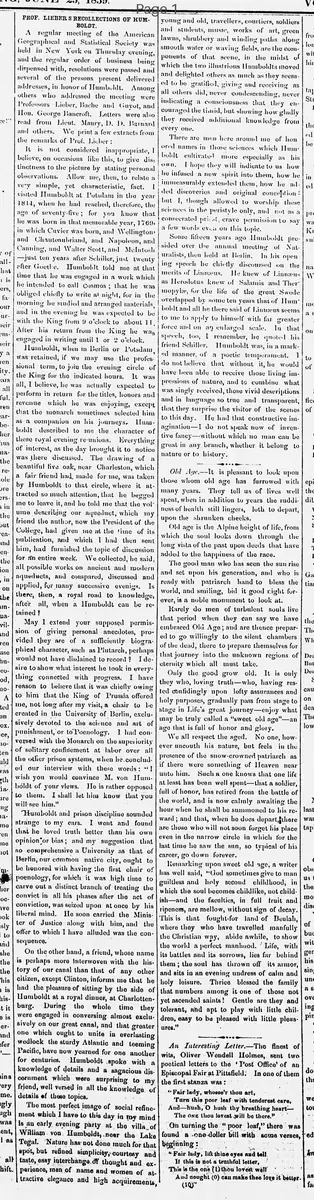
A regular meeting of the American Geographical and Statistical Society was held in New York on Thursday evening, and the regular order of business being dispensed with, resolutions were passed and several of the persons present delivered addresses, in honor of Humboldt. Among others who addressed the meeting were Professors Lieber, Bache and Guyot, and Hon. George Bancroft. Letters were also read from Lieut. Maury, D. D. Barnard and others. We print a few extracts from the remarks of Prof. Lieber:
It is not considered inappropriate, I believe, on occasions like this, to give distinctness to the picture by stating personal observations. Allow me, then, to relate a very simple, yet characteristic, fact. I visited Humboldt at Potsdam in the year 1844, when he had reached, therefore, the age of seventy-five; for you know that he was born in that memorable year, 1769, in which Cuvier was born, and Wellingtons and Chateaubriand, and Napoleon, and Canning, and Walter Scott, and Macintosh—just ten years after Schiller, just twenty after Goethe. Humboldt told me at that time that he was engaged in a work which he intended to call Cosmos; that he was obliged chiefly to write at night, for in the morning he studied and arranged materials, and in the evening he was expected to be with the King from 9 o'clock to about 11. After his return from the King he was engaged in writing until 1 or 2 o'clock.
Humboldt, when in Berlin or Potsdam, was—retained, if we may use the professional term, to join the evening circle of the King for the indicated hours. It was all, I believe, he was actually expected to perform in return for the titles, honors and revenue which he was enjoying, except that the monarch sometimes selected him as a companion on his journeys. Humboldt described to me the character of these royal evening re-unions. Everything of interest, as the day brought it to notice was there discussed. The drawing of a beautiful live oak, near Charleston, which a fair friend had made for me, was taken by Humboldt to that circle, where it attracted so much attention, that he begged me to leave it, and he told me that the volume describing our aqueduct, which my friend the author, now the President of the College, had given me at the time of its publication, and which I had then sent him, had furnished the topic of discussion for an entire week. We collected, he said, all possible works on ancient and modern aqueducts, and compared, discussed and applied, for many successive evenings. Is there, then, a royal road to knowledge, after all, when a Humboldt can be retained?
May I extend your supposed permission of giving personal anecdotes, provided they are of a sufficiently biographical character, such as Plutarch, perhaps would not have disdained to record? I desire to show what interest he took in everything connected with progress. I have reason to believe that it was chiefly owing to him that the King of Prussia offered me, not long after my visit, a chair to be created in the University of Berlin, exclusively devoted to the science and art of punishment,' or to 'Penology. I had conversed with the Monarch on the superiority of solitary confinement at labor over all the other prison systems, when he concluded our interview with these words: "I wish you would convince M. von Humboldt of your views. He is rather opposed to them. I shall let him know that you will see him."
Humboldt and prison discipline sounded strange to my ears. I went and found that he loved truth better than his own opinion or bias; and my suggestion that so comprehensive a University as that of Berlin, our common native city, ought to be honored with having the first chair of penology, for which it was high time to carve out a distinct branch of treating the convict in all his phases after the act of conviction, was seized upon at once by his liberal mind. He soon carried the Minister of Justice along with him, and the offer to which I have alluded was the consequence.
On the other hand, a friend, whose name is perhaps more interwoven with the history of our canal than that of any other citizen, except Clinton, informs me that he had the pleasure of sitting by the side of Humboldt at a royal dinner, at Charlottenburg. During the whole time they were engaged in conversing almost exclusively on our great canal, and that greater one which ought to unite in everlasting wedlock the sturdy Atlantic and teeming Pacific, have now yearned for one another for centuries. Humboldt spoke with a knowledge of details and a sagacious discernment which were surprising to my friend, well versed in all the knowledge of details of these topics.
The most perfect image of social refinement which I have to this day in my mind is an early evening party at the villa of William von Humboldt, near the Lake Tegel. Nature has not done much for that spot, but refined simplicity, courtesy and taste, easy interchange of thought and experience, men of name and women of attractive elegance and high acquirements young and old, travellers, courtiers, soldiers and students, music, works of art, green lawns, shrubbery and winding paths along smooth water or waving fields, are the components of that scene, in the midst of which the two illustrious Humboldts moved and delighted others as much as they seemed to be gratified, giving and receiving as all others did, never condescending, never indicating a consciousness that they encouraged the timid, but showing how gladly they received additional knowledge from every one.
There are men here around me of honored names in those sciences which Humboldt cultivated more especially as his own. I hope they will indicate to us how he infused a new spirit into them, how he immeasurably extended them, how he added discoveries and original conceptions: but I, though allowed to worship these sciences in the peristyle only, and not as a consecrated priest, crave permission to say a few words even on this topic.
Some fifteen years ago Humboldt presided over the annual meeting of Naturalists, then held at Berlin. In his opening speech he chiefly discoursed on the merits of Linnaeus. He knew of Linnaeus as Herodotus knew of Salamis and Thermopylae, for the life of the great Swede overlapped by some ten years that of Humboldt and all he there said of Linnaeus seems to me to apply to himself with far greater force and on an enlarged scale. In that speech, too, I remember, he quoted his friend Schiller. Humboldt was, in a marked manner, of a poetic temperament. I do not believe that without it, he would have been able to receive those living impressions of nature, and to combine what was singly received, those vivid descriptions and in language so true and transparent, that they surprise the visitor of the scenes to this day. He had that constructive imagination—I do not speak now of inventive fancy—without which no man can be great in any branch, whether it belong to nature or to history.
What sub-type of article is it?
What themes does it cover?
What keywords are associated?
What entities or persons were involved?
Where did it happen?
Story Details
Key Persons
Location
New York, Potsdam, Berlin, Charlottenburg, Lake Tegel
Event Date
1844
Story Details
Prof. Lieber shares personal recollections of Alexander von Humboldt, including a 1844 visit where Humboldt discussed his Cosmos work and evenings with the King of Prussia; advocacy for a penology chair in Berlin; conversations on canals; a social gathering at William von Humboldt's villa; and Humboldt's poetic temperament and contributions to science.