Thank you for visiting SNEWPapers!
Sign up free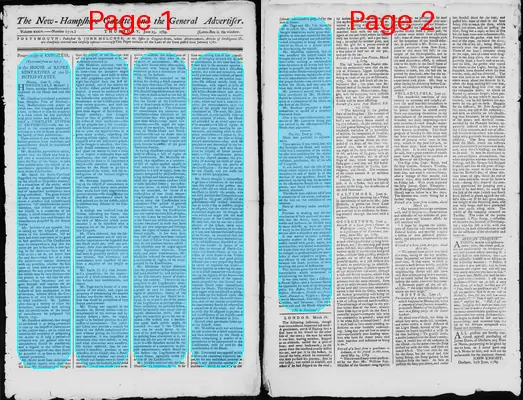
The New Hampshire Gazette And General Advertiser
Portsmouth, Rockingham County, New Hampshire
What is this article about?
Proceedings of the U.S. House of Representatives on June 8-9, 1789: Oath of Maryland representative Michael J. Stone; petition for copyright by Nicholas Pike; transmission of tradesmen petitions; heated debate on timing of constitutional amendments, with Madison advocating immediate consideration via committee of the whole, opposed by Smith, Jackson, and others prioritizing revenue; eventual referral to committee; next day, rules amendment and continuation of revenue collection bill discussion.
Merged-components note: Direct textual continuation of the Congress proceedings story from page 1 to page 2, indicated by matching content and '(To be Continued.)'.
Clippings
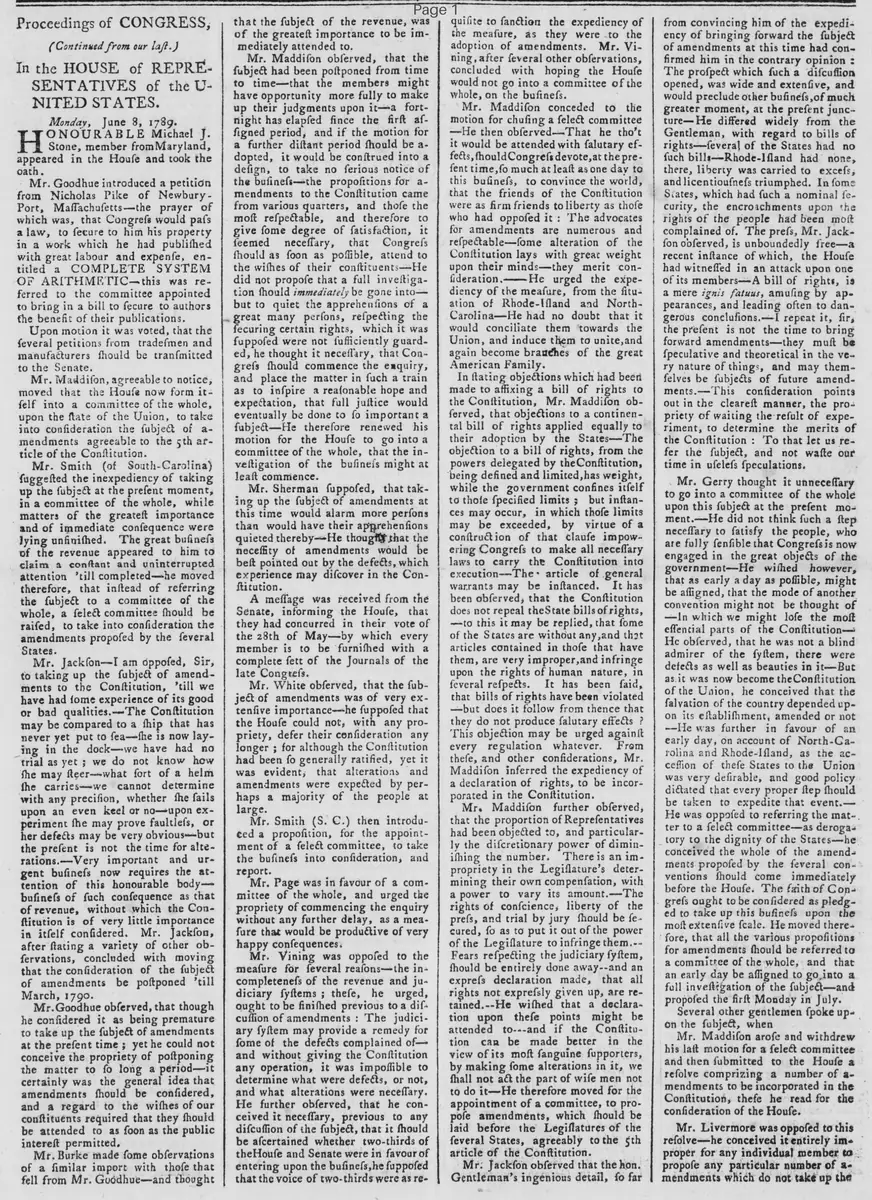
1 of 2
OCR Quality
Full Text
(Continued from our last.)
In the HOUSE of REPRESENTATIVES of the UNITED STATES.
Monday, June 8, 1789.
THE HONOURABLE Michael J. Stone, member from Maryland, appeared in the House and took the oath.
Mr. Goodhue introduced a petition from Nicholas Pike of Newbury-Port, Massachusetts--the prayer of which was, that Congress would pass a law, to secure to him his property in a work which he had published with great labour and expense, entitled a COMPLETE SYSTEM OF ARITHMETIC--this was referred to the committee appointed to bring in a bill to secure to authors the benefit of their publications.
Upon motion it was voted, that the several petitions from tradesmen and manufacturers should be transmitted to the Senate.
Mr. Madison, agreeable to notice, moved that the House now form itself into a committee of the whole, upon the state of the Union, to take into consideration the subject of amendments agreeable to the 5th article of the Constitution.
Mr. Smith (of South-Carolina) suggested the inexpediency of taking up the subject at the present moment, in a committee of the whole, while matters of the greatest importance and of immediate consequence were lying unfinished. The great business of the revenue appeared to him to claim a constant and uninterrupted attention 'till completed--he moved therefore, that instead of referring the subject to a committee of the whole, a select committee should be raised, to take into consideration the amendments proposed by the several States.
Mr. Jackson--I am opposed, Sir, to taking up the subject of amendments to the Constitution, 'till we have had some experience of its good or bad qualities.--The Constitution may be compared to a ship that has never yet put to sea--she is now laying in the dock--we have had no trial as yet; we do not know how she may steer--what sort of a helm she carries--we cannot determine with any precision, whether she sails upon an even keel or no--upon experiment she may prove faultless, or her defects may be very obvious--but the present is not the time for alterations.--Very important and urgent business now requires the attention of this honourable body--business of such consequence as that of revenue, without which the Constitution is of very little importance in itself considered. Mr. Jackson, after stating a variety of other observations, concluded with moving that the consideration of the subject of amendments be postponed 'till March, 1790.
Mr. Goodhue observed, that though he considered it as being premature to take up the subject of amendments at the present time; yet he could not conceive the propriety of postponing the matter to so long a period--it certainly was the general idea that amendments should be considered, and a regard to the wishes of our constituents required that they should be attended to as soon as the public interest permitted.
Mr. Burke made some observations of a similar import with those that fell from Mr. Goodhue--and thought that the subject of the revenue, was of the greatest importance to be immediately attended to.
Mr. Madison observed, that the subject had been postponed from time to time--that the members might have opportunity more fully to make up their judgments upon it--a fortnight has elapsed since the first assigned period, and if the motion for a further distant period should be adopted, it would be construed into a design, to take no serious notice of the business--the propositions for amendments to the Constitution came from various quarters, and those the most respectable, and therefore to give some degree of satisfaction, it seemed necessary, that Congress should as soon as possible, attend to the wishes of their constituents--He did not propose that a full investigation should immediately be gone into--but to quiet the apprehensions of a great many persons, respecting the securing certain rights, which it was supposed were not sufficiently guarded, he thought it necessary, that Congress should commence the enquiry, and place the matter in such a train as to inspire a reasonable hope and expectation, that full justice would eventually be done to so important a subject--He therefore renewed his motion for the House to go into a committee of the whole, that the investigation of the business might at least commence.
Mr. Sherman supposed, that taking up the subject of amendments at this time would alarm more persons than would have their apprehensions quieted thereby--He thought that the necessity of amendments would be best pointed out by the defects, which experience may discover in the Constitution.
A message was received from the Senate, informing the House, that they had concurred in their vote of the 28th of May--by which every member is to be furnished with a complete set of the Journals of the late Congress.
Mr. White observed, that the subject of amendments was of very extensive importance--he supposed that the House could not, with any propriety, defer their consideration any longer; for although the Constitution had been so generally ratified, yet it was evident; that alterations and amendments were expected by perhaps a majority of the people at large.
Mr. Smith (S. C.) then introduced a proposition, for the appointment of a select committee, to take the business into consideration, and report.
Mr. Page was in favour of a committee of the whole, and urged the propriety of commencing the enquiry without any further delay, as a measure that would be productive of very happy consequences.
Mr. Vining was opposed to the measure for several reasons--the incompleteness of the revenue and judiciary systems; these, he urged, ought to be finished previous to a discussion of amendments: The judiciary system may provide a remedy for some of the defects complained of--and without giving the Constitution any operation, it was impossible to determine what were defects, or not, and what alterations were necessary.
He further observed, that he conceived it necessary, previous to any discussion of the subject, that it should be ascertained whether two-thirds of the House and Senate were in favour of entering upon the business, he supposed that the voice of two-thirds were as requisite to sanction the expediency of the measure, as they were to the adoption of amendments. Mr. Vining, after several other observations, concluded with hoping the House would not go into a committee of the whole, on the business.
Mr. Madison conceded to the motion for choosing a select committee--He then observed--That he thought it would be attended with salutary effects, should Congress devote, at the present time, so much at least as one day to this business, to convince the world, that the friends of the Constitution were as firm friends to liberty as those who had opposed it: The advocates for amendments are numerous and respectable--some alteration of the Constitution lays with great weight upon their minds--they merit consideration.--He urged the expediency of the measure, from the situation of Rhode-Island and North-Carolina--He had no doubt that it would conciliate them towards the Union, and induce them to unite, and again become branches of the great American Family.
In stating objections which had been made to affixing a bill of rights to the Constitution, Mr. Madison observed, that objections to a continental bill of rights applied equally to their adoption by the States--The objection to a bill of rights, from the powers delegated by the Constitution, being defined and limited, has weight, while the government confines itself to those specified limits; but instances may occur, in which those limits may be exceeded, by virtue of a construction of that clause empowering Congress to make all necessary laws to carry the Constitution into execution--The article of general warrants may be instanced. It has been observed, that the Constitution does not repeal the State bills of rights,--to this it may be replied, that some of the States are without any, and those articles contained in those that have them, are very improper, and infringe upon the rights of human nature, in several respects. It has been said, that bills of rights have been violated--but does it follow from thence that they do not produce salutary effects? This objection may be urged against every regulation whatever. From these, and other considerations, Mr. Madison inferred the expediency of a declaration of rights, to be incorporated in the Constitution.
Mr. Madison further observed, that the proportion of Representatives had been objected to, and particularly the discretionary power of diminishing the number. There is an impropriety in the Legislature's determining their own compensation, with a power to vary its amount.--The rights of conscience, liberty of the press, and trial by jury should be secured, so as to put it out of the power of the Legislature to infringe them.--Fears respecting the judiciary system, should be entirely done away--and an express declaration made, that all rights not expressly given up, are retained.--He wished that a declaration upon these points might be attended to---and if the Constitution can be made better in the view of its most sanguine supporters, by making some alterations in it, we shall not act the part of wise men not to do it--He therefore moved for the appointment of a committee, to propose amendments, which should be laid before the Legislatures of the Several States, agreeably to the 5th article of the Constitution.
Mr. Jackson observed that the hon. Gentleman's ingenious detail, so far from convincing him of the expediency of bringing forward the subject of amendments at this time had confirmed him in the contrary opinion: The prospect which such a discussion opened, was wide and extensive, and would preclude other business, of much greater moment, at the present juncture--He differed widely from the Gentleman, with regard to bills of rights--several of the States had no such bill:--Rhode-Island had none, there, liberty was carried to excess, and licentiousness triumphed. In some States, which had such a nominal security, the encroachments upon the rights of the people had been most complained of. The press, Mr. Jackson observed, is unboundedly free--a recent instance of which, the House had witnessed in an attack upon one of its members--A bill of rights, is a mere ignis fatuus, amusing by appearances, and leading often to dangerous conclusions.--I repeat it, sir, the present is not the time to bring forward amendments--they must be speculative and theoretical in the very nature of things, and may themselves be subjects of future amendments.--This consideration points out in the clearest manner, the propriety of waiting the result of experiment, to determine the merits of the Constitution: To that let us refer the subject, and not waste our time in useless speculations.
Mr. Gerry thought it unnecessary to go into a committee of the whole upon this subject at the present moment.--He did not think such a step necessary to satisfy the people, who are fully sensible that Congress is now engaged in the great objects of the government--He wished however, that as early a day as possible, might be assigned, that the mode of another convention might not be thought of--In which we might lose the most essential parts of the Constitution--He observed, that he was not a blind admirer of the system, there were defects as well as beauties in it--But as it was now become the Constitution of the Union, he conceived that the salvation of the country depended upon its establishment; amended or not--He was further in favour of an early day, on account of North-Carolina and Rhode-Island, as the accession of these States to the Union was very desirable, and good policy dictated that every proper step should be taken to expedite that event.--He was opposed to referring the matter to a select committee--as derogatory to the dignity of the States--he conceived the whole of the amendments proposed by the several conventions should come immediately before the House. The faith of Congress ought to be considered as pledged to take up this business upon the most extensive scale. He moved therefore, that all the various propositions for amendments should be referred to a committee of the whole, and that an early day be assigned to go into a full investigation of the subject--and proposed the first Monday in July.
Several other gentlemen spoke upon the subject, when Mr. Madison arose and withdrew his last motion for a select committee and then submitted to the House a resolve comprising a number of amendments to be incorporated in the Constitution, these he read for the consideration of the House.
Mr. Livermore was opposed to this resolve--he conceived it entirely improper for any individual member to propose any particular number of amendments which do not take up the
different amendments proposed by the several States.
Mr. Page and Mr. Lee severally rose to justify Mr. Madison, they thought themselves under great obligations to him and conceived that the mode he had adopted was just and fair—and calculated to bring the attention of the House to a proper point in determining the subject.
Mr. Madison observed, that it was necessary the subject should be brought forward in some form or other—after waiting a considerable time for others to do it—he had thought proper to propose the form now submitted to the House—newspapers and pamphlets were the repositories of the several amendments—those were not the proper sources—the resolve is now before the House, and they may do what they think proper with it.
Mr. Lawrence moved, that the resolve introduced by Mr. Madison should be submitted to the consideration of a committee of the whole on the state of the Union.
Mr. Boudinot proposed a select committee to consist of a member from each State.
After a few more observations, the motion of Mr. Lawrence being put was carried in the affirmative—The House then adjourned.
Tuesday, June 9, 1789.
House met pursuant to adjournment.
Upon motion it was voted, that this day fortnight the House will resolve itself into a committee of the whole, to take into consideration the report of the committee respecting the enrollment, attestation, &c. of the acts of Congress.
It was moved, that the rule of the House which enjoins a division of the members, in case of doubt as to the decision of any question, should be amended, by saying that the members in the affirmative should rise in their places, and stand till counted—this motion obtained.
The House then resolved itself into a committee of the whole, and resumed the bill on the collection of the revenue.
Ports of delivery under consideration.
Previous to making any further nomination of such ports—it was moved, that the shores, bays, rivers, creeks and harbours, be divided into as many districts as there are ports of entry in the United States.—This motion after a discussion was adopted.
It was moved to insert a clause, whereby masters of ships and other vessels loaded with goods, wares, and merchandize, and bound into the United States from any foreign port, shall be obliged to produce duplicate manifests of their respective cargoes, to any officers of the customs that may demand the same, previous to their entering the ports of destination.
This motion gave rise to a lengthy conversation which terminated in withdrawing the motion.
It was then voted, that a Collector, a Naval-Officer, and a Surveyor should be appointed for each of the following ports, viz. Boston, New-York, Philadelphia, Baltimore, Norfolk and Portsmouth, Alexandria, Virginia; Georgetown in Maryland, Charleston, South-Carolina, and Savannah.—The committee rose and the House adjourned.
(To be Continued.)
What sub-type of article is it?
What themes does it cover?
What keywords are associated?
What entities or persons were involved?
Where did it happen?
Story Details
Key Persons
Location
House Of Representatives Of The United States
Event Date
June 8, 1789 And June 9, 1789
Story Details
The House administers oath to new member Michael J. Stone; refers copyright petition from Nicholas Pike; transmits tradesmen petitions to Senate; debates priority of constitutional amendments versus revenue, with Madison proposing committee consideration to address public concerns on rights, opposed by Jackson and others favoring postponement; Madison submits resolve on amendments, referred to committee of the whole; next day, amends voting rule and advances revenue bill by dividing districts and appointing officers for major ports.