Thank you for visiting SNEWPapers!
Sign up free
Story
February 23, 1828
New Hampshire Statesman And Concord Register
Concord, Merrimack County, New Hampshire
What is this article about?
In 1828, Col. J.L. Sullivan proposes combining McAdam roads with an innovative elevated railway system using timber and iron to reduce costs and improve internal commerce in the US, critiquing English models and detailing construction for durability and efficiency.
Clipping
OCR Quality
98%
Excellent
Full Text
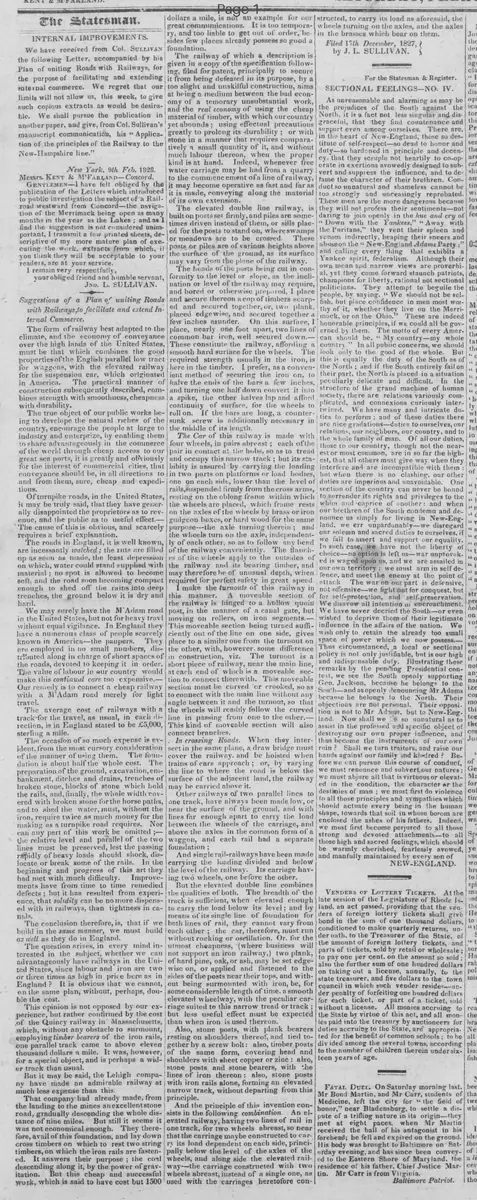
INTERNAL IMPROVEMENTS.
We have received from Col. Sullivan the following Letter, accompanied by his Plan of uniting Roads with Railways, for the purpose of facilitating and extending internal commerce. We regret that our limits will not allow us, this week, to give such copious extracts as would be desirable. We shall pursue the publication in another paper, and give, from Col. Sullivan's manuscript communication, his "Application of the principles of the Railway to the New-Hampshire line."
New York, 9th Feb. 1828.
Messrs. Kent & McFarland--Concord.
Gentlemen--I have felt obliged by the publication of the Letters which introduced to public investigation the subject of a Railroad westward from Concord--the navigation of the Merrimack being open as many months in the year as the Lakes; and as I find the suggestion is not considered unimportant, I transmit a few printed sheets, descriptive of my more mature plan of executing the work. Extracts from which, if you think they will be acceptable to your readers, are at your service.
I remain very respectfully,
your obliged friend and humble servant,
JNO. L. SULLIVAN.
Suggestions of a Plan of uniting Roads with Railways, to facilitate and extend Internal Commerce.
The form of railway best adapted to the climate, and the economy of conveyance over the high lands of the United States must be that which combines the good properties of the English parallel low tract for waggons, with the elevated railway for the suspension car, which originated in America. The practical manner of construction subsequently described, combines strength with smoothness, cheapness with durability.
The true object of our public works being to develope the natural riches of the country, encourage the people at large to industry and enterprize, by enabling them to share advantageously in the commerce of the world through cheap access to our great sea ports, it is greatly and obviously for the interest of commercial cities, that conveyance should be, in all directions to and from them, sure, cheap and expeditious.
Of turnpike roads, in the United States, it may be truly said, that they have generally disappointed the proprietors as to revenue, and the public as to useful effect. The cause of this is obvious, and scarcely requires a brief explanation.
The roads in England, it is well known are incessantly watched; the ruts are filled up as soon as made, the least depression on which, water could stand supplied with material; no spot is allowed to become soft, and the road soon becoming compact enough to shed off the rains into deep trenches, the ground below it is dry and hard.
We may surely have the McAdam road in the United States, but not for heavy travel without equal vigilance. In England they have a numerous class of people scarcely known in America--the paupers. They are employed in no small numbers, distributed along in charge of short spaces of the roads, devoted to keeping it in order. The value of labour in our country would make this continual care too expensive.
Our remedy is to connect a cheap railway with a McAdam road merely for light travel.
The average cost of railways with a track--for the travel, as usual, in each direction, is in England stated to be £5,000, sterling a mile.
The occasion of so much expense is evident, from the most cursory consideration of the manner of using them. The foundation is about half the whole cost. The preparation of the ground, excavation, embankment, ditches and drains, trenches of broken stone, blocks of stone which hold the rails, and, finally, the whole width covered with broken stone for the horse paths, and to shed the water, must, without the iron, require twice as much money for the making as a turnpike road requires. Nor can any part of this work be omitted;-- the relative level and parallel of the two lines must be preserved, lest the passing rapidly of heavy loads should shock, dislocate or break some of the rails. In the beginning and progress of this art they had met with much difficulty. Improvements have from time to time remedied defects: but it has resulted from experience, that solidity can be no more dispensed with in railways, than tightness in canals.
The conclusion therefore, is, that if we build in the same manner, we must build as well as they do in England.
The question arises, in every mind interested in the subject, whether we can advantageously have railways in the United States, since labour and iron are two or three times as high in price here as in England? It is obvious that we cannot, on the same plan, without, perhaps, double the cost
This opinion is not opposed by our experience, but rather confirmed by the cost of the Quincy railway in Massachusetts, which, without any obstacle to surmount, employing timber bearers of the iron rails, one parallel track came to above eleven thousand dollars a mile. It was, however, for a special object, and is perhaps a wider track than usual.
But it may be said, the Lehigh company have made an admirable railway at much less expense than this.
That company had already made, from the landing to the mines an excellent stone road, gradually descending the whole distance of nine miles, But still it seems it was not economical enough, They therefore, avail of this foundation. and lay down cross timbers on which to rest two string timbers, on which the iron rails are fastened. It answers their purpose : the coal descending along it. by the power of gravitation. But this cheap and successful work, which is said to have cost but 1500 dollars a mile. is not an example for our great communications. It is too temporary, and too liable to get out of order, besides few places already possess so good a foundation.
The railway of which a description is given in a copy of the specification following, filed for patent, principally to secure it from being defeated in its purpose, by a too slight and unskilful construction, aims at being a medium between the bad economy of a temporary unsubstantial work, and the real economy of using the cheap material of timber, with which our country yet abounds; using effectual precautions greatly to prolong its durability ; or with stone in a manner that requires comparatively a small quantity of it, and without much labour thereon, when the proper kind is at hand. Indeed, whenever free water carriage may be had from a quarry to the commencement of a line of railway. it may become operative as fast and far as it is made, conveying along the material of its own extension.
The elevated double line railway, is built on posts set firmly, and piles are sometimes driven instead of them, or sills placed for the posts to stand on, where swamps or meadows are to be crossed. These posts or piles are of various heights above the surface of the ground, as its surface may vary from the plane of the railway. The heads of the posts being cut in conformity to the level or slope, as the inclination or level of the railway may require, and bored or otherwise prepared, I place and secure thereon a cap of timbers scarped and secured together, or, two plank, placed edgewise, and secured together a few inches asunder. On this surface, I place, nearly one foot apart, two lines of common bar iron, well secured down. These constitute the railway, affording a smooth hard surface for the wheels. The required strength usually in the iron, is here in the timber. I prefer, as a convenient method of securing the iron on, to halve the ends of the bars a few inches, and turning one half down convert it into a spike, the other halves lap and afford continuity of surface, for the wheels to roll on. If the bars are long, a counter-sunk screw is additionally necessary in the middle of its length.
The Car of this railway is made with four wheels, in pairs abreast ; each of the pair in contact at the hubs, so as to tread and occupy this narrow track ; but its stability is assured by carrying the loading in two parts on platforms or load bodies. one on each side. lower than the level of rails, suspended firmly from the cross arms. resting on the oblong frame within which the wheels are placed, which frame rests on the axles of the wheels by brass or iron gudgeon boxes, or hard wood for the same purpose---the axle turning therein: and the wheels turn on the axle, independently of each other, so as to follow any bend of the railway conveniently. The flanches of the wheels apply to the outsides of the railway and its bearing timber, and may therefore be of unusual depth, when required for perfect safety in great speed
I make the turnouts of this railway in this manner. A moveable section of the railway is hinged to a hollow quoin post, in the manner of a canal gate, but moving on rollers, on iron segments.-- This moveable section being turned sufficiently out of the line on one side, gives place to a similar one from the turnout on the other, with, however, some difference in construction, viz. The turnout is a short piece of railway, near the main line, at each end of which is a moveable section to connect therewith. This moveable section must be curved or crooked, so as to connect with the main line without any angle between it and the turnout, so that the wheels will readily follow the curved line in passing from one to the other.- This kind of moveable section will also connect branches.
In crossing Roads. When they intersect in the same plane, a draw bridge must cover the railway. and be hoisted when trains of cars approach; or, by varying the line to where the road is below the surface of the adjacent land, the railway may be carried above it.
Other railways of two parallel lines to one track, have always been made low, or near the surface of the ground, and with lines far enough apart to carry the load between the wheels of the carriage, and above the axles in the common form of a waggon, and each rail had a separate foundation;
And single rail-railways have been made carrying the loading divided and below the level of the railway. Its carriage having two wheels, one before the other.
But the elevated double line combines the qualities of both. The breadth of the track is sufficient, when elevated enough to carry the load below its level; and by means of its single line of foundation for both lines of rail, they cannot vary from each other ; the car, therefore, must run without rocking or oscillation. Or, for the utmost cheapness, (where business will not support an iron railway,) two plank, of hard pine, oak, or ash, may be set edge-wise on, or applied and fastened to the sides of the posts near their tops, and without being surmounted with iron, be, for some considerable length of time, a smooth elevated wheelway, with the peculiar carriage suited to this narrow tread or track : but less useful effect must be expected than when iron is used thereon.
Also, stone posts, with plank bearers resting on shoulders thereof, and tied together by a screw bolt: also, timber posts of the same form, covering head and shoulders with sheet copper or zinc : also. stone posts and stone bearers, with the lines of iron thereon : also, stone posts with iron rails alone, forming an elevated narrow track, without departing from this principle.
And the principle of this invention consists in the following combination. An elevated railway, having two lines of rail in one track, for two wheels abreast, so near that the carriage may be constructed to carry its load dependent on each side, principally below the level of the axles of the wheels, and along side the elevated railway--the carriage constructed with two wheels abreast, instead of a single one, as used with the carriages heretofore constructed, to carry its load as aforesaid, the wheels turning on the axles, and the axles in the brasses which bear on them.
Filed 17th December, 1827,
by J. L. SULLIVAN.
We have received from Col. Sullivan the following Letter, accompanied by his Plan of uniting Roads with Railways, for the purpose of facilitating and extending internal commerce. We regret that our limits will not allow us, this week, to give such copious extracts as would be desirable. We shall pursue the publication in another paper, and give, from Col. Sullivan's manuscript communication, his "Application of the principles of the Railway to the New-Hampshire line."
New York, 9th Feb. 1828.
Messrs. Kent & McFarland--Concord.
Gentlemen--I have felt obliged by the publication of the Letters which introduced to public investigation the subject of a Railroad westward from Concord--the navigation of the Merrimack being open as many months in the year as the Lakes; and as I find the suggestion is not considered unimportant, I transmit a few printed sheets, descriptive of my more mature plan of executing the work. Extracts from which, if you think they will be acceptable to your readers, are at your service.
I remain very respectfully,
your obliged friend and humble servant,
JNO. L. SULLIVAN.
Suggestions of a Plan of uniting Roads with Railways, to facilitate and extend Internal Commerce.
The form of railway best adapted to the climate, and the economy of conveyance over the high lands of the United States must be that which combines the good properties of the English parallel low tract for waggons, with the elevated railway for the suspension car, which originated in America. The practical manner of construction subsequently described, combines strength with smoothness, cheapness with durability.
The true object of our public works being to develope the natural riches of the country, encourage the people at large to industry and enterprize, by enabling them to share advantageously in the commerce of the world through cheap access to our great sea ports, it is greatly and obviously for the interest of commercial cities, that conveyance should be, in all directions to and from them, sure, cheap and expeditious.
Of turnpike roads, in the United States, it may be truly said, that they have generally disappointed the proprietors as to revenue, and the public as to useful effect. The cause of this is obvious, and scarcely requires a brief explanation.
The roads in England, it is well known are incessantly watched; the ruts are filled up as soon as made, the least depression on which, water could stand supplied with material; no spot is allowed to become soft, and the road soon becoming compact enough to shed off the rains into deep trenches, the ground below it is dry and hard.
We may surely have the McAdam road in the United States, but not for heavy travel without equal vigilance. In England they have a numerous class of people scarcely known in America--the paupers. They are employed in no small numbers, distributed along in charge of short spaces of the roads, devoted to keeping it in order. The value of labour in our country would make this continual care too expensive.
Our remedy is to connect a cheap railway with a McAdam road merely for light travel.
The average cost of railways with a track--for the travel, as usual, in each direction, is in England stated to be £5,000, sterling a mile.
The occasion of so much expense is evident, from the most cursory consideration of the manner of using them. The foundation is about half the whole cost. The preparation of the ground, excavation, embankment, ditches and drains, trenches of broken stone, blocks of stone which hold the rails, and, finally, the whole width covered with broken stone for the horse paths, and to shed the water, must, without the iron, require twice as much money for the making as a turnpike road requires. Nor can any part of this work be omitted;-- the relative level and parallel of the two lines must be preserved, lest the passing rapidly of heavy loads should shock, dislocate or break some of the rails. In the beginning and progress of this art they had met with much difficulty. Improvements have from time to time remedied defects: but it has resulted from experience, that solidity can be no more dispensed with in railways, than tightness in canals.
The conclusion therefore, is, that if we build in the same manner, we must build as well as they do in England.
The question arises, in every mind interested in the subject, whether we can advantageously have railways in the United States, since labour and iron are two or three times as high in price here as in England? It is obvious that we cannot, on the same plan, without, perhaps, double the cost
This opinion is not opposed by our experience, but rather confirmed by the cost of the Quincy railway in Massachusetts, which, without any obstacle to surmount, employing timber bearers of the iron rails, one parallel track came to above eleven thousand dollars a mile. It was, however, for a special object, and is perhaps a wider track than usual.
But it may be said, the Lehigh company have made an admirable railway at much less expense than this.
That company had already made, from the landing to the mines an excellent stone road, gradually descending the whole distance of nine miles, But still it seems it was not economical enough, They therefore, avail of this foundation. and lay down cross timbers on which to rest two string timbers, on which the iron rails are fastened. It answers their purpose : the coal descending along it. by the power of gravitation. But this cheap and successful work, which is said to have cost but 1500 dollars a mile. is not an example for our great communications. It is too temporary, and too liable to get out of order, besides few places already possess so good a foundation.
The railway of which a description is given in a copy of the specification following, filed for patent, principally to secure it from being defeated in its purpose, by a too slight and unskilful construction, aims at being a medium between the bad economy of a temporary unsubstantial work, and the real economy of using the cheap material of timber, with which our country yet abounds; using effectual precautions greatly to prolong its durability ; or with stone in a manner that requires comparatively a small quantity of it, and without much labour thereon, when the proper kind is at hand. Indeed, whenever free water carriage may be had from a quarry to the commencement of a line of railway. it may become operative as fast and far as it is made, conveying along the material of its own extension.
The elevated double line railway, is built on posts set firmly, and piles are sometimes driven instead of them, or sills placed for the posts to stand on, where swamps or meadows are to be crossed. These posts or piles are of various heights above the surface of the ground, as its surface may vary from the plane of the railway. The heads of the posts being cut in conformity to the level or slope, as the inclination or level of the railway may require, and bored or otherwise prepared, I place and secure thereon a cap of timbers scarped and secured together, or, two plank, placed edgewise, and secured together a few inches asunder. On this surface, I place, nearly one foot apart, two lines of common bar iron, well secured down. These constitute the railway, affording a smooth hard surface for the wheels. The required strength usually in the iron, is here in the timber. I prefer, as a convenient method of securing the iron on, to halve the ends of the bars a few inches, and turning one half down convert it into a spike, the other halves lap and afford continuity of surface, for the wheels to roll on. If the bars are long, a counter-sunk screw is additionally necessary in the middle of its length.
The Car of this railway is made with four wheels, in pairs abreast ; each of the pair in contact at the hubs, so as to tread and occupy this narrow track ; but its stability is assured by carrying the loading in two parts on platforms or load bodies. one on each side. lower than the level of rails, suspended firmly from the cross arms. resting on the oblong frame within which the wheels are placed, which frame rests on the axles of the wheels by brass or iron gudgeon boxes, or hard wood for the same purpose---the axle turning therein: and the wheels turn on the axle, independently of each other, so as to follow any bend of the railway conveniently. The flanches of the wheels apply to the outsides of the railway and its bearing timber, and may therefore be of unusual depth, when required for perfect safety in great speed
I make the turnouts of this railway in this manner. A moveable section of the railway is hinged to a hollow quoin post, in the manner of a canal gate, but moving on rollers, on iron segments.-- This moveable section being turned sufficiently out of the line on one side, gives place to a similar one from the turnout on the other, with, however, some difference in construction, viz. The turnout is a short piece of railway, near the main line, at each end of which is a moveable section to connect therewith. This moveable section must be curved or crooked, so as to connect with the main line without any angle between it and the turnout, so that the wheels will readily follow the curved line in passing from one to the other.- This kind of moveable section will also connect branches.
In crossing Roads. When they intersect in the same plane, a draw bridge must cover the railway. and be hoisted when trains of cars approach; or, by varying the line to where the road is below the surface of the adjacent land, the railway may be carried above it.
Other railways of two parallel lines to one track, have always been made low, or near the surface of the ground, and with lines far enough apart to carry the load between the wheels of the carriage, and above the axles in the common form of a waggon, and each rail had a separate foundation;
And single rail-railways have been made carrying the loading divided and below the level of the railway. Its carriage having two wheels, one before the other.
But the elevated double line combines the qualities of both. The breadth of the track is sufficient, when elevated enough to carry the load below its level; and by means of its single line of foundation for both lines of rail, they cannot vary from each other ; the car, therefore, must run without rocking or oscillation. Or, for the utmost cheapness, (where business will not support an iron railway,) two plank, of hard pine, oak, or ash, may be set edge-wise on, or applied and fastened to the sides of the posts near their tops, and without being surmounted with iron, be, for some considerable length of time, a smooth elevated wheelway, with the peculiar carriage suited to this narrow tread or track : but less useful effect must be expected than when iron is used thereon.
Also, stone posts, with plank bearers resting on shoulders thereof, and tied together by a screw bolt: also, timber posts of the same form, covering head and shoulders with sheet copper or zinc : also. stone posts and stone bearers, with the lines of iron thereon : also, stone posts with iron rails alone, forming an elevated narrow track, without departing from this principle.
And the principle of this invention consists in the following combination. An elevated railway, having two lines of rail in one track, for two wheels abreast, so near that the carriage may be constructed to carry its load dependent on each side, principally below the level of the axles of the wheels, and along side the elevated railway--the carriage constructed with two wheels abreast, instead of a single one, as used with the carriages heretofore constructed, to carry its load as aforesaid, the wheels turning on the axles, and the axles in the brasses which bear on them.
Filed 17th December, 1827,
by J. L. SULLIVAN.
What sub-type of article is it?
Historical Event
What themes does it cover?
Triumph
Moral Virtue
What keywords are associated?
Railway Plan
Internal Commerce
Mcadam Road
Elevated Railway
Sullivan Proposal
What entities or persons were involved?
Col. Sullivan
Jno. L. Sullivan
Messrs. Kent & Mcfarland
Where did it happen?
New York, Concord, United States
Story Details
Key Persons
Col. Sullivan
Jno. L. Sullivan
Messrs. Kent & Mcfarland
Location
New York, Concord, United States
Event Date
9th Feb. 1828
Story Details
Col. Sullivan transmits a plan uniting roads with railways, describing an elevated double line railway on timber posts with iron rails, combined with McAdam roads for light travel, to enable cheap, expeditious internal commerce by adapting English methods to American conditions and materials.