Thank you for visiting SNEWPapers!
Sign up free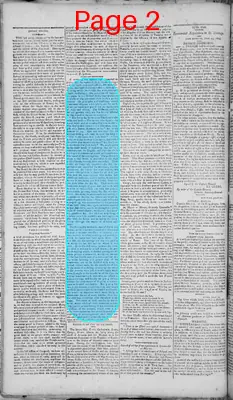
Editorial
August 2, 1802
Jenks's Portland Gazette
Portland, Cumberland County, Maine
What is this article about?
A Washington Federalist editorial criticizes an Aurora writer for claiming the repeal of carriage and loaf sugar taxes benefits manufacturers, mechanics, and farmers, arguing it only aids the rich while burdening the poor with other taxes on necessities.
Clipping
OCR Quality
95%
Excellent
Full Text
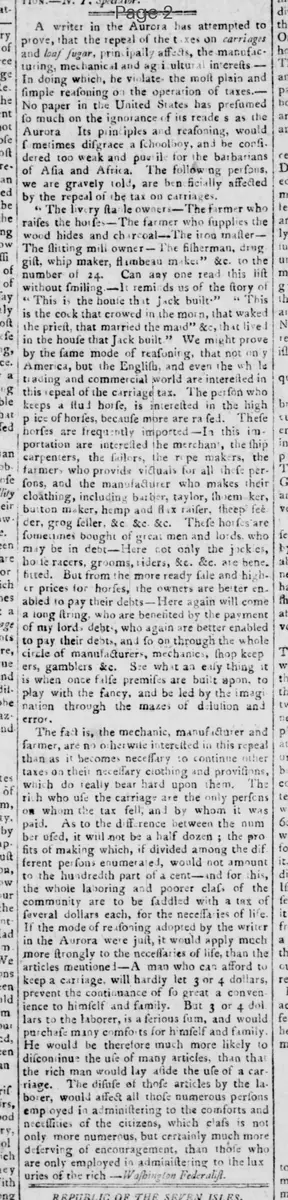
A writer in the Aurora has attempted to prove, that the repeal of the taxes on carriages and loaf sugar, principally affects, the manufacturing, mechanical and agricultural interests -- In doing which, he violates the most plain and simple reasoning on the operation of taxes.-- No paper in the United States has presumed so much on the ignorance of its readers as the Aurora. Its principles and reasoning, would sometimes disgrace a schoolboy, and be considered too weak and puerile for the barbarians of Asia and Africa. The following persons, we are gravely told, are beneficially affected by the repeal of the tax on carriages. " The livery stable owners-The farmer who raises the horses-The farmer who supplies the wood hides and charcoal- The iron master- The smithing mill owner- The fisherman, druggist, whip maker, flambeau maker" &c. to the number of 24. Can any one read this list without smiling.-It reminds us of the story of " This is the house that jack built." "This is the cock that crowed in the morn, that waked the priest, that married the maid" &c, that lived in the house that Jack built" We might prove by the same mode of reasoning, that not only America, but the English, and even the whole trading and commercial world are interested in this repeal of the carriage tax. The person who keeps a stud horse, is interested in the high price of horses, because more are raised. These horses are frequently imported-In this importation are interested the merchant, the ship carpenters, the sailors, the rope makers, the farmer who provides victuals for all the persons, and the manufacturer who makes their cloathing, including barber, taylor, shoemaker, button maker, hemp and flax raiser, sheep feeder, grog seller, &c &c. &c. These horses are sometimes bought of great men and lords. who may be in debt-Here not only the jockeys, horse racers, grooms, riders, &c. &c. are benefited. But from the more ready sale and higher prices for horses, the owners are better enabled to pay their debts-Here again will come a long string, who are benefited by the payment of my lord's debt, who again are better enabled to pay their debts, and so on through the whole circle of manufacturers, mechanics, Shop keepers, gamblers &c. See what an easy thing it is when once false premises are built upon, to play with the fancy, and be led by the imagination through the mazes of delusion and error,
The fact is, the mechanic, manufacturer and farmer, are no otherwise interested in this repeal than as it becomes necessary to continue other taxes on their necessary clothing and provisions, which do really bear hard upon them. The rich who use the carriage are the only persons on whom the tax fell, and by whom it was paid. As to the difference between the number used, it will not be a half dozen : the profits of making which, if divided among the different persons enumerated, would not amount to the hundredth part of a cent-and for this, the whole laboring and poorer class, of the community are to be saddled with a tax of several dollars each, for the necessaries of life. If the mode of reasoning adopted by the writer in the Aurora were just, it would apply much more strongly to the necessaries of life, than the articles mentioned-A man who can afford to keep a carriage, will hardly let 3 or 4 dollars, prevent the continuance of so great a convenience to himself and family. But 3 or 4 dollars to the laborer, is a serious sum, and would purchase many comforts for himself and family. He would be therefore much more likely to discontinue the use of many articles, than that the rich man would lay aside the use of a carriage. The disuse of those articles by the laborer, would affect all those numerous persons employed in administering to the comforts and necessities of the citizens, which class is not only more numerous, but certainly much more deserving of encouragement, than those who are only employed in administering to the luxuries of the rich -Washington Federalist.
The fact is, the mechanic, manufacturer and farmer, are no otherwise interested in this repeal than as it becomes necessary to continue other taxes on their necessary clothing and provisions, which do really bear hard upon them. The rich who use the carriage are the only persons on whom the tax fell, and by whom it was paid. As to the difference between the number used, it will not be a half dozen : the profits of making which, if divided among the different persons enumerated, would not amount to the hundredth part of a cent-and for this, the whole laboring and poorer class, of the community are to be saddled with a tax of several dollars each, for the necessaries of life. If the mode of reasoning adopted by the writer in the Aurora were just, it would apply much more strongly to the necessaries of life, than the articles mentioned-A man who can afford to keep a carriage, will hardly let 3 or 4 dollars, prevent the continuance of so great a convenience to himself and family. But 3 or 4 dollars to the laborer, is a serious sum, and would purchase many comforts for himself and family. He would be therefore much more likely to discontinue the use of many articles, than that the rich man would lay aside the use of a carriage. The disuse of those articles by the laborer, would affect all those numerous persons employed in administering to the comforts and necessities of the citizens, which class is not only more numerous, but certainly much more deserving of encouragement, than those who are only employed in administering to the luxuries of the rich -Washington Federalist.
What sub-type of article is it?
Taxation
Partisan Politics
What keywords are associated?
Carriage Tax
Loaf Sugar Tax
Tax Repeal
Aurora Criticism
Federalist Response
Class Interests
Economic Reasoning
What entities or persons were involved?
Aurora
Washington Federalist
Editorial Details
Primary Topic
Critique Of Aurora's Reasoning On Carriage Tax Repeal
Stance / Tone
Strongly Critical Of Aurora, Pro Laboring Class
Key Figures
Aurora
Washington Federalist
Key Arguments
Aurora's Reasoning On Tax Repeal Benefits To Various Trades Is Absurd And Chain Like Fallacy
Repeal Only Aids The Rich Carriage Users, Not Mechanics Or Farmers
Continued Taxes On Necessities Burden The Poor More Than Luxuries Burden The Rich
Laborers More Likely To Cut Necessities Than Rich Cut Luxuries