Thank you for visiting SNEWPapers!
Sign up free
Editorial
December 2, 1785
Fowle's New Hampshire Gazette And General Advertiser
Portsmouth, Rockingham County, New Hampshire
What is this article about?
A dialogue between a Countryman and a Townman critiques post-Revolutionary economic woes in America, advocating self-sufficiency, manufacturing, heavy duties on imports, debt repayment via taxes and retrenchment, and stronger Congressional powers for trade regulation and settling state claims like the Penobscot expedition.
Clipping
OCR Quality
95%
Excellent
Full Text
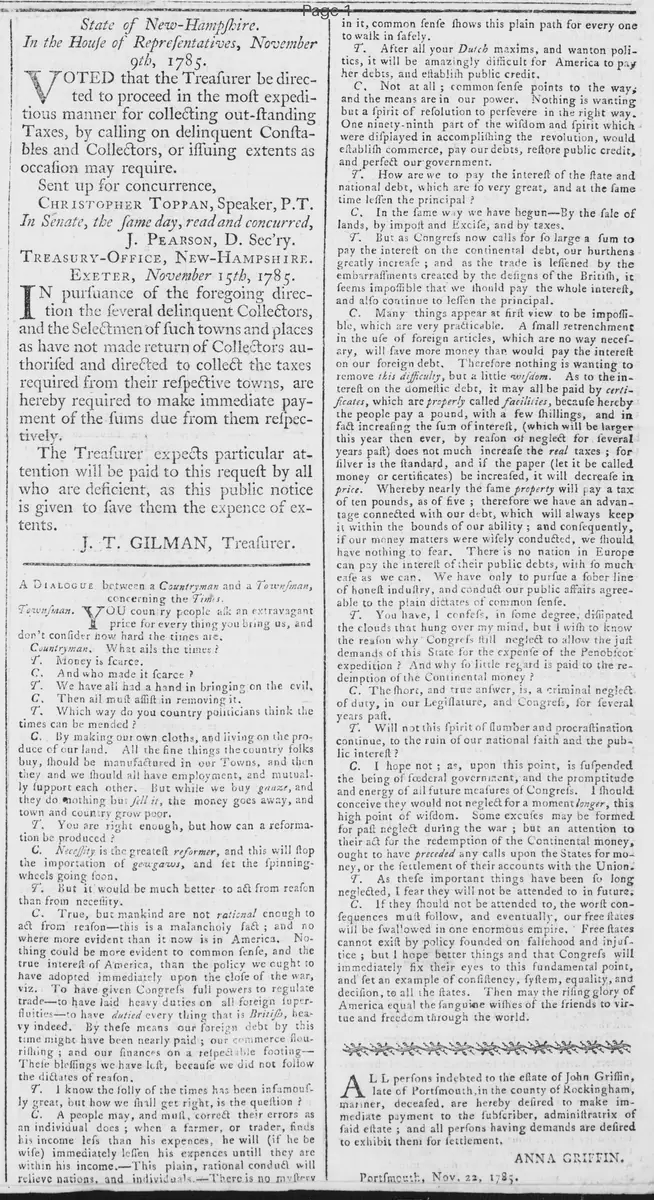
A Dialogue between a Countryman and a Townman, concerning the Times.
Townman. YOU country people ask an extravagant price for every thing you bring us, and don't consider how hard the times are.
Countryman. What ails the times?
T. Money is scarce.
C. And who made it scarce?
T. We have all had a hand in bringing on the evil.
C. Then all must assist in removing it.
T. Which way do you country politicians think the times can be mended?
C. By making our own clothes, and living on the produce of our land. All the fine things the country folks buy, should be manufactured in our Towns, and then they and we should all have employment, and mutually support each other. But while we buy gauze, and they do nothing but sell it, the money goes away, and town and country grow poor.
T. You are right enough, but how can a reformation be produced?
C. Necessity is the greatest reformer, and this will stop the importation of geegaws, and set the spinning wheels going soon.
T. But it would be much better to act from reason than from necessity.
C. True, but mankind are not rational enough to act from reason--this is a melancholy fact: and no where more evident than it now is in America. Nothing could be more evident to common sense, and the true interest of America, than the policy we ought to have adopted immediately upon the close of the war, viz. To have given Congress full powers to regulate trade--to have laid heavy duties on all foreign superfluities--to have dutied every thing that is British, heavy indeed. By these means our foreign debt by this time might have been nearly paid; our commerce flourishing; and our finances on a respectable footing--These blessings we have lost, because we did not follow the dictates of reason.
T. I know the folly of the times has been infamously great, but how we shall get right, is the question?
C. A people may, and must, correct their errors as an individual does: when a farmer, or trader, finds his income less than his expenses, he will (if he be wise) immediately lessen his expenses untill they are within his income.--This plain, rational conduct will relieve nations and individuals.--There is no mystery in it, common sense shows this plain path for every one to walk in safely.
T. After all your Dutch maxims, and wanton politics, it will be amazingly difficult for America to pay her debts, and establish public credit.
C. Not at all; common sense points to the way; and the means are in our power. Nothing is wanting but a spirit of resolution to persevere in the right way. One ninety-ninth part of the wisdom and spirit which were displayed in accomplishing the revolution, would establish commerce, pay our debts, restore public credit, and perfect our government.
T. How are we to pay the interest of the state and national debt, which are so very great, and at the same time lessen the principal?
C. In the same way we have begun--By the sale of lands, by impost and Excise, and by taxes.
T. But as Congress now calls for so large a sum to pay the interest on the continental debt, our burthens greatly increase; and as the trade is lessened by the embarrassments created by the designs of the British, it seems impossible that we should pay the whole interest, and also continue to lessen the principal.
C. Many things appear at first view to be impossible, which are very practicable. A small retrenchment in the use of foreign articles, which are no way necessary, will save more money than would pay the interest on our foreign debt. Therefore nothing is wanting to remove this difficulty, but a little wisdom. As to the interest on the domestic debt, it may all be paid by certificates, which are properly called facilities, because hereby the people pay a pound, with a few shillings, and in fact increasing the sum of interest, (which will be larger this year then ever, by reason of neglect for several years past) does not much increase the real taxes; for silver is the standard, and if the paper (let it be called money or certificates) be increased, it will decrease in price. Whereby nearly the same property will pay a tax of ten pounds, as of five; therefore we have an advantage connected with our debt, which will always keep it within the bounds of our ability; and consequently, if our money matters were wisely conducted, we should have nothing to fear. There is no nation in Europe can pay the interest of their public debts, with so much ease as we can. We have only to pursue a sober line of honest industry, and conduct our public affairs agreeable to the plain dictates of common sense.
T. You have, I confess, in some degree, dissipated the clouds that hung over my mind, but I wish to know the reason why Congress still neglect to allow the just demands of this State for the expense of the Penobscot expedition? And why so little regard is paid to the redemption of the Continental money?
C. The short, and true answer, is, a criminal neglect of duty, in our Legislature, and Congress, for several years past.
T. Will not this spirit of slumber and procrastination continue, to the ruin of our national faith and the public interest?
C. I hope not; as, upon this point, is suspended the being of federal government, and the promptitude and energy of all future measures of Congress. I should conceive they would not neglect for a moment longer, this high point of wisdom. Some excuse may be formed for past neglect during the war; but an attention to their act for the redemption of the Continental money, ought to have preceded any calls upon the States for money, or the settlement of their accounts with the Union.
T. As these important things have been so long neglected, I fear they will not be attended to in future.
C. If they should not be attended to, the worst consequences must follow, and eventually, our free states will be swallowed in one enormous empire. Free states cannot exist by policy founded on falsehood and injustice; but I hope better things and that Congress will immediately fix their eyes to this fundamental point, and set an example of consistency, system, equality, and decision, to all the states. Then may the rising glory of America equal the sanguine wishes of the friends to virtue and freedom through the world.
Townman. YOU country people ask an extravagant price for every thing you bring us, and don't consider how hard the times are.
Countryman. What ails the times?
T. Money is scarce.
C. And who made it scarce?
T. We have all had a hand in bringing on the evil.
C. Then all must assist in removing it.
T. Which way do you country politicians think the times can be mended?
C. By making our own clothes, and living on the produce of our land. All the fine things the country folks buy, should be manufactured in our Towns, and then they and we should all have employment, and mutually support each other. But while we buy gauze, and they do nothing but sell it, the money goes away, and town and country grow poor.
T. You are right enough, but how can a reformation be produced?
C. Necessity is the greatest reformer, and this will stop the importation of geegaws, and set the spinning wheels going soon.
T. But it would be much better to act from reason than from necessity.
C. True, but mankind are not rational enough to act from reason--this is a melancholy fact: and no where more evident than it now is in America. Nothing could be more evident to common sense, and the true interest of America, than the policy we ought to have adopted immediately upon the close of the war, viz. To have given Congress full powers to regulate trade--to have laid heavy duties on all foreign superfluities--to have dutied every thing that is British, heavy indeed. By these means our foreign debt by this time might have been nearly paid; our commerce flourishing; and our finances on a respectable footing--These blessings we have lost, because we did not follow the dictates of reason.
T. I know the folly of the times has been infamously great, but how we shall get right, is the question?
C. A people may, and must, correct their errors as an individual does: when a farmer, or trader, finds his income less than his expenses, he will (if he be wise) immediately lessen his expenses untill they are within his income.--This plain, rational conduct will relieve nations and individuals.--There is no mystery in it, common sense shows this plain path for every one to walk in safely.
T. After all your Dutch maxims, and wanton politics, it will be amazingly difficult for America to pay her debts, and establish public credit.
C. Not at all; common sense points to the way; and the means are in our power. Nothing is wanting but a spirit of resolution to persevere in the right way. One ninety-ninth part of the wisdom and spirit which were displayed in accomplishing the revolution, would establish commerce, pay our debts, restore public credit, and perfect our government.
T. How are we to pay the interest of the state and national debt, which are so very great, and at the same time lessen the principal?
C. In the same way we have begun--By the sale of lands, by impost and Excise, and by taxes.
T. But as Congress now calls for so large a sum to pay the interest on the continental debt, our burthens greatly increase; and as the trade is lessened by the embarrassments created by the designs of the British, it seems impossible that we should pay the whole interest, and also continue to lessen the principal.
C. Many things appear at first view to be impossible, which are very practicable. A small retrenchment in the use of foreign articles, which are no way necessary, will save more money than would pay the interest on our foreign debt. Therefore nothing is wanting to remove this difficulty, but a little wisdom. As to the interest on the domestic debt, it may all be paid by certificates, which are properly called facilities, because hereby the people pay a pound, with a few shillings, and in fact increasing the sum of interest, (which will be larger this year then ever, by reason of neglect for several years past) does not much increase the real taxes; for silver is the standard, and if the paper (let it be called money or certificates) be increased, it will decrease in price. Whereby nearly the same property will pay a tax of ten pounds, as of five; therefore we have an advantage connected with our debt, which will always keep it within the bounds of our ability; and consequently, if our money matters were wisely conducted, we should have nothing to fear. There is no nation in Europe can pay the interest of their public debts, with so much ease as we can. We have only to pursue a sober line of honest industry, and conduct our public affairs agreeable to the plain dictates of common sense.
T. You have, I confess, in some degree, dissipated the clouds that hung over my mind, but I wish to know the reason why Congress still neglect to allow the just demands of this State for the expense of the Penobscot expedition? And why so little regard is paid to the redemption of the Continental money?
C. The short, and true answer, is, a criminal neglect of duty, in our Legislature, and Congress, for several years past.
T. Will not this spirit of slumber and procrastination continue, to the ruin of our national faith and the public interest?
C. I hope not; as, upon this point, is suspended the being of federal government, and the promptitude and energy of all future measures of Congress. I should conceive they would not neglect for a moment longer, this high point of wisdom. Some excuse may be formed for past neglect during the war; but an attention to their act for the redemption of the Continental money, ought to have preceded any calls upon the States for money, or the settlement of their accounts with the Union.
T. As these important things have been so long neglected, I fear they will not be attended to in future.
C. If they should not be attended to, the worst consequences must follow, and eventually, our free states will be swallowed in one enormous empire. Free states cannot exist by policy founded on falsehood and injustice; but I hope better things and that Congress will immediately fix their eyes to this fundamental point, and set an example of consistency, system, equality, and decision, to all the states. Then may the rising glory of America equal the sanguine wishes of the friends to virtue and freedom through the world.
What sub-type of article is it?
Economic Policy
Trade Or Commerce
Constitutional
What keywords are associated?
Economic Hardship
Post War Debt
Trade Regulation
Self Sufficiency
Congressional Powers
Public Credit
Import Duties
Continental Money
What entities or persons were involved?
Congress
British
States
Countryman
Townman
Editorial Details
Primary Topic
Post Revolutionary Economic Reform And Self Sufficiency
Stance / Tone
Advocacy For Rational Economic Measures And Congressional Action
Key Figures
Congress
British
States
Countryman
Townman
Key Arguments
Make Own Clothes And Live On Land Produce To Retain Money
Impose Heavy Duties On Foreign And British Superfluities
Retrench Unnecessary Expenses To Match Income
Give Congress Full Powers To Regulate Trade
Pay Debts Via Land Sales, Imposts, Excise, And Taxes
Use Certificates For Domestic Debt Interest To Ease Burden
Address Neglect Of State Claims Like Penobscot Expedition
Redeem Continental Money To Restore Public Credit