Thank you for visiting SNEWPapers!
Sign up free
The Logan Republican
Logan, Cache County, Utah
What is this article about?
Brigadier General Charles A. Woodruff's 1915 address critiques pacifist movements promoting internationalism, advocates for patriotic education, national preparedness, and military discipline to foster morale and ensure peace with honor. Delivered to War Department Summer Camp students at Presidio of San Francisco.
Merged-components note: Merging continuation of the long editorial 'The Psychology of War' across pages 3 and 4.
Clippings
1 of 2
OCR Quality
Full Text
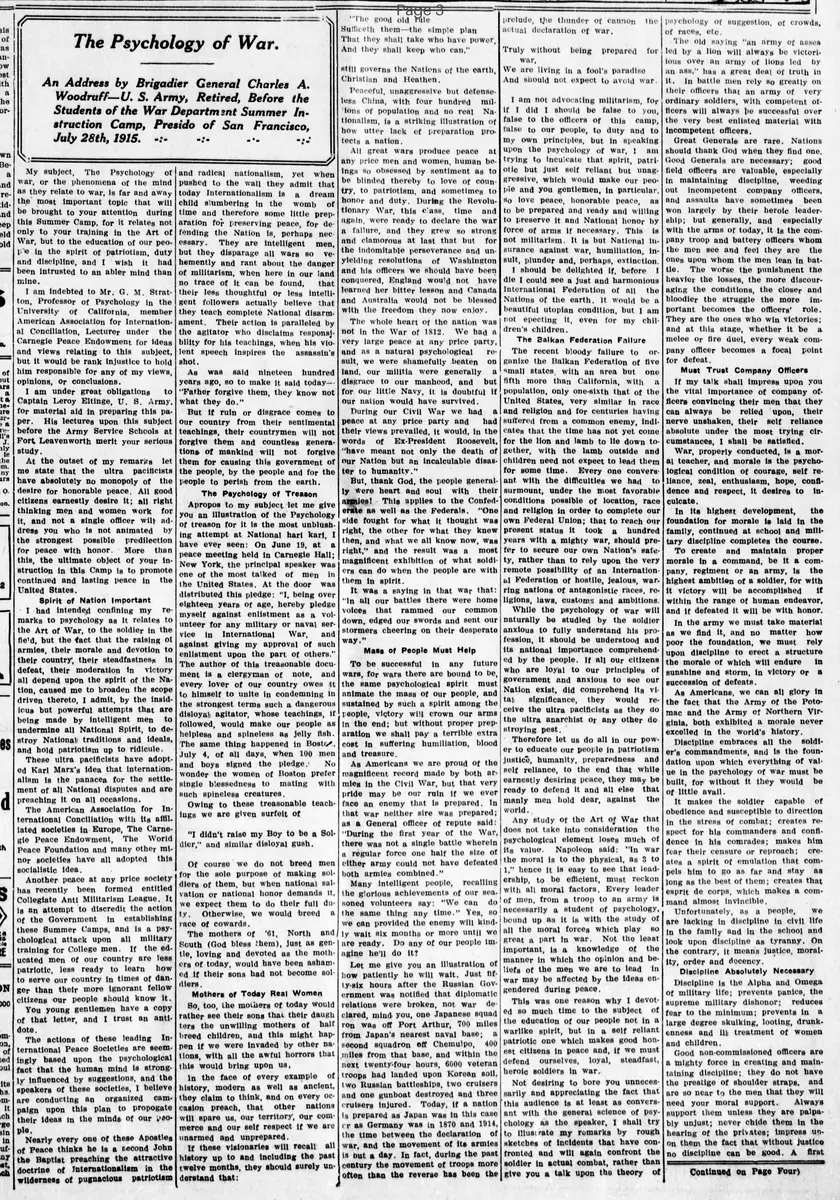
An Address by Brigadier General Charles A. Woodruff-U. S. Army, Retired, Before the Students of the War Department Summer Instruction Camp, Presidio of San Francisco, July 28th, 1915.
My subject, The Psychology of war, or the phenomena of the mind as they relate to war, is far and away the most important topic that will be brought to your attention during this Summer Camp, for it relates not only to your training in the Art of War, but to the education of our people in the spirit of patriotism, duty and discipline, and I wish it had been intrusted to an abler mind than mine.
I am indebted to Mr. G. M. Stratton, Professor of Psychology in the University of California, member American Association for International Conciliation, Lecturer under the Carnegie Peace Endowment for ideas and views relating to this subject but it would be rank injustice to hold him responsible for any of my views, opinions, or conclusions.
I am under great obligations to Captain Leroy Eltinge, U. S. Army, for material aid in preparing this paper. His lectures upon this subject before the Army Service Schools at Fort Leavenworth merit your serious study.
At the outset of my remarks let me state that the ultra pacificists have absolutely no monopoly of the desire for honorable peace. All good citizens earnestly desire it: all right thinking men and women work for it, and not a single officer will address you who is not animated by the strongest possible predilection for peace with honor. More than this, the ultimate object of your instruction in this Camp is to promote continued and lasting peace in the United States.
Spirit of Nation Important
I had intended confining my remarks to psychology as it relates to the Art of War, to the soldier in the field, but the fact that the raising of armies, their morale and devotion to their country, their steadfastness in defeat, their moderation in victory all depend upon the spirit of the Nation, caused me to broaden the scope driven thereto. I admit, by the insidious but powerful attempts that are being made by intelligent men to undermine all National Spirit, to destroy National traditions and ideals, and hold patriotism up to ridicule.
These ultra pacificists have adopted Karl Marx's idea that internationalism is the panacea for the settlement of all National disputes and are preaching it on all occasions.
The American Association for International Conciliation with its affiliated societies in Europe, The Carnegie Peace Endowment, The World Peace Foundation and many other minor societies have all adopted this socialistic idea.
Another peace at any price society has recently been formed entitled Collegiate Anti Militarism League. It is an attempt to discredit the action of the Government in establishing these Summer Camps, and is a psychological attack upon all military training for College men. If the educated men of our country are less patriotic, less ready to learn how to serve our country in times of danger than their more ignorant fellow citizens our people should know it.
You young gentlemen have a copy of that letter, and I trust an antidote.
The actions of these leading International Peace Societies are seemingly based upon the psychological fact that the human mind is strongly influenced by suggestions, and the speakers of these societies, I believe are conducting an organized campaign upon this plan to propagate their ideas in the minds of our people.
Nearly every one of these Apostles of Peace thinks he is a second John the Baptist preaching the attractive doctrine of Internationalism in the wilderness of pugnacious patriotism and radical nationalism, yet when pushed to the wall they admit that today Internationalism is a dream child slumbering in the womb of time and therefore some little preparation for preserving peace, for defending the Nation is, perhaps necessary.
They are intelligent men, but they disparage all wars so vehemently and rant about the danger of militarism, when here in our land no trace of it can be found, that their less thoughtful or less intelligent followers actually believe that they teach complete National disarmament. Their action is paralleled by the agitator who disclaims responsibility for his teachings, when his violent speech inspires the assassin's shot.
As was said nineteen hundred years ago, so to make it said today- "Father forgive them. they know not what they do."
But if ruin or disgrace comes to our country from their sentimental teachings, their countrymen will not forgive them and countless generations of mankind will not forgive them for causing this government of the people, by the people and for the people to perish from the earth.
The Psychology of Treason
Apropos to my subject let me give you an illustration of the Psychology of treason for it is the most unblushing attempt at National hari kari, I have ever seen: On June 19, at a peace meeting held in Carnegie Hall; New York, the principal speaker was one of the most talked of men in the United States. At the door was distributed this pledge: "I, being over eighteen years of age, hereby pledge myself against enlistment as a volunteer for any military or naval service in International War, and against giving my approval of such enlistment upon the part of others."
The author of this treasonable document is a clergyman of note, and every lover of our country owes it to himself to unite in condemning in the strongest terms such a dangerous disloyal agitator, whose teachings, if followed, would make our people as helpless and spineless as jelly fish.
The same thing happened in Boston, July 4, of all days, when 100 men and boys signed the pledge.
No wonder the women of Boston prefer single blessedness to mating with such spineless creatures.
Owing to these treasonable teachings we are given surfeit of "I didn't raise my Boy to be a Soldier," and similar disloyal gush.
Of course we do not breed men for the sole purpose of making soldiers of them, but when national salvation or national honor demands it, we expect them to do their full duty. Otherwise, we would breed a race of cowards.
The mothers of '61, North and South (God bless them), just as gentle, loving and devoted as the mothers of today, would have been ashamed if their sons had not become soldiers.
Mothers of Today Real Women
So, too, the mothers of today would rather see their sons that their daughters the unwilling mothers of half breed children, and this might happen if we were invaded by other nations, with all the awful horrors that this would bring upon us.
In the face of every example of history, modern as well as ancient, they claim to think, and on every occasion preach, that other nations will spare us, Our territory, our commerce and our self respect if we are unarmed and unprepared.
If these visionaries will recall all history up to and including the past twelve months, they should surely understand that:
"Sufficient them-the simple plan That they shall take who have the power And they shall keep who can,"
still governs the Nations of the earth, Christian and Heathen.
Peaceful, unaggressive but defenseless China, with four hundred millions of population and no real Nationalism, is a striking illustration of how utter lack of preparation protects a nation.
All great wars produce peace at any price men and women, human beings so obsessed by sentiment as to be blinded thereby to love of country, to patriotism, and sometimes to honor and duty. During the Revolutionary War, this class, time and again, were ready to declare the war a failure, and they grew so strong and clamorous at last that but for the indomitable perseverance and unyielding resolutions of Washington and his officers we should have been conquered, England would not have learned her bitter lesson and Canada and Australia would not be blessed with the freedom they now enjoy.
The whole heart of the nation was not in the War of 1812. We had a very large peace at any price party, and as a natural psychological result, we were shamefully beaten on land, our militia were generally a disgrace to our manhood, and but for our little Navy, it is doubtful if our nation would have survived.
During our Civil War we had a peace at any price party and had their views prevailed, it would, in the words of Ex-President Roosevelt "have meant not only the death of our Nation but an incalculable disaster to humanity."
But, thank God, the people generally were heart and soul with their armies! This applies to the Confederate as well as the Federals, "One side fought for what it thought was right, the other for what they knew then, and what we all know now, was right." and the result was a most magnificent exhibition of what soldiers can do when the people are with them in spirit.
It was a saying in that war that: "In all our battles there were home voices that rammed our cannon down, edged our swords and sent our stormers cheering on their desperate way."
Mass of People Must Help
To be successful in any future wars, for wars there are bound to be, the same psychological spirit must animate the mass of our people, and sustained by such a spirit among the people, victory will crown our arms in the end; but without proper preparation we shall pay a terrible extra cost in suffering humiliation, blood and treasure.
As Americans we are proud of the magnificent record made by both armies in the Civil War, but that very pride may be our ruin if we ever face an enemy that is prepared. In that war neither side was prepared; as a General officer of repute said: "During the first year of the War, there was not a single battle wherein a regular force one half the size of either army could not have defeated both armies combined."
Many intelligent people, recalling the glorious achievements of our seasoned volunteers say: "We can do the same thing any time." Yes, so we can provided the enemy will kindly wait six months or more until we are ready. Do any of our people imagine he'll do it?
Let me give you an illustration of how patiently he will wait. Just fifty-six hours after the Russian Government was notified that diplomatic relations were broken, not war declared, mind you, one Japanese squadron was off Port Arthur, 700 miles from Japan's nearest naval base; a second squadron off Chemulpo, 400 miles from that base, and within the next twenty-four hours, 6000 veteran troops had landed upon Korean soil, two Russian battleships, two cruisers and one gunboat destroyed and three cruisers injured. Today, if a nation is prepared as Japan was in this case or as Germany was in 1870 and 1914, the time between the declaration of war, and the movement of its armies is but a day. In fact, during the past century the movement of troops more often than the reverse has been the prelude, the thunder of cannon the actual declaration of war.
Truly without being prepared for war, we are living in a fool's paradise and should not expect to avoid war.
I am not advocating militarism, for if I did I should be false to you, false to the officers of this camp, false to our people, to duty and to my own principles, but in speaking upon the psychology of war, I am trying to inculcate that spirit, patriotic but just self reliant but unaggressive, which would make our people and you gentlemen, in particular, so love peace, honorable peace, as to be prepared and ready and willing to preserve it and National honor by force of arms if necessary. This is not militarism. It is but National insurance against war, humiliation, insult, plunder and, perhaps, extinction.
I should be delighted if, before I die I could see a just and harmonious International Federation of all the Nations of the earth. It would be a beautiful utopian condition, but I am not expecting it, even for my children's children.
The Balkan Federation Failure
The recent bloody failure to organize the Balkan Federation of five small states, with an area but one fifth more than California, with a population, only one-sixth that of the United States, very similar in race and religion and for centuries having suffered from a common enemy, indicates that the time has not yet come for the lion and lamb to lie down together, with the lamb outside and children need not expect to lead them for some time. Every one conversant with the difficulties we had to surmount, under the most favorable conditions possible of location, race and religion in order to complete our own Federal Union; that to reach our present status it took a hundred years with a mighty war, should prefer to secure our own Nation's safety, rather than to rely upon the very remote possibility of an International Federation of hostile, jealous, warring nations of antagonistic races, religions, laws, customs and ambitions.
While the psychology of war will naturally be studied by the soldier anxious to fully understand his profession, it should be understood and its national importance comprehended by the people. If all our citizens who are loyal to our principles of government and anxious to see our Nation exist, did comprehend its vital significance, they would receive the ultra pacificists as they do the ultra anarchist or any other destroying pest.
Therefore let us do all in our power to educate our people in patriotism justice, humanity, preparedness and self reliance, to the end that while earnestly desiring peace, they may be ready to defend it and all else that manly men hold dear, against the world.
Any study of the Art of War that does not take into consideration the psychological element loses much of its value. Napoleon said: "In War the moral is to the physical, as 3 to 1," hence it is easy to see that leadership, to be efficient, must reckon with all moral factors. Every leader of men, from a troop to an army is necessarily a student of psychology, bound up as it is with the study of all the moral forces which play so great a part in war. Not the least important, is a knowledge of the manner in which the opinion and beliefs of the men we are to lead in war may be affected by the ideas engendered during peace.
This was one reason why I devoted so much time to the subject of the education of our people not in a warlike spirit, but in a self reliant patriotic one which makes good honest citizens in peace and, if we must defend ourselves, loyal, steadfast, heroic soldiers in war.
Not desiring to bore you unnecessarily and appreciating the fact that this audience is at least as conversant with the general science of psychology as the speaker, I shall try to illustrate my remarks by rough sketches of incidents that have confronted and will again confront the soldier in actual combat, rather than give you a talk upon the theory of psychology of suggestion, of crowds, of races, etc.
The old saying "an army of asses led by a lion will always be victorious over an army of lions led by an ass," has a great deal of truth in it. In battle men rely so greatly on their officers that an army of very ordinary soldiers, with competent officers will always be successful over the very best enlisted material with incompetent officers.
Great Generals are rare. Nations should thank God when they find one. Good Generals are necessary: good field officers are valuable, especially in maintaining discipline, weeding out incompetent company officers, and assaults have sometimes been won largely by their heroic leadership; but generally, and especially with the arms of today, it is the company troop and battery officers whom the men see and feel they are the ones upon whom the men lean in battle. The worse the punishment the heavier the losses, the more discouraging the conditions, the closer and bloodier the struggle the more important becomes the officers' role.
They are the ones who win victories; and at this stage, whether it be a melee or fire duel, every weak company officer becomes a focal point for defeat.
Must Trust Company Officers
If my talk shall impress upon you the vital importance of company officers convincing their men that they can always be relied upon, their nerve unshaken, their self reliance absolute under the most trying circumstances, I shall be satisfied.
War, properly conducted, is a moral teacher, and morale is the psychological condition of courage, self reliance, zeal, enthusiasm, hope, confidence and respect, it desires to inculcate.
In its highest development, the foundation for morale is laid in the family, continued at school and military discipline completes the course.
To create and maintain proper morale in a command, be it a company, regiment or an army, is the highest ambition of a soldier, for with it victory will be accomplished if within the range of human endeavor, and if defeated it will be with honor.
In the army we must take material as we find it, and no matter how poor the foundation, we must rely upon discipline to erect a structure the morale of which will endure in sunshine and storm, in victory or a succession of defeats.
As Americans, we can all glory in the fact that the Army of the Potomac and the Army of Northern Virginia, both exhibited a morale never excelled in the world's history.
Discipline embraces all the soldier's commandments, and is the foundation upon which everything of value in the psychology of war must be built, for without it they would be of little avail.
It makes the soldier capable of obedience and susceptible to direction in the stress of combat; creates respect for his commanders and confidence in his comrades; makes him fear their censure or reproach; creates a spirit of emulation that compels him to go as far and stay as long as the best of them; creates that esprit de corps, which makes a command almost invincible.
Unfortunately, as a people, we are lacking in discipline in civil life in the family and in the school and look upon discipline as tyranny. On the contrary, it means justice, morality, order and decency.
Discipline Absolutely Necessary
Discipline is the Alpha and Omega of military life; prevents panics, the supreme military dishonor: reduces fear to the minimum; prevents in a large degree skulking, looting, drunkenness and ill treatment of women and children.
Good non-commissioned officers are a mighty force in creating and maintaining discipline; they do not have the prestige of shoulder straps, and are so near to the men that they will need your moral support.
Always support them unless they are palpably unjust; never chide them in the hearing of the privates; impress upon them the fact that without justice no discipline can be good. A first
Continued on Page Four
The Psychology of War
(Continued from page three)
class First Sergeant is almost necessary for a good Captain and may even make a good company for a very ordinary Captain.
I love to recall the discipline, devotion and loyalty … the non-coms. of my active soldier life..
(Concluded In Next Issue)
What sub-type of article is it?
What keywords are associated?
What entities or persons were involved?
Editorial Details
Primary Topic
Psychology Of War And National Preparedness
Stance / Tone
Advocacy For Patriotism, Military Discipline, And Preparedness Against Pacifist Internationalism
Key Figures
Key Arguments