Thank you for visiting SNEWPapers!
Sign up free
The Roanoke Times
Roanoke, Virginia
What is this article about?
Ella Wheeler Wilcox critiques how women dawdle and waste time on trivialities like prolonged toileting, hindering ambitions such as studying French or swimming, contrasting past limitations with modern opportunities, urging better time management for personal growth.
Clipping
OCR Quality
Full Text
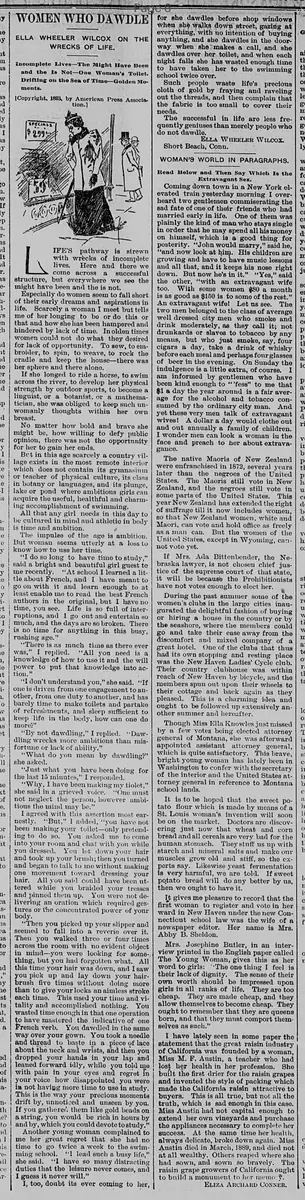
ELLA WHEELER WILCOX
ON THE WRECKS OF LIFE.
Incomplete Lives--The Might Have Been and the Is Not--One Woman's Toilet.
Drifting on the Sea of Time--Golden Moments.
[Copyright, 1893, by American Press Association.]
Life's pathway is strewn with wrecks of incomplete lives.
Here and there we come across a successful structure, but everywhere we see the might have been and the is not.
Especially do women seem to fall short of their early dreams and aspirations in life. Scarcely a woman I meet but tells me of her longing to be or do this or that and how she has been hampered and hindered by lack of time. In olden times women could not do what they desired for lack of opportunity. To sew, to embroider, to spin, to weave, to rock the cradle and keep the house--there was her sphere and there alone.
If she longed to ride a horse, to swim across the river, to develop her physical strength by outdoor sports, to become a linguist, or a botanist, or a mathematician, she was obliged to keep such unwomanly thoughts within her own breast.
No matter how bold and brave she might be, how willing to defy public opinion, there was not the opportunity for her to gain her ends.
But in this age scarcely a country village exists in the most remote interior which does not contain its gymnasium or teacher of physical culture, its class in botany or languages, and its plunge, lake or pond where ambitious girls can acquire the useful, healthful and charming accomplishment of swimming.
All that any girl needs in this day to be cultured in mind and athletic in body is time and ambition.
The impulse of the age is ambition. But woman seems utterly at a loss to know how to use her time.
"I do so long to have time to study," said a bright and beautiful girl guest to me recently. "At school I learned a little about French, and I have meant to go on with it and learn enough to at least enable me to read the best French authors in the original, but I have no time, you see. Life is so full of interruptions, and I go out and entertain so much, and the days are so broken. There is no time for anything in this busy, rushing age."
"There is as much time as there ever was," I replied. "All you need is a knowledge of how to use it and the will power to put that knowledge into action."
"I don't understand you," she said. "If one is driven from one engagement to another, from one duty to another, and has barely time to make toilets and partake of refreshments, and sleep sufficient to keep life in the body, how can one do more?"
"By not dawdling," I replied. "Dawdling wrecks more ambitions than misfortune or lack of ability."
"What do you mean by dawdling?" she asked.
"Just what you have been doing for the last 15 minutes," I responded.
"Why, I have been making my toilet," she said in a grieved voice. "One must not neglect the person, however ambitious the mind may be."
I agreed with this assertion most earnestly. "But," I added, "you have not been making your toilet--only pretending to do so. You asked me to come into your room and chat with you while you dressed. You let down your hair and took up your brush; then you turned and began to talk to me without making one movement toward dressing your hair. All you said could have been uttered while you braided your tresses and pinned them up. You were not delivering an oration which required gestures or the concentrated power of your body.
"Then you picked up your slipper and seemed to fall into a reverie over it. Then you walked three or four times across the room with no evident object in mind--you were looking for something, but you had forgotten what. All this time your hair was down, and I saw you pick up and lay down your hairbrush five times without doing more than to give your locks an aimless stroke each time. This used your time and vitality and accomplished nothing. You wasted time enough in that one operation to have mastered the indicative of one French verb. You dawdled in the same way over your gown. You took a needle and thread to baste in a piece of lace about the neck and wrists, and then you dropped your hands in your lap and leaned forward idly, while you told me with pain in your eyes and regret in your voice how disappointed you were in not having more time to use in study.
This is the way your precious moments drift by, unnoticed and unseen by you. If you gathered them like gold beads on a string, you would be rich in hours by and by, which you could devote to study."
Another young woman complained to me her great regret that she had no time to go twice a week to the swimming school. "I lead such a busy life," she said. "I have so many distracting duties that the leisure never comes, and I guess it never will."
I, too, doubt its ever coming to her, for she dawdles before shop windows when she walks down street, gazing at everything, with no intention of buying anything, and she dawdles in the doorway when she makes a call, and she dawdles over her toilet, and when each night falls she has wasted enough time to have taken her to the swimming school twice over.
Such people waste life's precious cloth of gold by fraying and raveling out the threads, and then complain that the fabric is too small to cover their needs.
The successful in life are less frequently geniuses than merely people who do not dawdle.
ELLA WHEELER WILCOX.
Short Beach, Conn.
What sub-type of article is it?
What themes does it cover?
What keywords are associated?
What entities or persons were involved?
Where did it happen?
Story Details
Key Persons
Location
Short Beach, Conn.
Event Date
1893
Story Details
Ella Wheeler Wilcox argues that modern women have opportunities for education and athletics but waste time dawdling on trivial tasks like dressing or window-shopping, using anecdotes of a girl regretting lack of study time while idly preparing her toilet and another missing swimming lessons due to similar habits, emphasizing that success comes from efficient use of time rather than genius.