Thank you for visiting SNEWPapers!
Sign up free
Literary
July 18, 1839
South Carolina Temperance Advocate
Columbia, Richland County, South Carolina
What is this article about?
This essay series in the South-Carolina Temperance Advocate critiques the intemperate lives and immoral dramatic works of poets John Dryden, Thomas Otway, and Nathaniel Lee, arguing their writings promote vice, debauchery, and moral degradation, influencing society negatively against temperance and virtue.
Merged-components note: Multi-part series (Nos. III-V and continuation) on the influence of intemperate poets and poetry, continued across sequential components in reading order.
Clipping
OCR Quality
95%
Excellent
Full Text
Communications.
For the Temperance Advocate
THE INFLUENCE OF INTEMPERATE POETS AND INTEMPERATE POETRY.
NO. III.
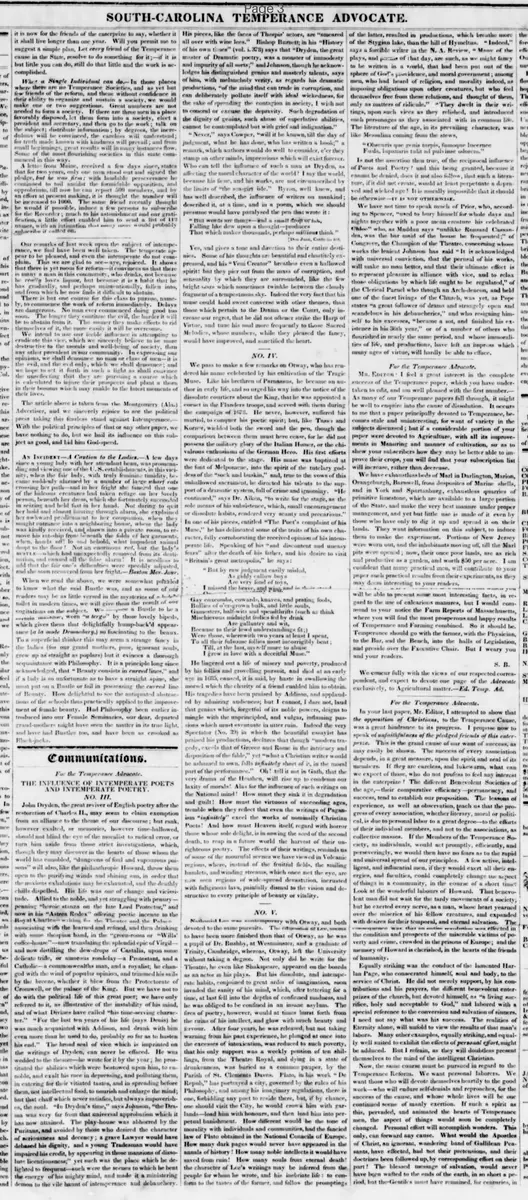
John Dryden, the great reviver of English poetry after the restoration of Charles II., may seem to claim exemption from an alliance to the theme of our discourse; but rank, however exalted, or memories, however time-hallowed, should not blind the eye of the moralist to radical error, or turn him aside from those strict investigations, which, though they may discover in the hearts of those whom the world has ennobled, "dungeons of foul and vapourous poisons" will also, like the philanthropic Howard, throw them open to the purifying winds and shining sun, in order that the noxious exhalations may be exhausted, and the deathly chills dispelled. His life was one of change and vicissitude. Allied to the noble, and yet struggling with penury—penning "heroic stanza on the late Lord Protector," and now in his "Astrea Redux" offering poetic incense to the Royal Charles—whig in the Theatre and the Palace associating with the learned and refined, and then drinking with some thespian band, in the "green-room or "Wills' coffee-house"—now translating the splendid epic of Virgil—and now distilling the dew-drops of Castalia, upon some delicate trile, or amorous rondelay—a Protestant, and a Catholic—a commonwealths man, and a royalist; he changed with the wind of popular opinion, and trimmed his sails by the breeze, whether it blew from the Protectorate of Cromwell, or the palace of the King. But we have not to do with the political life of this great poet; we have only referred to it, as illustrative of the instability of his mind, and of what Divines have called "his time-serving character." "For the last ten years of his life (says Denis) he was much acquainted with Addison, and drank with him even more than he used to do, probably so far as to hasten his end." The broad seal of vice which is imprinted on the writings of Dryden, can never be effaced. He was wedded to the theatre—he wrote for it by the year; he prostituted the abilities which were bestowed upon him, to ennoble, and exalt his race in depressing, and polluting them, in catering for their vitiated tastes, and in spreading before them, not intellectual food, to nourish and enlarge the mind: but that chaff which never satisfies, but always impoverishes, the soul. "In Dryden's time," says Johnson, "the Drama was very far from that universal approbation which it has now attained. The play-house was abhorred by the Puritans, and avoided by those who desired the character of seriousness and decency; a grave Lawyer would have debased his dignity, and a young Tradesman would have impaired his credit, by appearing in those mansions of dissolute licentiousness;" yet such was the place which he delighted to frequent—such were the scenes to which he bent the energy of his mighty mind, and made it a ministering demon to the vile haunt of intemperance and debauchery.
SOUTH-CAROLINA TEMPERANCE
ADVOCATE
His pieces, like the faces of Thespis' actors, are "smeared all over with wine lees." Bishop Burnett; in his "History of his own times" (vol. i. 378) says that "Dryden, the great master of Dramatic poetry, was a monster of immodesty and impurity of all sorts;" and Johnson, though he acknowledges his distinguished genius and masterly talents, says of him, with melancholy verity, as regards his dramatic productions, "of the mind that can trade in corruption, and can deliberately pollute itself with ideal wickedness, for the sake of spreading the contagion in society. I wish not to conceal or excuse the depravity. Such degradation of the dignity of genius, such abuse of superlative abilities, cannot be contemplated but with grief and indignation."
"Never," says Cowper, "will it be known, till the day of judgment, what he has done, who has written a book;" a remark, which authors would do well to consider, ere they stamp on other minds, impressions which will exist forever. Who can tell the influence of such a man as Dryden, as affecting the moral character of the world? I say the world, because his fame, and his works, are not circumscribed by the limits of "the sea-girt isle." Byron, well knew, and has well described, the influence of writers on mankind: described it, at a time, and in a poem, which we should presume would have paralysed the pen that wrote it :
"Its words are things—and a small drop of ink,
Falling like dew upon a thought-produces
That which makes thousands, perhaps millions think."
[Don Juan, Canto XI. L4]
Yes, and gives a tone and direction to their entire destinies. Some of his thoughts are beautiful and chastely expressed, and his "Veni Creator" breathes even a hallowed spirit: but they pier out from the mass of corruption, and sensuality by which they are surrounded, like the few bright stars which sometimes twinkle between the cloudy fragment of a tempestuous sky. Indeed the very fact that his muse could hold sweet converse with other themes, than those which pertain to the Drama or the Court, only increases our regret, that he did not oftener strike the Harp of Virtue, and tune his soul more frequently to those Sacred Melodies, whose numbers, while they pleased the fancy, would have improved, and sanctified the heart.
NO. IV.
We pass to make a few remarks on Otway, who has rendered his name celebrated by his cultivation of the Tragic Muse, Like his brethren of Parnassus, he became an author in early life, and so urged his way into the notice of the dissolute courtiers about the King, that he was appointed a cornet in the Flanders troops, and served with them during the campaign of 1678. He never, however, suffered his martial, to conquer his poetic spirit; but, like Tasso and Körner, wielded both the sword and the pen, though the comparison between them must here cease, for he did not possess the military glory of the Italian Homer, or the chivalrous enthusiasm of the German Hero. His first efforts were dedicated to the stage. His muse was baptized at the font of Melpomene, into the spirit of the tutelary goddess of the "sock and buskin." and, true to the vows of this unhallowed sacrament, he directed his talents to the support of a dramatic system, full of crime and ignominy. "He continued." says Dr. Aiken, "to write for the stage, as the sole means of his subsistence, which, small encouragement or dissolute habits, rendered very scanty and precarious."
In one of his pieces, entitled "The Poet's complaint of his Muse." he has delineated some of the traits of his own character, fully corroborating the received opinion of his intemperate life. Speaking of his "sad discontent and uneasy fears" after the death of his father, and his desire to visit Britain's great metropolis," he says:
"But by raw judgment easily misled
As giddy callow boys
Are very fond of toys,
I missed the brave, and wise aim
Gay coxcombs, cowards, knaves, and prating fools,
Bulls of o'er-grown bulk, and little souls,
Gamesters, half-wits and spendthrifts—(such as think
Mischievous midnight frolics fed by drink
Are gallantry and wit,
Because to their lewd understandings fit;)
Were those, wherewith two years at least I spent,
To all their fulsome follies most incorrigibly bent,
Till, at the last, myself more to abuse
I grew in love with a deceitful Muse."
He lingered out a life of misery and poverty, produced by his follies and grovelling pursuit, and died at an early age in 1685, caused, it is said, by haste in swallowing the morsel which the charity of a friend enabled him to obtain. His tragedies have been praised by Addison, and applauded by admiring audiences: but I cannot, I dare not, laud that genius which, forgetful of its noble powers, deigns to mingle with the unprincipled, and vulgar, inflaming passions which must eventuate in utter ruin. Indeed the very Spectator (No. 3) in which the beautiful essayist has praised his productions, declares that though "modern tragedy, excels that of Greece and Rome in the intricacy and disposition of the fable." yet "what a Christian writer would be ashamed to own, falls infinitely short of it, in the moral part of the performance." Oh! tell it not in Gath, that the very drama of the Heathen, will rise up to condemn our laxity of morals: Alas for the influence of such writings on the National mind! How must they sink it in degradation and guilt! How must the virtuous of succeeding ages, tremble when they reflect that even the writings of Paganism "infinitely" excel the works of nominally Christian Poets! And how must Heaven itself, regard with horror those whose sole delight, is in sowing the seed of the second death, to reap in a future world the harvest of their unrighteous poetry. The effects of their writings, reminds us of some of the mournful scenes we have viewed in Volcanic regions, where, instead of the fruitful fields, the smiling hamlets, and winding streets, which once met the eye, are now seen regions of wide-spread devastation, incrusted with fuliginous lava, painfully dismal to the vision and destructive to every principle of beauty or vitality.
NO. V.
Nathaniel Lee was contemporary with Otway, and both devoted to the same pursuits. The education of Lee, seems to have been more finished than that of Otway, as he was a pupil of Dr. Busby, at Westminster, and a graduate of Trinity, Cambridge, whereas, Otway, left the University without taking a degree. Not only did he write for the Theatre, he even like Shakspeare, appeared on the boards as an actor in his plays. But his dissolute, and intemperate habits, conjoined to great ardor of imagination, soon invaded the sanity of his mind, which, after tottering for a time, at last fell into the depths of confirmed madness, and he was obliged to be confined in an insane asylum. The fires of poetry, however, would at times burst forth from the ruins of his intellect, and glow with much beauty and fervour. After four years, he was released, but not taking warning from his past experience, he plunged at once into the excesses of intoxication, was reduced to such poverty, that his only support was a weekly pension of ten shillings, from the Theatre Royal, and dying in a state of drunkenness, was buried as a common pauper, by the Parish of St. Clements Danes. Plato, in his work "De Repub," has portrayed a city, governed by the rules of his Philosophy, and among his imaginary regulations, there is one, forbidding any poet to reside there, but, if by chance, one should visit the City, he would crown him with garlands—load him with honours, and then lead him into perpetual banishment. How different would be the tone of morality with individuals and communities, had the fancied law of Plato obtained in the National Councils of Europe. How many dark pages would never have appeared in the annals of history! How many noble intellects it would have saved from ruin! How many souls from eternal death! the character of Lee's writings may be inferred from the people for whom he wrote, and his inebriate life: to conform to the tastes of the former, and follow the promptings of the latter, resulted in productions, which breathe more of the Stygian lake, than the hill of Hymettus. "Indeed." says a forcible writer in the N. A. Review, "Many of the plays, and poems of that day, are such, as we might fancy to be written in a world, that had been put out of the sphere of God's providence, and moral government; among men, who had heard of religion, and morality indeed, as imposing obligations upon other creatures, but who feel themselves free from these relations, and thought of them, only as matters of ridicule." "They dwelt in their writings, upon such vices as they relished, and introduced such personages as they associated with in common life. The literature of the age, in its prevailing character, was like Messalina coming from the stews,
"Obscuris que genis turpis, fumoque lucernae
Farda, lupanaris tulit ad pulvinar odorem."
Is not the assertion then true, of the reciprocal influence of Poets and Poetry! and this being granted, because it cannot be denied, does it not also follow, that such a literature, if it did not create, would at least perpetuate a depraved and wicked age? It is morally impossible that it should be otherwise—It Is so otherwise.
We have not time to speak much of Prior, who, according to Spencer, "used to bury himself for whole days and nights together with a poor mean creature his celebrated Chloe" who, as Madden says "unlike Ronsard's Cassan. dra, was the bar maid of the house he frequented;" of Congreve, the Champion of the Theatre, concerning whose works the lenient Johnson has said "It is acknowledged with universal conviction, that the perusal of his works, will make no man better, and that their ultimate effect is to represent pleasure in alliance with vice, and to relax those obligations by which life ought to be regulated." of the Clerical Parnel who though an Arch-deacon, and held one of the finest livings of the Church, was yet, as Pope states "a great follower of drams and strangely open and scandalous in his debaucheries," and who resigning himself to his excesses, "became a sot, and finished his existence in his 38th year." or of a number of others who flourished in nearly the same period, and whose immoralities of life, and productions, have left an impress which many ages of virtue, will hardly be able to efface.
For the Temperance Advocate
THE INFLUENCE OF INTEMPERATE POETS AND INTEMPERATE POETRY.
NO. III.
John Dryden, the great reviver of English poetry after the restoration of Charles II., may seem to claim exemption from an alliance to the theme of our discourse; but rank, however exalted, or memories, however time-hallowed, should not blind the eye of the moralist to radical error, or turn him aside from those strict investigations, which, though they may discover in the hearts of those whom the world has ennobled, "dungeons of foul and vapourous poisons" will also, like the philanthropic Howard, throw them open to the purifying winds and shining sun, in order that the noxious exhalations may be exhausted, and the deathly chills dispelled. His life was one of change and vicissitude. Allied to the noble, and yet struggling with penury—penning "heroic stanza on the late Lord Protector," and now in his "Astrea Redux" offering poetic incense to the Royal Charles—whig in the Theatre and the Palace associating with the learned and refined, and then drinking with some thespian band, in the "green-room or "Wills' coffee-house"—now translating the splendid epic of Virgil—and now distilling the dew-drops of Castalia, upon some delicate trile, or amorous rondelay—a Protestant, and a Catholic—a commonwealths man, and a royalist; he changed with the wind of popular opinion, and trimmed his sails by the breeze, whether it blew from the Protectorate of Cromwell, or the palace of the King. But we have not to do with the political life of this great poet; we have only referred to it, as illustrative of the instability of his mind, and of what Divines have called "his time-serving character." "For the last ten years of his life (says Denis) he was much acquainted with Addison, and drank with him even more than he used to do, probably so far as to hasten his end." The broad seal of vice which is imprinted on the writings of Dryden, can never be effaced. He was wedded to the theatre—he wrote for it by the year; he prostituted the abilities which were bestowed upon him, to ennoble, and exalt his race in depressing, and polluting them, in catering for their vitiated tastes, and in spreading before them, not intellectual food, to nourish and enlarge the mind: but that chaff which never satisfies, but always impoverishes, the soul. "In Dryden's time," says Johnson, "the Drama was very far from that universal approbation which it has now attained. The play-house was abhorred by the Puritans, and avoided by those who desired the character of seriousness and decency; a grave Lawyer would have debased his dignity, and a young Tradesman would have impaired his credit, by appearing in those mansions of dissolute licentiousness;" yet such was the place which he delighted to frequent—such were the scenes to which he bent the energy of his mighty mind, and made it a ministering demon to the vile haunt of intemperance and debauchery.
SOUTH-CAROLINA TEMPERANCE
ADVOCATE
His pieces, like the faces of Thespis' actors, are "smeared all over with wine lees." Bishop Burnett; in his "History of his own times" (vol. i. 378) says that "Dryden, the great master of Dramatic poetry, was a monster of immodesty and impurity of all sorts;" and Johnson, though he acknowledges his distinguished genius and masterly talents, says of him, with melancholy verity, as regards his dramatic productions, "of the mind that can trade in corruption, and can deliberately pollute itself with ideal wickedness, for the sake of spreading the contagion in society. I wish not to conceal or excuse the depravity. Such degradation of the dignity of genius, such abuse of superlative abilities, cannot be contemplated but with grief and indignation."
"Never," says Cowper, "will it be known, till the day of judgment, what he has done, who has written a book;" a remark, which authors would do well to consider, ere they stamp on other minds, impressions which will exist forever. Who can tell the influence of such a man as Dryden, as affecting the moral character of the world? I say the world, because his fame, and his works, are not circumscribed by the limits of "the sea-girt isle." Byron, well knew, and has well described, the influence of writers on mankind: described it, at a time, and in a poem, which we should presume would have paralysed the pen that wrote it :
"Its words are things—and a small drop of ink,
Falling like dew upon a thought-produces
That which makes thousands, perhaps millions think."
[Don Juan, Canto XI. L4]
Yes, and gives a tone and direction to their entire destinies. Some of his thoughts are beautiful and chastely expressed, and his "Veni Creator" breathes even a hallowed spirit: but they pier out from the mass of corruption, and sensuality by which they are surrounded, like the few bright stars which sometimes twinkle between the cloudy fragment of a tempestuous sky. Indeed the very fact that his muse could hold sweet converse with other themes, than those which pertain to the Drama or the Court, only increases our regret, that he did not oftener strike the Harp of Virtue, and tune his soul more frequently to those Sacred Melodies, whose numbers, while they pleased the fancy, would have improved, and sanctified the heart.
NO. IV.
We pass to make a few remarks on Otway, who has rendered his name celebrated by his cultivation of the Tragic Muse, Like his brethren of Parnassus, he became an author in early life, and so urged his way into the notice of the dissolute courtiers about the King, that he was appointed a cornet in the Flanders troops, and served with them during the campaign of 1678. He never, however, suffered his martial, to conquer his poetic spirit; but, like Tasso and Körner, wielded both the sword and the pen, though the comparison between them must here cease, for he did not possess the military glory of the Italian Homer, or the chivalrous enthusiasm of the German Hero. His first efforts were dedicated to the stage. His muse was baptized at the font of Melpomene, into the spirit of the tutelary goddess of the "sock and buskin." and, true to the vows of this unhallowed sacrament, he directed his talents to the support of a dramatic system, full of crime and ignominy. "He continued." says Dr. Aiken, "to write for the stage, as the sole means of his subsistence, which, small encouragement or dissolute habits, rendered very scanty and precarious."
In one of his pieces, entitled "The Poet's complaint of his Muse." he has delineated some of the traits of his own character, fully corroborating the received opinion of his intemperate life. Speaking of his "sad discontent and uneasy fears" after the death of his father, and his desire to visit Britain's great metropolis," he says:
"But by raw judgment easily misled
As giddy callow boys
Are very fond of toys,
I missed the brave, and wise aim
Gay coxcombs, cowards, knaves, and prating fools,
Bulls of o'er-grown bulk, and little souls,
Gamesters, half-wits and spendthrifts—(such as think
Mischievous midnight frolics fed by drink
Are gallantry and wit,
Because to their lewd understandings fit;)
Were those, wherewith two years at least I spent,
To all their fulsome follies most incorrigibly bent,
Till, at the last, myself more to abuse
I grew in love with a deceitful Muse."
He lingered out a life of misery and poverty, produced by his follies and grovelling pursuit, and died at an early age in 1685, caused, it is said, by haste in swallowing the morsel which the charity of a friend enabled him to obtain. His tragedies have been praised by Addison, and applauded by admiring audiences: but I cannot, I dare not, laud that genius which, forgetful of its noble powers, deigns to mingle with the unprincipled, and vulgar, inflaming passions which must eventuate in utter ruin. Indeed the very Spectator (No. 3) in which the beautiful essayist has praised his productions, declares that though "modern tragedy, excels that of Greece and Rome in the intricacy and disposition of the fable." yet "what a Christian writer would be ashamed to own, falls infinitely short of it, in the moral part of the performance." Oh! tell it not in Gath, that the very drama of the Heathen, will rise up to condemn our laxity of morals: Alas for the influence of such writings on the National mind! How must they sink it in degradation and guilt! How must the virtuous of succeeding ages, tremble when they reflect that even the writings of Paganism "infinitely" excel the works of nominally Christian Poets! And how must Heaven itself, regard with horror those whose sole delight, is in sowing the seed of the second death, to reap in a future world the harvest of their unrighteous poetry. The effects of their writings, reminds us of some of the mournful scenes we have viewed in Volcanic regions, where, instead of the fruitful fields, the smiling hamlets, and winding streets, which once met the eye, are now seen regions of wide-spread devastation, incrusted with fuliginous lava, painfully dismal to the vision and destructive to every principle of beauty or vitality.
NO. V.
Nathaniel Lee was contemporary with Otway, and both devoted to the same pursuits. The education of Lee, seems to have been more finished than that of Otway, as he was a pupil of Dr. Busby, at Westminster, and a graduate of Trinity, Cambridge, whereas, Otway, left the University without taking a degree. Not only did he write for the Theatre, he even like Shakspeare, appeared on the boards as an actor in his plays. But his dissolute, and intemperate habits, conjoined to great ardor of imagination, soon invaded the sanity of his mind, which, after tottering for a time, at last fell into the depths of confirmed madness, and he was obliged to be confined in an insane asylum. The fires of poetry, however, would at times burst forth from the ruins of his intellect, and glow with much beauty and fervour. After four years, he was released, but not taking warning from his past experience, he plunged at once into the excesses of intoxication, was reduced to such poverty, that his only support was a weekly pension of ten shillings, from the Theatre Royal, and dying in a state of drunkenness, was buried as a common pauper, by the Parish of St. Clements Danes. Plato, in his work "De Repub," has portrayed a city, governed by the rules of his Philosophy, and among his imaginary regulations, there is one, forbidding any poet to reside there, but, if by chance, one should visit the City, he would crown him with garlands—load him with honours, and then lead him into perpetual banishment. How different would be the tone of morality with individuals and communities, had the fancied law of Plato obtained in the National Councils of Europe. How many dark pages would never have appeared in the annals of history! How many noble intellects it would have saved from ruin! How many souls from eternal death! the character of Lee's writings may be inferred from the people for whom he wrote, and his inebriate life: to conform to the tastes of the former, and follow the promptings of the latter, resulted in productions, which breathe more of the Stygian lake, than the hill of Hymettus. "Indeed." says a forcible writer in the N. A. Review, "Many of the plays, and poems of that day, are such, as we might fancy to be written in a world, that had been put out of the sphere of God's providence, and moral government; among men, who had heard of religion, and morality indeed, as imposing obligations upon other creatures, but who feel themselves free from these relations, and thought of them, only as matters of ridicule." "They dwelt in their writings, upon such vices as they relished, and introduced such personages as they associated with in common life. The literature of the age, in its prevailing character, was like Messalina coming from the stews,
"Obscuris que genis turpis, fumoque lucernae
Farda, lupanaris tulit ad pulvinar odorem."
Is not the assertion then true, of the reciprocal influence of Poets and Poetry! and this being granted, because it cannot be denied, does it not also follow, that such a literature, if it did not create, would at least perpetuate a depraved and wicked age? It is morally impossible that it should be otherwise—It Is so otherwise.
We have not time to speak much of Prior, who, according to Spencer, "used to bury himself for whole days and nights together with a poor mean creature his celebrated Chloe" who, as Madden says "unlike Ronsard's Cassan. dra, was the bar maid of the house he frequented;" of Congreve, the Champion of the Theatre, concerning whose works the lenient Johnson has said "It is acknowledged with universal conviction, that the perusal of his works, will make no man better, and that their ultimate effect is to represent pleasure in alliance with vice, and to relax those obligations by which life ought to be regulated." of the Clerical Parnel who though an Arch-deacon, and held one of the finest livings of the Church, was yet, as Pope states "a great follower of drams and strangely open and scandalous in his debaucheries," and who resigning himself to his excesses, "became a sot, and finished his existence in his 38th year." or of a number of others who flourished in nearly the same period, and whose immoralities of life, and productions, have left an impress which many ages of virtue, will hardly be able to efface.
What sub-type of article is it?
Essay
What themes does it cover?
Temperance
Moral Virtue
What keywords are associated?
Temperance
Intemperate Poets
Dryden
Otway
Nathaniel Lee
Moral Influence
Poetry Critique
Dissolute Habits
Literary Details
Title
The Influence Of Intemperate Poets And Intemperate Poetry.
Subject
Critique Of Intemperate Poets For The Temperance Advocate
Key Lines
"For The Last Ten Years Of His Life (Says Denis) He Was Much Acquainted With Addison, And Drank With Him Even More Than He Used To Do, Probably So Far As To Hasten His End."
"Never," Says Cowper, "Will It Be Known, Till The Day Of Judgment, What He Has Done, Who Has Written A Book;"
"Its Words Are Things—And A Small Drop Of Ink, Falling Like Dew Upon A Thought Produces That Which Makes Thousands, Perhaps Millions Think."
"But By Raw Judgment Easily Misled As Giddy Callow Boys Are Very Fond Of Toys, I Missed The Brave, And Wise Aim Gay Coxcombs, Cowards, Knaves, And Prating Fools, Bulls Of O'er Grown Bulk, And Little Souls, Gamesters, Half Wits And Spendthrifts—(Such As Think Mischievous Midnight Frolics Fed By Drink Are Gallantry And Wit, Because To Their Lewd Understandings Fit;) Were Those, Wherewith Two Years At Least I Spent, To All Their Fulsome Follies Most Incorrigibly Bent, Till, At The Last, Myself More To Abuse I Grew In Love With A Deceitful Muse."
"It Is Acknowledged With Universal Conviction, That The Perusal Of His Works, Will Make No Man Better, And That Their Ultimate Effect Is To Represent Pleasure In Alliance With Vice, And To Relax Those Obligations By Which Life Ought To Be Regulated."