Thank you for visiting SNEWPapers!
Sign up free
Editorial
February 22, 1957
The Prison Mirror
Stillwater, Washington County, Minnesota
What is this article about?
Editorial from the viewpoint of family members of prisoners, detailing the emotional and financial burdens they endure due to loved ones' repeated incarcerations. It critiques the prison system's ineffective rehabilitation methods, highlights high recidivism rates, and emphasizes the role of family love and support in fostering positive change.
Clipping
OCR Quality
98%
Excellent
Full Text
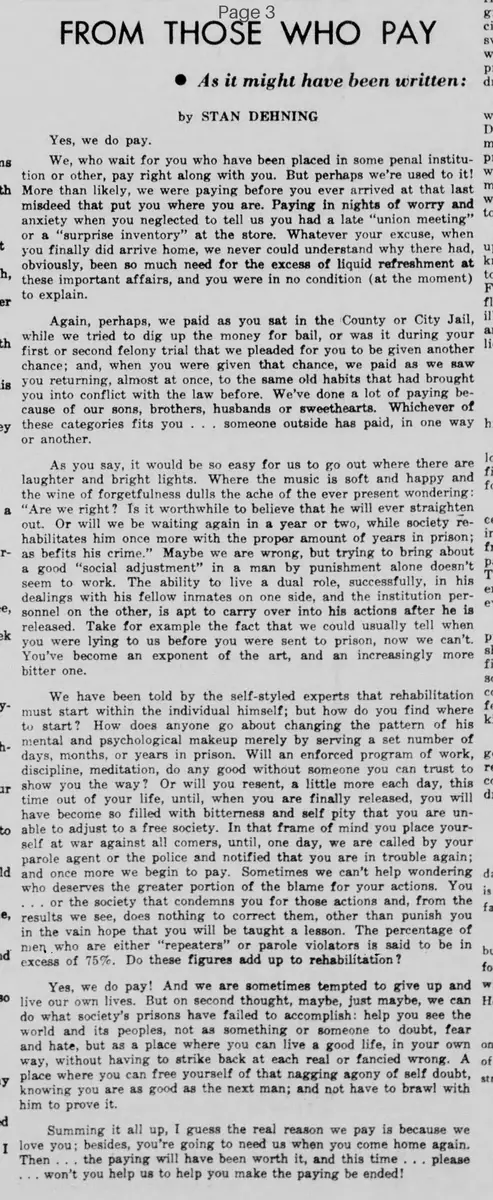
FROM THOSE WHO PAY
As it might have been written:
by STAN DEHNING
Yes, we do pay.
We, who wait for you who have been placed in some penal institution or other, pay right along with you. But perhaps we're used to it! More than likely, we were paying before you ever arrived at that last misdeed that put you where you are. Paying in nights of worry and anxiety when you neglected to tell us you had a late "union meeting" or a "surprise inventory" at the store. Whatever your excuse, when you finally did arrive home, we never could understand why there had, obviously, been so much need for the excess of liquid refreshment at these important affairs, and you were in no condition (at the moment) to explain.
Again, perhaps, we paid as you sat in the County or City Jail, while we tried to dig up the money for bail, or was it during your first or second felony trial that we pleaded for you to be given another chance; and, when you were given that chance, we paid as we saw you returning, almost at once, to the same old habits that had brought you into conflict with the law before. We've done a lot of paying because of our sons, brothers, husbands or sweethearts. Whichever of these categories fits you . . . someone outside has paid, in one way or another.
As you say, it would be so easy for us to go out where there are laughter and bright lights. Where the music is soft and happy and the wine of forgetfulness dulls the ache of the ever present wondering: "Are we right? Is it worthwhile to believe that he will ever straighten out. Or will we be waiting again in a year or two, while society rehabilitates him once more with the proper amount of years in prison; as befits his crime." Maybe we are wrong, but trying to bring about a good "social adjustment" in a man by punishment alone doesn't seem to work. The ability to live a dual role, successfully, in his dealings with his fellow inmates on one side, and the institution personnel on the other, is apt to carry over into his actions after he is released. Take for example the fact that we could usually tell when you were lying to us before you were sent to prison, now we can't. You've become an exponent of the art, and an increasingly more bitter one.
We have been told by the self-styled experts that rehabilitation must start within the individual himself: but how do you find where to start? How does anyone go about changing the pattern of his mental and psychological makeup merely by serving a set number of days, months, or years in prison. Will an enforced program of work, discipline, meditation, do any good without someone you can trust to show you the way? Or will you resent, a little more each day, this time out of your life, until, when you are finally released, you will have become so filled with bitterness and self pity that you are unable to adjust to a free society. In that frame of mind you place yourself at war against all comers, until, one day, we are called by your parole agent or the police and notified that you are in trouble again; and once more we begin to pay. Sometimes we can't help wondering who deserves the greater portion of the blame for your actions. You . . . or the society that condemns you for those actions and, from the results we see, does nothing to correct them, other than punish you in the vain hope that you will be taught a lesson. The percentage of men who are either "repeaters" or parole violators is said to be in excess of 75%. Do these figures add up to rehabilitation?
Yes, we do pay! And we are sometimes tempted to give up and live our own lives. But on second thought, maybe, just maybe, we can do what society's prisons have failed to accomplish: help you see the world and its peoples, not as something or someone to doubt, fear and hate, but as a place where you can live a good life, in your own way, without having to strike back at each real or fancied wrong. A place where you can free yourself of that nagging agony of self doubt, knowing you are as good as the next man; and not have to brawl with him to prove it.
Summing it all up, I guess the real reason we pay is because we love you; besides, you're going to need us when you come home again. Then ... the paying will have been worth it, and this time ... please . .. won't you help us to help you make the paying be ended!
As it might have been written:
by STAN DEHNING
Yes, we do pay.
We, who wait for you who have been placed in some penal institution or other, pay right along with you. But perhaps we're used to it! More than likely, we were paying before you ever arrived at that last misdeed that put you where you are. Paying in nights of worry and anxiety when you neglected to tell us you had a late "union meeting" or a "surprise inventory" at the store. Whatever your excuse, when you finally did arrive home, we never could understand why there had, obviously, been so much need for the excess of liquid refreshment at these important affairs, and you were in no condition (at the moment) to explain.
Again, perhaps, we paid as you sat in the County or City Jail, while we tried to dig up the money for bail, or was it during your first or second felony trial that we pleaded for you to be given another chance; and, when you were given that chance, we paid as we saw you returning, almost at once, to the same old habits that had brought you into conflict with the law before. We've done a lot of paying because of our sons, brothers, husbands or sweethearts. Whichever of these categories fits you . . . someone outside has paid, in one way or another.
As you say, it would be so easy for us to go out where there are laughter and bright lights. Where the music is soft and happy and the wine of forgetfulness dulls the ache of the ever present wondering: "Are we right? Is it worthwhile to believe that he will ever straighten out. Or will we be waiting again in a year or two, while society rehabilitates him once more with the proper amount of years in prison; as befits his crime." Maybe we are wrong, but trying to bring about a good "social adjustment" in a man by punishment alone doesn't seem to work. The ability to live a dual role, successfully, in his dealings with his fellow inmates on one side, and the institution personnel on the other, is apt to carry over into his actions after he is released. Take for example the fact that we could usually tell when you were lying to us before you were sent to prison, now we can't. You've become an exponent of the art, and an increasingly more bitter one.
We have been told by the self-styled experts that rehabilitation must start within the individual himself: but how do you find where to start? How does anyone go about changing the pattern of his mental and psychological makeup merely by serving a set number of days, months, or years in prison. Will an enforced program of work, discipline, meditation, do any good without someone you can trust to show you the way? Or will you resent, a little more each day, this time out of your life, until, when you are finally released, you will have become so filled with bitterness and self pity that you are unable to adjust to a free society. In that frame of mind you place yourself at war against all comers, until, one day, we are called by your parole agent or the police and notified that you are in trouble again; and once more we begin to pay. Sometimes we can't help wondering who deserves the greater portion of the blame for your actions. You . . . or the society that condemns you for those actions and, from the results we see, does nothing to correct them, other than punish you in the vain hope that you will be taught a lesson. The percentage of men who are either "repeaters" or parole violators is said to be in excess of 75%. Do these figures add up to rehabilitation?
Yes, we do pay! And we are sometimes tempted to give up and live our own lives. But on second thought, maybe, just maybe, we can do what society's prisons have failed to accomplish: help you see the world and its peoples, not as something or someone to doubt, fear and hate, but as a place where you can live a good life, in your own way, without having to strike back at each real or fancied wrong. A place where you can free yourself of that nagging agony of self doubt, knowing you are as good as the next man; and not have to brawl with him to prove it.
Summing it all up, I guess the real reason we pay is because we love you; besides, you're going to need us when you come home again. Then ... the paying will have been worth it, and this time ... please . .. won't you help us to help you make the paying be ended!
What sub-type of article is it?
Crime Or Punishment
Social Reform
What keywords are associated?
Prison Rehabilitation
Family Support
Recidivism
Penal System
Emotional Toll
Social Adjustment
What entities or persons were involved?
Prisoners
Family Members
Society
Parole Agents
Police
Editorial Details
Primary Topic
Emotional Toll On Families Of Prisoners And Critique Of Prison Rehabilitation
Stance / Tone
Empathetic And Critical Of Penal System, Hopeful For Family Intervention
Key Figures
Prisoners
Family Members
Society
Parole Agents
Police
Key Arguments
Families Endure Worry, Anxiety, And Financial Costs Due To Inmates' Actions And Recidivism
Punishment Alone Fails To Achieve Social Adjustment Or Rehabilitation
Prison Life Teaches Deception And Bitterness That Persists Post Release
High Recidivism Rate Over 75% Indicates Systemic Failure
Family Love And Support Can Guide Positive Change Where Prisons Fail