Thank you for visiting SNEWPapers!
Sign up free
Rhode Island Republican
Newport, Newport County, Rhode Island
What is this article about?
Summary of European politics in October 1802, detailing Anglo-French tensions over the Treaty of Amiens, Malta settlement, commerce treaty delays, and Swiss intervention; French military threats to Switzerland under Ney; German indemnity uncertainties; foiled constitutional plot in Batavian Republic by First Consul; Algiers port cession rumors; diplomatic movements of Andreossi and Whitworth; Admiralty preparations; Paris war rumors and Bonaparte's defiant response to Russia.
Clipping
OCR Quality
Full Text
LONDON, October 15.
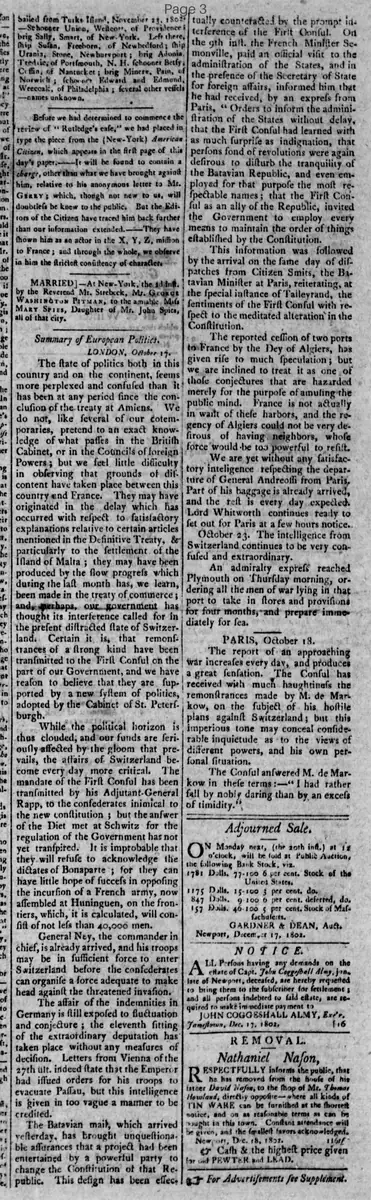
The state of politics both in this country and on the continent, seems more perplexed and confused than it has been at any period since the conclusion of the treaty at Amiens. 'We do not, like several of our contemporaries, pretend to an exact knowledge of what passes in the British Cabinet, or in the Councils of foreign Powers; but we feel little difficulty in observing that grounds of discontent have taken place between this country and France. They may have originated in the delay which has occurred with respect to satisfactory explanations relative to certain articles mentioned in the Definitive Treaty, & particularly to the settlement, of the Island of Malta ; they may have been produced by the slow progress which during the last month has, we learn, been made in the treaty of commerce; and perhaps, our government has thought its interference called for in the present distracted state of Switzerland. Certain it is, that remonstrances of a strong kind have been transmitted to the First Consul on the part of our Government, and we have reason to believe that they are, supported by a new system of politics, adopted by the Cabinet of St. Petersburg. While the political horizon is thus clouded; and our funds are seriously affected by the gloom that prevails, the affairs of Switzerland become every day more critical. The mandate of the First Consul has been transmitted by his Adjutant-General Rapp, to the confederates inimical to the new constitution ; but the answer of the Diet met at Schwytz for the regulation of the Government has not yet transpired. It is improbable that they will refuse to acknowledge the dictates of Bonaparte ; for they can have little hope of success in opposing the incursion of a French army, now assembled at Huninguen, on the frontiers, which, it is calculated, will consist of not less than 40,000 men. General Ney, the commander in chief, is already arrived, and his troops may be in sufficient force to enter Switzerland before the confederates can organize a force adequate to make head against the threatened invasion. The affair of the indemnities in Germany is still exposed to fluctuation and conjecture ; the eleventh sitting of the extraordinary deputation has taken place without any measures of decision. Letters from Vienna of the 27th ult. indeed state that the Emperor had issued orders for his troops to evacuate Passau, but this intelligence is given in too vague a manner to be credited. The Batavian mail, which arrived yesterday, has brought unquestionable assurances that a project had been entertained by a powerful party to change the Constitution of that Republic. This design has been effectually counteracted by the prompt interference of the First Consul. On the 6th inst. the French Minister Semmonville, paid an official visit to the administration of the States, and in the presence of the Secretary of State for foreign affairs, informed him that he had received, by an express from Paris, "Orders to inform the administration of the States without delay. that the First Consul had learned with as much surprise as indignation, that persons fond of revolutions were again desirous to disturb the tranquility of the Batavian Republic, and even employed for that purpose the most respectable names: that the First Consul as an ally of the Republic, invited the Government to employ every means to maintain the order of things established by the Constitution." This information was followed by the arrival on the same day of dispatches from Citizen Schimmelpenninck, the Batavian Minister at Paris, reiterating, at the special instance of Talleyrand, the sentiments of the First Consul with respect to the meditated alteration in the Constitution. The reported cession of two ports to France by the Dey of Algiers, has given rise to much speculation; but we are inclined to treat it as one of those conjectures that are hazarded merely for the purpose of amusing the public mind. France is not actually in want of these harbours, and the regency of Algiers could not be very desirous of having. neighbors, whose force would be too powerful to resist. We are yet without any satisfactory intelligence respecting the departure of General Andreossi from Paris. Part of his baggage is already arrived, and the rest is every day expected. Lord Whitworth continues ready to set out for Paris at a few hours notice.. October 23. The intelligence from Switzerland continues to be very confused and extraordinary. An admiralty express reached Plymouth on Thursday morning, ordering all the men of war lying in that port to take in stores and provisions for four months, and prepare immediately for sea. PARIS, October 18. The report of an approaching war increases every day, and produces a great sensation. The Consul has received with much haughtiness the remonstrances made by M. de Markov, on the subject of- his hostile plans against Switzerland; but this imperious tone may conceal considerable inquietude as to the views of different powers, and his own personal situation. The Consul answered M. de Markov in these terms:- "I had rather fall by nobly daring than by an excess of timidity."
What sub-type of article is it?
What keywords are associated?
What entities or persons were involved?
Where did it happen?
Foreign News Details
Primary Location
Europe
Event Date
October 15
Key Persons
Outcome
anglo-french remonstrances transmitted; french army of 40,000 assembled at huninguen threatening switzerland; batavian constitutional plot counteracted by french intervention; german indemnity decisions pending; algiers port cession rumored but doubted; british ships ordered to prepare for sea; war rumors increasing in paris.
Event Details
Politics in Europe perplexed post-Amiens Treaty with Anglo-French discontent over Malta, commerce treaty delays, and Swiss state; strong remonstrances to First Consul supported by St. Petersburg; Swiss confederates receive Bonaparte's mandate via Rapp, unlikely to resist 40,000 French troops under Ney at Huninguen; German indemnities fluctuate, vague report of Austrian evacuation of Passau; Batavian plot to change constitution thwarted by First Consul's orders via Semmonville and Schimmelpenninck; Algiers ceding ports to France speculated but dismissed; Andreossi preparing to leave Paris, Whitworth ready; October 23 update on confused Swiss intelligence and Admiralty orders at Plymouth; Paris report of rising war fears, Consul's haughty response to Russian remonstrances by Markov.