Thank you for visiting SNEWPapers!

Sign up free
Page thumbnail for The Virginia Gazette
Foreign News December 10, 1767

The Virginia Gazette

Richmond, Williamsburg, Richmond County, Virginia

What is this article about?

Abbe Rochon returns from Morocco voyage on the Union, commanded by Count Breughon, after conducting astronomical observations of Jupiter's satellites using his new ship-stable instrument, approved by the Academy of Sciences.

Clipping
OCR Quality

98% Excellent

Full Text

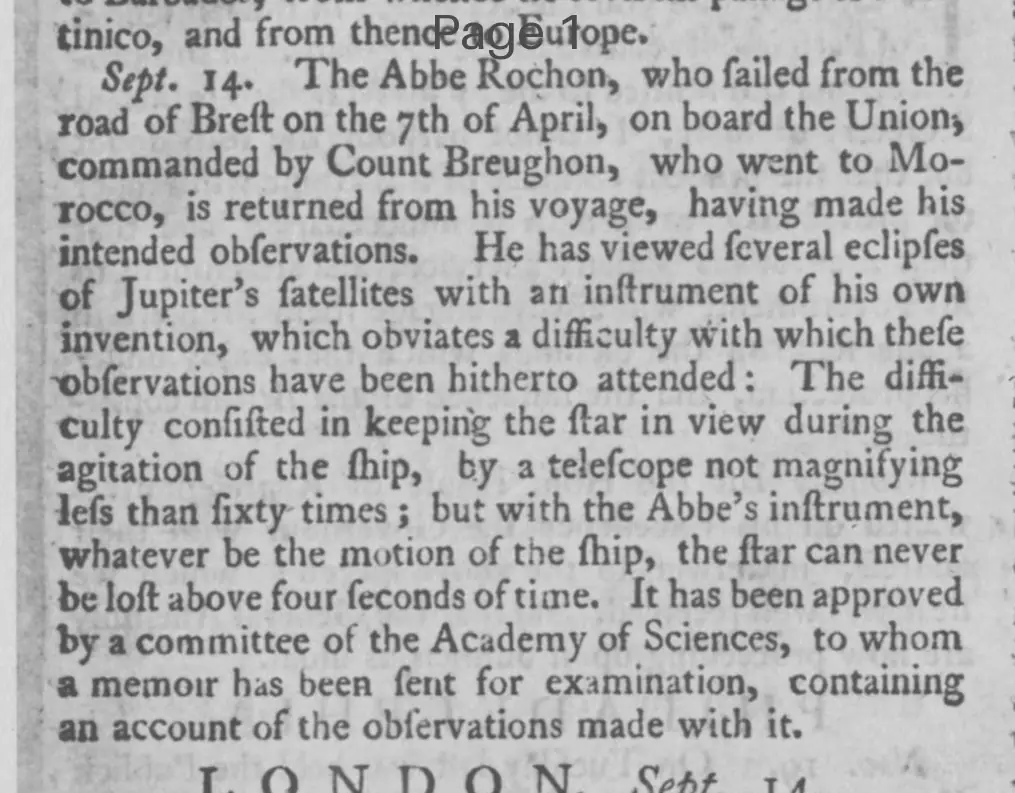
Sept. 14. The Abbe Rochon, who sailed from the road of Brest on the 7th of April, on board the Union; commanded by Count Breughon, who went to Morocco, is returned from his voyage, having made his intended observations. He has viewed several eclipses of Jupiter's satellites with an instrument of his own invention, which obviates a difficulty with which these observations have been hitherto attended: The difficulty consisted in keeping the star in view during the agitation of the ship, by a telescope not magnifying less than sixty times; but with the Abbe's instrument, whatever be the motion of the ship, the star can never be lost above four seconds of time. It has been approved by a committee of the Academy of Sciences, to whom a memoir has been sent for examination, containing an account of the observations made with it.

What sub-type of article is it?

Scientific Voyage Astronomical Observations

What keywords are associated?

Abbe Rochon Morocco Voyage Jupiter Eclipses Ship Stable Instrument Academy Of Sciences

What entities or persons were involved?

Abbe Rochon Count Breughon

Where did it happen?

Morocco

Foreign News Details

Primary Location

Morocco

Event Date

Sailed 7th Of April, Returned By Sept. 14

Key Persons

Abbe Rochon Count Breughon

Outcome

instrument approved by academy of sciences committee; memoir sent for examination

Event Details

Abbe Rochon sailed from Brest on April 7 aboard the Union commanded by Count Breughon to Morocco, returned after making observations of Jupiter's satellites eclipses using his invention that stabilizes viewing during ship motion, allowing no more than four seconds loss of the star despite telescope magnification of at least sixty times.

Are you sure?