Thank you for visiting SNEWPapers!
Sign up free
Literary
January 13, 1848
Watchman And Observer
Richmond, Virginia
What is this article about?
Article on John Gregorie's 1683 posthumous essays, excerpting his discourse on the history of the organ in church music, tracing origins from Old Testament to its Western introduction around 766 AD by Emperor Constantinus Copronymus, including Greek epigram by Julian.
Clipping
OCR Quality
95%
Excellent
Full Text
CHURCH MUSIC FROM AN OLD BOOK,
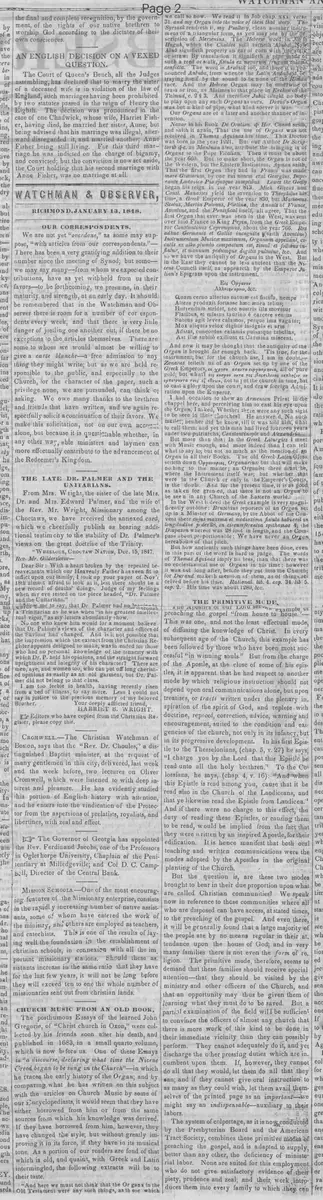
The posthumous Essays of the learned John Gregorie, of "Christ church in Oxon," were collected by his friends soon after his death, and published in 1683, in a small quarto volume, which is now before us. One of these Essays is "a discourse, declaring what time the Nicene Creed began to be sung in the Church"—in which he traces the early history of the Organ; and by comparing what he has written on this subject with the articles on Church Music by some of our Encyclopedists, it would seem that they have either borrowed from him or from the same sources from which his knowledge was derived. If they have borrowed from him, however, they have changed the style; but without greatly improving it in its force, if they have in its musical tone. As a portion of our readers are fond of that which is old, and quaint, with Greek and Latin intermingled, the following extracts will be to their taste,
"And here we must not think that the Organs in the Old Testament were any such things, as those which we call so now. We read it in Job chap. xxx: verse 31. and my Organ into the voice of them that weep. The Syrack rendeth it, my Psallery, clean another instrument of a triangular form, as you may see by the description of Mersenius. The Hebrew word in Job is Hugah, which the Chaldee still turneth Abuba: Now Abub signifieth properly an ear of corn with three stalk or straw: By translation it signifieth a pipe made of such a reed or stalk, fistula ex novarum frugum talamo confecta. The word is Arabick too, and there in is pronounced Anbuba, from whence the Latin Ambubaja, betraying itself by the sound to be none of the Roman race. And the Hebrew Organ may be otherwise of brass or iron, as Maimon to that place in Erchin of the Talmud, c. 2. § 3. And therefore Jubal taught no body to play upon any such Organs as ours. David's Organ was but a kind of pipe, what kind soever it was. Our Organs are of a later and another manner of invention.
Navar in his Book De Oratione Hor. Canon saith, and saith it again, That the use of Organs was not received in Thomas Aquinas his time. This Doctor was born in the year 1221. But our Author De Serin lorib qc. as Mantuan also, attribute the bringing in of Organs to the Pope Vitalian. Then it must be about the year 660. But to make short, the Organ is not of the Western, but the Eastern Institution. Aymon saith, That the first Organ they had in France was made more Gracorum, by one cui nomen erat Georgius, Imperante Ludovico Pio ejusque sumptibus. Lewes the Godly began his reign in the year 813. Mich. Glycus and Const. Manasses yield the invention to Theophilus his time, a Greek Emperor of the year 830, but Marianus Scotus, Martin Polonus, Plotina, the Annals of France, Aventine, and the Pontifical itself, all agree, That the first Organ that ever was seen in the West, was sent over into France to King Pepin, from the Greek Emperor Constantinus Copronymus, about the year 766. Res adhuc Germanis et Gallis incognita (saith Aventine) Instrumentum Musicæ maximum, Organum appellant, ære ex albo plumbo compactum est, simul et follibus inflatur, et manuum pedumque digitis pulsatur, &c. And so we have the antiquity of Organs in the West. But in the East they cannot be less ancient than the Nicene Council itself, as appeareth by the Emperor Julian's Epigram upon the instrument.
"1.
Eis Oeyavov
Aλλonoopow,&c.
Quam cerno alterius naturæ est fistula, nempe
Altera produxit fortasse hæc ænea tellus;
Horrendum stridet, nec nostris illa movetur
Flatibus, et missus taurino carcere ventus
Subtus agit leves calamos, perque ima vagatur;
Mox aliquis velox digitis insignis et arte
Adstat, concordes calamis pulsaique tabellas,
Ast illa subito exiliunt et Carmina miscent."
And now it may be thought that the antiquity of the Organ is brought far enough back. 'Tis true, for the instrument; but for the church use, I am in doubt. Zonaras telleth us of an Organ set up by one of the Greek Emperors, σκευος αργυροπρεπες, all of pure gold; but what? σις κοινον οντα των βασιλειων εκκλησιων εμποιουντα rois ε εθνεσιν, not to put the church in tune, but to cast a glory upon the court, and draw foreign Admiration upon the Emperor.
I had occasion to shew an Armenian Priest in the chappel here, and perceiving him to cast his eye upon the Organ, I asked, Whether there were any such sight to be seen in their churches? He answered, No such matter; neither did he know, till it was told him, what to call them: and yet this man had lived fourteen years under two patriarchs, Constantinople and Alexandria. But more than this: In the Greek Liturgies I meet with Music enough, and more indeed than I can tell what to say to; but not so much as the mention of an Organ in all their Books. The old Greek-Latin-Gloss setteth down Oeyavaplos, Organarius: but that will make nothing to the matter; an Organist there must be, where the Instrument itself was; but whether that were in the Church or only in the Emperor's Courts, is the doubt. And for the present time, it is as good as taken for granted, that there is not an Organ to be seen in any Church of the Eastern world.
In the West indeed the Greek example is very magnificently outdone: Bruschius reporteth of an Organ set up in a Minster of Germany, by the Abbot of the Convent there cujus maxima et medioxima fistula habuerit in longitudine pedes 28, in circumferentia spithamas 4; the Diapason whereof was 28 foot in length, and the Compass about proportionable: We have never an Organ hereabouts of that pitch.
But how anciently such things have been done, even in this part of the world is hard to judge. The words of Thomas Aquinas imply no less, than that there was no ecclesiastical use of Organs in his time: however it was not long after, before they got into the Church; for Durand maketh mention of them, as of things received before his time. Rational. lib. 4. cap. 34. lib 5. cap. 2. His time was about 1280, &c.
The posthumous Essays of the learned John Gregorie, of "Christ church in Oxon," were collected by his friends soon after his death, and published in 1683, in a small quarto volume, which is now before us. One of these Essays is "a discourse, declaring what time the Nicene Creed began to be sung in the Church"—in which he traces the early history of the Organ; and by comparing what he has written on this subject with the articles on Church Music by some of our Encyclopedists, it would seem that they have either borrowed from him or from the same sources from which his knowledge was derived. If they have borrowed from him, however, they have changed the style; but without greatly improving it in its force, if they have in its musical tone. As a portion of our readers are fond of that which is old, and quaint, with Greek and Latin intermingled, the following extracts will be to their taste,
"And here we must not think that the Organs in the Old Testament were any such things, as those which we call so now. We read it in Job chap. xxx: verse 31. and my Organ into the voice of them that weep. The Syrack rendeth it, my Psallery, clean another instrument of a triangular form, as you may see by the description of Mersenius. The Hebrew word in Job is Hugah, which the Chaldee still turneth Abuba: Now Abub signifieth properly an ear of corn with three stalk or straw: By translation it signifieth a pipe made of such a reed or stalk, fistula ex novarum frugum talamo confecta. The word is Arabick too, and there in is pronounced Anbuba, from whence the Latin Ambubaja, betraying itself by the sound to be none of the Roman race. And the Hebrew Organ may be otherwise of brass or iron, as Maimon to that place in Erchin of the Talmud, c. 2. § 3. And therefore Jubal taught no body to play upon any such Organs as ours. David's Organ was but a kind of pipe, what kind soever it was. Our Organs are of a later and another manner of invention.
Navar in his Book De Oratione Hor. Canon saith, and saith it again, That the use of Organs was not received in Thomas Aquinas his time. This Doctor was born in the year 1221. But our Author De Serin lorib qc. as Mantuan also, attribute the bringing in of Organs to the Pope Vitalian. Then it must be about the year 660. But to make short, the Organ is not of the Western, but the Eastern Institution. Aymon saith, That the first Organ they had in France was made more Gracorum, by one cui nomen erat Georgius, Imperante Ludovico Pio ejusque sumptibus. Lewes the Godly began his reign in the year 813. Mich. Glycus and Const. Manasses yield the invention to Theophilus his time, a Greek Emperor of the year 830, but Marianus Scotus, Martin Polonus, Plotina, the Annals of France, Aventine, and the Pontifical itself, all agree, That the first Organ that ever was seen in the West, was sent over into France to King Pepin, from the Greek Emperor Constantinus Copronymus, about the year 766. Res adhuc Germanis et Gallis incognita (saith Aventine) Instrumentum Musicæ maximum, Organum appellant, ære ex albo plumbo compactum est, simul et follibus inflatur, et manuum pedumque digitis pulsatur, &c. And so we have the antiquity of Organs in the West. But in the East they cannot be less ancient than the Nicene Council itself, as appeareth by the Emperor Julian's Epigram upon the instrument.
"1.
Eis Oeyavov
Aλλonoopow,&c.
Quam cerno alterius naturæ est fistula, nempe
Altera produxit fortasse hæc ænea tellus;
Horrendum stridet, nec nostris illa movetur
Flatibus, et missus taurino carcere ventus
Subtus agit leves calamos, perque ima vagatur;
Mox aliquis velox digitis insignis et arte
Adstat, concordes calamis pulsaique tabellas,
Ast illa subito exiliunt et Carmina miscent."
And now it may be thought that the antiquity of the Organ is brought far enough back. 'Tis true, for the instrument; but for the church use, I am in doubt. Zonaras telleth us of an Organ set up by one of the Greek Emperors, σκευος αργυροπρεπες, all of pure gold; but what? σις κοινον οντα των βασιλειων εκκλησιων εμποιουντα rois ε εθνεσιν, not to put the church in tune, but to cast a glory upon the court, and draw foreign Admiration upon the Emperor.
I had occasion to shew an Armenian Priest in the chappel here, and perceiving him to cast his eye upon the Organ, I asked, Whether there were any such sight to be seen in their churches? He answered, No such matter; neither did he know, till it was told him, what to call them: and yet this man had lived fourteen years under two patriarchs, Constantinople and Alexandria. But more than this: In the Greek Liturgies I meet with Music enough, and more indeed than I can tell what to say to; but not so much as the mention of an Organ in all their Books. The old Greek-Latin-Gloss setteth down Oeyavaplos, Organarius: but that will make nothing to the matter; an Organist there must be, where the Instrument itself was; but whether that were in the Church or only in the Emperor's Courts, is the doubt. And for the present time, it is as good as taken for granted, that there is not an Organ to be seen in any Church of the Eastern world.
In the West indeed the Greek example is very magnificently outdone: Bruschius reporteth of an Organ set up in a Minster of Germany, by the Abbot of the Convent there cujus maxima et medioxima fistula habuerit in longitudine pedes 28, in circumferentia spithamas 4; the Diapason whereof was 28 foot in length, and the Compass about proportionable: We have never an Organ hereabouts of that pitch.
But how anciently such things have been done, even in this part of the world is hard to judge. The words of Thomas Aquinas imply no less, than that there was no ecclesiastical use of Organs in his time: however it was not long after, before they got into the Church; for Durand maketh mention of them, as of things received before his time. Rational. lib. 4. cap. 34. lib 5. cap. 2. His time was about 1280, &c.
What sub-type of article is it?
Essay
What themes does it cover?
Religious
What keywords are associated?
Church Music
Organ History
John Gregorie
Nicene Creed
Eastern Church
What entities or persons were involved?
John Gregorie
Literary Details
Title
Church Music From An Old Book
Author
John Gregorie
Subject
Discourse On The History Of The Organ In Church Music
Key Lines
And Here We Must Not Think That The Organs In The Old Testament Were Any Such Things, As Those Which We Call So Now.
The First Organ That Ever Was Seen In The West, Was Sent Over Into France To King Pepin, From The Greek Emperor Constantinus Copronymus, About The Year 766.
Quam Cerno Alterius Naturæ Est Fistula, Nempe
Altera Produxit Fortasse Hæc ænea Tellus;
Horrendum Stridet, Nec Nostris Illa Movetur
Flatibus, Et Missus Taurino Carcere Ventus
Subtus Agit Leves Calamos, Perque Ima Vagatur;
Mox Aliquis Velox Digitis Insignis Et Arte
Adstat, Concordes Calamis Pulsaique Tabellas,
Ast Illa Subito Exiliunt Et Carmina Miscent.