Thank you for visiting SNEWPapers!
Sign up free
Story
August 16, 1867
The Carson Daily Appeal
Carson City, Ormsby County, Carson City County, Nevada
What is this article about?
A large Union party meeting in Sacramento on Monday evening, chaired by Judge Sanderson, featured speeches by Senator William M. Stewart and candidate George C. Gorham. They praised the party's role in the Civil War, emancipation under Lincoln, and criticized Democrats and President Johnson, affirming Union loyalty and progress.
Clipping
OCR Quality
95%
Excellent
Full Text
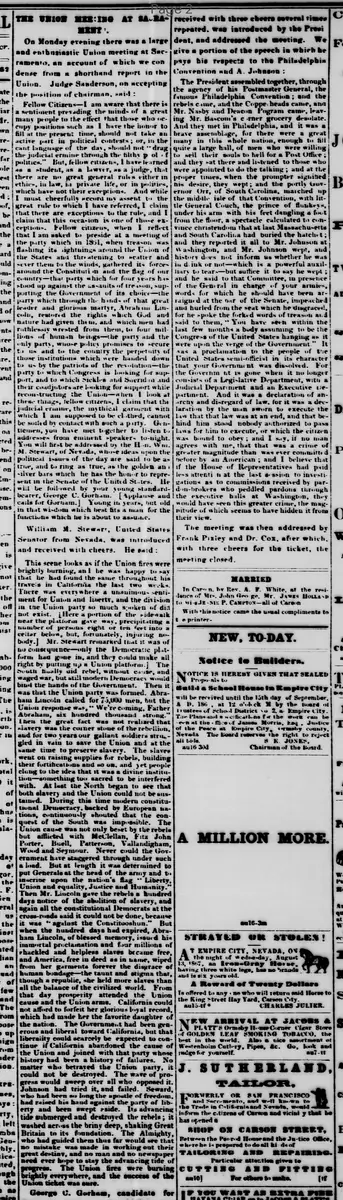
On Monday evening there was a large and enthusiastic Union meeting at Sacramento, an account of which we condense from a shorthand report in the Union. Judge Sanderson, on accepting the position of chairman, said:
Fellow Citizens—I am aware that there is a sentiment pervading the minds of a great many people to the effect that those who occupy positions such as I have the honor to fill at the present time, should not take an active part in political contests; or, in the cant language of the day, should not drag the judicial ermine through the filth of politics. But, fellow citizens, I have learned as a student, as a lawyer, as a judge, that there are no great general rules either in ethics, in law, in private life, or in politics, which have not their exceptions. And while I must cheerfully accord my assent to the great rule to which I have referred, I claim that there are exceptions to the rule, and I claim that this occasion is one of those exceptions.
Fellow citizens, when I reflect that I am asked to preside at a meeting of the party which in 1861, when treason was flashing its lightnings around the Union of the States and threatening to scatter and sever them to the winds, gathered its forces around the Constitution and the flag of our Country—that party which for four years has stood up against the assaults of treason, supporting the Government of its choice—the party which through the hands of that great leader and glorious martyr, Abraham Lincoln, restored the rights which God and nature had given them, and which men had ruthlessly wrested from them, to four millions of human beings—the party and the only party, whose policy promises to secure to us and to the country the perpetuity of those institutions which were handed down to us by the patriots of the revolution—the party to which Congress is looking for support, and to which Sickles and Sheridan and their coadjutors are looking for support while reconstructing the Union—when I look at these things, fellow citizens, I claim that the judicial ermine, the mythical garment with which I am supposed to be clothed, cannot be soiled by contact with such a party. Gentlemen, you have met together to listen to addresses from eminent speakers to-night. You will first be addressed by the Hon. Wm. M. Stewart, of Nevada, whose ideas upon the political issues of the day are said to be as true, and to ring as true, as the golden and silver bars which he has the honor to represent in the Senate of the United States. He will be followed by your young standard-bearer, George C. Gorham. [Applause and calls for Gorham.] Young in years, but old in that wisdom which best fits a man for the functions which he is about to assume.
William M. Stewart, United States Senator from Nevada, was introduced and received with cheers. He said:
This scene looks as if the Union fires were brightly burning, and he was happy to say that he had found the same throughout his travels in California the last two weeks. There was everywhere a unanimous sentiment for Union and liberty, and the division in the Union party so much spoken of did not exist. [Here a portion of the sidewalk near the platform gave way, precipitating a number of persons eight or ten feet into a cellar below, but, fortunately, injuring nobody.] Mr. Stewart remarked that it was of no consequence—only the Democratic platform had gone in, and they could make all right by putting up a Union platform.] The South finally did rebel, without cause, and waged war, but still modern Democracy would bind the hands of the Government. Then it was that the Union party was formed. Abraham Lincoln called for 75,000 men, but the Union response was, "We're coming, Father Abraham, six hundred thousand strong."
I then the great fact was not realized that slavery was the corner stone of the rebellion, and for two years our gallant soldiers struggled in vain to save the Union and at the same time to preserve slavery. The slaves went on raising supplies for rebels, building their fortifications and so on, and yet people clung to the idea that it was a divine institution—something too sacred to be interfered with. At last the North began to see that both slavery and the Union could not be sustained. During this time modern constitutional Democracy, backed by European nations, continuously shouted that the conquest of the South was impossible. The Union cause was not only beset by the rebels but afflicted with McClellan, Fitz John Porter, Buell, Patterson, Vallandigham, Wood and Seymour. Never could the Government have staggered through under such a load. But at length it was determined to put Generals at the head of the army and to inscribe upon the nation's flag "Liberty, Union and equality, Justice and Humanity."
Then Mr. Lincoln gave the rebels a hundred days' notice of the abolition of slavery, and again all the constitutional Democrats at the cross-roads said it could not be done, because it was "against the Constitooshun." But when the hundred days had expired, Abraham Lincoln, of blessed memory, issued his immortal proclamation and four millions of shackled and helpless slaves became free, and America, free in deed as in name, wiped from her garments forever the disgrace of human bondage—the taunt and stigma that, though a republic, she held more slaves than all the balance of the civilized world. From that day prosperity attended the Union Cause and the Union arms. California could not afford to forfeit her glorious loyal record, which had made her the favorite daughter of the nation. The Government had been generous and liberal toward California, but that liberality could scarcely be expected to continue if California abandoned the cause of the Union and joined with that party whose history had been a history of failures. No matter who betrayed the Union party, it could not be destroyed. The wave of progress would sweep over all who opposed it. Johnson had tried it, and failed. Seward, who had been so long the apostle of freedom, had raised his hand against the party of liberty and been swept aside. Its advancing tide submerged and destroyed the rebellion; it washed across the briny deep, shaking Great Britain to its foundation. The Almighty, who had guided them thus far would see that no mistake was made in working out their great destiny, and no man and no newspaper need ever hope to stay the advancing tide of progress. The Union fires were burning brightly everywhere, and the success of the Union ticket was sure.
George C. Gorham, candidate for Secretary of State, received with three cheers over and over repeated, was introduced by the President, and addressed the meeting. Here a portion of the speech in which he pays his respects to the Philadelphia Convention and A. Johnson:
The President assembled together, through the agency of his Postmaster General, the famous Philadelphia Convention; and the rebels came, and the Copperheads came, and Mr. Nasby and Deacon Pogram came, leaving Mr. Bascom's corner grocery desolate. And they met in Philadelphia, and it was a brave assemblage, for there were a great many in this whole nation, enough to fill quite a large hall, of men who were willing to sell their souls to hell for a Post Office; and they sat there and listened to those who were appointed to do the talking; and at the proper times, when the prompter sighed his desire, they wept; and the portly Governor Orr, of South Carolina, marched up the middle aisle of that Convention, with little General Couch, the prince of flunkies, under his arm with his feet dangling a foot from the floor, a spectacle calculated to convince Christendom that at last Massachusetts and South Carolina had buried the hatchet; and they reported it all to Mr. Johnson at Washington, and Mr. Johnson wept, and history does not inform us whether he was in drink or not—which is a powerful auxiliary to tear.—but suffice it to say he wept; and he said to that Committee, in presence of the General in charge of your armies, words for which he should have been arraigned at the bar of the Senate, impeached and hurled from the seat which he disgraced, for he spoke the forked words of treason and said to them, "You have seen within the last few months a body assuming to be the Congress of the United States hanging as it were upon the verge of the Government." It was a proclamation to the people of the United States semi-official in its character that your Government was dissolved. For the Government is gone when it no longer consists of a Legislative Department, with a Judicial Department and an Executive Department. And it was a declaration of anarchy and disregard of law, for it was a declaration by the man sworn to execute the law that that law was at an end, and that behind him stood nobody authorized to pass laws for him to execute, or which the citizen was bound to obey; and I say, if no man agrees with me, that that was a crime of greater magnitude than was ever committed before by an American; and I believe that if the House of Representatives had paid less attention at the last session to investigations as to commissions received by pardon-brokers who peddled pardons through the executive halls at Washington, they would have seen this greater crime, the magnitude of which seems to have hidden it from their view.
The meeting was then addressed by Frank Pixley and Dr. Cox, after which, with three cheers for the ticket, the meeting closed.
Fellow Citizens—I am aware that there is a sentiment pervading the minds of a great many people to the effect that those who occupy positions such as I have the honor to fill at the present time, should not take an active part in political contests; or, in the cant language of the day, should not drag the judicial ermine through the filth of politics. But, fellow citizens, I have learned as a student, as a lawyer, as a judge, that there are no great general rules either in ethics, in law, in private life, or in politics, which have not their exceptions. And while I must cheerfully accord my assent to the great rule to which I have referred, I claim that there are exceptions to the rule, and I claim that this occasion is one of those exceptions.
Fellow citizens, when I reflect that I am asked to preside at a meeting of the party which in 1861, when treason was flashing its lightnings around the Union of the States and threatening to scatter and sever them to the winds, gathered its forces around the Constitution and the flag of our Country—that party which for four years has stood up against the assaults of treason, supporting the Government of its choice—the party which through the hands of that great leader and glorious martyr, Abraham Lincoln, restored the rights which God and nature had given them, and which men had ruthlessly wrested from them, to four millions of human beings—the party and the only party, whose policy promises to secure to us and to the country the perpetuity of those institutions which were handed down to us by the patriots of the revolution—the party to which Congress is looking for support, and to which Sickles and Sheridan and their coadjutors are looking for support while reconstructing the Union—when I look at these things, fellow citizens, I claim that the judicial ermine, the mythical garment with which I am supposed to be clothed, cannot be soiled by contact with such a party. Gentlemen, you have met together to listen to addresses from eminent speakers to-night. You will first be addressed by the Hon. Wm. M. Stewart, of Nevada, whose ideas upon the political issues of the day are said to be as true, and to ring as true, as the golden and silver bars which he has the honor to represent in the Senate of the United States. He will be followed by your young standard-bearer, George C. Gorham. [Applause and calls for Gorham.] Young in years, but old in that wisdom which best fits a man for the functions which he is about to assume.
William M. Stewart, United States Senator from Nevada, was introduced and received with cheers. He said:
This scene looks as if the Union fires were brightly burning, and he was happy to say that he had found the same throughout his travels in California the last two weeks. There was everywhere a unanimous sentiment for Union and liberty, and the division in the Union party so much spoken of did not exist. [Here a portion of the sidewalk near the platform gave way, precipitating a number of persons eight or ten feet into a cellar below, but, fortunately, injuring nobody.] Mr. Stewart remarked that it was of no consequence—only the Democratic platform had gone in, and they could make all right by putting up a Union platform.] The South finally did rebel, without cause, and waged war, but still modern Democracy would bind the hands of the Government. Then it was that the Union party was formed. Abraham Lincoln called for 75,000 men, but the Union response was, "We're coming, Father Abraham, six hundred thousand strong."
I then the great fact was not realized that slavery was the corner stone of the rebellion, and for two years our gallant soldiers struggled in vain to save the Union and at the same time to preserve slavery. The slaves went on raising supplies for rebels, building their fortifications and so on, and yet people clung to the idea that it was a divine institution—something too sacred to be interfered with. At last the North began to see that both slavery and the Union could not be sustained. During this time modern constitutional Democracy, backed by European nations, continuously shouted that the conquest of the South was impossible. The Union cause was not only beset by the rebels but afflicted with McClellan, Fitz John Porter, Buell, Patterson, Vallandigham, Wood and Seymour. Never could the Government have staggered through under such a load. But at length it was determined to put Generals at the head of the army and to inscribe upon the nation's flag "Liberty, Union and equality, Justice and Humanity."
Then Mr. Lincoln gave the rebels a hundred days' notice of the abolition of slavery, and again all the constitutional Democrats at the cross-roads said it could not be done, because it was "against the Constitooshun." But when the hundred days had expired, Abraham Lincoln, of blessed memory, issued his immortal proclamation and four millions of shackled and helpless slaves became free, and America, free in deed as in name, wiped from her garments forever the disgrace of human bondage—the taunt and stigma that, though a republic, she held more slaves than all the balance of the civilized world. From that day prosperity attended the Union Cause and the Union arms. California could not afford to forfeit her glorious loyal record, which had made her the favorite daughter of the nation. The Government had been generous and liberal toward California, but that liberality could scarcely be expected to continue if California abandoned the cause of the Union and joined with that party whose history had been a history of failures. No matter who betrayed the Union party, it could not be destroyed. The wave of progress would sweep over all who opposed it. Johnson had tried it, and failed. Seward, who had been so long the apostle of freedom, had raised his hand against the party of liberty and been swept aside. Its advancing tide submerged and destroyed the rebellion; it washed across the briny deep, shaking Great Britain to its foundation. The Almighty, who had guided them thus far would see that no mistake was made in working out their great destiny, and no man and no newspaper need ever hope to stay the advancing tide of progress. The Union fires were burning brightly everywhere, and the success of the Union ticket was sure.
George C. Gorham, candidate for Secretary of State, received with three cheers over and over repeated, was introduced by the President, and addressed the meeting. Here a portion of the speech in which he pays his respects to the Philadelphia Convention and A. Johnson:
The President assembled together, through the agency of his Postmaster General, the famous Philadelphia Convention; and the rebels came, and the Copperheads came, and Mr. Nasby and Deacon Pogram came, leaving Mr. Bascom's corner grocery desolate. And they met in Philadelphia, and it was a brave assemblage, for there were a great many in this whole nation, enough to fill quite a large hall, of men who were willing to sell their souls to hell for a Post Office; and they sat there and listened to those who were appointed to do the talking; and at the proper times, when the prompter sighed his desire, they wept; and the portly Governor Orr, of South Carolina, marched up the middle aisle of that Convention, with little General Couch, the prince of flunkies, under his arm with his feet dangling a foot from the floor, a spectacle calculated to convince Christendom that at last Massachusetts and South Carolina had buried the hatchet; and they reported it all to Mr. Johnson at Washington, and Mr. Johnson wept, and history does not inform us whether he was in drink or not—which is a powerful auxiliary to tear.—but suffice it to say he wept; and he said to that Committee, in presence of the General in charge of your armies, words for which he should have been arraigned at the bar of the Senate, impeached and hurled from the seat which he disgraced, for he spoke the forked words of treason and said to them, "You have seen within the last few months a body assuming to be the Congress of the United States hanging as it were upon the verge of the Government." It was a proclamation to the people of the United States semi-official in its character that your Government was dissolved. For the Government is gone when it no longer consists of a Legislative Department, with a Judicial Department and an Executive Department. And it was a declaration of anarchy and disregard of law, for it was a declaration by the man sworn to execute the law that that law was at an end, and that behind him stood nobody authorized to pass laws for him to execute, or which the citizen was bound to obey; and I say, if no man agrees with me, that that was a crime of greater magnitude than was ever committed before by an American; and I believe that if the House of Representatives had paid less attention at the last session to investigations as to commissions received by pardon-brokers who peddled pardons through the executive halls at Washington, they would have seen this greater crime, the magnitude of which seems to have hidden it from their view.
The meeting was then addressed by Frank Pixley and Dr. Cox, after which, with three cheers for the ticket, the meeting closed.
What sub-type of article is it?
Historical Event
What themes does it cover?
Triumph
Justice
Moral Virtue
What keywords are associated?
Union Meeting
Sacramento Rally
Civil War Reminiscence
Emancipation Proclamation
Political Speeches
Anti Johnson
Reconstruction
What entities or persons were involved?
Judge Sanderson
William M. Stewart
George C. Gorham
Abraham Lincoln
Where did it happen?
Sacramento
Story Details
Key Persons
Judge Sanderson
William M. Stewart
George C. Gorham
Abraham Lincoln
Location
Sacramento
Event Date
Monday Evening
Story Details
A Union party rally in Sacramento where Judge Sanderson chaired, Senator Stewart spoke on Union loyalty and emancipation, and Gorham criticized President Johnson and Democrats, ending with cheers for the Union ticket.