Thank you for visiting SNEWPapers!
Sign up free
Story
April 7, 1840
The New Hampshire Gazette
Portsmouth, Rockingham County, New Hampshire
What is this article about?
Article from Washington Globe critiques Federalists' misrepresentation of Gen. Harrison's opposition to the salt tax in Eastern fishing areas to support bounties, contrasting with truthful Western promotion; quotes his 1820s Senate speeches decrying the tax as burdensome and monopolistic.
Clipping
OCR Quality
98%
Excellent
Full Text
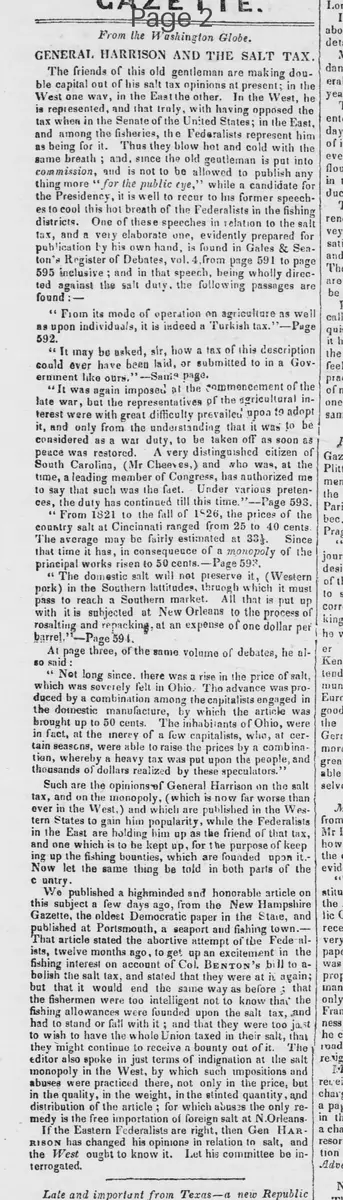
From the Washington Globe.
GENERAL HARRISON AND THE SALT TAX.
The friends of this old gentleman are making double capital out of his salt tax opinions at present; in the West one way, in the East the other. In the West, he is represented, and that truly, with having opposed the tax when in the Senate of the United States; in the East, and among the fisheries, the Federalists represent him as being for it. Thus they blow hot and cold with the same breath; and, since the old gentleman is put into commission, and is not to be allowed to publish anything more 'for the public eye,' while a candidate for the Presidency, it is well to recur to his former speeches to cool this hot breath of the Federalists in the fishing districts. One of these speeches in relation to the salt tax, and a very elaborate one, evidently prepared for publication by his own hand, is found in Gales & Seaton's Register of Debates, vol. 4, from page 591 to page 595 inclusive; and in that speech, being wholly directed against the salt duty, the following passages are found:-
'From its mode of operation on agriculture as well as upon individuals, it is indeed a Turkish tax.'—Page 592.
'It may be asked, sir, how a tax of this description could ever have been laid, or submitted to in a Government like ours,'—Same page.
'It was again imposed at the commencement of the late war, but the representatives of the agricultural interest were with great difficulty prevailed upon to adopt it, and only from the understanding that it was to be considered as a war duty, to be taken off as soon as peace was restored. A very distinguished citizen of South Carolina, (Mr Cheves,) and who was, at the time, a leading member of Congress, has authorized me to say that such was the act. Under various pretences, the duty has continued till this time.'—Page 593.
'From 1821 to the fall of 1826, the prices of the country salt at Cincinnati ranged from 25 to 40 cents. The average may be fairly estimated at 33. Since that time it has, in consequence of a monopoly of the principal works risen to 50 cents.—Page 592.
'The domestic salt will not preserve it, (Western pork) in the Southern latitudes, through which it must pass to reach a Southern market. All that is put up with it is subjected at New Orleans to the process of resalting and repacking, at an expense of one dollar per barrel,'—Page 594.
At page three, of the same volume of debates, he also said:
'Not long since, there was a rise in the price of salt, which was severely felt in Ohio. The advance was produced by a combination among the capitalists engaged in the domestic manufacture, by which the article was brought up to 50 cents. The inhabitants of Ohio, were in fact, at the mercy of a few capitalists, who, at certain seasons, were able to raise the prices by a combination, whereby a heavy tax was put upon the people, and thousands of dollars realized by these speculators.'
Such are the opinions of General Harrison on the salt tax, and on the monopoly, (which is now far worse than ever in the West.) and which are published in the Western States to gain him popularity, while the Federalists in the East are holding him up as the friend of that tax, and one which is to be kept up, for the purpose of keeping up the fishing bounties, which are founded upon it.
Now let the same thing be told in both parts of the country.
We published a highminded and honorable article on this subject a few days ago, from the New Hampshire Gazette, the oldest Democratic paper in the State, and published at Portsmouth, a seaport and fishing town. That article stated the abortive attempt of the Federalists, twelve months ago, to get up an excitement in the fishing interest on account of Col. Benton's bill to abolish the salt tax, and stated that they were at it again; but that it would end the same way as before; that the fishermen were too intelligent not to know that the fishing allowances were founded upon the salt tax, and had to stand or fall with it; and that they were too just to wish to have the whole Union taxed in their salt, that they might continue to receive a bounty out of it. The editor also spoke in just terms of indignation at the salt monopoly in the West, by which such impositions and abuses were practiced there, not only in the price, but in the quality, in the weight, in the stinted quantity, and distribution of the article; for which abuses the only remedy is the free importation of foreign salt at New Orleans.
If the Eastern Federalists are right, then Gen Harrison has changed his opinions in relation to salt, and the West ought to know it. Let his committee be interrogated.
GENERAL HARRISON AND THE SALT TAX.
The friends of this old gentleman are making double capital out of his salt tax opinions at present; in the West one way, in the East the other. In the West, he is represented, and that truly, with having opposed the tax when in the Senate of the United States; in the East, and among the fisheries, the Federalists represent him as being for it. Thus they blow hot and cold with the same breath; and, since the old gentleman is put into commission, and is not to be allowed to publish anything more 'for the public eye,' while a candidate for the Presidency, it is well to recur to his former speeches to cool this hot breath of the Federalists in the fishing districts. One of these speeches in relation to the salt tax, and a very elaborate one, evidently prepared for publication by his own hand, is found in Gales & Seaton's Register of Debates, vol. 4, from page 591 to page 595 inclusive; and in that speech, being wholly directed against the salt duty, the following passages are found:-
'From its mode of operation on agriculture as well as upon individuals, it is indeed a Turkish tax.'—Page 592.
'It may be asked, sir, how a tax of this description could ever have been laid, or submitted to in a Government like ours,'—Same page.
'It was again imposed at the commencement of the late war, but the representatives of the agricultural interest were with great difficulty prevailed upon to adopt it, and only from the understanding that it was to be considered as a war duty, to be taken off as soon as peace was restored. A very distinguished citizen of South Carolina, (Mr Cheves,) and who was, at the time, a leading member of Congress, has authorized me to say that such was the act. Under various pretences, the duty has continued till this time.'—Page 593.
'From 1821 to the fall of 1826, the prices of the country salt at Cincinnati ranged from 25 to 40 cents. The average may be fairly estimated at 33. Since that time it has, in consequence of a monopoly of the principal works risen to 50 cents.—Page 592.
'The domestic salt will not preserve it, (Western pork) in the Southern latitudes, through which it must pass to reach a Southern market. All that is put up with it is subjected at New Orleans to the process of resalting and repacking, at an expense of one dollar per barrel,'—Page 594.
At page three, of the same volume of debates, he also said:
'Not long since, there was a rise in the price of salt, which was severely felt in Ohio. The advance was produced by a combination among the capitalists engaged in the domestic manufacture, by which the article was brought up to 50 cents. The inhabitants of Ohio, were in fact, at the mercy of a few capitalists, who, at certain seasons, were able to raise the prices by a combination, whereby a heavy tax was put upon the people, and thousands of dollars realized by these speculators.'
Such are the opinions of General Harrison on the salt tax, and on the monopoly, (which is now far worse than ever in the West.) and which are published in the Western States to gain him popularity, while the Federalists in the East are holding him up as the friend of that tax, and one which is to be kept up, for the purpose of keeping up the fishing bounties, which are founded upon it.
Now let the same thing be told in both parts of the country.
We published a highminded and honorable article on this subject a few days ago, from the New Hampshire Gazette, the oldest Democratic paper in the State, and published at Portsmouth, a seaport and fishing town. That article stated the abortive attempt of the Federalists, twelve months ago, to get up an excitement in the fishing interest on account of Col. Benton's bill to abolish the salt tax, and stated that they were at it again; but that it would end the same way as before; that the fishermen were too intelligent not to know that the fishing allowances were founded upon the salt tax, and had to stand or fall with it; and that they were too just to wish to have the whole Union taxed in their salt, that they might continue to receive a bounty out of it. The editor also spoke in just terms of indignation at the salt monopoly in the West, by which such impositions and abuses were practiced there, not only in the price, but in the quality, in the weight, in the stinted quantity, and distribution of the article; for which abuses the only remedy is the free importation of foreign salt at New Orleans.
If the Eastern Federalists are right, then Gen Harrison has changed his opinions in relation to salt, and the West ought to know it. Let his committee be interrogated.
What sub-type of article is it?
Historical Event
Deception Fraud
What themes does it cover?
Deception
Justice
What keywords are associated?
Salt Tax
General Harrison
Federalists
Political Deception
Western Monopoly
Fishing Bounties
What entities or persons were involved?
General Harrison
Mr Cheves
Col. Benton
Where did it happen?
United States (West And East)
Story Details
Key Persons
General Harrison
Mr Cheves
Col. Benton
Location
United States (West And East)
Event Date
1820s
Story Details
Political commentary exposing how General Harrison's past opposition to the salt tax is misrepresented by Federalists in the East to support fishing bounties, while truthfully promoted in the West; quotes his Senate speeches against the tax and Western monopoly.