Thank you for visiting SNEWPapers!
Sign up free
The Monroe Journal
Monroe, Union County, North Carolina
What is this article about?
Detailed account of the Leo M. Frank case: Jewish factory superintendent convicted of murdering 14-year-old Mary Phagan in Atlanta amid anti-Semitic mob frenzy, flawed police investigations, coerced testimony from Jim Conley, and media hysteria. Argues for innocence and new trial via Supreme Court appeal.
Merged-components note: Continued article on the Leo Frank case across pages 4, 6, and 8.
Clippings
1 of 3
OCR Quality
Full Text
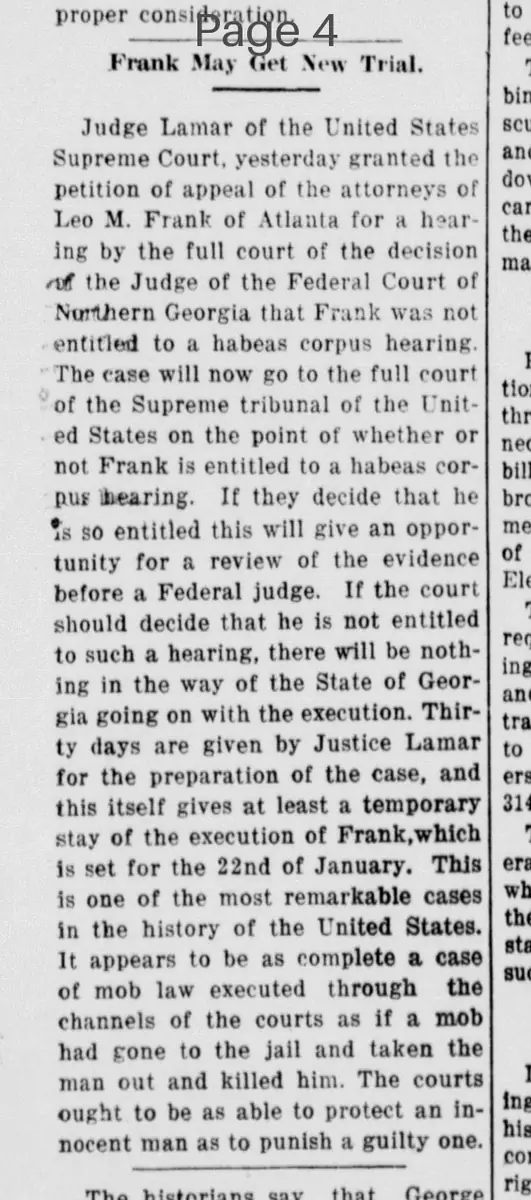
Judge Lamar of the United States Supreme Court, yesterday granted the petition of appeal of the attorneys of Leo M. Frank of Atlanta for a hearing by the full court of the decision of the Judge of the Federal Court of Northern Georgia that Frank was not entitled to a habeas corpus hearing.
The case will now go to the full court of the Supreme tribunal of the United States on the point of whether or not Frank is entitled to a habeas corpus hearing. If they decide that he is so entitled this will give an opportunity for a review of the evidence before a Federal judge. If the court should decide that he is not entitled to such a hearing, there will be nothing in the way of the State of Georgia going on with the execution. Thirty days are given by Justice Lamar for the preparation of the case, and this itself gives at least a temporary stay of the execution of Frank, which is set for the 22nd of January. This is one of the most remarkable cases in the history of the United States.
It appears to be as complete a case of mob law executed through the channels of the courts as if a mob had gone to the jail and taken the man out and killed him. The courts ought to be as able to protect an innocent man as to punish a guilty one.
The Story of the Frank Case.
The Astonishing Frenzy of the Mob Which Dominated the Trial of the Man Now Waiting Execution. The Summary of a Trained Investigator.
With the finding of the body of Mary Phagan that Sunday morning there began in Atlanta a public delirium, which has hardly yet, after a year and a half, subsided. There had been some sixteen or eighteen women murdered in Atlanta in the previous two or three years, most of them colored women. None of the murderers had been caught. Two white women, charged with the murders of their husbands, had recently been acquitted by Atlanta juries. Back in 1906 there had been a riot, growing out of assaults and murders of white women, in which some fifty negroes had been shot or beaten to death on the streets of Atlanta. Immediately after the Phagan murder the Mayor of the City called a special meeting of the City Council to consider the murder, and the Council offered a reward of $1,000. The rewards offered aggregated $3,400. The Mayor urged the chief of police to caution his men to keep the crowds moving on the streets and to quickly disperse gatherings where the Phagan tragedy was the topic of discussion. The newspapers had editorials calling on the police officials to find the murderer or murderers of Mary Phagan, or suffer the political consequences. The Atlanta "Constitution" said editorially two days after the discovery of Mary Phagan's body: "The detective force and the entire police authorities of Atlanta are on probation in the detection and arrest of this criminal with proof. To justify the confidence that is placed in them and the relation they are assured to hold toward law and order, they must locate this arch-murderer. . . . If ever the men who ferret crime and uphold the law in Atlanta are to justify their function, it must be in apprehending the assailant and murderer of Mary Phagan."
Panic Stricken Police.
Another newspaper expressed the same thought in a cartoon in which the spirit of the community was pictured in a figure pointing dramatically and underneath the words: "Solve it." This newspaper hysteria was but one element in the storm cloud aspersions and policies which surround the case. The police, panic-stricken by their own sense of official incompetency, as shown by full page newspaper accounts of Atlanta murders now recalled that had never been traced, and goaded by public clamor and the ridicule by the newspapers of their former failures, sought to appease the public wrath by the immediate arrest of two men, the one who had seen Mary Phagan last alive, and the one who had discovered the body. That at first they believed Newt Lee guilty is proved by the fact that they got access to Newt Lee's house, and that on the next day a "bloody" shirt belonging to Lee was found by them in a trash barrel in Lee's house. A scientific examination of the shirt disclosed that it had been clumsily smeared. The police, finally convinced of Lee's innocence, now centered their attention on Frank, and the fact that Frank was a Jew added fuel to the popular indignation of the hour, and culminated in a blaze of racial prejudice which charred all footprints of the crime.
And He Was a Jew.
"No Jew in modern times," said Colonel Pendleton H. Brewster, a law partner of Solicitor General Dorsey, who prosecuted Frank, "has been persecuted as this Jew has been."
Tom Watson's magazine, the "Jeffersonian," which is published near Atlanta, said: "Our little girl—ours by the eternal God! has been pursued to a hideous death and bloody grave by this filthy perverted Jew of New York."
When William J. Burns, by the dexterous ruse of his Southern manager, Don Lehon, escaped from the mob about to hang him at Marietta, the former home of Mary Phagan, the leader of the gathering crowd approached Burns, shouting: "Is that you Burns? Is that William J. Burns, the man who sold out to the Jews?" and the "Jeffersonian," justifying the action of the mob, said that Burns "came boastingly confident, and virtually saying that the rich Jews of Atlanta, New York, and Chicago would not allow Frank to be hanged."
The Solicitor General, though adroitly paying a tribute to the Jewish race in his argument to the jury, pointed out that "when Becker wished to put to death his bitter enemy, it was men of Frank's race he selected." He referred to Abe Hummel, "the lawyer who went to the penitentiary in New York," and Abe Ruef, "who went to the penitentiary in San Francisco."
Police Methods.
We have seen how there come forth the stories of "witnesses from the brothels and dives." A little girl was sent to the reformatory in Cincinnati. The story was circulated that Frank was responsible for her downfall. The police approached another girl who had fallen and endeavored to get her to swear that Frank was responsible for her disgrace. A former forewoman of the pencil factory made affidavit after Frank's conviction that three of the detectives prominent in gathering evidence against Frank sought to have her give certain scandalous testimony against Frank. Another young woman made affidavit that one of these same detectives tried to get her to tell the same story her married sister afterward did tell at the coroner's inquest regarding Frank. Many people in Atlanta believe that on the walls of Frank's office was an art gallery of lewd pictures.
Leo M. Frank of Atlanta lies under sentence of death, the execution to take place on January 22, his birthday. Efforts are still being made by his counsel to get a new hearing. Collier's Weekly has sent a trained investigator, Mr. C. P. Connolly, a lawyer, to investigate and write the story of this remarkable crime. This story The Journal presents by permission from Collier's. The next installment will appear Tuesday.
(Concluded from last issue.)
pictures. The only foundation for this story was a business calendar illuminated with a pretty face. These stories convicted Frank in the public mind.
During the time these lies were being published Dr. Marx, the Jewish rabbi, went to the editor of one of Atlanta's newspapers and protested against their publication. At the conclusion of the interview the editor said: "Anyhow, if we don't publish these things the other papers will, and we can't afford to be scooped."
The police were diligently at work overlooking no opportunity to fasten guilt on Frank, when an incident occurred which made it impossible to retrace their steps. Frank had employed the Pinkerton Detective Agency to ferret out the murder the Monday following the crime. His motive in doing this, as he stated, was that the public feeling was running so high in Atlanta that the public would naturally expect the pencil company to do everything in its power to help solve the mystery, and that this feeling was in accord with his own sentiments. But in this he was fated to misconstrue. Solicitor General Dorsey, on the trial and in his argument before the Supreme Court of Georgia, insisted that Frank had employed the Pinkertons as a blind to cover up his own guilt, and that his employment of the Pinkertons was one of the strongest links in the chain of evidence against him. Like many other innocent moves of Frank and his counsel, made in the cloud of suspicion that surrounded them, the employment of the Pinkertons was unfortunate for Frank.
Changing Frank's Story.
An ordinance of the city of Atlanta makes the city detectives of all private detective operatives and subjects them to police supervision and control. No private detective agency can operate in the city of Atlanta without the consent of the Board of Police Commissioners. The detective agency, therefore, that runs counter to the Police Department of Atlanta forfeits, at the pleasure of the police, its right to do business in that city. This ordinance was one of the factors in the conviction of Frank. L. P. Whitfield, a Pinkerton operative at the time of the investigation into the murder of Mary Phagan, has stated under oath that Harry Scott, the assistant superintendent of the Pinkertons in Atlanta, told him that "unless the Jew is convicted the Pinkerton Detective Agency would have to get out of Atlanta."
When, after the trial, William J. Burns undertook a personal investigation of the Frank case at the earnest solicitation of Frank's friends, the police of Atlanta revoked the license of the Burns detectives to do business in Atlanta, and drove that agency out of the State. On the trial of Frank, Harry Scott swore that it was the policy of his agency in criminal cases to work with the police of the various cities. "We never clash over views," said Scott.
It will be remembered that when Mary Phagan left Frank's office, she inquired if the metal for the metal tips had come. Frank had replied "No." The girl would, ordinarily, therefore, have gone on her way. But it was necessary to the theory of the State that Frank and the girl should, for some reason, have gone back to the metal room in the rear of the second floor. How to get the two there was the dilemma. Detective Harry Scott of the Pinkertons swore on the stand at the trial that when Frank interviewed him about Scott's employment in the case, he had told Scott that he had replied to the girl "I don't know," although Frank had always declared he had replied "No" and others heard him. Scott, in his written reports of the conversation both to the attorneys and to the police at the time, as well as in his testimony at the coroner's inquest, stated that Frank said he had replied "No," but on the trial Scott explained that his "No" meant "I don't know." He said it was a "grammatical" error—and this was the man Frank had employed to ferret out the murder. The whole case just drips with such perversions of the truth.
Frank having replied "I don't know," the State argued that he had gone back to the metal room with Mary Phagan to see if the metal had arrived, and there the incidents leading to the murder and the murder itself had occurred.
Unfortunate Feuds Injured Frank.
The Mayor of the city was at loggerheads with the police officials. Just before Mary Phagan was murdered there had been much talk and rumors of graft on the part of the Atlanta police, and a public investigation had been threatened. Atlanta had grown from a population of 87,000 in 1900 to a population of 200,000 in 1913. The heads of the police force were the crude product of a small city suddenly burgeoned into metropolitan greatness. Associated in a way with the Mayor in his fight against alleged graft was Colonel Thomas B. Felder, the man who is generally credited with having procured the release of Charles W. Morse from the Federal prison in Atlanta. Felder is a lawyer of prominence and represents very large interests throughout the country. He had worked in conjunction with William J. Burns in exposing the dispensary frauds in South Carolina. He claimed to have been employed in the Frank case by certain neighbors of Mary Phagan's parents. Felder brought to Atlanta a Burns representative in the person of C. W. Tobie of Chicago, an expert investigator in criminal matters. Also he sought to secure from Mary Phagan's stepfather written authority for his own employment in order to secure professional entrance into the case. This attempt the police exposed. The only plausible purpose of the exposure was to ridicule Felder and to destroy his possible usefulness in the Phagan murder case. Felder publicly retorted that the police force of Atlanta was as dangerous as "the deadly society of the Mafia," and dramatically declared that the police were shielding Leo Frank; that he had been told that they had extorted a confession from a negro by the name of Conley, who was then in jail, and that this was done in conspiracy with the Pinkertons, who had been employed by the National Pencil Company, and to thwart the efforts of the Burns Detective Agency. The police and the Pinkertons both assured the public that they had worked from the beginning on the theory of Frank's guilt, and that there was conclusive evidence against Frank not yet made public. All this happened just as the police had discovered, but had not made public, the fact that Conley was the author of the "Murder Notes." Frank thus became, as well as the victim of newspaper hysteria, a pawn in a feud between two detective agencies.
A Political Feud, Too.
Of this side issue, so unfortunate for Frank, and for which he was in no way responsible, the Atlanta Constitution said: "One thing is certain—it means one of the bitterest fights for control of the city government that Atlanta has ever known. A singular fact it is that this war of factions should have grown out of the murder of an innocent girl."
To cap the climax of this interlude, the representative of the Burns Detective Agency packed his trunk and left town, declaring that he also was a firm believer in Frank's guilt. The plot was thickening about Frank with as deadly certainty as if drawn by a loadstone and with a harmony that would have shamed the genius of a Belasco. If the police turned back, it would hasten and magnify the graft investigation which they feared. They told Conley the pencil-factory authorities were charging that he had committed murder, and showed him a newspaper with glaring headlines announcing this fact. Conley then asserted that he had written one of the "Murder Notes" at Frank's dictation, and that Frank himself had written the other. The police took Conley from the custody of the sheriff and placed him at police headquarters, where, day by day, they put him through his facings. Even Conley's lawyer was not allowed to be present at these interviews. Meanwhile the Formby woman, the keeper of the questionable house who had made affidavit that Frank had repeatedly telephoned her on the night of the murder asking for a room, quietly disappeared from Atlanta, and her whereabouts are unknown. The police announced that they would produce her at the trial, but they did not. Her story would not tally with Conley's. After the conviction of Frank, and the refusal of the Supreme Court of Georgia to grant a new trial, this woman made an affidavit in which she declared that her former statement was procured by two city detectives named Chewning and Norris, who came to her home and plied her with whiskey until they had secured the affidavit they wanted.
The Conley Negro.
"Jim" Conley was twenty-seven years old. He had gone to the public schools of Atlanta for two years. He had been fined six times for disorderly conduct. He had worked for the pencil factory for two years, and was a floor sweeper. One of the witnesses employed at the factory testified that Conley "always seemed to be kind of nervous or half drunk." More than once he had been found lying drunk in the factory. He was a low, squatty negro with a "ginger-cake" complexion. He lived in a little shack with a woman who was not his wife, and her two children, in that part of the city given over to the colored population. He was a frequenter of low negro dives and pool rooms, and at times a heavy drinker. He was arrested in the factory on the Thursday morning following the murder while engaged in attempting to wash some stains from a shirt. A score of people testified to Conley's general bad character and to his lack of credibility even under oath. Members of his own race, people who had known him all his life, with one accord testified that he was unworthy of belief. The combined efforts of the State and the police could not do better than to find the whole State G. and one man to vouch for Conley's testimony. There was no case came forward Frank and (day of the swore they lanta for blood. Conley swore that on Friday afternoon before the murder Frank had asked him to come to the pencil factory on the next day, Saturday; that he had some work for him to do on the second floor. He got to the pencil factory about 8:30 a. m. on Saturday. He met Frank at the entrance. Frank then told Conley that he wanted him to watch inside the street entrance "like I had watched before"—to prevent anyone going upstairs while Frank was "chatting" with a young lady. "When the lady comes," said Frank, "I will stomp like I did before. That will be the lady, and you go and shut the door. When I whistle you can then unlock the door and you come upstairs to my office then like you were going to borrow some money, and that will give the young lady time to get out."
After Mary Phagan went upstairs, Conley swore he heard her footsteps going toward Frank's office. Later he heard two people walking out of the office "and going like they were coming down the steps," but they went back toward the metal department. Then he heard a scream. Next he saw Monteen Stover, a young girl of Mary Phagan's age, enter the building. She had on a pair of tennis shoes and a raincoat. After Monteen Stover came back, in about five minutes, Conley heard some one from the metal department "come running back there upstairs on their tiptoes," and later he heard someone tiptoeing back toward the metal department. "After that I kind of dozed off and went to sleep. Next thing knew Mr. Frank was up over my head stomping, and then I went and locked the door, and sat on the box a little while, and the next thing I heard was Mr. Frank whistling."
Conley's Story of Crime.
When Conley heard Frank whistle he unlocked the door, as prearranged by Frank, and went up the steps. Frank was standing at the top of the steps on the second floor—there were double doors leading to the second floor halfway up the stairway—"shivering and trembling and rubbing his hands. He looked funny out of his eyes. His face was red."
When Conley got to the top of the stairway Frank asked him, "Did you see that little girl who passed here a while ago?" and Conley replied that he had seen one pass upstairs, that she had come back down the stairs; but he had seen another go up the stairs who hadn't come back. Frank thereupon told Conley that the little girl that hadn't returned wanted to know something about her work, and he had gone back to the metal department with the girl to see if the metal had come so that the girl could return to work. Frank told Conley that he had spoken disrespectfully to the little girl, she had resented it, "and I struck her, and I guess I struck her too hard and she fell and hit her head against something and I don't know how bad she got hurt." He asked Conley if he wouldn't go back there and bring her up, so that he could put her somewhere, and he said to hurry, that there would be money in it for Conley. When Conley went back to the metal room he found the lady lying flat on her back with a rope around her neck. She was dead, and Conley came back and told Mr. Frank the girl was dead, and he said "Sh—h!" Conley noticed the clock and it was four minutes to one. He said to go and get a piece of cloth to put around her, and Conley went and got a piece of cloth. Conley saw her hat and a piece of ribbon and slippers lying there, and he took them and put them in the cloth with the body. The cloth was tied just like a person was going to give out clothes on Monday."
Conley then went on to say that he tried to carry the body of the girl, but that she was too heavy, and he let her fall, and then Frank helped to carry her to the elevator, where they lowered her into the cellar and where Conley alone carried her to the place where she was found, "after pitching" the hat, the ribbon, and the slippers "over in front of the boiler." Frank and he then went back to Frank's office on the second floor on the elevator. "Frank commenced rubbing his hands and rubbing back his hair, and all at once he looked out the door and there was somebody coming, and he said: 'My God, here is Emma Clarke and Corinthia Hall! Come over here Jim; I have got to put you in this wardrobe,' and he put me in the wardrobe, and I stayed there a good while, and they come in there and I heard them go out, and Mr. Frank come and said: 'You are in a tight place,' and I said: 'Yes?' and he said: 'You done very well.'"
Frank then gave Conley a box of cigarettes and told him he could keep them. He asked Conley if Conley could write and Conley said: "Yes sir, a little bit," and then Frank dictated the "Murder Notes." At first they didn't suit, and he had to write several. "Then Frank pulled a nice little roll of greenbacks and said: 'Here is two hundred dollars,' and I took the money and he said: 'You go down in the basement and you take a lot of trash and burn that package that's in front of the furnace,' and I told him I was afraid to go down there by myself. He looked at me then kind of frightened and said: 'Let me see that money,' and he took the money and put it back in his pocket, and I said: 'Is that the way you do things?' and he said: 'You keep your mouth shut. That's all right,' and Mr. Frank folded his hands and looked up and said: 'Why should I hang? I have wealthy people in Brooklyn,' and he said: 'Don't you worry about this thing: you just come back to work Monday like you don't know anything, and keep your mouth shut; if you get caught I will get you out on bonds and send you away'; and he said: 'Can you come back this evening and do it?' and I said: 'Yes, that I was coming back to get my money.' 'Well if you are not coming back,' he said: 'let me know, and I will take those things (meaning the notes that Conley had written at Frank's dictation) and put them down with the body' and I said: 'All right. I will be back in about forty minutes.'
Conley went over to a beer canteen across the street and found there two paper dollar bills and silver quarters in the cigarette box, "and I looked at the clock and it said twenty minutes to two." When he got home he sent for some sausage and cooked it and lay down and went to sleep and did not leave the house but for a moment until Monday morning.
On the 18th of May, over three weeks after the murder, Conley was confronted with the evidence that he could write. He then admitted that he could write, but denied being the author of the notes; gave a circumstantial account of his doings on the day of the murder, saying he had spent the morning on Peters Street in a section of Atlanta devoted to negro trade. He said that he had bought a half pint of whiskey from a negro walking along Peters street that morning at eleven o'clock. He insisted that he was not at the pencil factory on Saturday. Six days later he admitted that on Friday afternoon prior to the murder he had written one of the notes and that Frank had written the other. He also said that Frank had given him the box of cigarettes, with the money in it, as told by him on the trial; that Frank had at the time asked him if he knew the night watchman, and if he ever saw him in the basement, and that Frank had said he would see that Conley got some money a little bit later.
Changing His Story.
This affidavit shows that on Friday afternoon prior to the murder Frank got Conley to write one of the notes; he inquired about the basement, and asked if Conley knew the watchman, and mysteriously intimated that there was some reason for Frank's belief that he might hang, but he didn't think so because he had "wealthy people in Brooklyn." Frank therefore, as Conley intended in his imaginative negro way to imply, meant to murder Mary Phagan on the following day; that he probably intended to put the crime on the night watchman by means of the notes, and at least that he contemplated escape from punishment for some crime the punishment for which was death by hanging. The police therefore pointed out to him, as they admitted afterward, that this would not do—it showed premeditation, and it was impossible that Frank could have premeditated the murder. Four days later Conley made another affidavit. He said that this was to be his last statement, and had made up his mind to tell the "whole truth;" that the reason he said before that he had seen Frank at the factory on Friday and had written one of the notes for him was that he "might not be accused of knowing anything of this murder, for I thought that if I put myself there on Saturday they might accuse me of having a hand in it."
Conley added to the former affidavit the incident of the wardrobe as told at the trial, in order to add to the mystery and to show on Frank's part guilty fear. In the next affidavit, for which the police announced at the time they would not take a fortune, Conley added that when he went up to the top of the stairs, Frank told him he had struck a little girl and that she was back in the metal room. The police were now satisfied. Conley had found the body. The conviction of Frank was now assured. Conley had never seen Mary Phagan dead until May 29, approximately a month after the murder. He never saw her alive on the day of the murder until he took the witness stand. Conley's final affidavit represented Frank as taking this trifling, irresponsible negro into his confidence without the slightest motive. Conley hadn't seen Mary Phagan go upstairs, and yet Frank, in order simply to have Conley's help in taking the body down on the elevator, shares his secret with Conley. Conley therefore testified at the trial that when Frank "whistled" him upstairs, he asked him if he had seen two girls come up stairs, and Conley volunteers: "Yes, and I saw only one come down." Conley therefore knew there was one of the girls missing, and Frank, of necessity, had to take him into confidence. The other important addition Conley added on the trial was that he had acted as a "lookout" for Frank on former occasions. This story of "watching" was the explanation of how Conley happened to be at the factory on that holiday when he had no business there. Conley must have been a pretty astute student of the law, for he could not otherwise have known that this story would give him the excuse for telling on the witness stand disgusting, poisonous, prejudicial "facts" similar to the gossip of the streets, the clubs, and the cafes.
Analysis of Conley's Story.
It would take an entire issue of Collier's to detail Conley's admitted lies on the stand. I shall undertake to show very briefly: First, the absurdity of Conley's story; second, the admitted facts which controvert it; third, the convincing evidence against Conley inherent in the "Murder Notes."
Mary Phagan left her home about fifteen minutes to twelve on that Saturday. She caught a car at 11:50 noon, which was due to arrive, and which according to the conductor and motorman did arrive at the point where she is said to have left it at 12:07½. She could not have arrived at the pencil factory by any possibility before 12:12. Various witnesses swore that it took them five minutes to walk the distance between the point where she alighted from the car and the factory. This time agrees with the time Frank swore she arrived. Monteen Stover, whom Conley said followed Mary Phagan up the stairs, swore she got to the office at exactly five minutes after twelve, and left at ten minutes after twelve. She, too, had come for her pay. She did not see Conley at the foot of the stairs, though he saw her. He was hiding "so Mr. Darley wouldn't see him," because Frank had told him, he said, not to let Darley see him, and that "explained" why Conley was hiding and why nobody had seen him that day. Monteen Stover's testimony contradicted Frank, who swore he had not been out of his office between 12 and 12:30 noon. Frank said it was possible that he had stepped out of his office for a moment in the performance of some routine which would not ordinarily have impressed itself on his mind. Frank's stenographer had left at two minutes after twelve.
If Conley's story is true, then Mary Phagan arrived between two minutes after twelve and five minutes after twelve, gave her number to Frank, received her pay envelope from the cash box, went back to the metal room with Frank, and screamed out before Monteen Stover arrived—all in the space of three minutes. While Monteen Stover was there Frank was strangling her back in the metal room, 150 feet away, and was back in his office before twenty minutes past twelve, because he was then seen sitting in his office at work at his desk by Lemmie Quinn, a foreman in the factory. Quinn stayed five minutes, and Frank showed not slightest trace of nervousness. Five minutes after Quinn left, Mrs. White, the wife of one of the men at work on the fourth floor, also saw Frank in the outer office as she went upstairs. When Conley reported to Frank that the girl was dead, this must have been a piece of remarkable news to the man who had strangled her with a rope an hour before. Perhaps Frank was not sure that she was dead, because Conley swore he had another rope in his hands, ready perhaps to use in case the rope around the girl's neck should fail; although how a man bent on completing such desperate, cold-blooded work should be nervously "shivering and trembling and rubbing his hands" (with a rope in one hand), is not just clear to anyone with average intelligence.
The Mix-ups in Conley's Story.
A Mrs. White had spoken to Frank as she went upstairs to the 4th floor. At about ten minutes to one this lady and her husband and another man saw Frank on the fourth floor, who told them that he was going to lunch and would have to lock up the factory. The two men told Frank they would not be through with their work before he got back from lunch, and then Frank told Mrs. White that if she wanted to go before he got back from lunch she would have to go then, or he would be compelled to lock her in the factory; that he was all ready to go except to put on his hat and coat. Mrs. White left, and was at a furniture store four blocks away at one o'clock. She had followed after Frank down the stairway, and saw him on the second floor writing at a desk in the outer office as she passed out. These witnesses are not disputed. So that when Conley returned from the metal room and told Frank that Mary Phagan was dead, he must have been talking to Frank's double or his ghost, because Frank, according to himself and three other white witnesses, was upstairs on the fourth floor getting ready to leave the factory for lunch. He did leave at one o'clock, and was at home at twenty minutes past one. A dozen witnesses saw him on his way home, at his home, and on his way back to the office. Conley said when he left the factory at about half past one he left Frank there. The State insisted that Mary Phagan was attacked before Monteen Stover came to the factory at 12:05. But Mary Phagan, according to three of the State's witnesses, was on the street car several blocks away as late as seven minutes after twelve. At about twenty minutes after one Frank had said to Conley: "My God, here come Emma Clarke and Corinthia Hall!" These two women were in Frank's office that day, but they were there, not at twenty minutes after one, but at twenty-five minutes to twelve. Six white witnesses swore to this time—and Frank was at his desk, not dictating "murder note" to Conley, or paying him $200 to burn the body of Mary Phagan, but attending to his legitimate business. Conley knew from the newspaper reports of the coroner's inquest that these two women had called, but his inferior brain was not able to grasp the time element.
A Remarkable Vis-a-vis.
One of the farcical pieces of testimony given by Conley was to the effect that after the body of Mary Phagan had been wrapped in a "crocus" sack and deposited in the basement of the factory, Frank and Conley repaired to Frank's office on the second floor. After the hiding of Conley in the wardrobe, the "Murder Notes" were written; and then the drunken, ignorant negro and the Cornell graduate and factory head sat down to a quiet, friendly smoke. After a few mutual congratulations on the success of the murder, Frank having recovered from his "shivering and trembling," and Conley having, as he said, sweated the whiskey and beer out of his system in the wardrobe sufficiently to be able to write, Frank gave Conley $200 in bills to go to the basement and burn the body with some "trash" and upon Conley's saying that he wouldn't go down unless Frank went with him, Frank took back the $200. Conley finally agreed to come back in forty minutes and burn the body and get the money, but he went home and went to sleep, and forgot all about the $200. This alleged action of Frank is contrary to all human nature. It was not the time to anger Conley. There was no money in the office. The help had just been paid off, and Frank's bank book showed a balance the day before of $16. With Mary Phagan's body was found two notes. There was also a pencil and a pad book containing half a dozen unused pages, from which one of the notes had been torn.
The first note reads as follows:
"mam that negro hire(ddown here did this i went to....and he pushed me down that hole a long tall negro black that hoo it wase long sleam tall negro i wright while...."
The second note reads:
"he said....play like the night witch did it but that long tall black negro did buy his self."
The first note starts off: "Mam, that negro hire(d) down here did this." This refers to one person (continued on page eight.)
The Story of The Frank Case
that is, "that one man hired down here did this."
There were several men "hired" on the second floor, and any number of girls. So that "one man" could not have referred to the one man hired on the second floor.
Of course Conley swears that Frank got him to write these notes in his (Frank's) office on the second floor; but every earmark of these notes that they were not the work of deliberation but of haste. Up to the time of the trial Conley insisted that Frank wrote the longer note. beginning "Mam." This was patently a lie.
Besides. Frank never would have had Mary Phagan address her mother as "Mam."
The negro would. So he claimed on the trial that Frank got him to write both notes. If it was only one note, as it was evidently intended to be, it could have been written on one sheet. The second note shows an afterthought. He writes "long, tall negro." and then he adds"black"—so that the police will be sure to know that it is not a yellow or "ginger-cake" negro.
Scratch Pad Contradicts Conley.
Conley claims that Frank reached up into a pigeonhole in his desk and drew down the pad on which these notes were written. Frank would not be likely to have on his desk for current use. unless for scratch purposes, an old pad four years old. But if he had this old pad for scratch purposes. would it be likely to be a pad composed entirely of sheets filled with carbon impressions? For it now turns out that the sheet on which the first or "Mam" note was written.as distinctly seen through the microscope, was a carbon impression of an order directed to the Cotton States Belting and Supply Company. and signed by a man named Becker. now a resident of New Jersey. who was at a time master mechanic at the pencil factory. The number of the order shown on the note"1018."
The original of this order as well as some of the immediately preceding and succeeding orders is in existence and in the possession of Frank's lawyers. The original order was dated in September. 1909. It was the custom to send the original orders out and to retain the carbon impressions. These pads filled with carbon impressions were carried into the cellar as refuse when, as Becker swears. his office was cleaned up; that is to say when he left the factory on the last Saturday in December. 1912.'a few months before the murder. Since January 1. 1911, all pads used for orders were printed with the date '191-"and the "190-"headline shown in this first note discarded.
The Notes and the "Night Witch."
It was too dark in the cellar. with the dim light, for Conley to see the carbon impression of the first note which he at first said Frank wrote. but it would have been impossible for Frank in his well-lighted office on the second floor, in the middle of the day not to have seen it. If the notes had been written in the office on the second floor, why was the pad back on which the second note was written found with the notes and the pencil and the body in the cellar?
Here were all the materials used in the making of the notes found in the cellar. Where then were the notes written? In the cellar and in the cellar only. by the light of the gas jet kept burning there. If the body was to be burned, why write the notes at all? Conley never said a word about burning the body in his affidavits before the trial. And why should Frank let Conley know that he was going to place Conley's incriminating handwriting beside the body?
The prosecutor and the police contended that Conley's story that Frank had dictated the notes to Conley was true on the face of the notes themselves, because no negro could write "did this"-he would have said "done this"' and no negro could write the word "negro""—he would have written "nigger." The old-time, uneducated. ante-bellum negro was often given to saying "I done it." and among the first inaccuracies of speech to be corrected by teachers in the South is this use of "done."
The same is true of "negro." The negro doesn't like the word "nigger." But we don't have to rely on theories.
Conley in his testimony on the trial used the word "did" in the same sense nearly a hundred times. For instance, "I did as he said." "They would keep at me until I did." "He walked faster than I did, and when I saw (not seen) he was walking faster than I did. then I walked faster. too." But a clearer proof is at hand in the "love" letters Conley wrote to his colored sweetheart with whom he became acquainted while both were in jail. In these letters the words "did" and "done" occur frequently. and these letters are frightfully obscene.
There is another strong piece of evidence inherent in the notes themselves. Conley makes Mary Phagan say that the "long, tall, slim, black negro" would "play"-that is. make it appear-like the night witch did it," but that he "did it buy nis slef." Again, turn to Conley's expressions on the witness stand: "It seemed like he was too far back."
"You just come back to work Monday like you never known anything."
"Going like they were coming down the steps." The term"night witch" has been used by negroes to designate an imaginary evil spirit that crawls through keyholes and suffocates little children, or lurks in dark places at night and waylays grown-ups. It is inconceivable that Frank, a Cornell graduate and a Northern man, unused all his life to association with negroes until his advent in
Atlanta, and then only in the remotest business association, would know of this negro superstition concerning the "night witch." The whole idea of the writing of the notes is so idiotic that no white man of intelligence, much less a Cornell graduate, would have conceived it. He could not have conceived either the language, the ideas, or the purpose of the notes.
Conley's Negro Logic.
Would Frank not know that these notes in Conley's handwriting would immediately fasten suspicion on Conley. and that Conley, to protect himself, would immediately expose Frank? The fact that Conley claimed before the trial that he wrote one note and Frank the other. shows that in his dense ignorance he did not know that handwriting is individual and would reveal the author: and that argues that when he left the notes alongside the body his cunning deceived him.
The notes repeat three times the words "a long, tall, black negro."
Conley. on the witness stand. described a "stout."black negro" behind the bar. He described a woman as "a tall, heavy-built lady." He claimed Frank "had a good. long. wide piece of cord in his hands." He described another as "a little bitta chunky man. wears big eyeglasses."
Another he describes as "a tall, slim-built, heavy man."
What white man would conceive the preposterous idea that a girl in her dying agony could write? What white man would believe that such a pretense would deceive anybody of intelligence? The purpose of the notes, no matter who wrote them was to divert suspicion. which would be immediately defeated by the handwriting itself. which was not Mary Phagan's. and by tracing the authorship. Frank would have known that instantly, but Conley was capable of no such logic. He placed the pencil and the notes and the pad by the body to make people believe Mary Phagan had written the notes in the cellar. He thought that the police would recognize it as a negro's crime. and so he makes the notes describe a negro. He knew that the crime occurred in the basement, and so he picks on the man who was employed down there. He never dreamed of the storm of prejudice that would swirl around Frank and make it so easy for him to say. and to be believed. that Frank had dictated the notes.
Tell-Tale Cinders.
The State contended that Frank murdered Mary Phagan on the second floor of the pencil factory. There was found four corpuscles of "blood" -a mere iota-on the second floor The girl was brutally handled and bled freely, not only from the wound in her head. but from other parts of her body, Her physical condition when found is utterly inconsistent with the theory of the State that Frank killed her in a moment of anger due to her resentment. There were cinders and sawdust in the girl's nose and mouth. drawn in in the act of breathing, and under her finger nails, Her face had been rubbed before death into these cinders evidently in the attempt to smother her cries. Her clothes were all soiled in the cinders-yet Conley swore he and Frank carried the body in a "crocus" sack into the cellar and left it there, This "crocus" sack was never found. There was not an ounce of cinders on the second floor where Conley said he found her dead The upper floors were swept clean every day. There were strands of loose hair found on a machine on the second floor where Frank is supposed to have struck Mary Phagan. They were not discovered by the officers on Sunday in a complete search of the factory. The expert who microscopically examined this hair and compared it with Mary Phagan's informed the prosecutor before the trial that the hair was not that of Mary Phagan's: but this information was withheld from the defense, and was not brought out by the prosecutor on the trial who afterward said the matter was not important, and that he had proved by other witnesses that the hair "resembled" Mary Phagan's. On the trial the prosecutor claimed to have lost these strands of hair.
Summing Up.
Mary Phagan's umbrella was found at the foot of the elevator shaft. Evidently she had leaned it against the elevator shaft when she "went to' (fasten her hose supporter, for illustration). It had fallen down into the cellar. Conley never mentioned it in his affidavits or testimony. He did not mention her handkerchief blood stained. found in the cellar. He denied ever having seen Mary's purse until he was recalled at the last moment of his evidence. Then he said he had seen it lying on Frank's desk when he and Frank returned from the cellar after disposing of the body. and that Frank had put the purse in the safe.
Frank opened the safe in the presence of the officers the next morning. Frank would have had no use for the purse, the hat ribbon, or the hat flowers which were stripped from the hat and never found. They are the natural spoils of the savage. It is inconceivable that the superintendent of the factory would escape from the back door in the basement after prying the lock off. Conley had $2.50 when he left the factory that day. Did he get it from a cigarette box given him by Frank, as he testified. or did he take it out of Mary Phagan's purse? Nobody would expect the factory entrance to be open on a holiday. Why should Frank have asked Conley to "watch" to see that nobody came in, instead of locking the door? Conley could not, and would not. have prevented any Southern white man from entering that factory that day. He would have been knocked down. The very fact that Conley was attempting it would arouse suspicion. There was a substance found at the bottom of the elevator shaft on Sunday which had been left there on Saturday morning. This is undisputed. It is Conley's own testimony.
If the elevator cage had gone into the basement that Saturday noon, it would have been crushed. It was crushed when the elevator was operated on Sunday. This is a physical fact which cannot be argued away, and which unimpeachably disproves Conley's story. The two silent workmen on the fourth floor never heard the elevator run that day. The gearing of the elevator was on the fourth floor, uninclosed. and they could not have avoided hearing the noise and feeling the vibration.
All this trouble has come upon Frank because of a bottle of cheap whisky purchased by one worthless negro from another negro in a Southern city which prohibits the sale of whisky.
The verdict of the jury was but the echo of the clamor of the crowd.
What sub-type of article is it?
What themes does it cover?
What keywords are associated?
What entities or persons were involved?
Where did it happen?
Story Details
Key Persons
Location
Atlanta, Georgia
Event Date
1913
Story Details
Leo M. Frank, Jewish superintendent of a pencil factory in Atlanta, convicted of strangling 14-year-old employee Mary Phagan based on coerced, inconsistent testimony from factory sweeper Jim Conley, amid anti-Semitic mob hysteria, media frenzy, police corruption, and detective agency feuds; article exposes flaws in evidence, timeline contradictions, and prejudice, arguing Frank's innocence and need for habeas corpus review.