Thank you for visiting SNEWPapers!
Sign up free
The New Hampshire Gazette
Portsmouth, Rockingham County, New Hampshire
What is this article about?
In Grodno, the Polish Diet, under threat from Russian troops surrounding the castle, reluctantly authorized a deputation to sign a treaty of cession with Prussia on September 2-3, 1793, protesting the coercion and demanding Russian guarantees on commerce, clergy, and security.
Clipping
OCR Quality
Full Text
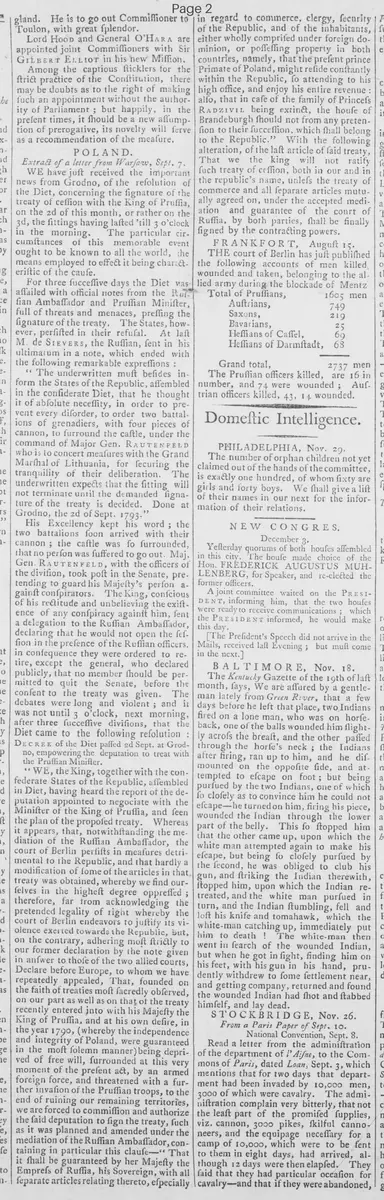
Extract of a letter from Warsaw, Sept. 7.
We have just received the important news from Grodno, of the resolution of the Diet, concerning the signature of the treaty of cession with the King of Prussia. On the 2d of this month, or rather on the 3d, the fittings having lasted till 3 o'clock in the morning. The particular circumstances of this memorable event ought to be known to all the world, the means employed to effect it being characteristic of the cause.
For three successive days the Diet was assailed with official notes from the Russian Ambassador and Prussian Minister, full of threats and menaces, pressing the signature of the treaty. The States, however, persisted in their refusal. At last M. de Sievers, the Russian, sent in his ultimatum in a note, which ended with the following remarkable expressions:
"The underwritten must besides inform the States of the Republic, assembled in the confederate Diet, that he thought it of absolute necessity, in order to prevent every disorder, to order two battalions of grenadiers, with four pieces of cannon, to surround the castle, under the command of Major Gen. RAUTENFELD, who is to concert measures with the Grand Marshal of Lithuania, for securing the tranquility of their deliberation. The underwritten expects that the fitting will not terminate until the demanded signature of the treaty is decided. Done at Grodno, the 2d of Sept. 1793."
His Excellency kept his word; the two battalions soon arrived with their cannon; the castle was so surrounded, that no person was suffered to go out. Maj. Gen. Rauttenfeld, with the officers of the division, took post in the Senate, pretending to guard his Majesty's person against conspirators. The King, conscious of his rectitude and unbelieving the existence of any conspiracy against him, sent a delegation to the Russian Ambassador, declaring that he would not open the session in the presence of the Russian officers. In consequence they were ordered to retire, except the general, who declared publicly, that no member should be permitted to quit the Senate, before the consent to the treaty was given. The debates were long and violent; and it was not until 3 o'clock, next morning, after three successive divisions, that the Diet came to the following resolution:
DECREE of the Diet passed 2d Sept. at Grodno, empowering the deputation to treat with the Prussian Minister.
"WE, the King, together with the confederate States of the Republic, assembled in Diet, having heard the report of the deputation appointed to negotiate with the Minister of the King of Prussia, and seen the plan of the proposed treaty. Whereas it appears, that, notwithstanding the mediation of the Russian Ambassador, the court of Berlin persists in measures detrimental to the Republic, and that hardly a modification of some of the articles in that treaty was obtained, whereby we find ourselves in the highest degree oppressed; therefore, far from acknowledging the pretended legality of right whereby the court of Berlin endeavors to justify its violence exerted towards the Republic, but, on the contrary, adhering most strictly to our former declaration by the note given in answer to those of the two allied courts,
Declare before Europe, to whom we have repeatedly appealed, That, founded on the faith of treaties most sacredly observed, on our part as well as on that of the treaty recently entered into with his Majesty the King of Prussia, and at his own desire, in the year 1790, (whereby the independence and integrity of Poland, were guaranteed in the most solemn manner) being deprived of free will, surrounded at this very moment of the present act, by an armed foreign force, and threatened with a further invasion of the Prussian troops, to the end of ruining our remaining territories, we are forced to commission and authorize the said deputation to sign the treaty, such as it was planned and amended under the mediation of the Russian Ambassador, containing in particular this clause--"That it shall be guaranteed by her Majesty the Empress of Russia, his Sovereign, with all separate articles relating thereto, especially in regard to commerce, clergy, security of the Republic, and of the inhabitants, either wholly comprised under foreign dominion, or possessing property in both countries, namely, that the present prince Primate of Poland, might reside constantly within the Republic, so attending to his high office, and enjoy his entire revenue: also, that in case of the family of Princes Radziwill being extinct, the house of Brandenburg should not from any pretension to their succession, which shall belong to the Republic." With the following alteration, of the last article of said treaty, That we the king will not ratify such treaty of cession, both in our and in the republic's name, unless the treaty of commerce and all separate articles mutually agreed on, under the accepted mediation and guarantee of the court of Russia, by both parties, shall be finally signed by the contracting powers.
What sub-type of article is it?
What keywords are associated?
What entities or persons were involved?
Where did it happen?
Foreign News Details
Primary Location
Grodno
Event Date
2d 3d Sept. 1793
Key Persons
Outcome
diet forced to authorize signing of treaty of cession with prussia under russian military coercion; includes guarantees by empress of russia on commerce, clergy, security; king withholds ratification until separate articles signed.
Event Details
The Polish Diet in Grodno faced threats from Russian Ambassador Sievers and Prussian Minister, culminating in two battalions and cannon surrounding the castle on Sept. 2, 1793. After violent debates until 3 a.m. on Sept. 3, the Diet decreed authorization for deputation to sign the treaty, protesting the armed force and appealing to Europe, while demanding Russian mediation on amendments.