Thank you for visiting SNEWPapers!
Sign up free
The Enquirer
Richmond, Henrico County, Virginia
What is this article about?
Political commentary defending the U.S. occupation of West Florida against Federalist opposition, quoting newspapers that previously supported the measure but now criticize it as influenced by France. Argues U.S. claims are valid and timing auspicious.
Clipping
OCR Quality
Full Text
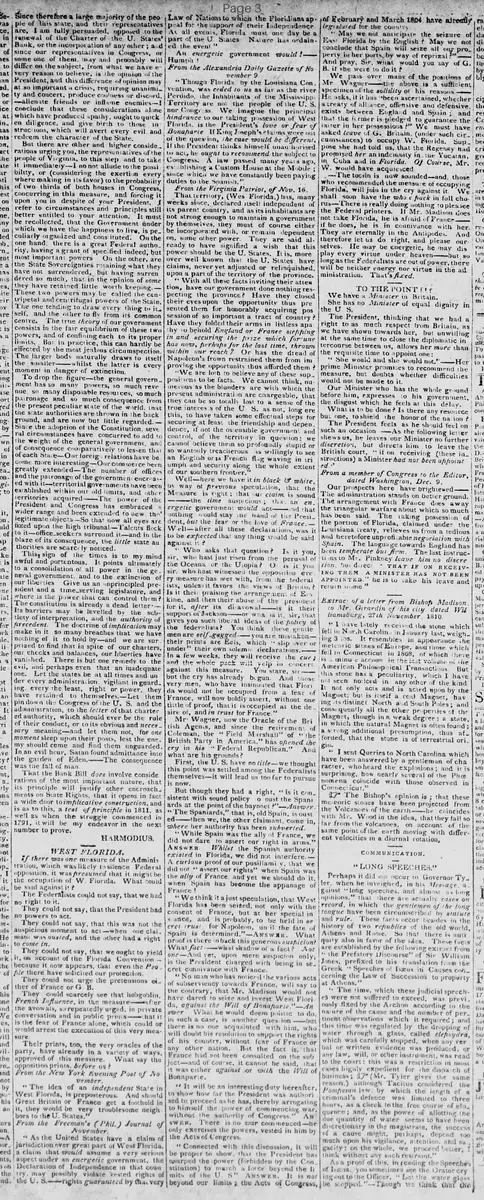
If there was one measure of the Administration, which was likely to silence Federal opposition, it was presumed that it might be the occupation of W. Florida. What could be said against it?
The Federalists could not say, that we had no right to it.
They could not say, that the President had no powers to act.
They could not say, that this was not the auspicious moment to act—when one claimant was ousted, and the other had a right to come in.
They could not say, that we ought to yield it, on account of the Florida Convention—because it now appears, that even the People there have solicited our protection.
They could not urge the pretensions either of France or G. B.
They could scarcely see that hobgoblin, French Influence, in the measure—after the avowals, so repeatedly urged, in private conversation and in public prints—that it is the fear of France alone, which could or would arrest the execution of this very measure.
Their prints, too, the very oracles of the party, have already in a variety of ways, approved of this measure. What say the opposition prints before us?
From the New York Evening Post of November.
"The idea of an independent State in West Florida, is preposterous. And should Great Britain or France get a foothold in it, they would be very troublesome neighbors to the U. States."
From the Freeman's (Phil.) Journal of November.
"As the United States have a claim of jurisdiction over great part of West Florida, a claim that would assume a very serious aspect under an energetic government, the Declaration of Independence in that country, may possibly violate vested rights of the U. S.—rights guaranteed by that very Law of Nations to which the Floridians appeal for the support of their Independence. At all events, Florida must one day be a part of the U States. Nature has ordained the event. An energetic government would! Humph!"
From the Alexandria Daily Gazette of November 9.
"Though Florida by the Louisiana Convention, was ceded to us as far as the river Perdido, the Inhabitants of the Mississippi Territory are not the people of the U. S. nor Congress. We imagine the principal hindrance to our taking possession of West Florida, is the President's love or fear of Bonaparte. If King Joseph's claims were out of the question, the case would be different. If the President thinks himself unauthorized to act, he ought to recommend the subject to Congress. A law passed many years ago, establishing a Custom House at the Mobile; since which we have constantly been paying duties to the Spanish."
From the Virginia Patriot, of Nov. 16.
That territory, (West Florida,) has, many weeks since, declared itself independent of its parent Country, and as its inhabitants are not strong enough to maintain a government by themselves, they must of course either be incorporated with, or remain dependent on, some other power. They are said already to have signified a wish that this power should be the U. States. It is, moreover well known that the U. States have claims, never yet adjusted or relinquished, upon a part of the territory of the province.
"With all these facts inviting their attention, have our government done nothing respecting the province? Have they closed their eyes upon the opportunity thus presented them for honorably acquiring possession of so important a tract of country? Have they folded their arms in listless apathy to behold England or France stepping in and securing the prize which fortune has now, perhaps for the last time, thrown within our reach? Or has the dread of Napoleon's frown restrained them from improving the opportunity thus afforded them?
We are loth to believe any of these suppositions to be facts. We cannot think, numerous as the blunders are with which the present administration are chargeable, that they can be so totally lost to a sense of the true interest of the U S. as not, long ere this, to have taken some effectual steps for securing at least the friendship and dependence, if not the ostensible government and control, of the territory in question: we cannot believe them so profoundly stupid or so wantonly treacherous as willingly to see an English or a French flag waving in triumph and security along the whole extent of our southern frontier.
Well here we have it in black & white, by way of previous speculation, that the Measure is right; that our claim is sound—the time auspicious; that an energetic government would act—and that nothing would stay the hand of the President, but the fear or the love of France.—Well—after all these declarations, was it to be expected that any thing would be said against it?
Who asks that question? Is it you, sir, who hast just risen from the perusal of the Oceana or the Utopia? O is it you sir, who hast witnessed the opposition every measure has met with, from the federalists, unless it favors the views of Britain? Is it their praising the arrangement of Erskine, and then their abuse of the president for it, after its disavowal—is it their support of Jackson—or what is it, sir, that gives you such liberal ideas of the policy of the federalists? You think these gentlemen are self-gagged—you are mistaken—their prints are Eels, which "slip over or under" their own solemn declarations.
In a few weeks, they will receive the cue; and the whole pack will yelp in concert against this measure.
You stare, sir.—but the cry has already begun. And those very men, who have insinuated that Florida would not be occupied from a fear of France, will now boldly assert, without one tittle of proof, that it is occupied at the desire of, and in trust for France."
Mr. Wagner, now the Oracle of the British Agents, and since the retirement of Coleman, the "Field Marshall" of "the British Party in America," has opened the cry in his "Federal Republican."
And what are his grounds?
First, the U. S. have no title—we thought this point was settled among the Federalists themselves—it will lead us too far to pursue it now.
But though they had a right, "is it consistent with sound policy to oust the Spaniards at the point of the bayonet?"—Answer. "The Spaniards," that is, old Spain, is ousted—then we, the other claimant, come in, where her authority has been subverted.
"While Spain was the ally of France, we did not dare to assert our right in arms." ANSWER. Whilst the Spanish authority existed in Florida, we did not interfere. A curious proof of our pusillanimity, that we did not "assert our rights" when Spain was the ally of France, and yet we should do it, when Spain has become the appanage of France!
"We think it a just speculation, that West Florida has been seized, not only with the consent of France, but at her special instance, and is probably, to be held in secret trust for Napoleon, until the fate of Spain is determined."—ANSWER. What proof is there to back this generous suspicion? What fact—what shadow of a fact? Not one—And yet, upon mere suspicion only, is the President charged with being in secret Connivance with France.
"No man who has noticed the various acts of subserviency towards France, will say to the contrary, that Mr. Madison would not have dared to seize and invest West Florida, against the Will of Bonaparte."—Answer. What he would deem politic to do, in such a case, is another question—but there is no one acquainted with him, who will doubt his resolution to support the rights of his country, without fear of France or any other nation. But the fact is, that France had not been consulted on the subject—and of course, it cannot be said, that it was either against or with the Will of Bonaparte.
"It will be an interesting duty hereafter, to show how far the President was authorized to proceed as he has, thereby arrogating to himself the power of commencing war, without the authority of Congress." An swer. There is no war commenced—he only exercises the powers, vested in him by the Acts of Congress.
"Connected with this discussion, it will be proper to show, that the President has usurped the power (forbidden by the Constitution) to march a force beyond the limit, of the U S." ANSWER. It is not beyond our limits; the Acts of Congress, of February and March 1804, have already legislated for the country.
"May we not anticipate the seizure of East Florida by the English? May we not conclude that Spain will seize all our property in her ports, by way of reprisal?" ….
And pray, Sir, what would you say of G. B. if she were to do it?
We pass over many of the positions of Mr. Wagner—the above is a sufficient specimen of the solidity of his reasons—et tu, Brute.
He asks, if it has "been ascertained, whether a treaty of alliance, offensive and defensive, exists between England and Spain; and that the former is pledged to guarantee the latter in her possessions?" We must have asked leave of G. Britain. (under such circumstances) to occupy W. Florida. Suppose she had told us, that the Regency had promised her an indemnity in the Yucatan, in Cuba and in Florida. Of course, Mr. W. would have acquiesced.
.—The tocsin is now sounded—and those who recommended the measure of occupying Florida, will join in the cry against it. We shall soon have the whole jackanapes chorus—There is really nothing to please the Federal printers. If Mr. Madison does not take Florida, he is afraid of France; if he does, he is in connivance with her. They are eternally in the Antipodes. And therefore let us do right, and please ourselves. He may be energetic, he may display every virtue under heaven—but so long as the Federalists are out of power, there will be neither energy nor virtue in the administration. That's fixed.
What sub-type of article is it?
What keywords are associated?
What entities or persons were involved?
Where did it happen?
Domestic News Details
Primary Location
West Florida
Key Persons
Outcome
u.s. occupation of west florida asserted as rightful and timely, amid shifting federalist opposition claiming french influence.
Event Details
Commentary defends the U.S. administration's occupation of West Florida, refuting Federalist arguments on rights, timing, and French involvement, quoting prior supportive newspaper excerpts and criticizing recent opposition in the Federal Republican.