Thank you for visiting SNEWPapers!
Sign up free
The New Hampshire Gazette And General Advertiser
Portsmouth, Exeter, Rockingham County, New Hampshire
What is this article about?
Letter reports Capt. George Church's failed 1783 voyage from New London to Jamaica, where British authorities denied entry and sale of cargo after the July 24 King's proclamation, including the Attorney General's advisory opinion. It concludes American trade to British West Indies is ended and questions Connecticut government's potential inaction on promoting local trade.
Clipping
OCR Quality
Full Text
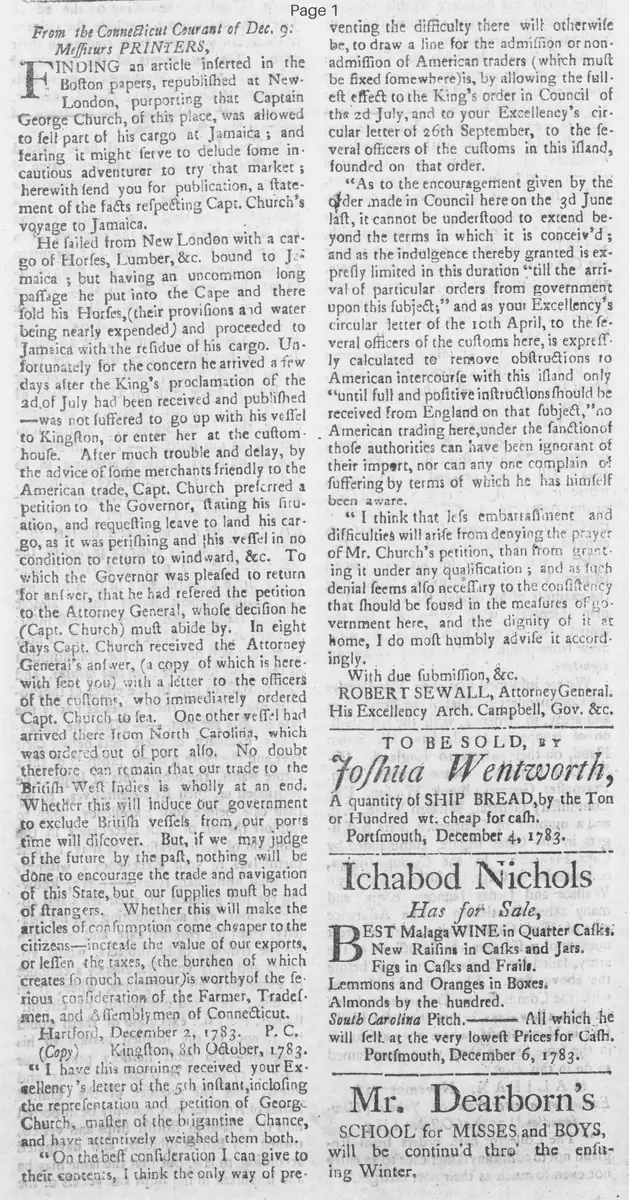
Messrs. PRINTERS,
Finding an article inserted in the Boston papers, republished at New London, purporting that Captain George Church, of this place, was allowed to sell part of his cargo at Jamaica; and fearing it might serve to delude some incautious adventurer to try that market; herewith send you for publication, a statement of the facts respecting Capt. Church's voyage to Jamaica.
He sailed from New London with a cargo of Horses, Lumber, &c. bound to Jamaica; but having an uncommon long passage he put into the Cape and there sold his Horses (their provisions and water being nearly expended) and proceeded to Jamaica with the residue of his cargo. Unfortunately for the concern he arrived a few days after the King's proclamation of the 24th of July had been received and published -- was not suffered to go up with his vessel to Kingston, or enter her at the custom-house. After much trouble and delay, by the advice of some merchants friendly to the American trade, Capt. Church preferred a petition to the Governor, stating his situation, and requesting leave to land his cargo, as it was perishing and his vessel in no condition to return to windward, &c. To which the Governor was pleased to return for answer, that he had referred the petition to the Attorney General, whose decision he (Capt. Church) must abide by. In eight days Capt. Church received the Attorney General's answer. (a copy of which is herewith sent you) with a letter to the officers of the customs, who immediately ordered Capt. Church to sea. One other vessel had arrived there from North Carolina, which was ordered out of port also. No doubt therefore can remain that our trade to the British-West Indies is wholly at an end: Whether this will induce our government to exclude British vessels from our ports time will discover. But, if we may judge of the future by the past, nothing will be done to encourage the trade and navigation of this State, but our supplies must be had of strangers. Whether this will make the articles of consumption come cheaper to the citizens -- increase the value of our exports, or lessen the taxes, (the burthen of which creates so much clamour) is worthy of the serious consideration of the Farmers, Tradesmen, and Assemblymen of Connecticut.
Hartford, December 2, 1783. P. C.
(Copy)
Kingston, 8th October, 1783.
I have this morning received your Excellency's letter of the 2d instant, inclosing the representation and petition of George Church, master of the brigantine Chance, and have attentively weighed them both.
On the best consideration I can give to their contents, I think the only way of preventing the difficulty there will otherwise be, to draw a line for the admission or non-admission of American traders (which must be fixed somewhere) is, by allowing the fullest effect to the King's order in Council of the 2d July, and to your Excellency's circular letter of 26th September, to the several officers of the customs in this island, founded on that order.
As to the encouragement given by the order made in Council here on the 3d June last, it cannot be understood to extend beyond the terms in which it is conceived: and as the indulgence thereby granted is expressly limited in its duration "till the arrival of particular orders from government upon this subject;" and as your Excellency's circular letter of the 10th April, to the several officers of the customs here, is expressly calculated to remove obstructions to American intercourse with this island only "until full and positive instructions should be received from England on that subject." no American trading here, under the sanction of those authorities can have been ignorant of their import, nor can any one complain of suffering by terms of which he has himself been aware.
I think that less embarrassment and difficulties will arise from denying the prayer of Mr. Church's petition, than from granting it under any qualification; and as such denial seems also necessary to the consistency that should be found in the measures of government here, and the dignity of it at home, I do most humbly advise it accordingly.
With due submission, &c.
ROBERT SEWALL, Attorney General.
His Excellency Arch. Campbell, Gov. &c.
What sub-type of article is it?
What themes does it cover?
What keywords are associated?
What entities or persons were involved?
Letter to Editor Details
Author
P. C.
Recipient
Messrs. Printers,
Main Argument
reports the facts of capt. george church's denied entry and cargo sale in jamaica due to the king's july 24, 1783 proclamation, confirming the end of american trade to british west indies, and urges connecticut leaders to consider implications for local trade, exports, and taxes amid government inaction.
Notable Details