Thank you for visiting SNEWPapers!
Sign up free
Editorial
January 23, 1956
The Lincoln Times
Lincolnton, Lincoln County, North Carolina
What is this article about?
Editorial by Lewis E. Everline discusses recent UN decision to admit 16 nations after vetoing Outer Mongolia and Japan, criticizing US diplomacy and advocating universal membership to enhance peace, citing Dulles' support and invalidity of peace-loving criterion.
Clipping
OCR Quality
98%
Excellent
Full Text
"Sketches From
The Current Scene
(By L. E. EVERLINE)
By LEWIS E. EVERLINE
UNIVERSAL MEMBERSHIP
IN THE U. N.
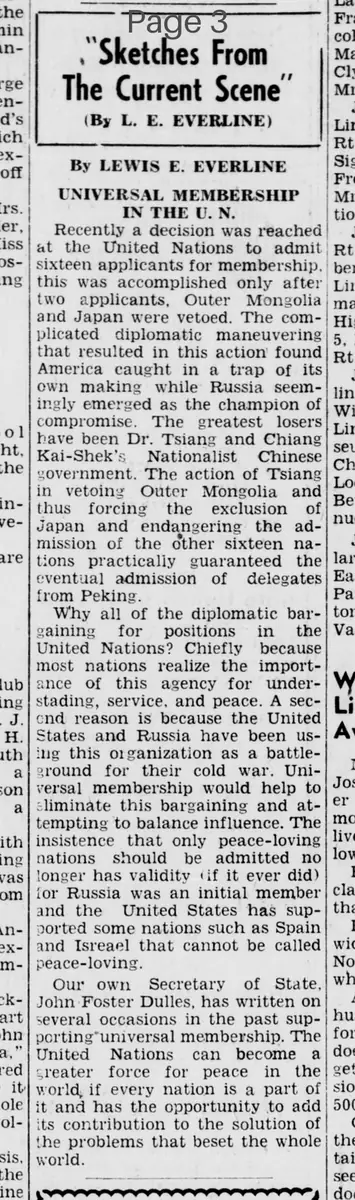
Recently a decision was reached at the United Nations to admit sixteen applicants for membership, this was accomplished only after two applicants, Outer Mongolia and Japan were vetoed. The complicated diplomatic maneuvering that resulted in this action found America caught in a trap of its own making while Russia seemingly emerged as the champion of compromise. The greatest losers have been Dr. Tsiang and Chiang Kai-Shek's Nationalist Chinese government. The action of Tsiang in vetoing Outer Mongolia and thus forcing the exclusion of Japan and endangering the admission of the other sixteen nations practically guaranteed the eventual admission of delegates from Peking.
Why all of the diplomatic bargaining for positions in the United Nations? Chiefly because most nations realize the importance of this agency for understanding, service, and peace. A second reason is because the United States and Russia have been using this organization as a battleground for their cold war. Universal membership would help to eliminate this bargaining and attempting to balance influence. The insistence that only peace-loving nations should be admitted no longer has validity (if it ever did) for Russia was an initial member and the United States has supported some nations such as Spain and Israel that cannot be called peace-loving.
Our own Secretary of State John Foster Dulles, has written on several occasions in the past supporting universal membership. The United Nations can become a greater force for peace in the world if every nation is a part of it and has the opportunity to add its contribution to the solution of the problems that beset the whole world.
The Current Scene
(By L. E. EVERLINE)
By LEWIS E. EVERLINE
UNIVERSAL MEMBERSHIP
IN THE U. N.
Recently a decision was reached at the United Nations to admit sixteen applicants for membership, this was accomplished only after two applicants, Outer Mongolia and Japan were vetoed. The complicated diplomatic maneuvering that resulted in this action found America caught in a trap of its own making while Russia seemingly emerged as the champion of compromise. The greatest losers have been Dr. Tsiang and Chiang Kai-Shek's Nationalist Chinese government. The action of Tsiang in vetoing Outer Mongolia and thus forcing the exclusion of Japan and endangering the admission of the other sixteen nations practically guaranteed the eventual admission of delegates from Peking.
Why all of the diplomatic bargaining for positions in the United Nations? Chiefly because most nations realize the importance of this agency for understanding, service, and peace. A second reason is because the United States and Russia have been using this organization as a battleground for their cold war. Universal membership would help to eliminate this bargaining and attempting to balance influence. The insistence that only peace-loving nations should be admitted no longer has validity (if it ever did) for Russia was an initial member and the United States has supported some nations such as Spain and Israel that cannot be called peace-loving.
Our own Secretary of State John Foster Dulles, has written on several occasions in the past supporting universal membership. The United Nations can become a greater force for peace in the world if every nation is a part of it and has the opportunity to add its contribution to the solution of the problems that beset the whole world.
What sub-type of article is it?
Foreign Affairs
What keywords are associated?
Un Membership
Universal Admission
Diplomatic Maneuvering
Cold War
Veto Power
Nationalist China
Peace Loving Nations
John Foster Dulles
What entities or persons were involved?
United Nations
America
Russia
Outer Mongolia
Japan
Dr. Tsiang
Chiang Kai Shek's Nationalist Chinese Government
Peking
John Foster Dulles
Spain
Israel
Editorial Details
Primary Topic
Advocacy For Universal Membership In The United Nations
Stance / Tone
Supportive Of Universal Un Membership
Key Figures
United Nations
America
Russia
Outer Mongolia
Japan
Dr. Tsiang
Chiang Kai Shek's Nationalist Chinese Government
Peking
John Foster Dulles
Spain
Israel
Key Arguments
Admission Of Sixteen Un Applicants After Vetoing Outer Mongolia And Japan
Us Caught In Diplomatic Trap, Russia Emerges As Compromise Champion
Tsiang's Veto Endangers Other Admissions And Guarantees Peking Delegates
Nations Seek Un Membership For Understanding, Service, And Peace
Un Used As Cold War Battleground By Us And Russia
Universal Membership Eliminates Bargaining And Balances Influence
Peace Loving Nations Criterion Invalid Given Members Like Russia, Spain, Israel
Dulles Has Supported Universal Membership In Writings
Un Stronger For Peace With Every Nation's Contribution