Thank you for visiting SNEWPapers!
Sign up free
The Farmville Herald
Farmville, Prince Edward County, Virginia
What is this article about?
Roger Babson critiques the drive for universal college education, warning it dilutes standards. He urges intellectual honesty in admissions, better high school preparation, and viewing education as a privilege to counter Cold War challenges, citing Sputnik as a catalyst. (248 characters)
Merged-components note: Merged split story 'Babson Discusses The Real Problem Of Education' due to sequential reading order and content continuation
Clipping
OCR Quality
Full Text
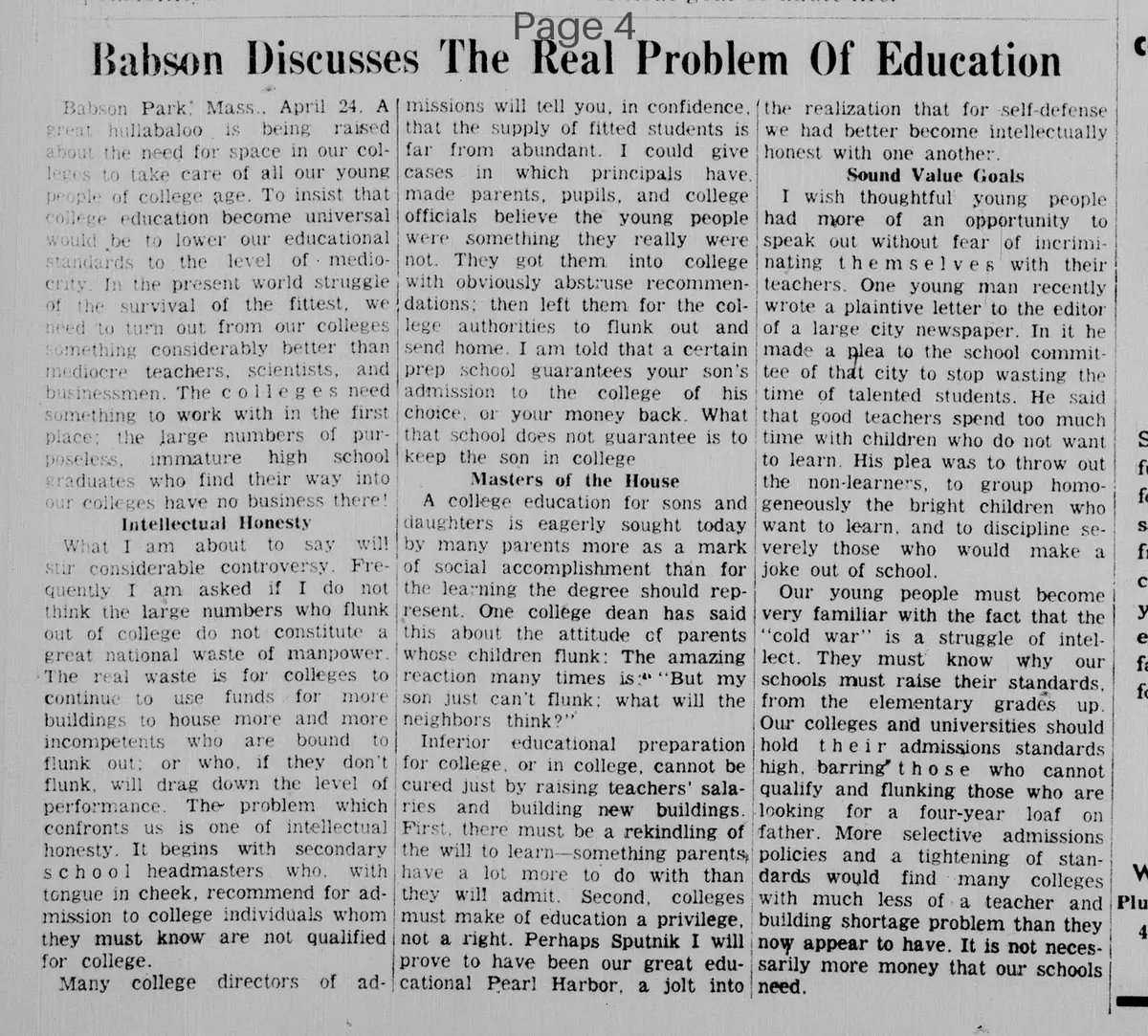
Babson Park, Mass., April 24. A great hullabaloo is being raised about the need for space in our colleges to take care of all our young people of college age. To insist that college education become universal would be to lower our educational standards to the level of mediocrity. In the present world struggle of the survival of the fittest, we need to turn out from our colleges something considerably better than mediocre teachers, scientists, and businessmen. The colleges need something to work with in the first place: the large numbers of purposeless, immature high school graduates who find their way into our colleges have no business there!
Intellectual Honesty
What I am about to say will stir considerable controversy. Frequently I am asked if I do not think the large numbers who flunk out of college do not constitute a great national waste of manpower. The real waste is for colleges to continue to use funds for more buildings to house more and more incompetents who are bound to flunk out, or who, if they don't flunk, will drag down the level of performance. The problem which confronts us is one of intellectual honesty. It begins with secondary school headmasters who, with tongue in cheek, recommend for admission to college individuals whom they must know are not qualified for college.
Many college directors of admissions will tell you, in confidence, that the supply of fitted students is far from abundant. I could give cases in which principals have made parents, pupils, and college officials believe the young people were something they really were not. They got them into college with obviously abstruse recommendations; then left them for the college authorities to flunk out and send home. I am told that a certain prep school guarantees your son's admission to the college of his choice, or your money back. What that school does not guarantee is to keep the son in college.
Masters of the House
A college education for sons and daughters is eagerly sought today by many parents more as a mark of social accomplishment than for the learning the degree should represent. One college dean has said this about the attitude of parents whose children flunk: The amazing reaction many times is: "But my son just can't flunk; what will the neighbors think?"
Inferior educational preparation for college, or in college, cannot be cured just by raising teachers' salaries and building new buildings. First, there must be a rekindling of the will to learn - something parents have a lot more to do with than they will admit. Second, colleges must make of education a privilege, not a right. Perhaps Sputnik I will prove to have been our great educational Pearl Harbor, a jolt into
the realization that for self-defense we had better become intellectually honest with one another.
Sound Value Goals
I wish thoughtful young people had more of an opportunity to speak out without fear of incriminating themselves with their teachers. One young man recently wrote a plaintive letter to the editor of a large city newspaper. In it he made a plea to the school committee of that city to stop wasting the time of talented students. He said that good teachers spend too much time with children who do not want to learn. His plea was to throw out the non-learners, to group homogeneously the bright children who want to learn, and to discipline severely those who would make a joke out of school.
Our young people must become very familiar with the fact that the "cold war" is a struggle of intellect. They must know why our schools must raise their standards, from the elementary grades up. Our colleges and universities should hold their admissions standards high, barring those who cannot qualify and flunking those who are looking for a four-year loaf on father. More selective admissions policies and a tightening of standards would find many colleges with much less of a teacher and building shortage problem than they now appear to have. It is not necessarily more money that our schools need.
What sub-type of article is it?
What themes does it cover?
What keywords are associated?
What entities or persons were involved?
Where did it happen?
Story Details
Key Persons
Location
Babson Park, Mass.
Event Date
April 24
Story Details
Babson argues that expanding college access to all would lower standards to mediocrity, especially amid global intellectual struggles. He criticizes dishonest high school recommendations, parental social pressures, and calls for intellectual honesty, selective admissions, and rekindling the will to learn, referencing Sputnik as a wake-up call.