Thank you for visiting SNEWPapers!
Sign up free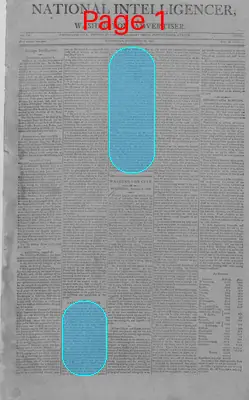
The National Intelligencer And Washington Advertiser
Washington, District Of Columbia
What is this article about?
Citizen Monge reported to the National Institute on August 5 about Citizen Laborde's discovery of superior ancient Mosaic representations in Italica, Spain, depicting a circus and chariot race. Laborde plans to publish details of these and other monuments, highlighting Italica's historical significance as birthplace of emperors and figures.
Clipping
OCR Quality
Full Text
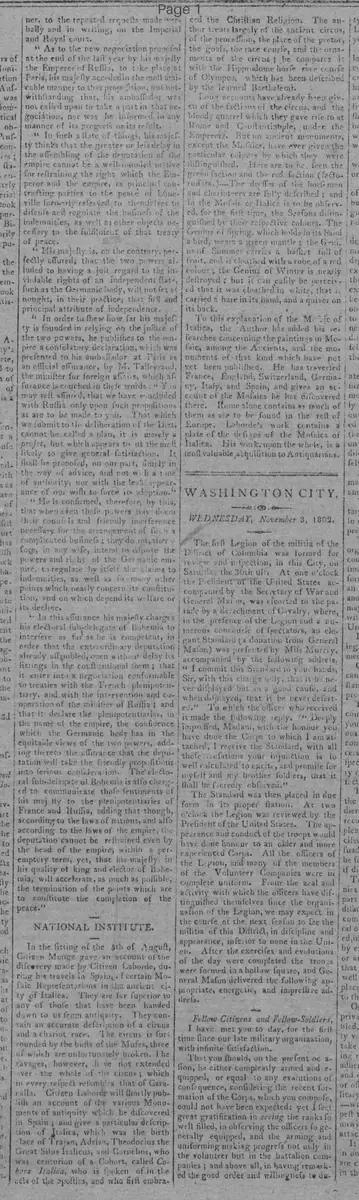
In the sitting of the 5th of August, Citizen Monge gave an account of the discovery made by Citizen Laborde, during his travels in Spain, of certain Mosaic Representations in the ancient city of Italica. They are far superior to any of those that have been handed down to us from antiquity. They contain an accurate description of a circus and a chariot race. The circus is surrounded by the busts of the Muses, three of which are unfortunately broken. The ravages, however, have not extended over the whole of the circus; which in every respect resembles that of Tarragona. Citizen Laborde will shortly publish an account of the various Monuments of antiquity which he discovered in Spain; and give a particular description of Italica, which was the birth place of Trajan, Adrian, Theodosius the Great, Silus Italicus, and Cornelius, who was centurion of a Cohort, called Cohort Italica, who is spoken of in the acts of the apostles, and who first embraced the Christian Religion. The author treats largely of the ancient circus, of the procession, the place of the pretor, the goals, the race course, and the ornaments of the circus; he compares it with the Hippodrome horse race course of Olympus, which has been described by the learned Barthelemy.
Long accounts have already been given of the factions of the circus, and the bloody quarrels which they gave rise to at Rome and Constantinople, under the Emperors. But no ancient monuments, except the Mosaic, have ever given the particular colours by which they were distinguished. Here are to be seen the green faction and the red faction (factiones). The dress of the horsemen and charioteers are fully described: and in the Mosaic of Italica is to be observed, for the first time, the Seasons distinguished by their respective colours. The Genius of Spring, which holds in its hand a bird, wears a green mantle; the Genius of Summer carries a basket full of fruit, and is clothed with a robe of a red colour: the Genius of Winter is nearly destroyed; but it can easily be perceived that it was clothed in white, that it carried a hare in its hand, and a quiver on its back.
To this explanation of the Mosaic of Italica, the Author has added his researches Concerning the paintings in Mosaic, among the Ancients, and the monuments of that kind which have not yet been published. He has traversed France, England, Switzerland, Germany, Italy, and Spain, and gives an account of the Mosaics he has discovered there. Rome alone contains as much of them as are to be found in the rest of Europe. Laborde's work contains a plate of the details of the Mosaics of Italica. His work, upon the whole, is a most valuable acquisition to Antiquarians.
What sub-type of article is it?
What keywords are associated?
What entities or persons were involved?
Where did it happen?
Foreign News Details
Primary Location
Italica, Spain
Event Date
Sitting Of The 5th Of August
Key Persons
Outcome
citizen laborde will shortly publish an account of the monuments discovered in spain, including a particular description of italica and details of the mosaic; his work includes researches on ancient mosaic paintings across europe and is considered a valuable acquisition to antiquarians.
Event Details
Citizen Monge gave an account of the discovery made by Citizen Laborde during his travels in Spain of certain Mosaic Representations in the ancient city of Italica. They are far superior to any of those that have been handed down to us from antiquity. They contain an accurate description of a circus and a chariot race. The circus is surrounded by the busts of the Muses, three of which are unfortunately broken. The ravages, however, have not extended over the whole of the circus; which in every respect resembles that of Tarragona. Italica was the birth place of Trajan, Adrian, Theodosius the Great, Silus Italicus, and Cornelius, who was centurion of a Cohort, called Cohort Italica, who is spoken of in the acts of the apostles, and who first embraced the Christian Religion. The author treats largely of the ancient circus, of the procession, the place of the pretor, the goals, the race course, and the ornaments of the circus; he compares it with the Hippodrome horse race course of Olympus, which has been described by the learned Barthelemy. Long accounts have already been given of the factions of the circus, and the bloody quarrels which they gave rise to at Rome and Constantinople, under the Emperors. But no ancient monuments, except the Mosaic, have ever given the particular colours by which they were distinguished. Here are to be seen the green faction and the red faction (factiones). The dress of the horsemen and charioteers are fully described: and in the Mosaic of Italica is to be observed, for the first time, the Seasons distinguished by their respective colours. The Genius of Spring, which holds in its hand a bird, wears a green mantle; the Genius of Summer carries a basket full of fruit, and is clothed with a robe of a red colour: the Genius of Winter is nearly destroyed; but it can easily be perceived that it was clothed in white, that it carried a hare in its hand, and a quiver on its back. To this explanation of the Mosaic of Italica, the Author has added his researches Concerning the paintings in Mosaic, among the Ancients, and the monuments of that kind which have not yet been published. He has traversed France, England, Switzerland, Germany, Italy, and Spain, and gives an account of the Mosaics he has discovered there. Rome alone contains as much of them as are to be found in the rest of Europe. Laborde's work contains a plate of the details of the Mosaics of Italica.