Thank you for visiting SNEWPapers!
Sign up free
The Kentucky Gazette
Lexington, Fayette County, Kentucky
What is this article about?
U.S. House of Representatives proceedings in New York, April 8-11, 1789: Oaths administered; debates on national revenue via impost duties led by Madison; resolution proposed on import taxes; Senate elects J. Langdon president; Baltimore manufacturers petition for support; discussions on temporary vs. permanent systems and collection methods.
Merged-components note: Continuation of the Proceedings of Congress article across pages 1 and 2; relabeled from 'story' to 'domestic_news' for consistency as it reports on U.S. legislative activities.
Clippings
1 of 2
OCR Quality
Full Text
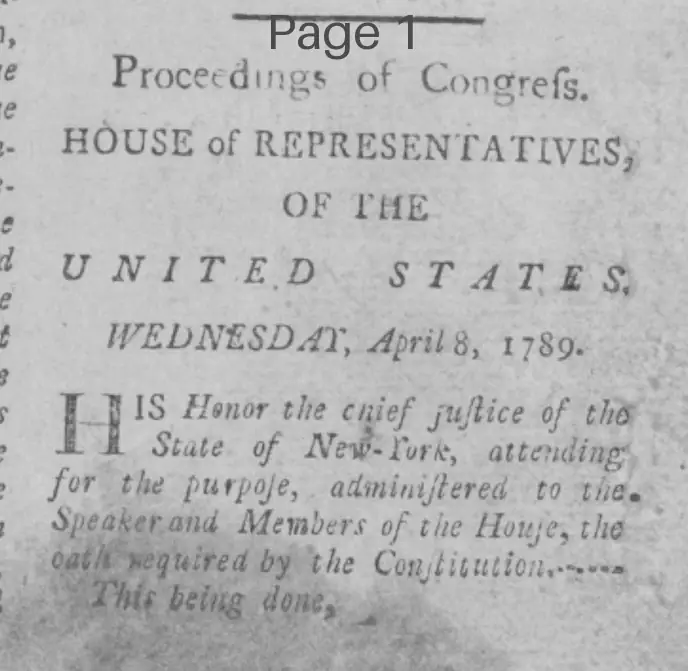
HOUSE of REPRESENTATIVES,
OF THE
UNITED STATES
WEDNESDAY, April 8, 1789.
His Honor the chief justice of the State of New-York, attending for the purpose, administered to the Speaker and Members of the House, the oath required by the Constitution.
This being done,
Mr. Parker (of Virginia) moved, that the House resolve itself into a committee of the whole, on the state of the Union. This motion was agreed to; and Mr. Page (of Virginia) was then called to the chair. Mr. Madison (of Virginia) then rose, and made a few observations on the state of our finances, the deficiencies of the federal treasury, and the necessity of immediately adopting some measures, on the subject of the national revenue. On this occasion, the first object which presented itself, was the resource, that might be drawn from a general system of impost on articles of importation. This subject, however, might be considered on two points of light. First as it respected the regulation of commerce. Secondly as to revenue. The second point, in his opinion, demanded more particularly the attention of the committee. — and with this view he offered the following resolution: —
Resolved; as the opinion of this committee, That the following duties ought to be levied on goods, wares, and merchandise imported into the United States viz.
On rum, per gallon, of dollar.
On all other spirituous liquors.
On molasses.
On Madeira wine
On all other wines
On common bohea teas per lb.
On all other teas.
On paper.
On brown sugars.
on loaf sugar.
On all other sugars.
On cocoa and coffee.
On all other articles per cent. on their value, at the time and place of importation.
That there ought moreover, to be levies, on the vessels in which goods, wares or merchandises shall be imported. the duties following viz On, all vessels built within the United States.and belonging wholly to citizens thereof, at the rate of per ton
On all vessels belonging wholly to the subjects of powers, with whom the United States have formed treaties, or partly to such subjects and partly to the citizens of the said States at the rate of
On all vessels belonging wholly or in part to the subjects of other powers at the rate of
After some debate. Mr. Madison then observed that as he did not suppose the committee to be prepared to proceed in the business, moved that they adjourn — which was agreed to, and the house adjourned.
We hear that the Senate have chosen J. Langdon, Esq. of New Hampshire, their president.
James Madison was appointed door keeper, and Cornelius Maxwell messenger.
Saturday April 11, A.M.
A petition from the manufacturers of the town of Baltimore was read, praying the house to take into consideration the encouragement of domestic manufactures.
In Committee of the whole on the State of the Union.
A member introduced an additional list of enumerated articles to become objects of impost. As he thought that the idea of a temporary plan was abandoned, it became the duty of the house to make the one they should frame as perfect as possible: with this view he submitted to the Committee the propriety of additional duties being laid on anchors, wool cards, limes and lemons.
It being received by the committee, Mr. Boudinot was sorry to hear it suggested, that the idea of a temporary system was not abandoned; for his part, he must own that he had not given that idea up, because he conceived it to be the only mode by which the spring importations could be embraced. This was an object of very considerable importance, and well worthy the attention of the Legislature.
After insisting on this point, he stated, with diffidence, a plan he had in contemplation, which was that Congress should establish some general regulation in the manner prescribed by the original motion of Mr. Madison, and leave the collection to be made by the officers already employed in a similar business by the individual states; this would save all that time which must otherwise be spent in forming regulations of the mode of collecting. When
this was done. the house would secure a revenue, and give themselves time to obtain such information as was necessary to perfect a permanent system. This information he expected could be drawn from three sources: first, from the laws of the different states. respecting revenue; second, and which was the most material from the great body of merchants spread through the Union; and third, from the members of the house, respecting the operation of the local laws in their respective states.
He considered it impracticable to get a duty for the spring importations, if the house should be decisive, until they were able to complete a perfect and permanent system. He endeavoured to shew how much time and labour it would require from considering the vast extent of coast, by which the United States were bounded, to make a law, with sufficient precautions to prevent illicit trade. He stated as one difficulty, the commercial connection between Vermont and Canada, which it was the duty of the house to counteract. In short, the embarrassments which must attend making a complete system, were so numerous and great, that if the house went now to encounter them, their present session would tell off. Wherefore he would advocate a temporary instead of a permanent plan.
He proposed to take the sense of the house on this point, viz: whether this law should be a permanent or temporary one. A joint committee was ordered to be appointed, consisting of a number from each state to devise a mode for making the collection.
What sub-type of article is it?
What keywords are associated?
What entities or persons were involved?
Where did it happen?
Domestic News Details
Primary Location
New York
Event Date
April 8 11, 1789
Key Persons
Outcome
house adjourned after debate on april 8; joint committee appointed on april 11 to devise collection mode; ongoing discussions on temporary vs. permanent impost system.
Event Details
On April 8, oaths administered by New-York chief justice; House forms committee of the whole; Madison discusses finances and proposes resolution for import duties on various goods and vessels. Senate chooses Langdon as president; appointments made. On April 11, Baltimore manufacturers petition for domestic support; additional impost articles proposed; Boudinot advocates temporary system using state officers for collection to secure spring revenue, citing difficulties in permanent plan.