Thank you for visiting SNEWPapers!
Sign up free
Literary
August 21, 1799
The Providence Journal, And Town And Country Advertiser
Providence, Providence County, Rhode Island
What is this article about?
In this installment of 'The Guelphiad,' the author defends literary discussions on human follies against political divisiveness, arguing they promote virtue over partisan labels like Jacobin or Federalist. Includes a satirical anecdote of a lawyer's library stocked with gothic novels instead of law books.
Clipping
OCR Quality
92%
Excellent
Full Text
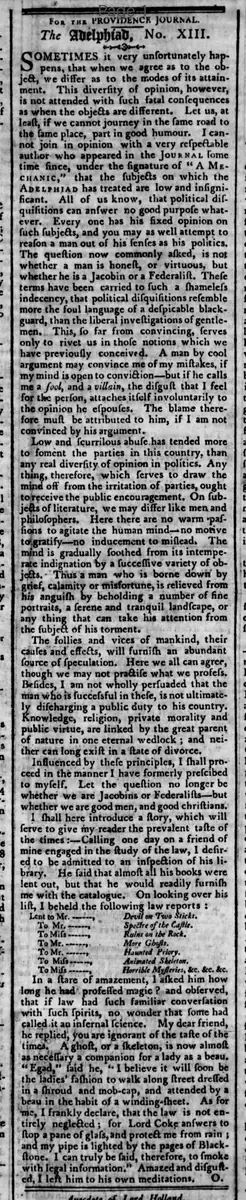
For THE PROVIDENCE JOURNAL.
The Guelphiad: No. XIII.
SOMETIMES it very unfortunately happens, that when we agree as to the object, we differ as to the modes of its attainment. This diversity of opinion, however, is not attended with such fatal consequences as when the objects are different. Let us, at least, if we cannot journey in the same road to the same place, part in good humour. I cannot join in opinion with a very respectable author who appeared in the JOURNAL some time since, under the signature of "A Mechanic," that the subjects on which the ADELPHIAD has treated are low and insignificant. All of us know, that political disquisitions can answer no good purpose whatever. Every one has his fixed opinion on such subjects, and you may as well attempt to reason a man out of his senses as his politics. The question now commonly asked, is not whether a man is honest, or virtuous, but whether he is a Jacobin or a Federalist. These terms have been carried to such a shameless indecency, that political disquisitions resemble more the foul language of a despicable blackguard, than the liberal investigations of gentlemen. This, so far from convincing, serves only to rivet us in those notions which we have previously conceived. A man by cool argument may convince me of my mistakes, if my mind is open to conviction--but if he calls me a fool, and a villain, the disgust that I feel for the person, attaches itself involuntarily to the opinion he espouses. The blame therefore must be attributed to him, if I am not convinced by his argument.
"Low and scurrilous abuse has tended more to foment the parties in this country, than any real diversity of opinion in politics. Anything, therefore, which serves to draw the mind off from the irritation of parties, ought to receive the public encouragement. On subjects of literature, we may differ like men and philosophers. Here there are no warm passions to agitate the human mind--no motive to gratify--no inducement to mislead. The mind is gradually soothed from its intemperate indignation by a successive variety of objects.-- Thus a man who is borne down by grief, calamity or misfortune, is relieved from his anguish by beholding a number of fine portraits, a serene and tranquil landscape, or anything that can take his attention from the subject of his torment.
The follies and vices of mankind, their causes and effects, will furnish an abundant source of speculation. Here we all can agree, though we may not practice what we profess. Besides, I am not wholly persuaded that the man who is successful in these, is not ultimately discharging a public duty to his country. Knowledge, religion, private morality and public virtue, are linked by the great parent of nature in one eternal wedlock; and neither can long exist in a state of divorce.
Influenced by these principles, I shall proceed in the manner I have formerly prescribed to myself. Let the question no longer be whether we are Jacobins or Federalists but whether we are good men, and good christians. I shall here introduce a story, which will serve to give my reader the prevalent state of the times:--Calling one day on a friend of mine engaged in the study of the law, I desired to be admitted to an inspection of his library. He said that almost all his books were lent out, but that he would readily furnish me with the catalogue. On looking over his list, I beheld the following law reports:
Lent to Mr. Devil on Two Sticks.
To Mr. Spectre of the Castle.
To Miss Ruins on the Rock.
To Mr. More Ghosts.
To Mr. Haunted Priory.
To Miss. Animated Skeleton.
To Miss Horrible Mysteries, &c. &c. &c.
In a state of amazement, I asked him how long he had professed magic? and observed, that if law had such familiar conversation with such spirits, no wonder that some had called it an infernal science. My dear friend, he replied, you are ignorant of the state of the times. A ghost, or a skeleton, is now almost as necessary a companion for a lady as a beau. "Egad." said he. I believe it will soon be the ladies' fashion to walk along street dressed in a shroud and mob-cap, and attended by a beau in the habit of a winding-sheet. As for me, I frankly declare, that the law is not entirely neglected; for Lord Coke answers to stop a pane of glass, and protect me from rain; and my pipe is lighted by the pages of Blackstone. I can truly be said, therefore, to smoke with Legal information." Amazed and disgusted, I left him to his own meditations.
The Guelphiad: No. XIII.
SOMETIMES it very unfortunately happens, that when we agree as to the object, we differ as to the modes of its attainment. This diversity of opinion, however, is not attended with such fatal consequences as when the objects are different. Let us, at least, if we cannot journey in the same road to the same place, part in good humour. I cannot join in opinion with a very respectable author who appeared in the JOURNAL some time since, under the signature of "A Mechanic," that the subjects on which the ADELPHIAD has treated are low and insignificant. All of us know, that political disquisitions can answer no good purpose whatever. Every one has his fixed opinion on such subjects, and you may as well attempt to reason a man out of his senses as his politics. The question now commonly asked, is not whether a man is honest, or virtuous, but whether he is a Jacobin or a Federalist. These terms have been carried to such a shameless indecency, that political disquisitions resemble more the foul language of a despicable blackguard, than the liberal investigations of gentlemen. This, so far from convincing, serves only to rivet us in those notions which we have previously conceived. A man by cool argument may convince me of my mistakes, if my mind is open to conviction--but if he calls me a fool, and a villain, the disgust that I feel for the person, attaches itself involuntarily to the opinion he espouses. The blame therefore must be attributed to him, if I am not convinced by his argument.
"Low and scurrilous abuse has tended more to foment the parties in this country, than any real diversity of opinion in politics. Anything, therefore, which serves to draw the mind off from the irritation of parties, ought to receive the public encouragement. On subjects of literature, we may differ like men and philosophers. Here there are no warm passions to agitate the human mind--no motive to gratify--no inducement to mislead. The mind is gradually soothed from its intemperate indignation by a successive variety of objects.-- Thus a man who is borne down by grief, calamity or misfortune, is relieved from his anguish by beholding a number of fine portraits, a serene and tranquil landscape, or anything that can take his attention from the subject of his torment.
The follies and vices of mankind, their causes and effects, will furnish an abundant source of speculation. Here we all can agree, though we may not practice what we profess. Besides, I am not wholly persuaded that the man who is successful in these, is not ultimately discharging a public duty to his country. Knowledge, religion, private morality and public virtue, are linked by the great parent of nature in one eternal wedlock; and neither can long exist in a state of divorce.
Influenced by these principles, I shall proceed in the manner I have formerly prescribed to myself. Let the question no longer be whether we are Jacobins or Federalists but whether we are good men, and good christians. I shall here introduce a story, which will serve to give my reader the prevalent state of the times:--Calling one day on a friend of mine engaged in the study of the law, I desired to be admitted to an inspection of his library. He said that almost all his books were lent out, but that he would readily furnish me with the catalogue. On looking over his list, I beheld the following law reports:
Lent to Mr. Devil on Two Sticks.
To Mr. Spectre of the Castle.
To Miss Ruins on the Rock.
To Mr. More Ghosts.
To Mr. Haunted Priory.
To Miss. Animated Skeleton.
To Miss Horrible Mysteries, &c. &c. &c.
In a state of amazement, I asked him how long he had professed magic? and observed, that if law had such familiar conversation with such spirits, no wonder that some had called it an infernal science. My dear friend, he replied, you are ignorant of the state of the times. A ghost, or a skeleton, is now almost as necessary a companion for a lady as a beau. "Egad." said he. I believe it will soon be the ladies' fashion to walk along street dressed in a shroud and mob-cap, and attended by a beau in the habit of a winding-sheet. As for me, I frankly declare, that the law is not entirely neglected; for Lord Coke answers to stop a pane of glass, and protect me from rain; and my pipe is lighted by the pages of Blackstone. I can truly be said, therefore, to smoke with Legal information." Amazed and disgusted, I left him to his own meditations.
What sub-type of article is it?
Essay
Satire
What themes does it cover?
Political
Moral Virtue
Social Manners
What keywords are associated?
Politics
Jacobin
Federalist
Literature
Gothic Novels
Morality
Satire
Follies
Literary Details
Title
The Guelphiad: No. Xiii.
Subject
Response To 'A Mechanic' On Literature Versus Politics
Form / Style
Satirical Prose Essay
Key Lines
Let The Question No Longer Be Whether We Are Jacobins Or Federalists But Whether We Are Good Men, And Good Christians.
A Ghost, Or A Skeleton, Is Now Almost As Necessary A Companion For A Lady As A Beau.
I Can Truly Be Said, Therefore, To Smoke With Legal Information."