Thank you for visiting SNEWPapers!
Sign up free
Editorial
May 21, 1941
The Daily Monitor
Mount Clemens, Macomb County, Michigan
What is this article about?
Ruth Millett critiques women's study clubs, arguing they waste time on assigned unfamiliar topics like South American literature, instead of members sharing personal expertise in gardening, cooking, or painting to foster genuine learning and interest.
Clipping
OCR Quality
98%
Excellent
Full Text
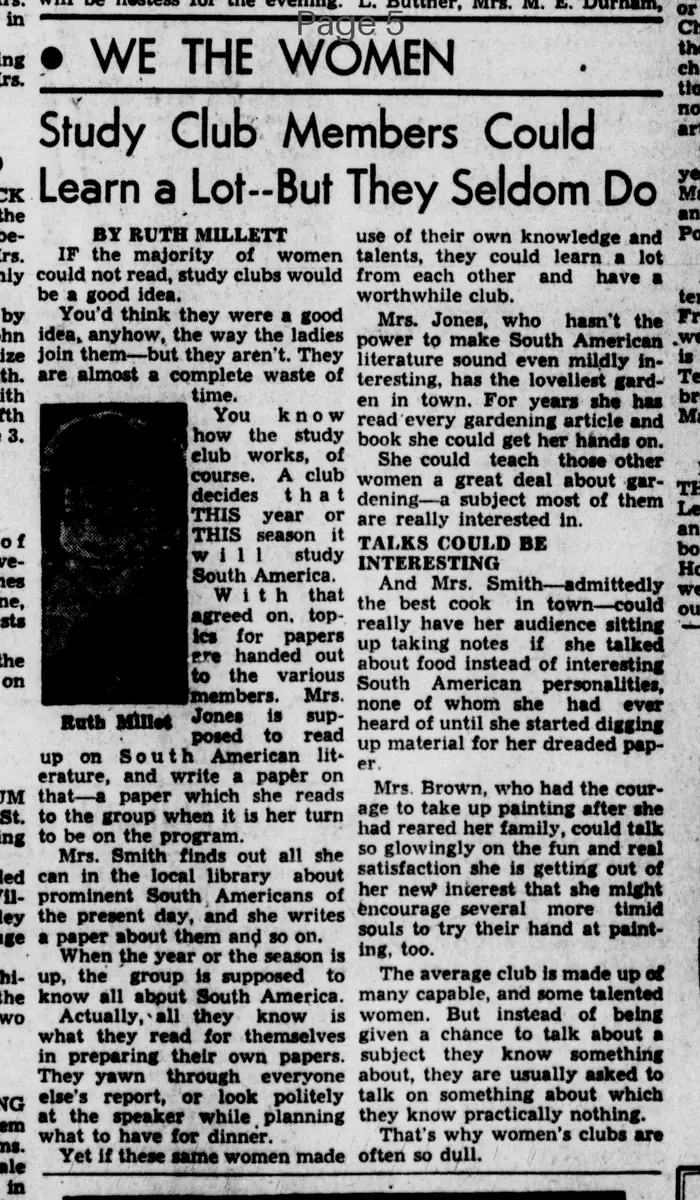
WE THE WOMEN Study Club Members Could Learn a Lot--But They Seldom Do
BY RUTH MILLETT
IF the majority of women could not read, study clubs would be a good idea.
You'd think they were a good idea, anyhow, the way the ladies join them--but they aren't. They are almost a complete waste of time.
You know how the study club works, of course.
A club decides that THIS year or THIS season it will study South America.
With that agreed on, topics for papers are handed out to the various members.
Mrs. Jones is supposed to read up on South American literature, and write a paper on that--a paper which she reads to the group when it is her turn to be on the program.
Mrs. Smith finds out all she can in the local library about prominent South Americans of the present day, and she writes a paper about them and so on.
When the year or the season is up, the group is supposed to know all about South America.
Actually, all they know is what they read for themselves in preparing their own papers. They yawn through everyone else's report, or look politely at the speaker while planning what to have for dinner.
Yet if these same women made use of their own knowledge and talents, they could learn a lot from each other and have a worthwhile club.
Mrs. Jones, who hasn't the power to make South American literature sound even mildly interesting, has the loveliest garden in town. For years she has read every gardening article and book she could get her hands on.
She could teach those other women a great deal about gardening--a subject most of them are really interested in.
TALKS COULD BE INTERESTING
And Mrs. Smith--admittedly the best cook in town--could really have her audience sitting up taking notes if she talked about food instead of interesting South American personalities, none of whom she had ever heard of until she started digging up material for her dreaded paper.
Mrs. Brown, who had the courage to take up painting after she had reared her family, could talk so glowingly on the fun and real satisfaction she is getting out of her new interest that she might encourage several more timid souls to try their hand at painting, too.
The average club is made up of many capable, and some talented women. But instead of being given a chance to talk about subject they know something about, they are usually asked to talk on something about which they know practically nothing.
That's why women's clubs are often so dull.
BY RUTH MILLETT
IF the majority of women could not read, study clubs would be a good idea.
You'd think they were a good idea, anyhow, the way the ladies join them--but they aren't. They are almost a complete waste of time.
You know how the study club works, of course.
A club decides that THIS year or THIS season it will study South America.
With that agreed on, topics for papers are handed out to the various members.
Mrs. Jones is supposed to read up on South American literature, and write a paper on that--a paper which she reads to the group when it is her turn to be on the program.
Mrs. Smith finds out all she can in the local library about prominent South Americans of the present day, and she writes a paper about them and so on.
When the year or the season is up, the group is supposed to know all about South America.
Actually, all they know is what they read for themselves in preparing their own papers. They yawn through everyone else's report, or look politely at the speaker while planning what to have for dinner.
Yet if these same women made use of their own knowledge and talents, they could learn a lot from each other and have a worthwhile club.
Mrs. Jones, who hasn't the power to make South American literature sound even mildly interesting, has the loveliest garden in town. For years she has read every gardening article and book she could get her hands on.
She could teach those other women a great deal about gardening--a subject most of them are really interested in.
TALKS COULD BE INTERESTING
And Mrs. Smith--admittedly the best cook in town--could really have her audience sitting up taking notes if she talked about food instead of interesting South American personalities, none of whom she had ever heard of until she started digging up material for her dreaded paper.
Mrs. Brown, who had the courage to take up painting after she had reared her family, could talk so glowingly on the fun and real satisfaction she is getting out of her new interest that she might encourage several more timid souls to try their hand at painting, too.
The average club is made up of many capable, and some talented women. But instead of being given a chance to talk about subject they know something about, they are usually asked to talk on something about which they know practically nothing.
That's why women's clubs are often so dull.
What sub-type of article is it?
Education
Feminism
Social Reform
What keywords are associated?
Women Study Clubs
Personal Expertise
Learning From Peers
Women Empowerment
Club Reform
What entities or persons were involved?
Women's Study Clubs
Ruth Millett
Editorial Details
Primary Topic
Critique Of Women's Study Clubs
Stance / Tone
Critical Of Formal Study Methods, Advocating Personal Knowledge Sharing
Key Figures
Women's Study Clubs
Ruth Millett
Key Arguments
Study Clubs Assign Unfamiliar Topics Leading To Boring Presentations
Members Only Learn From Their Own Papers, Ignoring Others
Women Should Share Expertise In Personal Interests Like Gardening, Cooking, Painting
This Approach Would Make Clubs Engaging And Educational
Current Format Wastes Talents Of Capable Women